Out of the Furnace

Posted on December 5, 2013 at 6:00 pm

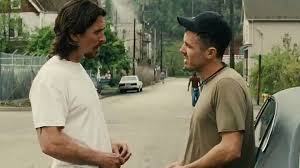
out of the furnace“Out of the Furnace” gets no credit for its good intentions because it collapses under the combined weight of pretentiousness and condescension. This is Hollywood’s idea of a searing drama about life in recession-era heartland, as phony as a painted backdrop.  It is clearly intended to be a sympathetic portrait of two brothers betrayed by America. Russell (Christian Bale) lost his job when the steel mill closed down. His brother Rodney (Casey Affleck) went into the military and came home shattered by what he saw in four tours in Iraq. With no alternatives, their problems get worse. Rodney makes money in bare-knuckle fights, but keeps getting into trouble because he cannot bring himself to take a dive when told to do so by the fight promoter, Petty (Willem Dafoe). As their situations become more desperate, Rodney insists that Petty introduce him to meth dealer DeGroat (Woody Harrelson), so that he can make more money.

Co-writer/director Scott Cooper (“Crazy Heart”) tries to convey a sense of relentless pressure, crumbling infrastructure, and ever-constricting choices that force Russell and Rodney into making decisions with catastrophic consequences. But the film could easily be used to make the opposite points. Over and over, the brothers are told not to do something — like get involved with a murderous meth dealer — and they do it anyway. Russell is losing his job because the economy is bad. But he loses the girl he loves (Zoe Saldana) because he goes to prison. He goes to prison because he goes to a bar, gets drunk, drives, and causes an accident that kills two people. He has a lot of strong feelings and sense of loyalty for his brother and he is very upset about the death of his parents and his girlfriend leaving him for another man. When it comes to the innocent people he killed, he does not seem to have a sense of responsibility. We are supposed to be on his side because he is a decent guy who loves his brother, cares for his dying father, and misses his girlfriend, who married the decent local cop while Russell was in prison. But it is hard to be sympathetic when he — and the film — make no distinction between the limits imposed on him and the bad choices he made. Indeed, the movie ultimately becomes condescending, even contemptuous, in ignoring one of the core principles of narrative, which is respecting just that distinction. We are supposed to be on Rodney’s side because something in him, some core integrity, will not allow him to lose a fight he knows he can win. The metaphor is off-base and heavy-handed.

These are all great actors, and they all work hard to give good performances, but that in itself finally seems distancing. If they understood the essential humanity of the people dealing with these circumstances, the veterans struggling with PTSD, the factory workers whose jobs are gone, they would not distance themselves with such obvious artifice. Harrelson’s over-the-top sociopath seems to be from another movie entirely. Only Dafoe and Forest Whitaker as the sympathetic policeman create characters with any sense of authenticity, with Zoe Saldana relegated to a sad girlfriend role, doubly dreary because it is so tiresomely predictable.  The real Russells and Rodneys deserve better, and so does the audience.

Parents should know that this film has very strong and disturbing violence with graphic images, fatal drunk driving accident, murder, brutal fight scenes, guns, description of wartime violence, constant very strong language, substance abuse, and non-explicit sexual situations.

Family discussion: What does the title refer to? Why do the characters constantly ignore advice that will keep them out of trouble? What does this movie want to say about our economy and political system?

If you like this, try: “Killing Them Softly” and “October Country”

Related Tags:


Crime Drama Tragedy

The Counselor

Posted on October 24, 2013 at 6:00 pm

B-
Lowest Recommended Age: Adult
MPAA Rating: Rated R for graphic violence, some grisly images, strong sexual content and language
Profanity: Very strong, explicit, and crude language
Alcohol/ Drugs: Drugs and drug dealers, drinking
Violence/ Scariness: Very graphic and disturbing violence with characters injured and murdered, decapitations, guns, sexual violence
Diversity Issues: Diverse characters
Date Released to Theaters: October 25, 2013

the-counselor-posterCormac McCarthy’s spare, bleak, and very literary prose has made for some compelling cinema, most effectively in No Country for Old Men and The Road and the adaption of his play for an HBO movie, The Sunset Limited.  In his first original screenplay, he shows his flair for dialog that is half gangster, half poetry, but he is still more writer than visual story-teller.  He needs to learn to trust the audience.  If you show something, you don’t have to tell it, and you certainly don’t have to tell it more than once.  Some good ideas and some gorgeous talk get lost in an awkward, over-the-top, you’ve got to be kidding me mess.  Other writers are better at adapting his ideas for film than he is.

Michael Fassbender plays the title character, a handsome lawyer with a lot of low-life clients and a gorgeous girlfriend (Penélope Cruz) who adores him.  What he does not have is a name.  We never hear him called anything but “counselor.”  He does have — a very bad combination — a plan to get a lot of money very quickly, some friends and clients involved with some very bad people, and a wildly unrealistic notion that he can veer off of that path of what’s legal just one time and then get right back on.  If you have any confusion about what happens next, check your ancient Greek dramas with the hashtag #hubris.  Or, just listen to the loving description of a method of killing people from Reiner (Javier Bardem) that involves a wire noose that tightens inexorably around the neck.  METAPHOR ALERT.  Don’t even get me started on the diamond seller the counselor visits to buy an engagement ring, the one who explains that in the world of diamonds, what we look at are the imperfections, sells him a cautionary stone, and tells the counselor, “We will not be diminished by the brevity of our lives.”

Renier also has a girlfriend named Malkina (Cameron Diaz) who not only MORE METAPHORS COMING loves to watch her pet cheetahs chase and devour jackrabbits but has cheetah-themed tattoos and eye make-up, a gold tooth, and an amber ring the size of a cheese sandwich. She also brings new meaning to the term “auto-erotica” in a crazynutsy scene narrated by Bardem that is literally over-the-top.  Note: Diaz is very limber and has lovely long legs.  “I asked her whether she had ever done anything like that before and she said she had done everything before,” Renier says, a little dazed.  Also, the drug smuggling involves trucks carrying human waste and occasionally a dead human body.  On the side, it says, “We pump it all!”  Is it just me, or is that a METAPHOR, too?  Did I mention Renier lives in a glass house?

Ridley Scott’s direction, the cinematography by Dariusz Wolski, and outstanding performances keep the movie watchable, even when it isn’t working, until the literary pretentiousness overcomes it with a series of speeches near the end that tip the scales from poetic, and ironic to purplish and self-parodying.  In small roles, Rosie Perez, Rubén Blades, and Natalie Dormer create vivid characters who evoke the work the counselor thought he could keep himself apart from and does not realize he has already been changed by.  “If you think that, Counselor, that you can live in this world and not be a part of it, you are wrong,” Renier tells him.

McCarthy knows this is a world where the problem that brings you down is one that in normal world would be quickly explained and quickly forgiven.  These people do not believe in explanations.  “They’re a pragmatic lot.  They don’t believe in coincidences. They’ve heard of them.  They’ve just never seen one.”  There are no second chances.  And then, as Renier explains, “it’s not that you’re going down.  It’s about what you’re taking down with you.”

I enjoyed the elliptical epigrams tossed around by the characters, especially Brad Pitt’s cowboy, a loner who has a bit more perspective than the others.  “How bad a problem?” the counselor asks the cowboy.  “I’d say pretty bad.  Then multiply it by ten,” he answers.   These are people who expect they are being listened to by law enforcement, so it makes sense that they would corkscrew their communications.  And it was fun to see the actors having fun with their roles, especially Diaz, with her asymmetric hair, cut to a point that looks like it could etch metal, swanning into a church to try out this confession idea she had heard about.  With all the flamboyance, though, the movie’s best moments are the quiet ones.  Everything ends up turning on a decision that was not really a mistake.  And the most terrifying moments are not the ones with spurting blood or automatic weapons.  They are a quiet phone call and a simple, “Hola!”

Parents should know that this film is an extremely violent crime drama with very disturbing and graphic images including decapitation. Many characters injured and brutally killed.  It includes guns, crashes, drug dealing, drinking, smoking, very explicit sexual references and situations, and very strong and crude language.

Family discussion: Who suffered the most? Why do we never learn the counselor’s name?

If you like this, try: “No Country for Old Men” and “The Lincoln Lawyer” and the books of Cormac McCarthy and James M. Cain
Related Tags:


Crime Drama Movies -- format Thriller

Prisoners

Posted on September 19, 2013 at 8:08 pm

B
Lowest Recommended Age: Mature High Schooler
MPAA Rating: Rated R for disturbing violent content including torture and language throughout
Profanity: Constant very strong language
Alcohol/ Drugs: Substance abuse to deal with stress
Violence/ Scariness: Extensive and disturbing violence, including torture
Diversity Issues: Diverse characters
Date Released to Theaters: September 20, 2013

The subject matter of the movie “Prisoners”– parents desperately searching for their kidnapped little girls– is so potent that it requires a strong, sure director to maintain control.  Canadian director Denis Villeneuve (“Incendies”), in his first Hollywood feature film, is mostly successful but along the way he is sorely tested by emotionally charged social, religious and moral themes struggling to break free of the excruciating situation and gallop off in the direction of  political metaphor, propaganda, violence, or sermonizing.

Hugh Jackman plays Keller Dover, a strong, self-reliant, religious man whose six-year-old daughter disappears while walking in their neighborhood with a friend.  Dover’s wife, played by Maria Bello, becomes so distraught that she soon sedates herself into helplessness.  Their neighbors, Franklin and Nancy Birch (played by Terrence Howard and Viola Davis) whose daughter also disappears, look for a different path out of their nightmare.PRISONERS

As the hours tick by, the parents lose patience with police detective Loki (played by Jake Gyllenhaal) and begin to take matters into their own hands. The distraught father yells at the cop,  “Two little girls have to be worth more than whatever little rule you have to break.”  Loki does not agree, and the race is on, to see whose tactics will be most effective, and whose tactics are morally justifiable.  Jackman makes clear he is willing to do anything to get his daughter back, including torturing a suspect: “He’s not a person anymore, he stopped being a person when he took on our daughter.”

Prisoners is a dark, tense crime drama with an excellent cast and some important topical themes.  It is not for the faint of heart.  Director Villeneuve says that he hopes his film will inspire audiences to debate these issues “long after the movie ends,” and in this he surely succeeds.  There are issues to debate regarding the treatment of the mentally ill, civil liberties, law enforcement, self-reliance, and morals in modern society, and especially the ultimate question of whether the end justifies the means.  The movie has some excellent, artful moments, cleverly filmed with flair and style.    However, there are also moments when the movie gets carried away with itself, losing its sense of proportion, and taking already extreme situations a notch or two beyond credibility.

Parents should know that this story concerns kidnapping and child abuse, extensive violence (including torture and shooting, alcohol, substance abuse to deal with stress, and constant very strong language.

Family discussion: When is it appropriate for people to take the law into their own hands?  Who is right?  Who does the director think is right?  How does this story relate to issues in geopolitical conflict?

If you like this, try: “Ransom”


Related Tags:


Crime Movies -- format Thriller

The Family

Posted on September 12, 2013 at 6:00 pm

the-family-movie-poster“Anybody who doesn’t contradict me can expect nothing but good things,” “Fred Blake” (Robert De Niro) explains in item 10 of his David Letterman-style countdown of what he considers his best qualities.  Fred is his current nom de witness protection.  Formerly, he was Giovanni Manzoni, a made man in the mob, now being hidden in the Normandy region of France with his wife and teenage children under the bleary but watchful eyes of the long-suffering federal marshal, Robert Stansfield (Tommy Lee Jones).  “Try to fit in,” he tells them.  “I’m tired of finding you a new place every 90 days.”  But those who do contradict Fred, we are shown, can end up sleeping with the fishes or just being buried in the back yard.

Co-writer/director Luc Besson enjoys genre mash-ups that can be outrageous to the point of being deranged.  Sometimes that mixture of mayhem, comedy, and sentiment works better than others.  Here, it works pretty well, if the idea of a combination of “The Sopranos” and “The Addams Family” seems appealing.

Fred (as we will call him) and his family are not cruel or insensitive.  Fred and “Maggie” (Michelle Pfeiffer) love each other and their children, Belle (“Glee’s” Dianna Agron) and Warren (John D’Leo).  You might think of them as your friendly neighborhood sociopaths with impulse control issues.  Maggie is a bit of a firebug, but like her husband, she directs her antisocial behavior at those who have violated her moral code in some way, usually by being rude to her.  Warren has a remarkably precocious, even preternatural, ability to size up the culture, cliques, and power of the high school in one day and master it the next, with a piece of every action in the school and a hefty squad of enforcers.  Belle has her mother’s temper and her father’s wicked way with weapons — also a crush on a student teacher.  And of course the guys who once dubbed Fred a made man now want to make him a dead man, with a dirty death, meaning it will be very painful for him and his family.

At the moment, though, what is occupying Fred’s attention is the barbecue the family is planning for the neighbors, the memoir he is banging out on the manual typewriter, and the brown water that comes out of the faucet.  Also on his Letterman list is his pride in seeing things through to the finish and his satisfaction in knowing that his sadistic urges are exclusively applied when he causes pain for a good reason.  And then, as a representative from America, he is invited to discuss an American film, Frank Sinatra’s “Some Came Running.”  But there is a mix-up and the film he ends up responding to is none other than “Goodfellas.”  Starring, of course, De Niro.

Yes, the plot is over the top and silly.  But it isn’t really about the Blakes or about the mob.  It is about the movies, and Luc Besson’s stylish fun in playing with them.  What works is the performances by De Niro and Pfeiffer who have showed in “Analyze This” and “Married to the Mob” that they know how to tweak the kind of crime drama portrayals they deliver in “The Godfather, Part II,” “Scarface,” and, well, “Goodfellas” for comic purpose without making them silly or over the top.  There is something giddily liberating about watching characters respond to the indignities of everyday life with such extreme measures, and something satisfying about knowing they will be able to respond to the extreme measures that are headed their way.

Parents should know that this film includes extensive and graphic crime-related violence with many shoot-outs and explosions, some chases, dead bodies, bullies, disturbing images, very strong language used by teenagers and adults, drinking, smoking, sexual references and a brief explicit situation.  There is an attempted suicide and a threatened rape.

Family discussion: What qualities did Belle and Warren inherit from their parents? Why did Fred want to write his story? How do you see the influence of American films on Luc Besson’s directing style?

If you like this, try: “Analyze This,” “Married to the Mob,” “Goodfellas,” and “Some Came Running”

Related Tags:


Action/Adventure Comedy Crime

Kick-Ass 2

Posted on August 15, 2013 at 6:00 pm

kick-ass-2-poster1The first Kick-Ass was entertaining as an over-the-top response to true-blue superhero movies.  The Dark Knight might think he’s angsty and tortured and tough, but he has nothing on the merry band of misfits who form a sort of Justice League on crack, featuring an 11-year-old known as Hit Girl who was raised to be the world’s greatest assassin.

It is less entertaining this time.  The lines have already been crossed, the 11-year-old is now 15, and all that’s left is to add a few new characters and a lot more violence.  There are some interesting ideas, but mostly it’s just a bloodbath.

The first movie ended with Dave (Aaron Tayl0r-Johnson), who has assumed the identity of a superhero (without any superpowers) named Kick-Ass, killing off the crime boss with a bazooka.  Now the crime boss’ son, Chris (Christopher Mintz-Plasse), wants revenge.  He has unlimited resources and unlimited fury.  He dresses up in his late mother’s bondage gear, looking like a cross between Spinal Tap and Maleficent.  He gives himself an unprintable name, builds an evil lair with strippers and a shark, and hires an international assortment of mercenaries to set himself up as a super-villain.

Meanwhile, and this is the interesting part, it turns out that even knowing dozens of ways to kill a bad guy, with his own finger if necessary, Mindy/Hit Girl (Chloë Grace Moretz) cannot escape a little bit of an adolescent identity crisis.  Though she confidently assures Dave that Kick-Ass is his real identity and it is being Dave that is the mask, when her cop guardian (an underused Morris Chestnut) makes her promise to be a normal highschool freshman, she decides to give it a try.  A section of the movie is like Buffy crossed with “Mean Girls” as she is taken in by her high school’s Plastics and there is a funny scene where she tries out for Dance Squad by imaging herself in a ninja fight.  But, as we all know only too well, the evil in high school is worse than any super-villain, and Mindy, like Dave, will learn what her real identity is.

Over and over, characters tell us that what they are going through is real life, not a comic book.  That gets as tiresome as the over-the-top carnage and efforts to shock.  Writer-director Jeff Wadlow, taking over for Matthew Vaughn and Jane Goldman, fumbles the eternal challenge of a sequel, keeping it enough like the first to deliver what the audience expects while taking it in new directions to make it surprising.  His biggest mistake is in overlooking the obvious — this movie belongs to Hit Girl.  Every time she is off the screen, it’s like the projector bulb fades.

Parents should know that this is borderline NC-17, an exceptionally violent film with very graphic and disturbing images and sounds, massive destruction, and many injuries and deaths.  It also includes exceptionally raw and crude language (a running joke has Mindy filling more than one swear jar), sexual references, and explicit sexual situations and nudity.

Family discussion:  Was Dave responsible for what happened to his father?  What is the difference between Dave and his friends and vigilantes?

If you like this, try: the original film and the comics by Mark Miller and John Romita, Jr.

Related Tags:


Action/Adventure Comic book/Comic Strip/Graphic Novel Crime Fantasy Series/Sequel Stories about Teens Superhero
THE MOVIE MOM® is a registered trademark of Nell Minow. Use of the mark without express consent from Nell Minow constitutes trademark infringement and unfair competition in violation of federal and state laws. All material © Nell Minow 1995-2026, all rights reserved, and no use or republication is permitted without explicit permission. This site hosts Nell Minow’s Movie Mom® archive, with material that originally appeared on Yahoo! Movies, Beliefnet, and other sources. Much of her new material can be found at Rogerebert.com, Huffington Post, and WheretoWatch. Her books include The Movie Mom’s Guide to Family Movies and 101 Must-See Movie Moments, and she can be heard each week on radio stations across the country.

Website Designed by Max LaZebnik