Miss Sloane

Miss Sloane

Posted on December 8, 2016 at 5:30 pm

Copyright 2016 Filmnation

Striding confidently down the halls of the Congressional office buildings, picking up the check in restaurants with crisp white tablecloths and extensive wine cellars, and, inevitably, at fundraisers, lobbyists are impossible to miss in Washington, D.C. They wear discreetly expensive suits. In fact, they are usually pretty discreet about everything, whether it is handing over money or making threats. Especially when they are making threats.

The film’s title may use the quaint honorific “Miss Sloane,” but do not let that mislead you. Elizabeth Stone (Jessica Chastain in a subtle, vibrant performance) is not looking back. She is a top lobbyist and she tells us right away that means that she always must be thinking ahead. “Lobbying is about foresight and anticipating your opponent’s moves and plotting countermeasures.” She is all about tactics, she is ruthless, and she is determined. “Make sure you surprise them and they don’t surprise you.” Everything about her is controlled and knife-edged. Her sheet of red hair is cut so severely it could slice through granite.

There are a fews signs of stress, though. When she thinks no one is looking, she pops some white pills. Some nights she goes to a hotel to spend time with a male escort. And she is rattled when the one she is used to seeing is not there and the new one (Jake Lacy as Forde), but not so rattled that she declines.

The most significant sign of stress is that in a meeting with a very lucrative prospective client, instead of listening politely when he explains his plan to create a group to promote the idea of women opponents to any restrictions on gun ownership, she laughs, harshly and derisively. Her boss (Sam Waterston) is furious. But for Elizabeth it is just one moral outrage too many. In what she herself recognizes is a “Jerry Maguire” move, she quits, taking her staff with her — except for Jane (Alison Pill), her closest aide, who opts to stay with the high salary and opportunity for partnership. Elizabeth is going from one extreme to the other, working to oppose the gun lobby on behalf of a small non-profit run by Rodolfo Schmidt (Mark Strong, usually the bad guy but here fine as an idealist).

The smart script by first-time screenwriter Jonathan Perera and brisk direction from John Madden (“Shakespeare in Love”) make this a solid Washington thriller with some telling (and accurate) details, moral dilemmas, and plot twists that keep you guessing until the last ten minutes.

Parents should know that this film includes strong and crude language, substance abuse, sexual references and a mildly explicit situation, and corruption and betrayal.

Family discussion: Why did Elizabeth allow herself to be so consumed by the job? Why did she decide to make a change? What would she recommend to improve politics and government?

If you like this, try: the documentary about a real-life lobbyist who went to prison, “Casino Jack and the United States of Money” featuring former Congressman Bob Ney

Related Tags:


Drama Politics
Manchester By the Sea

Manchester By the Sea

Posted on November 23, 2016 at 10:00 pm

A-
Lowest Recommended Age: Mature High Schooler
MPAA Rating: Rated R for language throughout and some sexual content
Profanity: Very strong language
Alcohol/ Drugs: Drinking and drunkenness, substance abuse and recovery
Violence/ Scariness: Fighting, tragic deaths of parent and children
Diversity Issues: None
Date Released to Theaters: November 23, 2016
Date Released to DVD: February 20, 2017
Amazon.com ASIN: B01LTHZVKG
Copyright 2016 Pearl Street Films

We think the hard question is why bad things happen to good people, but really the hardest question is this: when the hard things happen, how do we go on?

Writer/director Kenneth Lonergan likes to explore this question in films that are complex, layered, and respectful of the audience’s intelligence and attention span. He lets the story bloom in its own time. He lets his characters lead messy lives, even after the story ends. He does not lay out all the backstory with voiceover narration or the kind of exposition-heavy dialog (“It’s been three year since it happened. Don’t you think it’s time to move on?”) that writers often use as shortcuts. As we go back and forth in time, it is not clear whether we are seeing incidents from the past that the characters are recalling now or whether it is just Lonergan himself, letting us deepen our understanding. Either way, it is presented with exquisite care, and exquisitely calibrated performances that reward our careful attention.

Lee (Casey Affleck), his brother Joe (Kyle Chandler), and Joe’s son Patrick (Ben O’Brien as a child, Lucas Hedges as a teenager) enjoy an afternoon on Joe’s fishing boat.  And then we see Lee, shoveling snow, doing repairs in an apartment building, dogged and remote. He overhears a tenant telling someone she thinks he is attractive, but he does not respond.  He argues with his boss.  He overreacts at a bar and gets into a fight.  Later, we will hear someone refer to him in hushed tones as “the Lee Chandler.” But it will be a while before we learn the tragic details that led to his notoriety.

Lee gets a call.  Joe, who had a bad heart, has died. Lee is calm and capable, driving to the hospital and making arrangements.  But he is shocked to find that Joe has made him Patrick’s guardian. We know that Lee is a limited, damaged man. And perhaps we know that the unexpected guardianship of a teenager is his opportunity for redemption. We’ve all seen that movies, probably often enough we can predict how many minutes until the big hug scene. But Lonergan has something different in mind, something more layered and complex. It is sad, but not dreary. There are moments of great humor, especially as Lee and Patrick try to find a way to figure out what they are going to do next. Each, in his own way, is disconnected from his feelings and not interested in trying. Patrick cares about his two girlfriends and his band. He wants to hold onto his father’s boat, even though Lee cannot afford it. He wants to stay in the film’s title town, even though Lee works in Boston. Lee — well, he pretty much just wants to whatever task lies in front of him without having to feel too much.

It all literally pieced together for us gradually as moments from the past are revealed, perhaps as recalled by Lee, perhaps just Lonergan’s sure sense that only putting the pieces of the puzzle together slowly, leaving some spaces for us to fill in ourselves, will give us the deeper sense of recognition. Individual scenes are exquisitely composed and performed, especially a conversation between Lee and his ex-wife, Randi (Michelle Williams), another in a police station, and an awkward meal with Patrick, his mother, a recovering substance abuser (Gretchen Mol), and her tightly-wound new partner (Matthew Broderick), poised between protective and controlling. The cumulative power sneaks up on you, until the perfectly imperfect ending.

Parents should know that this film includes disturbing material with very strong and crude language, a deadly fire, tragic deaths including parent and children, attempted suicide, sexual references including teen sex and brief nudity, drugs, drinking and drunkenness, and some fighting.

Family discussion: Why did Joe pick Lee? Why didn’t Patrick show more emotion? Why does this movie wait to tell us what happened to Lee?

If you like this, try: “You can Count on Me” and “Margaret” from the same writer-director

Related Tags:


Drama DVD/Blu-Ray Pick of the Week
Bleed for This

Bleed for This

Posted on November 17, 2016 at 5:44 pm

Copyright Sony 2016
Copyright Sony 2016
We watch sports for the skill.

We love sports for the heart.

Sports stories give us heroes whose determination and courage is constantly tested. The athletes who face those challenges — who live for those challenges — can help us understand and face our own. Vinny Pazienza was a great boxer, but what made him heroic was not his skill in the ring or his unprecedented wins in three different weight classes. It was his comeback from injuries he got in a deadly car crash, including a broken neck so severe that it was not clear whether he would ever walk again. He was given the choice between spinal fusion that would guarantee that he could walk but would prevent him from getting back in the ring, or six months in a Torquemada-style halo contraption literally screwed into his skull, where the slightest bump could paralyze him forever but, if everything went perfectly he might regain enough mobility to fight again, he chose the halo. He ended up resuming his training — against the advice of his doctors — and removing the halo after three months, then returning to boxing. Let me put it this way: knocked down worse by life than by any opponent in the ring, he was up by 9.

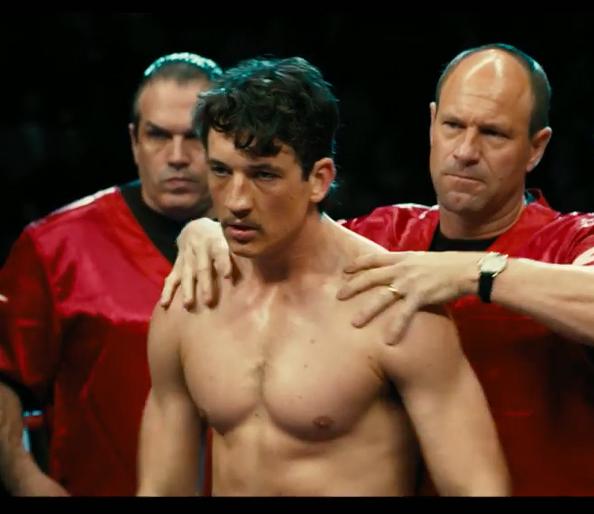
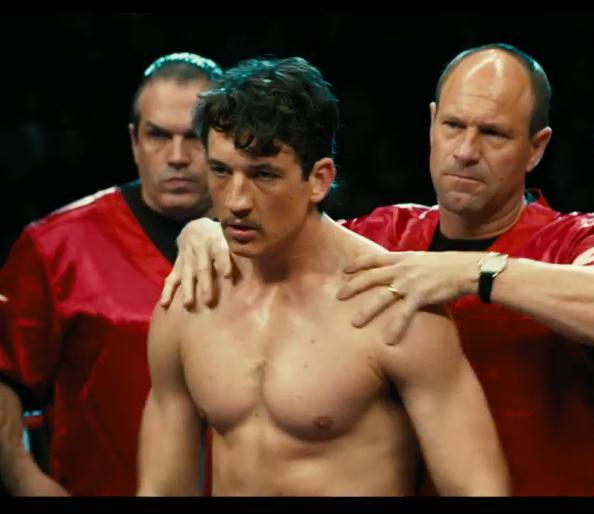
For his first film in more than ten years, writer/director Ben Younger (“Prime,” “Boiler Room”) tells the true story of one of the greatest comebacks of all time. Miles Teller, himself a survivor of a serious car accident, plays Pazienza, known as Vinnie Paz. We first see him sweating out the last few minutes before a weigh-in, swathed in plastic wrap, on a stationary bike, determined to make weight so he can still qualify as a lightweight. He just makes it, stripped down to a thong. That night, instead of getting some rest, he stays up most of the night playing blackjack and having sex. But the next day, he wins.

Vinnie loves his fights. After each one, he’s ready for the next. His mother listens from the next room, holding her rosary and lighting candles as his sister watches the fights on television. But his father (Ciaran Hinds) is literally in his corner, urging him on and arguing with his fight promoters. Vinnie switches to a new trainer, Kevin Rooney (Aaron Eckhart), who has a sometime drinking problem but who has taken fighters all the way to the top. Kevin persuades him to stop trying to qualify for the junior welterweight class and put on some extra weight to fight as a junior middleweight. Things go pretty well until the car accident.

And that is how he learns who he is. Vinnie has never stopped for anything and nothing has stopped him. He worked hard at boxing, but never considered why or whether it mattered to him. Literally and metaphorically immobilized, he discovers that the combination of recklessness and determination gives him a way to get back in the ring.

Teller is one of the best young actors working today, and he makes Vinnie’s physicality real. His chemistry with Eckert gives what could be yet another boxing story hold our attention, even without the usual romance. Younger makes the family scenes of a rowdy middle class Italian vibrant — you can almost smell the oregano. And the story of resilience and redemption is always welcome, especially when it is as well told as it is here.

Parents should know that this film includes very strong language, brutal fight scenes, and graphic and disturbing images including a fatal car accident, surgery, and other medical procedures. Characters smoke and drink, including alcohol abuse.

Family discussion: Who helped Vinnie the most? Why did fighting matter so much to him?

If you like this, try: “The Fighter” and “Creed”

Related Tags:


Based on a true story Drama Sports
The Edge of Seventeen

The Edge of Seventeen

Posted on November 17, 2016 at 5:42 pm

Copyright 2016 STX
Copyright 2016 STX
A psychiatrist once told me that just as an infant can have fevers that would be lethal in an adult, a teenager can have symptoms that would be evidence of psychosis at any other stage of life. Mood swings, the feeling that everyone is looking at you, disordered thinking, bizarre appearance: you might be having some sort of breakdown, or you just might be an adolescent. Stories about that intensely traumatic age connect to those of us who have been through it and those who are in the midst of it with a visceral sense of recognition, and, if we’re lucky, a bittersweet humor.

“Edge of Seventeen,” written and directed by Kelly Fremon Craig, captures the intensity and chaos and drama drama drama of this age. Hailee Steinfeld plays Nadine, who, like many 17-year-olds, is certain that she is the only person on earth who truly understands what it is to suffer. She actually has experienced a terrible loss, the death of her father, which has left her remaining family fragile. Her older brother Darian (Blake Jenner of “Everybody Wants Some!!”) compensates by being perfect in every disgusting way possible, from Nadine’s perspective. He is handsome, talented, athletic, and popular. That leaves nothing left for her but to be awkward and miserable.

The only thing good in her life, she thinks, is her endlessly supportive and understanding BFF Krista (Haley Lu Richardson), who sympathizes with Nadine about the misery of having no father, a perfect brother, and a crush on an unattainable boy who works at Petland in the mall (Alexander Calvert as Nick). She also has a teacher named Mr. Bruner, played with perfectly dry, understated wit by Woody Harrelson, who knows teenagers well enough to understand that the best way to reassure Nadine is not to try to comfort her. When she trounces into the classroom where he is eating lunch alone to tell him she has to kill herself, he responds by noting mildly that in fact she has just interrupted his own creation of a suicide note. “As some of you know, I have 32 fleeting minutes of happiness per school day during lunch which has been eaten up again and again by the same especially badly dressed student and I finally thought, you know what, I would rather have the dark, empty nothingness.” She thinks she wants everyone to be as fraught as she is. He knows how to strike just the right balance of detachment and sympathy.

So when she tries to cancel a sexually explicit invitation to Nick but accidentally sends it instead, Mr. Bruner is there to take a look and point out that she should be more careful about run-on sentences. The reason she is talking to him about it instead of Krista is that Krista, the single good thing in her life, has committed the ultimate betrayal. She and Darien are in a relationship. Nadine is in such a severe state of collapse that she does not notice that there is a smart, handsome, very nice boy interested in her (Hayden Szeto in a star-making performance as Erwin).

The film itself has that same perceptive sympathy for the agonies of adulthood, allowing us to laugh at Nadine only because we know she’ll be fine — she’s going to grow up and make this movie.

Parents should know that this movie has very explicit and crude language, sexual references, and non-explicit sexual situations, a car accident with a sad (offscreen) death of a parent), and teen drinking.

Family discussion: How did Nadine, Darien, and their mother express their grief differently? Is it easier being the perfect one? What do you do to feel better?

If you like this, try: “Rocket Science,” “Thumbsucker,” and “The Duff”

Related Tags:


Comedy Coming of age Drama Romance School Stories about Teens
Arrival

Arrival

Posted on November 10, 2016 at 5:26 pm

B+
Lowest Recommended Age: Middle School
MPAA Rating: Rated PG-13 for brief strong language
Profanity: Brief strong language
Alcohol/ Drugs: Some drinking
Violence/ Scariness: Very sad death of a child, peril
Diversity Issues: Diverse characters
Date Released to Theaters: November 11, 2016
Date Released to DVD: February 13, 2017
Amazon.com ASIN: B01LTHYE0O

Copyright 2016 Paramount
It’s called “Arrival.” Not “Attack” or “War of the Worlds.” In this thought-provoking, conceptually ambitious film, the creatures from another world just…arrive. At twelve points around the globe, huge, monolithic spacecraft that look like flying saucers turned sideways are suddenly just there. What do you do? How do you determine the intentions and capacities for harm from a species of creature with whom you do not have the most fundamental experiences and assumptions in common? Do they even have a language we are capable of understanding? Do they have the capacity to speak or write? Do we have the capacity to understand? Is this “ET” or “Battlefield Earth?” Or maybe that “Twilight Zone” episode where the book the aliens bring titled To Serve Man turns out to be a cookbook?

And how can we tell? This is not one of those sci-fi movies where the aliens get some TV signals and teach themselves English by watching game shows and sitcoms. So, the US military seeks out a linguist (Amy Adams as Dr. Louise Banks) because before we can decide what our response will be, we have to try to find a way to figure out how to communicate with them. “Language is the foundation of civilization,” she says to another expert being transported to the alien ship with her. “No,” he tells her. “It is science.” He is a physicist (Jeremy Renner as Dr. Ian Donnelly). If you think that both sets of skills will be necessary, that they will find a way to communicate, and find some connection with one another as well, you are right, but it will still surprise you all the way to the end.

Director Denis Villeneuve is not afraid to take on big issues and complex questions. And, as always in movies about aliens, it is more about who we are than who they are. Positioning us against creatures who are completely unknown requires us to think more deeply about our assumptions and capabilities.

Louise figures out a way to begin to communicate with the floating squid-like creatures. But is the word they are conveying “tool” or “weapon?” And will humans around the world be able to find a way to work together or will one country undermine our efforts to communicate by attacking the alien ships? We may be better at communicating with other species than our own.

The details really matter here and production designer Patrice Vermette fills the screen with thoughtful, illuminating touches from the Brancusi-like sculptural curves of the spacecraft to the calligraphy-like symbols created by the aliens. Striking images inspire awe and wonder in us as they do the characters. And the Chomsky-esque notions that language shapes our thinking even more than our thinking shapes language is conveyed in the film’s own structure as well as its dialog. Ultimately, it is a reminder of the power of communication, with movies themselves as one of humanity’s best examples.

Parents should know that this movie’s theme includes worldwide threats, with some peril, very sad illness and death of a child, divorce, and some strong language.

Family discussion: Which is the foundation of civilization, language or science? Or is it something else? What would you ask the aliens?

If you like this, try: “Close Encounters of the Third Kind” and “2001: A Space Odyssey”

Related Tags:


Drama DVD/Blu-Ray Pick of the Week Science-Fiction
THE MOVIE MOM® is a registered trademark of Nell Minow. Use of the mark without express consent from Nell Minow constitutes trademark infringement and unfair competition in violation of federal and state laws. All material © Nell Minow 1995-2026, all rights reserved, and no use or republication is permitted without explicit permission. This site hosts Nell Minow’s Movie Mom® archive, with material that originally appeared on Yahoo! Movies, Beliefnet, and other sources. Much of her new material can be found at Rogerebert.com, Huffington Post, and WheretoWatch. Her books include The Movie Mom’s Guide to Family Movies and 101 Must-See Movie Moments, and she can be heard each week on radio stations across the country.

Website Designed by Max LaZebnik