Brooklyn

Brooklyn

Posted on November 25, 2015 at 5:22 pm

Copyright 20th Century Fox 2015

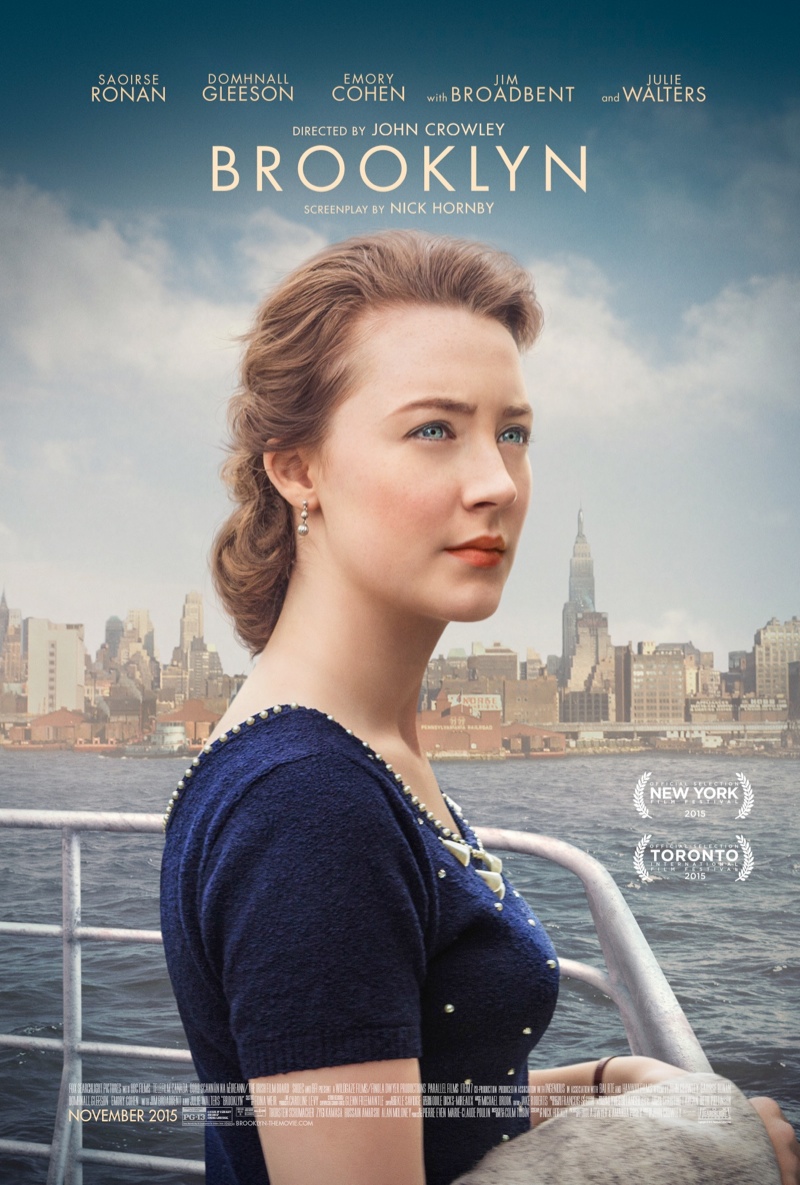
“Brooklyn,” based on the book by Colm Tóibín, is exquisitely lyrical, the story of a young woman who immigrates from Ireland to New York in 1952. She is sad, homesick, and lonely at first, then just as she begins to feel at home she is called back to Ireland.

Movies can show us monsters and aliens and explosions but none of that will ever have the quiet power of Saoirse Ronan in close-up. The breathtaking intimacy of being so close to her face, her sky-blue eyes, the lift of her chin, is a story in itself. For once, the Irish-raised actress is using her own accent, and the lilt of it is pure and poetic.

She plays Eilis (pronounced EYE-lish), who lives with her mother and sister Rose in a small town. Rose has helped her make arrangements with a priest in New York (Jim Broadbent) for an apartment and a job. Eilis loves her family. But she is stuck in a part-time job working for a shrew in a grocery store. Ireland in the post-WWII years has little to offer her by way of love or work. And so she takes a voyage. The reason she is the only one at dinner the first night out is revealed when she gets very, very sick. But a sympathetic roommate helps her through and advises her about how to pass muster at Ellis Island — to act like an American, which means looking confident.

Eilis moves into an all-Irish boarding house, owned by the formidable Mrs. Keough (Julie Walters), a sharp-eyed but not unkind woman who can tell the difference between the simpering giggles of the other girls and the shy but steady Eilis. Soon Eilis is working at a department store, where the complexities of the transactions (payment sent to a central location via vacuum tube) and inventory are not as challenging as learning to chat pleasantly with the customers. It is an amusing change from the store in Ireland, where the owner barked at someone for wanting shoe polish on a Sunday, and “Mad Men’s” Jessica Paré is excellent as the manager.

Eilis slowly begins to feel at home.  Ronan’s performance is precise and sensitive.  She shows, not tells us how Eilis begins to bloom through taking some bookkeeping classes and meeting a nice guy, an Italian boy named Tony (the piercingly sweet Emory Cohen).  There is believable magic in their sweetly developing relationship.

And then, there is a tragedy at home and Eilis has to go back to Ireland.  But is that her home anymore?  Can she fit into her old place?  Does she want to?

Director John Crowley is a careful observer, and every moment rewards careful observation from us.  A yawn in church.  The faces of the people at the dock saying goodbye to their emigrating family members.  The look on Eilis’ face as she struggles to tell Tony how she feels — it is a wonder, and one of the year’s best films.

Parents should know that this film includes a non-explicit sexual situation, sexual references, some strong language, and a sad death.

Family discussion: Did Eilis make the right choice? Why or why not? Who was most helpful to her?

If you like this, try: “In America,” another story of Irish immigrants in New York

Related Tags:


Based on a book Date movie Drama Romance
Creed

Creed

Posted on November 24, 2015 at 5:18 pm

B+
Lowest Recommended Age: High School
MPAA Rating: Rated PG-13 for violence, language and some sensuality
Profanity: Some strong language
Alcohol/ Drugs: Social drinking
Violence/ Scariness: Intense sports violence (boxing), illness and disability
Diversity Issues: Diverse characters
Date Released to Theaters: November 25, 2015
Date Released to DVD: March 7, 2016
Amazon.com ASIN: B019EEK7ZA
Copyright Warner Brothers 2015

Rocky had to find the eye of the tiger. When we first met him back in 1976, Rocky Balboa (Sylvester Stallone) was an amiable, good-hearted lug who loved his pet turtles, Cuff and Link, and if he ever saw himself getting into the ring with champ Apollo Creed (Carl Weathers), he could only imagine it would be as a sparring partner. His aspiration was not to get his nose broken and go the distance. Over the course of six films, he took on ever-more daunting opponents, so we could always think of him as the underdog. In the first film, he had the advantage of surprise. Creed assumed he could easily defeat the unknown fighter. Rocky did go the distance (and did get his nose broken), and lost in a split decision. In the second film, Creed knew what to expect and his pride was on the line. This time, it was Rocky who got soft after his fame and success. He had to get hungry and learn to be a fighter again. Rocky faced — and defeated — a champion at the top of his game.

Rocky went on to fight ever-more terrifying foes: Clubber Lang (Mr. T) who was not the decent, honorable guy that Creed was, and then the steroid Soviet man-machine Ivan Drago (Dolph Lundgren). In the last two films, Rocky struggled with the killer knock-out punch that we all face — old age. His trainer Mickey and his wife Adrian have died. He still wants to go the distance, but now it does not seem so distant any more.

And now here is another fighter looking for a title shot. We first meet young Adonis Johnson (called Donny) in juvie, where we learn that he just can’t stop fighting. Eye of the tiger is not his problem. It is taming the tiger he has to work on.

Apollo Creed’s widow Mary Anne (dignified but warm-hearted Phylicia Rashad) is willing to give him a home. Donny’s father was Apollo Creed. His mother is dead. Mary Anne has decided to raise him. And she has no intention of letting him become a fighter.

Donny (charismatic Michael B. Jordan) is doing well in his office job, but there is something in him that just needs to punch people. So he leaves Mary Anne working in an office and he seeks out Rocky as a trainer. Rocky does not want to train anyone (see Tommy Morrison in #5). He just wants to miss Adrian in the restaurant he named for her. But this would not be a Rocky movie if Rocky didn’t go back to the gym, and pretty soon that training montage starts up. Gosh darn if it doesn’t still work, especially when that Rocky theme starts filtering through.

Pretty soon there’s a pretty girl, of course, Bianca, played by Tessa Thompson (“Dear White People” and if you haven’t seen it, please do so now). I loved this character for many reasons, primarily because she never took the “oh, don’t fight, you’ll get hurt” role (that is left to Rashad), and because she plays a character who embraces life so fully that she responds to a progressive hearing loss by devoting herself to her passion for creating music while she can. It is genuinely moving to see a disabled character in a film who is not defined by disability. Bianca is a strong, confident, passionate woman and Thompson plays the role beautifully in every sense of the word. Plus, she and Jordan have some sizzling chemistry.

This next chapter (apparently the beginning of a new series) goes the distance. Jordan, thankfully far from the catastrophically awful “Fantastic Four,” is back with writer/director Ryan Coogler. Their last film together, “Fruitvale Station,” was one of the best movies of 2013. As they did in that film, they have created a character who is complex, layered, trying to understand his past and not sure whether he can move on from it. Jordan can hold the screen with as much star power as any young actor in Hollywood today. He and Coogler are true to the Rocky tradition without being trapped by history. Yes, they go back to the steps at the Philadelphia Museum of Art. And yes, you will tear up when they do.

Parents should know that this film includes intense scenes of boxing with graphic injuries, strong language, sexual references and a sexual situation.

Family discussion: Why didn’t Adonis want to use his father’s name? What changed his mind? What would you do if you had Bianca’s health challenges?

If you like this, try: the “Rocky” movies and “Southpaw”

Related Tags:


Drama DVD/Blu-Ray Pick of the Week Series/Sequel Sports
Secret in Their Eyes

Secret in Their Eyes

Posted on November 19, 2015 at 5:28 pm

Copyright 2015 STX Entertainment

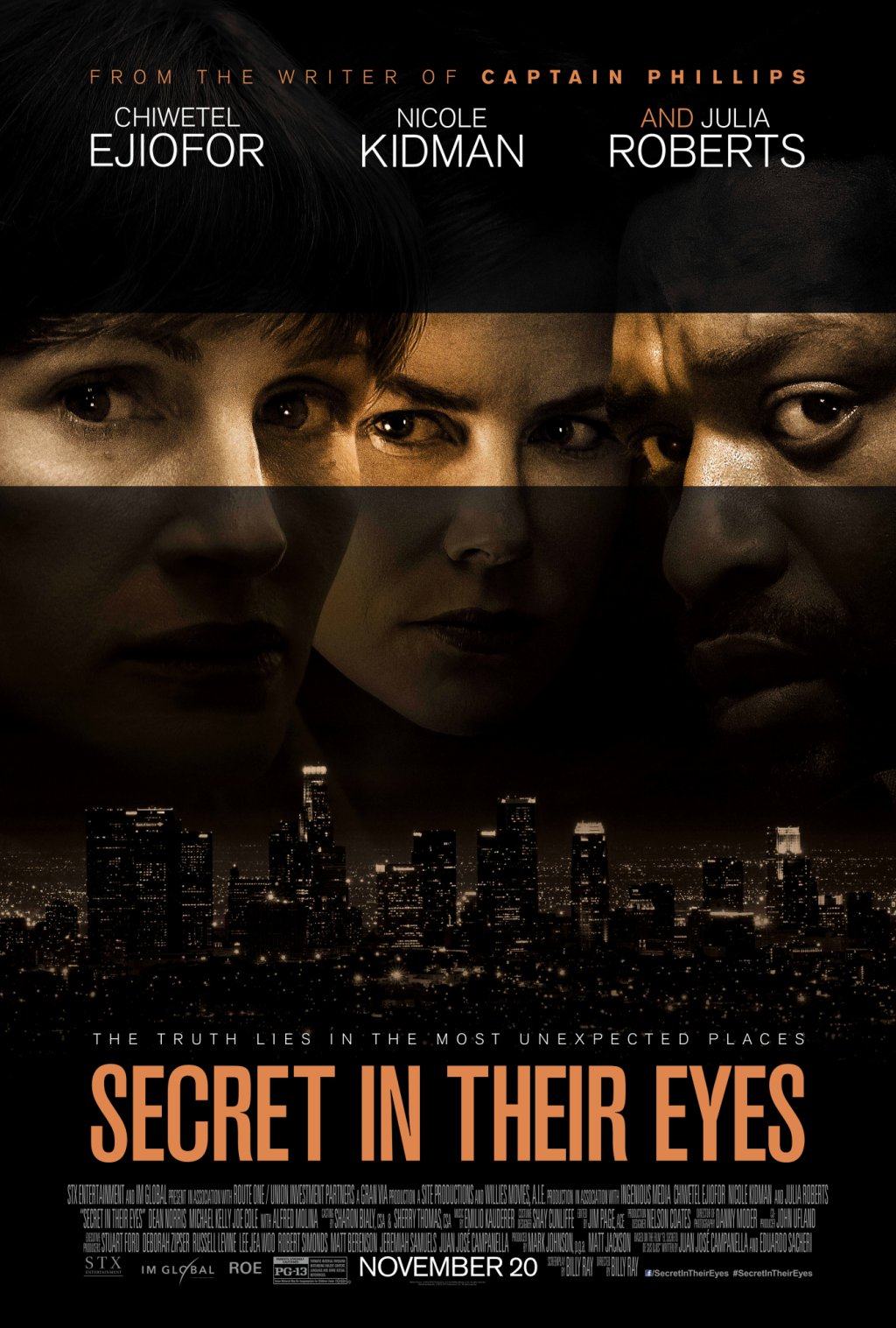
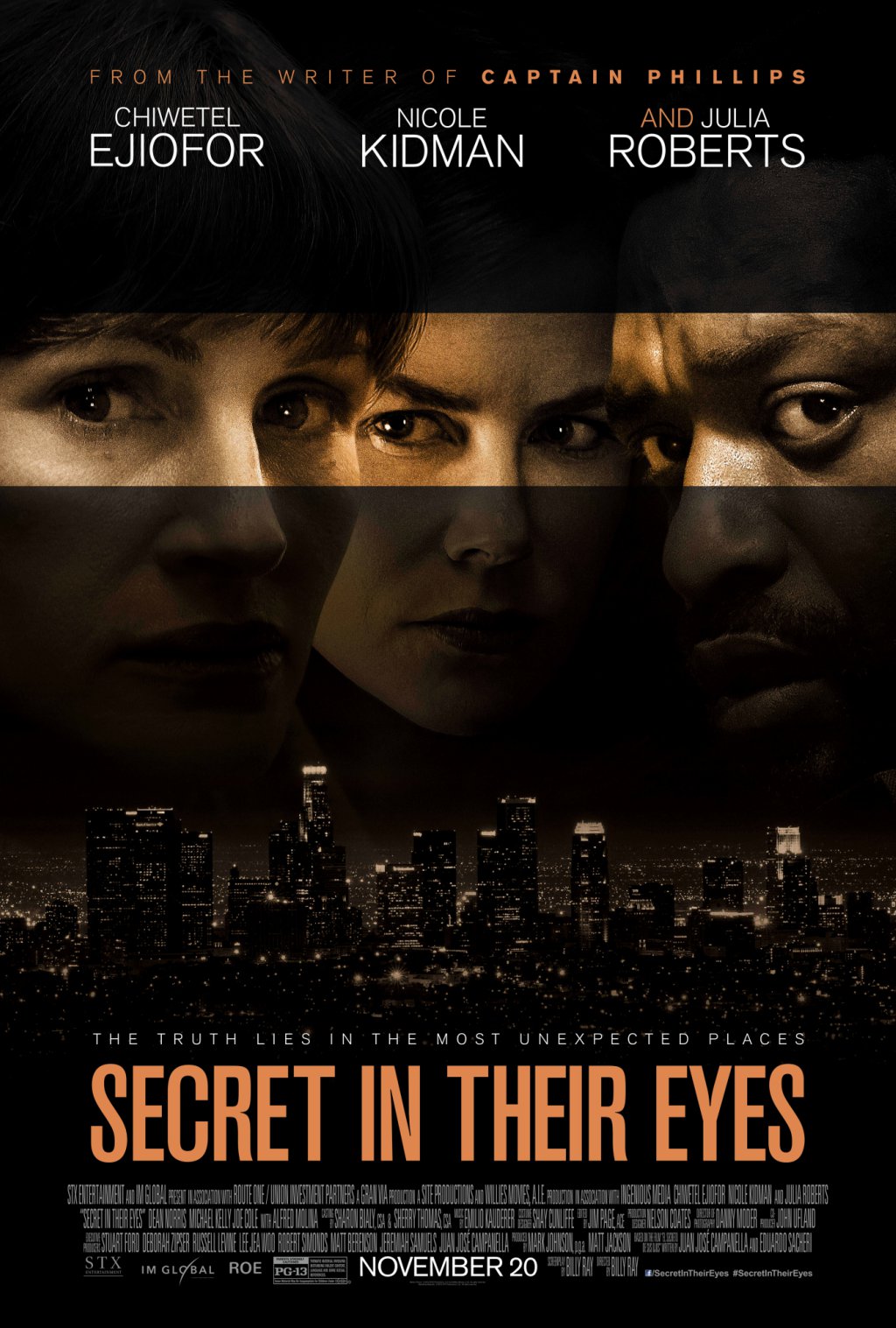
A girl is murdered. That girl, that crime and the man who did it are seen very differently by different people, all of whom are in law enforcement and all who have sworn to devote their professional lives to justice in this dark thriller based on an Oscar-winning Argentinian film (“The Secret in Their Eyes“). Just as that film used a long-unsolved murder to explore the shifts of politics and culture over the decades, this version, from writer-director Billy Ray, sets the murder in the frantic realigning of priorities following the terrorist attacks of 9/11. For those who loved her, justice for the death of the girl is all that matters. For those working on anti-terrorism, though, the suspect may be of more use out in the world as an informant than in prison as a murderer.

The story takes us back and forth between the present day and the time of the murder, in 2001.  Claire (Nicole Kidman) is a District Attorney and Ray (Chiwetel Ejiofor) is an investigator newly assigned to the FBI’s anti-terrorism division.  There is an immediate charged connection between them, though Claire is more reserved. Ray works with Jess (Julia Roberts), who teases him about his evident interest in Claire.

Then there is the report of a death, a body in a dumpster. Ray and Jess arrive, alert, professional, but detached, snapping on their blue latex gloves and talking about a possible connection to their work because the body was found near the mosque they are investigating.

And then Ray sees the girl and has to tell Jess that everything she cared about in the world has been destroyed. The shot of Roberts’ face as she has to go from thinking she has been called to see a body to understanding that it, that she is the one particular individual who means the most to her, “the thing,” she says, “that made me me,” is shattering to see. For the rest of the film, the radiant presence we know so well is haggard, numb, broken.

In the present day, the murder has not been solved. Because the suspect was an informant from a mosque that could have been harboring terrorists, the case against him was not pursued, and he has disappeared. But Ray has never stopped looking for him. He went through 1906 photos a night, searching every white male in the FBI’s system, for 13 years. He thinks he has found him.

More successful in mood than plot, Ray uses this story to meditate on loss, hopelessness, and the gulf between law and justice. Each of the characters wants something different from this investigation. Jess wants what she thinks of as justice but what looks more like revenge. “Death penalty would be too good for him,” she says. Ray feels somehow responsible, because he could have been with Jess’ daughter the morning she was killed. Claire wants the law to be enforced. And she still feels a connection to Ray. As for the suspect — in his own way, he is as controlled by his obsessions as the others.

Parents should know that this film includes a brutal rape and murder (off-screen) and some violence, with some peril and some injuries and abuse. There is some strong language.

Family discussion: Do you agree with Morales’ decision on how to treat Marzin? Should Ray have told Claire how he felt?

If you like this, try: the original film, “The Secret in Their Eyes” and Ray’s earlier films, “Shattered Glass” and “Breach”

Related Tags:


Crime Drama Remake Thriller
Spotlight

Spotlight

Posted on November 12, 2015 at 5:30 pm

“Spotlight” is about the ultimate betrayal of trust from an institution that literally represented the Word of God to many people. And it is about whether we will continue to have institutions that serve the essential function of monitoring the gap between aspiration and actuality, between what people say they are and do and the reality.

Copyright Open Road Films 2015

Spotlight is the name for the investigative group of journalists working for the Boston Globe. While their colleagues reported on stories that could be reported and written in days, the Spotlight group had the luxury and the responsibility of taking as much as a year to do the kind of in-depth original research necessary for more complex and difficult subjects.

The staff at Spotlight was let by Walter “Robby” Robinson (Michael Keaton) and included Mike Rezendes (Mark Ruffalo), Sacha Pfeiffer (Rachel McAdams), and Matt Carroll (Brian d’Arcy James).

Like most of the members of the Globe staff they were Boston born and bred, Red Sox fans to the end, and raised Catholic. They had just finished work on a long-term piece when their new editor arrived. He was not Boston born and bred, not a Sox fan, and not Catholic. And perhaps most important, he was not a Boston Globe lifer. He was Marty Baron (Liev Schreiber), most recently from Miami. He was an outsider in every way and they correctly suspected that the Globe was just a stop on his career trajectory. (He is now at the Washington Post.) They were not inclined to follow his idea of what stories they should cover.

But when he asked them about following up on a story about a priest who abused young boys, they could not come up with a reason not to other than it was too awful to imagine that it might be true. They begin to investigate. It turns out it was not one priest. It is a city-wide problem. A priest abuses children, is put on “medical leave” and transferred. The families of the boys are paid off and silenced. Then it happens again.

Director Tom McCarthy (“The Station Agent,” “Win Win”), writing with Josh Singer, really captures the culture of a newsroom, the stale coffee, the stale-er jokes, but the passionate curiosity that drives them all. This film will be compared to “All the President’s Men” because they are both true stories about young reporters getting huge stories everyone else missed. But the more important comparison is the way both movies capture the numbing work that goes into reporting. The doors knocked on. The doors slammed. And in this case, the nine years worth of diocese phone directories gone over, line by line (this was one of the last of the eras of off-line, analog document searches) to follow the “medical leave” priests took weeks of meticulous checking. It shows us reporting on the cusp of monumental technological change as well, when the paper makes the then-innovative decision to make the underlying documents available to readers online.

The reporters face enormous obstacles, starting with overcoming their own assumptions and then the powerful people who try to stop them. The church is an overwhelming force, politically and culturally. Do readers really want to know? Will the paper lose subscribers and advertisers?

There is no betrayal more devastating than to have the most trusted of institutions, the one most intimately involved in family joys and sorrows to be countenancing the abuse of those most deserving of its protection. But by the end of the film, that atrocity, already known to us, is not as troubling as the idea that news organizations may not be able to bring us the next one.

Parents should know that the theme of the movie is the investigation of widespread child sexual abuse and its cover-up, with sexual references, some graphic, and some strong language.

Family discussion: How did the arrival of an outsider affect the decision to do this story? Do today’s newspapers have the resources and support they need to do in-depth investigations like this one?

If you like this, try: “All the President’s Men” and “Truth” and the documentaries “Deliver Us from Evil” and “Twist of Faith”

Related Tags:


Based on a true story Drama Journalism
Miss You Already

Miss You Already

Posted on November 5, 2015 at 5:22 pm

B
Lowest Recommended Age: Mature High Schooler
Profanity: Very strong and crude language
Alcohol/ Drugs: Drinking, drug references
Violence/ Scariness: Serious illness, sad death, some graphic and disturbing images
Diversity Issues: None
Date Released to Theaters: November 6, 2015

Copyright Lionsgate 2015
Friendship has the best aspects of romantic love and the best of family love, and the worst of both as well. Your friends as are close to you as anyone in the world, which means you can rely on them and they can rely on you, whether it’s telling you if your butt looks too fat in those jeans or you need someone to come pick you up because a date has gone horribly wrong. And it means that they can hurt you terribly, because they mean so much to you and because you trust them and because they know you so well.

And yet, while there are hundreds of thousands of movies about love and family, there are not very many great movies about friendship. “Miss You Already,” from director Catherine Hardwicke, is a worthy attempt, the story of two women who were friends since childhood, and whose friendship is nearly destroyed by the complications of grown-up life. Though it appears only once in the film, the title refers to a catchphrase the two women use to say goodbye, making fun of themselves for being so deeply in one another’s lives, but really meaning it, too.

Drew Barrymore plays Jess, an American living in England and the more serious and responsible of the pair. Toni Collette is Milly, the wild party girl who improbably is living happily ever after with Kit (Dominic Cooper), the roadie who got her pregnant and then married her, started a successful business, and turned out to be a wonderful husband and father. They have darling children, a beautiful home, and satisfying careers and they are still mad for each other. Jess is happily married to Jago (Paddy Considine), though they do not have any money and are struggling with fertility problems. But they live on an adorable houseboat. It is one of the movie’s wisest choices that the husbands are not complaining (most of the time) or complained about. They are full partners to their wives and full partners in supporting the friendship.

Milly has always lived lightly, skimming along the top of life, still a party girl at heart. She loves her husband, children, and Jess, but she is admittedly superficial and vain. And then she gets a cancer diagnosis. Jess is happy to live up to the assigned tasks of “bringing treats and not being annoying” to help Milly through chemotherapy. And wig shopping (with the wonderful Frances de la Tour). And changing dressings. But she believes that Milly’s illness is so all-consuming that she cannot share what is going on in her life. And then Milly does something that creates the first serious breach in their relationship.

Yes, we’re in “Beaches” territory, so get out your handkerchiefs. Drew and Collette make a touching screen team, and Jacqueline Bisset, almost unrecognizable with platinum blonde hair, is a welcome antidote to over-sentimentality as Milly’s self-absorbed mother, a moderately successful actress. Hardwicke, who began her career as a production designer, has a superb eye and a great gift for using the settings to tell the story. If she cannot avoid the usual touchstones of women’s friendship movies (singing along to a favorite pop song), at least she changes it up a little — REM in a taxi instead of the usual Motown into a hairbrush. “Miss You Already” will make you want to call a friend you miss, and then bring her along to see it again.

Parents should know that this film includes very strong language, sexual references and situations, serious illness with some graphic images, a very sad death, a childbirth scene, alcohol and drug references.

Family discussion: What makes a great friendship? Ask family members about their most important friendships, how they met and their favorite moments.

If you like this, try: “50/50” and “Beaches”

Related Tags:


Drama Illness, Medicine, and Health Care Movies -- format
THE MOVIE MOM® is a registered trademark of Nell Minow. Use of the mark without express consent from Nell Minow constitutes trademark infringement and unfair competition in violation of federal and state laws. All material © Nell Minow 1995-2026, all rights reserved, and no use or republication is permitted without explicit permission. This site hosts Nell Minow’s Movie Mom® archive, with material that originally appeared on Yahoo! Movies, Beliefnet, and other sources. Much of her new material can be found at Rogerebert.com, Huffington Post, and WheretoWatch. Her books include The Movie Mom’s Guide to Family Movies and 101 Must-See Movie Moments, and she can be heard each week on radio stations across the country.

Website Designed by Max LaZebnik