Secret in Their Eyes

Secret in Their Eyes

Posted on November 19, 2015 at 5:28 pm
Copyright 2015 STX Entertainment

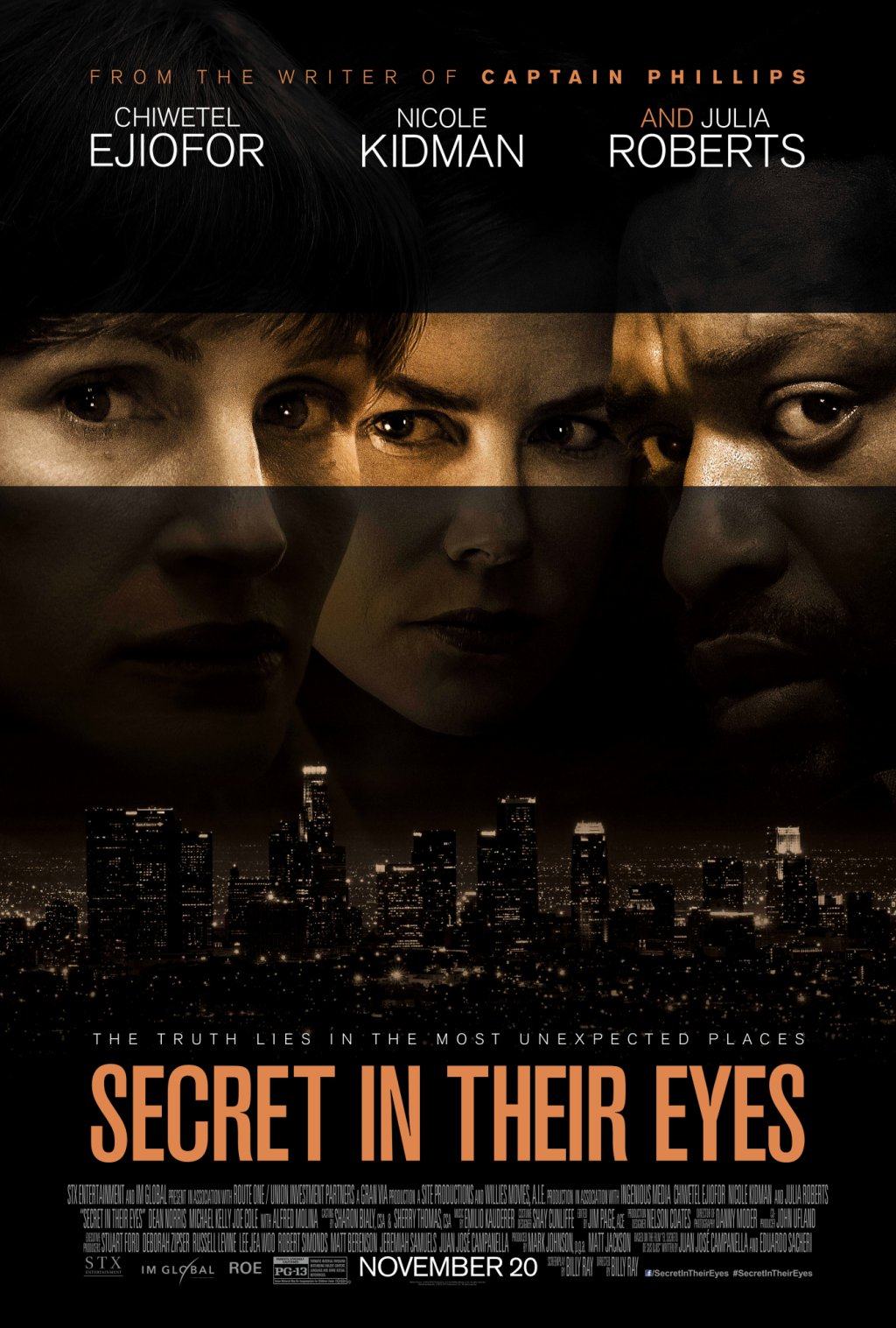
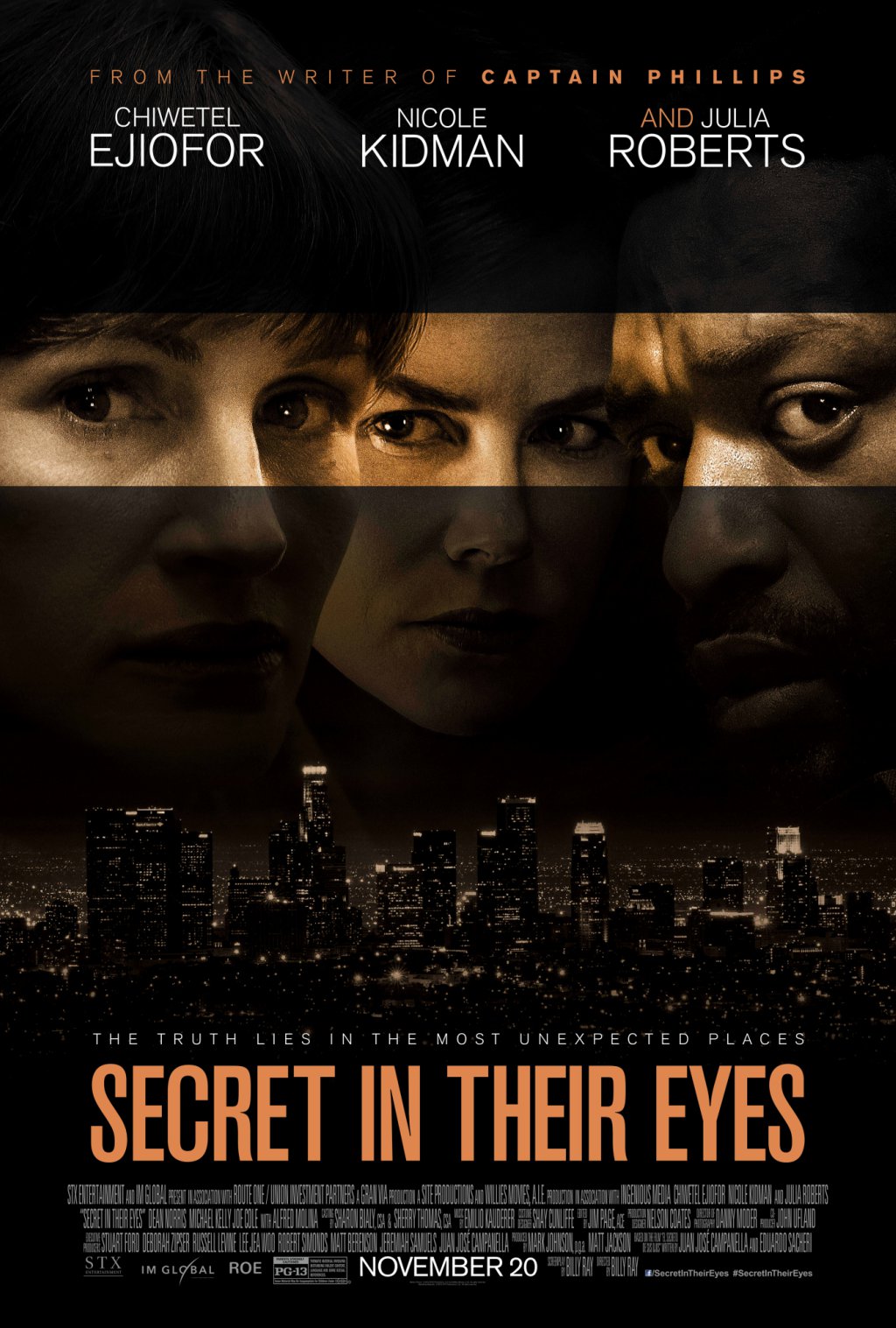
A girl is murdered. That girl, that crime and the man who did it are seen very differently by different people, all of whom are in law enforcement and all who have sworn to devote their professional lives to justice in this dark thriller based on an Oscar-winning Argentinian film (“The Secret in Their Eyes“). Just as that film used a long-unsolved murder to explore the shifts of politics and culture over the decades, this version, from writer-director Billy Ray, sets the murder in the frantic realigning of priorities following the terrorist attacks of 9/11. For those who loved her, justice for the death of the girl is all that matters. For those working on anti-terrorism, though, the suspect may be of more use out in the world as an informant than in prison as a murderer.

The story takes us back and forth between the present day and the time of the murder, in 2001.  Claire (Nicole Kidman) is a District Attorney and Ray (Chiwetel Ejiofor) is an investigator newly assigned to the FBI’s anti-terrorism division.  There is an immediate charged connection between them, though Claire is more reserved. Ray works with Jess (Julia Roberts), who teases him about his evident interest in Claire.

Then there is the report of a death, a body in a dumpster. Ray and Jess arrive, alert, professional, but detached, snapping on their blue latex gloves and talking about a possible connection to their work because the body was found near the mosque they are investigating.

And then Ray sees the girl and has to tell Jess that everything she cared about in the world has been destroyed. The shot of Roberts’ face as she has to go from thinking she has been called to see a body to understanding that it, that she is the one particular individual who means the most to her, “the thing,” she says, “that made me me,” is shattering to see. For the rest of the film, the radiant presence we know so well is haggard, numb, broken.

In the present day, the murder has not been solved. Because the suspect was an informant from a mosque that could have been harboring terrorists, the case against him was not pursued, and he has disappeared. But Ray has never stopped looking for him. He went through 1906 photos a night, searching every white male in the FBI’s system, for 13 years. He thinks he has found him.

More successful in mood than plot, Ray uses this story to meditate on loss, hopelessness, and the gulf between law and justice. Each of the characters wants something different from this investigation. Jess wants what she thinks of as justice but what looks more like revenge. “Death penalty would be too good for him,” she says. Ray feels somehow responsible, because he could have been with Jess’ daughter the morning she was killed. Claire wants the law to be enforced. And she still feels a connection to Ray. As for the suspect — in his own way, he is as controlled by his obsessions as the others.

Parents should know that this film includes a brutal rape and murder (off-screen) and some violence, with some peril and some injuries and abuse. There is some strong language.

Family discussion: Do you agree with Morales’ decision on how to treat Marzin? Should Ray have told Claire how he felt?

If you like this, try: the original film, “The Secret in Their Eyes” and Ray’s earlier films, “Shattered Glass” and “Breach”
Related Tags:


Crime Drama Remake Thriller
Spotlight

Spotlight

Posted on November 12, 2015 at 5:30 pm

“Spotlight” is about the ultimate betrayal of trust from an institution that literally represented the Word of God to many people. And it is about whether we will continue to have institutions that serve the essential function of monitoring the gap between aspiration and actuality, between what people say they are and do and the reality.

Copyright Open Road Films 2015

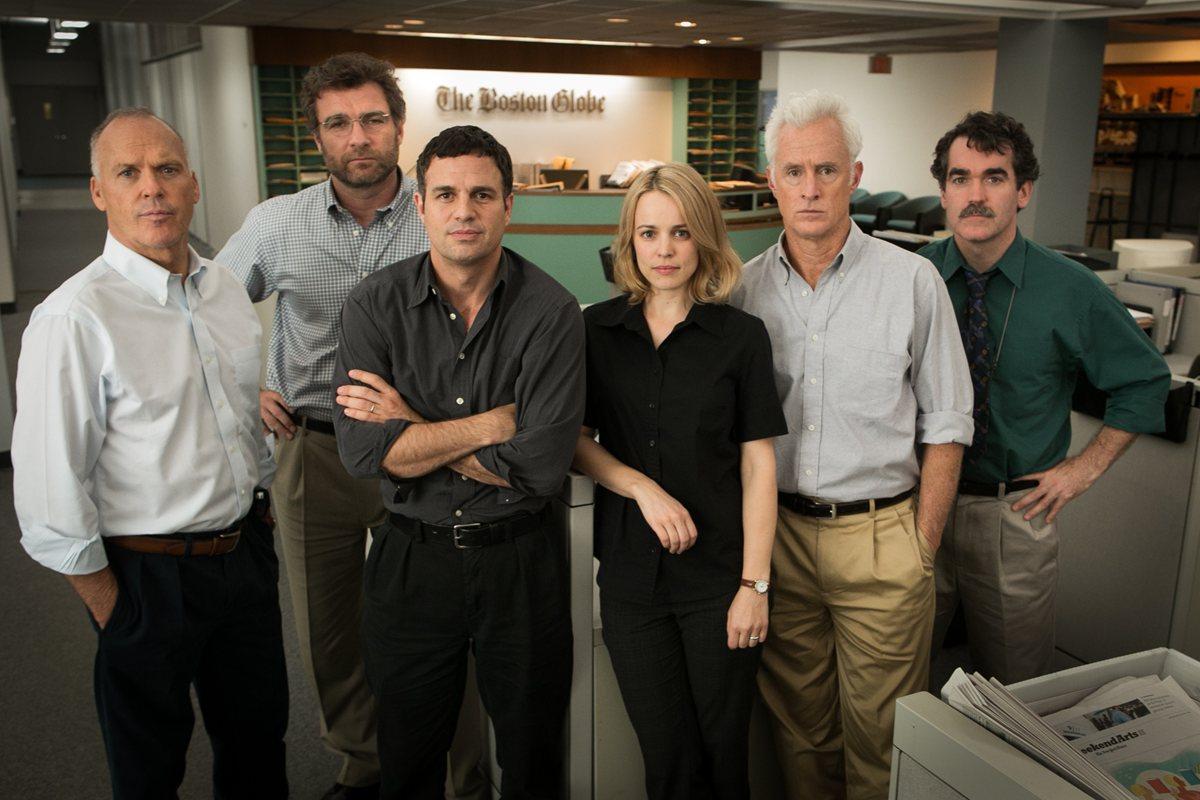
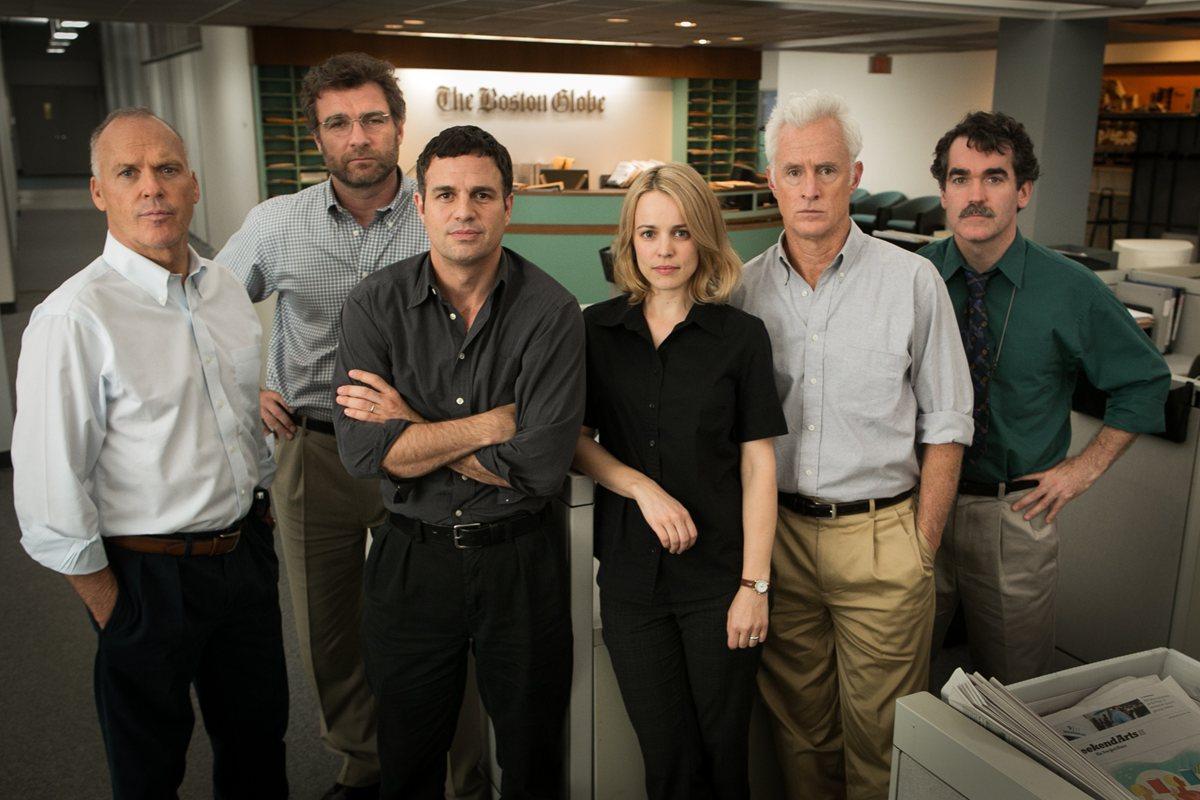
Spotlight is the name for the investigative group of journalists working for the Boston Globe. While their colleagues reported on stories that could be reported and written in days, the Spotlight group had the luxury and the responsibility of taking as much as a year to do the kind of in-depth original research necessary for more complex and difficult subjects.

The staff at Spotlight was let by Walter “Robby” Robinson (Michael Keaton) and included Mike Rezendes (Mark Ruffalo), Sacha Pfeiffer (Rachel McAdams), and Matt Carroll (Brian d’Arcy James).

Like most of the members of the Globe staff they were Boston born and bred, Red Sox fans to the end, and raised Catholic. They had just finished work on a long-term piece when their new editor arrived. He was not Boston born and bred, not a Sox fan, and not Catholic. And perhaps most important, he was not a Boston Globe lifer. He was Marty Baron (Liev Schreiber), most recently from Miami. He was an outsider in every way and they correctly suspected that the Globe was just a stop on his career trajectory. (He is now at the Washington Post.) They were not inclined to follow his idea of what stories they should cover.

But when he asked them about following up on a story about a priest who abused young boys, they could not come up with a reason not to other than it was too awful to imagine that it might be true. They begin to investigate. It turns out it was not one priest. It is a city-wide problem. A priest abuses children, is put on “medical leave” and transferred. The families of the boys are paid off and silenced. Then it happens again.

Director Tom McCarthy (“The Station Agent,” “Win Win”), writing with Josh Singer, really captures the culture of a newsroom, the stale coffee, the stale-er jokes, but the passionate curiosity that drives them all. This film will be compared to “All the President’s Men” because they are both true stories about young reporters getting huge stories everyone else missed. But the more important comparison is the way both movies capture the numbing work that goes into reporting. The doors knocked on. The doors slammed. And in this case, the nine years worth of diocese phone directories gone over, line by line (this was one of the last of the eras of off-line, analog document searches) to follow the “medical leave” priests took weeks of meticulous checking. It shows us reporting on the cusp of monumental technological change as well, when the paper makes the then-innovative decision to make the underlying documents available to readers online.

The reporters face enormous obstacles, starting with overcoming their own assumptions and then the powerful people who try to stop them. The church is an overwhelming force, politically and culturally. Do readers really want to know? Will the paper lose subscribers and advertisers?

There is no betrayal more devastating than to have the most trusted of institutions, the one most intimately involved in family joys and sorrows to be countenancing the abuse of those most deserving of its protection. But by the end of the film, that atrocity, already known to us, is not as troubling as the idea that news organizations may not be able to bring us the next one.

Parents should know that the theme of the movie is the investigation of widespread child sexual abuse and its cover-up, with sexual references, some graphic, and some strong language.

Family discussion: How did the arrival of an outsider affect the decision to do this story? Do today’s newspapers have the resources and support they need to do in-depth investigations like this one?

If you like this, try: “All the President’s Men” and “Truth” and the documentaries “Deliver Us from Evil” and “Twist of Faith”

Related Tags:


Based on a true story Drama Journalism
Miss You Already

Miss You Already

Posted on November 5, 2015 at 5:22 pm

B
Lowest Recommended Age: Mature High Schooler
Profanity: Very strong and crude language
Alcohol/ Drugs: Drinking, drug references
Violence/ Scariness: Serious illness, sad death, some graphic and disturbing images
Diversity Issues: None
Date Released to Theaters: November 6, 2015

Copyright Lionsgate 2015
Friendship has the best aspects of romantic love and the best of family love, and the worst of both as well. Your friends as are close to you as anyone in the world, which means you can rely on them and they can rely on you, whether it’s telling you if your butt looks too fat in those jeans or you need someone to come pick you up because a date has gone horribly wrong. And it means that they can hurt you terribly, because they mean so much to you and because you trust them and because they know you so well.

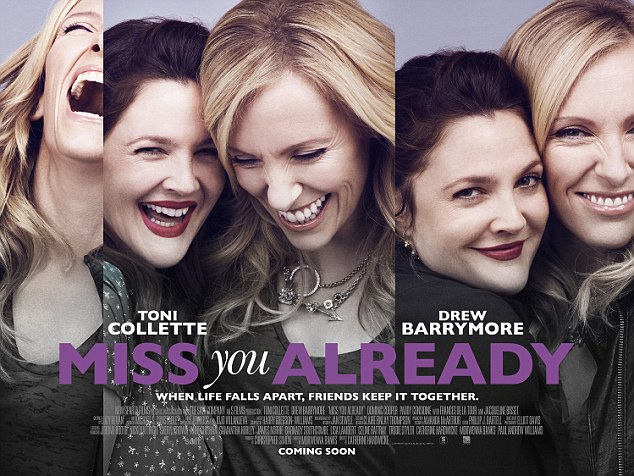
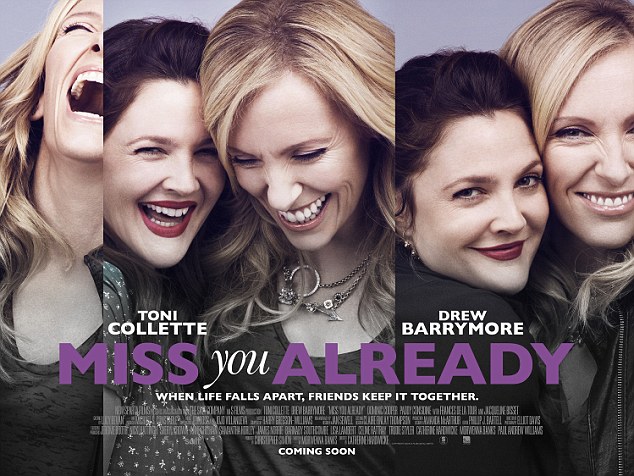
And yet, while there are hundreds of thousands of movies about love and family, there are not very many great movies about friendship. “Miss You Already,” from director Catherine Hardwicke, is a worthy attempt, the story of two women who were friends since childhood, and whose friendship is nearly destroyed by the complications of grown-up life. Though it appears only once in the film, the title refers to a catchphrase the two women use to say goodbye, making fun of themselves for being so deeply in one another’s lives, but really meaning it, too.

Drew Barrymore plays Jess, an American living in England and the more serious and responsible of the pair. Toni Collette is Milly, the wild party girl who improbably is living happily ever after with Kit (Dominic Cooper), the roadie who got her pregnant and then married her, started a successful business, and turned out to be a wonderful husband and father. They have darling children, a beautiful home, and satisfying careers and they are still mad for each other. Jess is happily married to Jago (Paddy Considine), though they do not have any money and are struggling with fertility problems. But they live on an adorable houseboat. It is one of the movie’s wisest choices that the husbands are not complaining (most of the time) or complained about. They are full partners to their wives and full partners in supporting the friendship.

Milly has always lived lightly, skimming along the top of life, still a party girl at heart. She loves her husband, children, and Jess, but she is admittedly superficial and vain. And then she gets a cancer diagnosis. Jess is happy to live up to the assigned tasks of “bringing treats and not being annoying” to help Milly through chemotherapy. And wig shopping (with the wonderful Frances de la Tour). And changing dressings. But she believes that Milly’s illness is so all-consuming that she cannot share what is going on in her life. And then Milly does something that creates the first serious breach in their relationship.

Yes, we’re in “Beaches” territory, so get out your handkerchiefs. Drew and Collette make a touching screen team, and Jacqueline Bisset, almost unrecognizable with platinum blonde hair, is a welcome antidote to over-sentimentality as Milly’s self-absorbed mother, a moderately successful actress. Hardwicke, who began her career as a production designer, has a superb eye and a great gift for using the settings to tell the story. If she cannot avoid the usual touchstones of women’s friendship movies (singing along to a favorite pop song), at least she changes it up a little — REM in a taxi instead of the usual Motown into a hairbrush. “Miss You Already” will make you want to call a friend you miss, and then bring her along to see it again.

Parents should know that this film includes very strong language, sexual references and situations, serious illness with some graphic images, a very sad death, a childbirth scene, alcohol and drug references.

Family discussion: What makes a great friendship? Ask family members about their most important friendships, how they met and their favorite moments.

If you like this, try: “50/50” and “Beaches”

Related Tags:


Drama Illness, Medicine, and Health Care Movies -- format
Our Brand is Crisis

Our Brand is Crisis

Posted on October 29, 2015 at 5:38 pm

Copyright Warner Brothers 2015

As we gear up for one of the most improbable and even outlandish Presidential campaigns in US history, we get a movie based on a real-life Presidential campaign in Bolivia, with imported American political consultants transplanting the media-savvy, scorched-earth, mud-slinging “expertise” that won elections in the US. What could go wrong?

The name of the film is “Our Brand is Crisis,” also the name of the 2006 documentary about what happened when James Carville, an architect of the Clinton campaign, went to Bolivia with his group of consultants and strategists to help elect the Bolivian-born, American-raised Gonzalo Sánchez de Lozada. Actually they went to help re-elect him. He had served as President from 1993-97. He was trying to regain the Presidency, and who better to help than the team who helped the young governor of Arkansas beat a sitting President, George H.W. Bush?
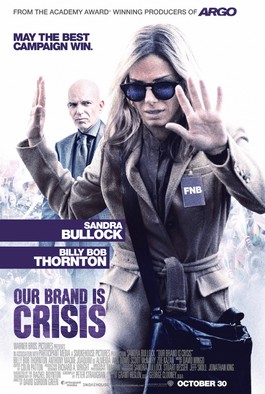
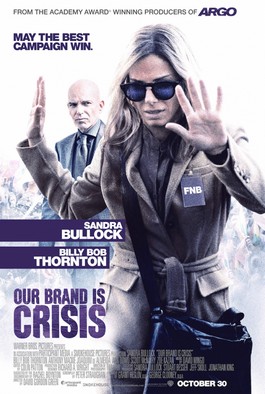
Sandra Bullock, taking a part based on Carville and originally written for George Clooney, plays a consultant known as “Calamity” Jane. She is burned out and living in a remote rural area when she gets a visit from two former colleagues.

Nell (Ann Dowd) and Ben (Anthony Mackie) want her for two reasons. First, she is good at what she does. Second, she is “disposable, expendable, and deniable.” If their candidate (named Castillo in this film and played by Joaquim de Almeida) wins, they get the glory. If he loses, they can blame “Calamity” Jane. Win win, and a good introduction to the small-p politics of the world of strategists and consultants who work on campaigns.

Jane is not interested, even though she needs the money, until she learns that Castillo’s opponent is being advised by her arch rival, Pat Candy (Billy Bob Thornton), a man who has been on the other side “three or four times” and beaten her “three or four times.” Much more interested in trouncing anyone Candy is advising than in any of the issues or the quality of the candidates, she agrees to fly to Bolivia, where she spends the first few days breathing oxygen from a tank and throwing up due to the altitude.

Finally she begins to wake up and her fiercely competitive spirit takes over. She brings in a secret weapon, a young woman with crackerjack online research skills known only as LeBlanc (Zoe Kazan), a sort of Lisbeth Salander who looks like a sophomore at Yale. And she starts barking orders, telling her candidate to take off his jacket and roll up his sleeves and to turn toward the camera if he feels a tear in his eye. “We are the syringe that injects the people’s voice into your campaign,” she barks. He is so far behind in the polls that he has no alternative.

Jane’s short-term goal: to humanize her candidate, who is seen by the electorate as imperious and out of touch. Her medium term goal: to persuade the electorate that there is a crisis and only his experienced hand can guide them through. Her ultimate goal: complete annihilation of Pat Candy, with a side order of public humiliation.

The political sophistication of the screenplay is below the level of an AP history class, with a lot of scorched earth posturing and the inevitable idealistic youngster to provide contrast to all the superficial cynics. A reference to Adam Smith’s theory of the invisible hand is there for a gloss of political sophistication, but the aphorisms are tired (“If you fight with monsters for too long, you become a monster”) and the film is almost as cynical as its characters. The reason to see it is Bullock, who gives one of the best performances of the year, as complex, nuanced, savvy, and honest as the film would like to be. She’s got my vote.

Parents should know that this film includes very strong and crude language, vulgar sexual references, smoking, drinking, and some violence including riots, tear gas, and guns.

Family discussion: Why did Jane take the job? What will she do next?

If you like this, try: the documentary of the same name that inspired this film and “No,” starring Gael Garcia Bernal, based on the 1988 election in Chile

Related Tags:


Based on a true story Drama Politics
Suffragette

Suffragette

Posted on October 29, 2015 at 5:30 pm

B
Lowest Recommended Age: Middle School
MPAA Rating: Rated PG-13 for some intense violence, thematic elements, brief strong language and partial nudity
Profanity: Brief strong language
Alcohol/ Drugs: Drinking, smoking
Violence/ Scariness: Some intense violence including bombs, police brutality, domestic violence, and sexual abuse, characters injured and killed
Diversity Issues: A theme of the movie
Date Released to Theaters: October 30, 2015
Date Released to DVD: February 1, 2016
Amazon.com ASIN: B017Y01GOM
Copyright 2015 Focus Features

How do you persuade politicians to give you the vote when you do not have the capacity to vote them out if they deny it? That was the problem faced by women in later 19th and early 20th century Great Britain and the US. While Abigail Adams urged her husband to “remember the ladies” in setting up the US government, the Constitution did not give them the right to vote. Nor did the 15th amendment to the Constitution adopted after the Civil War to give the vote to all men, regardless of race. Efforts to give “universal suffrage” in the UK led to reforms over the 19th century, but none of them granted any voting rights to women.

As this film begins, women in the UK had been fighting for the right to vote for 30 years. They concluded that they had exhausted all peaceful means of sending their message and were resorting to what today we might consider terrorism, throwing rocks at store windows and planting bombs in mailboxes. They were careful to destroy property only. No one was hurt through their protests, except for the protesters themselves, who were subjected to extreme brutality from the police, including torturous forced feeding for those who participated in hunger strikes when they were imprisoned.

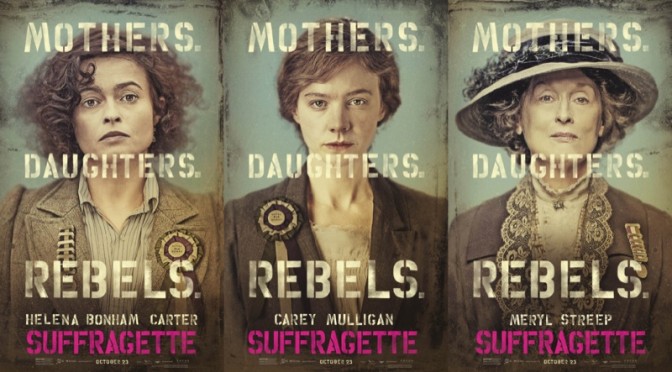
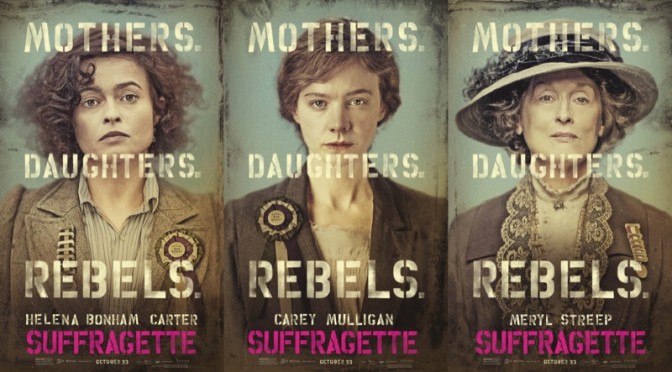
Those who have studied the history of women’s suffrage may be familiar with the names of the leaders, like Emmeline Pankhurst (played in this film by Meryl Streep). But as so often happens with history, the stories of the everyday women who played a vital role in the movement are not well known, and this film wisely focuses on them. Pankhurst is on screen for less than ten minutes. The movie’s main character is a composite who is representative of the working women who became a part of the cause. Maud (Carey Mulligan) works in a laundry as does her husband (Ben Wishaw) and as did her mother, until she was killed in an industrial accident. She began working there as a child and will work there as long as she can, though she knows that the likelihood of injury or illness caused by the working conditions is very high. That is not the only problem. As her friend’s young daughter comes to work in the laundry, we can see from Maud’s reaction to the sexual assaults by a predatory boss are something she recognizes from her own experience.

Maud is in the wrong place at the wrong time and is assumed to be working with the protesters. Instead of denying it or, when she has the opportunity to help her situation by spying on them and reporting what she learns back to the police, she begins to think for the first time that there could be a chance to create a better life for herself and for the next generation, and she becomes involved, though she risks losing her job, her husband, and her child.

The movie, written by Abi Morgan and directed by Sarah Gavron, is somber in tone but it is effective at showing the harsh conditions of Maud’s life and the always-watchable Mulligan gives her character a developing ferocity that is more of a surprise to her than it is to us. It also is effective at showing us the class divisions and how women across class lines worked together. But 21st century audiences well-versed in the narratives of later protests like the civil rights, women’s equality, environmental and and anti-war movements may find it difficult to sympathize with the literally incendiary tactics of these women. There are so many characters in a very limited time period with very little progress that its good intentions are not enough to make it a strong narrative.

Text at the end of the film provides sobering statistics about how long it has taken — and is still taking — for women to get the right to vote. Here’s hoping it will not take explosives for these women to have a say in the laws that govern them.

Parents should know that this film features protest violence including destruction of property and explosives by activists and police brutality by law enforcement. Characters are injured and killed and there is domestic violence, sexual abuse, a parent permanently separated from a child, brief strong language, and non-sexual nudity.

Family discussion: If you were advising the activists on behalf of women’s right to vote, what would you suggest? How did later political movements learn from their example?

If you like this, try: the documentaries “One Woman, One Vote” and “Not For Ourselves Alone

Related Tags:


Based on a true story Drama DVD/Blu-Ray Pick of the Week Epic/Historical Politics
THE MOVIE MOM® is a registered trademark of Nell Minow. Use of the mark without express consent from Nell Minow constitutes trademark infringement and unfair competition in violation of federal and state laws. All material © Nell Minow 1995-2026, all rights reserved, and no use or republication is permitted without explicit permission. This site hosts Nell Minow’s Movie Mom® archive, with material that originally appeared on Yahoo! Movies, Beliefnet, and other sources. Much of her new material can be found at Rogerebert.com, Huffington Post, and WheretoWatch. Her books include The Movie Mom’s Guide to Family Movies and 101 Must-See Movie Moments, and she can be heard each week on radio stations across the country.

Website Designed by Max LaZebnik