The Water Diviner

Posted on April 23, 2015 at 5:58 pm

B-
Lowest Recommended Age: Mature High Schooler
MPAA Rating: Rated R for war violence including some disturbing images
Profanity: Brief language
Alcohol/ Drugs: Drinking, smoking
Violence/ Scariness: Wartime violence with battles and terrorist attacks, characters injured and killed, graphic and disturbing images, suicide, mercy killing
Diversity Issues: A theme of the movie
Date Released to Theaters: April 24, 2015
Amazon.com ASIN: B00WFNPPVY
Copyright 2015 Warner Brothers

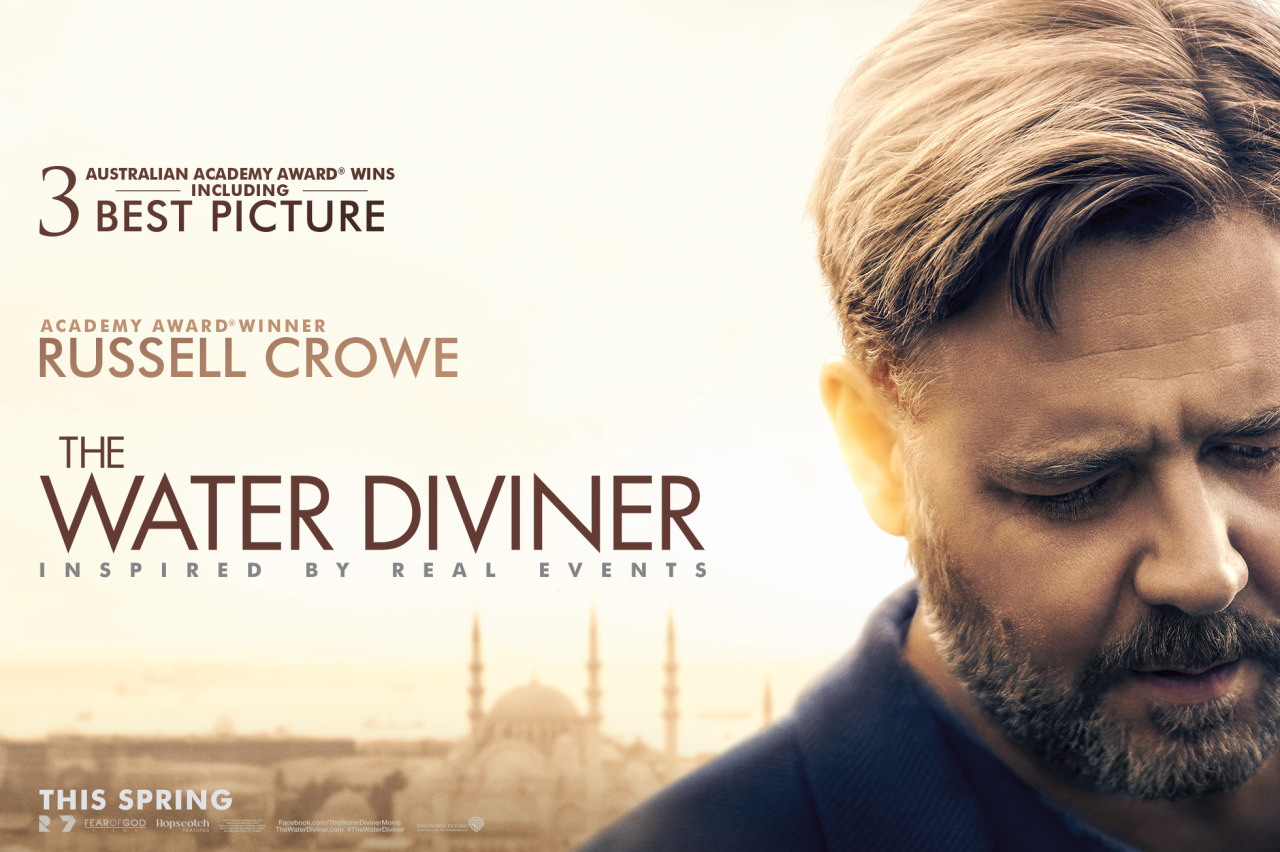
Before it detours into not one, not two, but at least three preposterous Hollywood twists, “The Water Diviner” is an absorbing drama about Joshua Connor, an Australian farmer (Russell Crowe, making his directing debut as well) who travels to Turkey to find the remains of his three sons, all killed in the battle of Gallipoli, so he can bring them home for burial. We first see Joshua dowsing for water. He selects the spot he is drawn to, then digs with skill, focus, and determination, until he hits water. He has a well.

He returns to the house where his wife tells him to read a bedtime story to their three sons. It is too much for her to accept that they are long gone to war and killed in battle. Finally, she is so overwhelmed by grief that she commits suicide. Joshua insists that she be buried in the church cemetery, and then leaves to bring their sons home and bury them next to her.

Crowe’s greatest asset as a director is himself as leading man, and his performance is powerful, with a muscular masculinity and sense of honor, but shredded by the loss of his family and by his fears that he may be responsible because he “filled their heads with heroic nonsense.” The clash of cultures and the unthinkable tragedies are intriguing. The best part of the film is the depiction of the way the defeated Australian command must work with the Turkish nationals to bury their dead as respectfully as possible, the tensions are inevitable. Was the end of the battle a “retreat” or an “evacuation?” “You killed my sons.” “You sent them. You invaded us.” Both, of course, are right. When one says, “I don’t know if I forgive any of us,” the other side has to agree.

“Four years ago you’d have given me a VC for shooting that bastard,” one of the ANZAC (Australian/New Zealand) officers growls. “That bastard” is Major Hasan (Yılmaz Erdoğan). The former enemies must work together on a task of unimaginable sadness and defeat, creating a sacred burial ground for thousands of dead soldiers, who will remain for eternity in the site of their defeat. “This is the first war anyone has given a damn,” to do even that much, says an ANZAC officer. Previous war dead were piled into pit graves with the horses.

Joshua finds a place to stay — or rather, it finds him, as a boy takes his bag and runs to the home where his mother and uncle have established a small hotel. They do not want an Australian there, but they need the money, so they gingerly make him welcome. The boy’s mother, Ayshe (Olga Kurylenko), is still insisting that her husband will return from battle, to keep her son’s hope alive more than her own, and perhaps also to protect her from the pressures put on a single mother to remarry. Joshua is forbidden from going to the burial ground, but Ayshe helps him find a way. Once he gets there, no one wants to help him. But “because he is the only father who came looking,” they grudgingly allow him to look through the piles of bones.

And then it starts to get Hollywood. The water diviner somehow uses that same skill to locate the remains of two of his sons. And then it may be that the third is still alive. The last section of the film takes a turn that even Indiana Jones would find daunting and a romance even Nicholas Sparks would find improbable. It is too bad that the earlier part of the film’s appreciation of conflicts and complexity is followed by a fairy tale ending.

Parents should know that this movie features wartime scenes of battle violence and terrorism with some disturbing and graphic images and a suicide and a mercy killing. Characters are wounded and killed. In addition, it includes some strong language, domestic abuse, sexual references, drinking, and smoking.

Family discussion: What did Joshua and Major Hasan have in common? What do we learn from the flashback to the sandstorm? What should Arthur have done?

If you like this, try: Gallipoli and “A Very Long Engagement”

Related Tags:


Drama Inspired by a true story Movies -- format War

Ex Machina

Posted on April 16, 2015 at 5:18 pm

A-
Lowest Recommended Age: Mature High Schooler
MPAA Rating: Rated R for graphic nudity, language, sexual references and some violence
Profanity: Very strong language
Alcohol/ Drugs: Drinking and drug use, intoxication
Violence/ Scariness: Violence and peril, characters injured and killed
Diversity Issues: Diverse characters
Date Released to Theaters: April 17, 2015
Date Released to DVD: July 14, 2015
Amazon.com ASIN: B00XI057M0
Copyright A24 2015
Copyright A24 2015

Movies about artificial intelligence or computers achieving consciousness are, of course, really about what it means to be human.

When software and hardware combine to mimic or exceed human qualities in “Her,” “Chappie,” “2001: A Space Odyssey,” “Terminator,” or the upcoming Avengers sequel, even “Planet of the Apes,” it is a way to think about what it is that defines us. Alan Turing of “The Imitation Game” used our ability as humans to recognize each other as the famous Turing test to determine whether artificial intelligence has been created. The test is passed when a person cannot tell whether the entity on the other side of a conversation is human. If we cannot tell the difference, then we have to rethink our exceptionalist notions of human supremacy.  We accept, sometimes reluctantly, the notion that computers are vastly superior in computation and memory, that they can whomp us in chess or on Jeopardy.  But can a machine achieve what we think of as consciousness?  Or conscience?

Caleb (Domhnall Gleeson) is a computer programmer who gets the equivalent of Charlie Bucket’s golden ticket.  He wins a chance to spend a week at the home of the brilliant founder of his company (think Steve Jobs), a man who at age 13 invented the most powerful search engine and now lives in a home so remote that a helicopter flies over the thickly wooded property for two hours before they reach the residence.  They are in the middle of nowhere.  (The film was made at the stunning Juvet Landscape Hotel in Norway.)

Nathan (Oscar Isaac, all brutish charm, feral, and entitled, with shaved head and beard), welcomes him with a rough candor, explaining that he is hung over, and giving Caleb a keycard, so that he will have access to those parts of the home where he is welcome and be kept out of those where he is not.  It turns out he has been brought there for a purpose.  Nathan has been working on what he describes as the greatest scientific advance of all time.  He is not creating a robot.  He is trying to create life.  He wants Caleb to perform the Turing test on his latest creation, named Ava (Alicia Vikander of “Anna Karenina”).  

But it turns out that it may not be Ava who is being tested.

Ava is gorgeously designed.  Nathan admits that he created her to be intensely appealing and she is, both her humanoid face and her transparent neck and midriff that allow us to glimpse her mechanics.  Vikander gives her a tentativeness and innocence, with a sweet seriousness and (at least at first) an endearing wish to please.  She tells Caleb to wait while she gets a surprise and it turns out to be clothes that cover up the machinery so well that it is not just the human part of Caleb that recognizes her as a part of the same species; it is the depths of the lizard brain instinct.  We may have wondered why Nathan’s test was conducted in a glass box that separates Ava and Caleb.  Perhaps it was to prevent him from abandoning the Turing test for a more animalistic evaluation based on smell and touch.

There is that always-compelling hubris/Frankenstein/Jurassic Park/sorcerer’s apprentice element of foolish, narcissistic grandiosity in creating something out of a grant vision without appreciating how dangerous it will be.  Something always goes wrong.  And anyone who does not realize that does not really understand that part of the essence of humanity, for better and worse, is the chasm between our ability to dream and our ability to execute.

First lesson: Isaac Asimov was right.  Second lesson: the qualities of human-hood go beyond syntactical complexity and conversational non-linearity.  To be human means independence of thought and action, and the pesky thing about independence is that it overlaps with rebellion.  We know computers can outsmart us.  Can they out-human us, too?  Is it any wonder that Caleb flays his own arm just to check that what is inside is not made of gears and chips?

Screenwriter Alex Garland (“28 Days Later,” “Sunshine,” “Never Let Me Go”), directing for the first time, has an eye for gorgeous visuals and a superb sense of balancing the future-wow with the ordinary to make his sci-fi-style extrapolations amplify and illuminate who we are.

Parents should know that this film has very strong language, substance abuse, explicit nudity and sexual situations, and violence.

Family discussion: What is Ava’s most human quality?  What is Nathan’s least human quality?

If you like this, try: Read up on the Turing test and watch movies like “A.I.” and “Her”


Related Tags:


Drama DVD/Blu-Ray Pick of the Week Science-Fiction

True Story

Posted on April 16, 2015 at 3:20 pm

Copyright 20th Century Fox 2015

A reporter in disgrace for fabricating details of a story sits across the table from an orange-jumpsuited prisoner, accused of murdering his wife and three children. They have more in common than either of them expected. They are both outcasts. They are both unable or unwilling to explain their actions.

And they both used the name Michael Finkel. The reporter was given that name at birth and it appeared on the byline of his stories in the New York Times Magazine, including the one that cost him his job and his reputation. The man who murdered his family used that name when he fled to Mexico to escape capture. The real Michael Finkel, in seclusion at his home in Montana following his humiliating dismissal, got a phone call when the murderer was arrested, asking him for comment. With nothing else to do, and with the thought that this might be the kind of big story that get him back to a job in journalism, the real Michael Finkel, or as real as sometime just fired for lying can be (Jonah Hill), drove to Oregon to visit the man who was accused of killing his family. His real name, by the way, was Chris Longo (James Franco).

Co-writer/director Rupert Goold has a lot of ideas to explore in this film, and some work much better than others. The focus should be on the parallels between the two men, what links them, the ways they tried to use each other, and the resentments and differences that separate them.  But Goold wastes Felicity Jones (“The Theory of Everything”) as Finkel’s girlfriend, with distracting diversions like an ominous shot of her running (for exercise) through the woods. She does as well as possible with a scene where her character confronts Longo, but it is artificial and stagey.

Franco perfectly captures the superficial charm that occasionally slips to reveal fierce underlying anger and self-justification. Hill is a bit out of his depth, or more likely the Finkel character is underwritten. We should be able to see his anger and self-justification, too. And he is lost in the scene where he is grappling with a moral dilemma or trying to consider the rights of anyone but himself.  He is better at showing us Finkel’s arrogance and his need for approval. When Longo says he took Finkel’s name because he was a fan, Finkel is unabashedly complimented. After his humiliating dismissal, he gravitates toward approval like a moth toward a flame. And we know how that turns out.

The ironic title reminds us that we can never really know the true story; there are always too many conflicting versions, too much that is just unknowable. And yet the difference between Finkel, who violated the most fundamental principles of journalism by combining the details of the Africans he met to tell it as a story about one individual, and the movie of his own story is that fiction is supposed to convey larger truths. It is not at all clear that this one does.

Parents should know that this film concerns the murder of a wife and children. There are some disturbing and grisly images, as well as child slavery and discussion of beatings, deception, some strong language, and drinking.

Family discussion: Why did Jill visit Chris? How did Chris and Mike try to con one another and who was most successful?

If you like this, try: “Capote” and “The Jinx” and Finkel’s book, Murder, Memoir, Mea Culpa

Related Tags:


Based on a book Based on a true story Crime Drama

While We’re Young

Posted on April 2, 2015 at 5:12 pm

B+
Lowest Recommended Age: Mature High Schooler
MPAA Rating: Rated R for language
Profanity: Very strong language
Alcohol/ Drugs: Drinking and drug use
Violence/ Scariness: Mild
Diversity Issues: None
Date Released to Theaters: March 27, 2015
Copyright 2015 A24
Copyright 2015 A24

“While We’re Young” opens with an exchange from Ibsen’s “The Master Builder” about what happens when the young come knocking at the door. But it might just as well begin with the wry Amish aphorism, “We grow too soon old and too late smart.”

Writer/director Noah Baumbach’s work often centers on the perils, agonies, and humiliations, and fears of growing up — including the attempts to avoid it. From the 20-somethings of “Kicking and Screaming” and “Frances Ha” to the immature parents with a teenager struggling through adolescence in his most autobiographical film, “The Squid and the Whale,” he shows us characters who try –unsuccessfully — to hold on to the optimism and narcissism of youth while having access to the powers and privileges of adulthood. Wouldn’t that be nice?

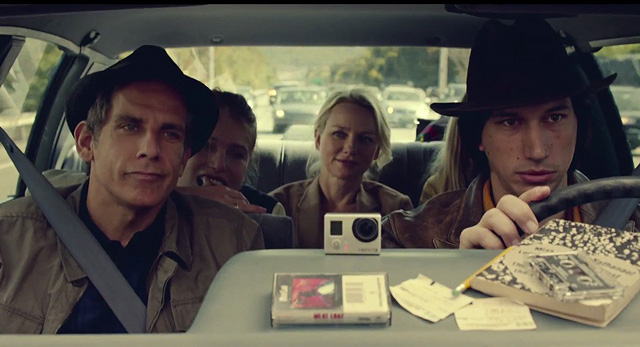
One of the toughest losses of adulthood is the sense of limitless possibilities. That is the moment at which we meet Josh (Ben Stiller) and Cornelia (Naomi Watts). Their friends all have babies. But after miscarriages and failed fertility treatments, they are giving up on having children and trying to convince themselves that they are happy to have nothing to keep them from spontaneous adventures — even if they never take them. Maybe planning a month ahead of time can still be spontaneous, but they don’t do that, either.

Josh is a documentary filmmaker who has been working on the same amorphous film for eight years. The version he is currently editing is so long it seems like it would take eight years to watch it. One problem is that he is not able to explain what it is about. Or, rather, it is about everything, including the very reality of being able to make a movie about whatever it is about. Also about America. So he is pretty much stalled in his personal and professional life.

And then he meets the adorably artisanal newlyweds Jamie (Adam Driver) and Darby (Amanda Seyfried), who have all the dewiness and boundless optimism Josh would love to feel. And, they have something even more important. They are so young that they think he is cool. They attend a class he is teaching and tell him they admire one of his documentary films, which they found on eBay. Josh and Cornelia are enraptured by the younger couple, who remind them of what they once were, while their old friends remind them of what they cannot have. In one sequence, Cornelia disastrously agrees to accompany her closest friend to a music session for infants, then runs out to join Darby at a hip hop dance class. She is hilariously out of place at both, but loves the feeling of being included with the hip hoppers.

Meanwhile, Josh starts wearing a hat just like Jamie’s and riding bicycles with him through the Brooklyn streets. But Josh’s best friend (played by Beastie Boy Adam Horovitz) tells Josh he’s “an old man with a hat” and Josh gets out of breath on the bike. Jamie calls Josh “Joshie,” affectionate but also infantilizing.

Both young and old will find a lot to laugh at in this film, which has Baumbach’s frothiest dialog and shrewdest characterizations.  “Arthritis arthritis?” Josh asks his doctor in dismay when he gets a diagnosis, hoping that perhaps he has some sort of specialized temporary form of arthritis that young people get.  “I usually just say ‘arthritis,'” his doctor dryly replies.  Josh and Cornelia are mesmerized by the preciously retro decor of Jamie’s and Darby’s apartment, with rows of LPs.  “It’s like they have everything we threw out but with them it looks good,” says Cornelia.

Then Jamie’s own documentary starts coming together, and Josh turns from mentor to stepping stone.  The documentarian’s obsession with truth-telling takes a twist. And the issue of fathers and sons takes another, as we learn that Cornelia’s father was a one-time mentor of Josh’s and is a possible mentor for Jamie.  

The final scene brings us full circle.  Baumbach’s past films have been perceptive and wryly funny, sometimes sympathetic, but here we get to see some tenderness for his characters.  As former poet laureate Billy Collins says when people use the word some critics are using about this film: “accessible,” this is not “accessible.”  It is welcoming.

Parents should know that this movie has very strong language and some drinking and drug use.

Family discussion: Who was right about Jamie’s movie? Ask the older people in your family what they like best about not being young anymore.

If you like this, try: “Metropolitan” and “Kicking and Screaming”

Related Tags:


Drama Movies -- format

The Woman in Gold

Posted on March 31, 2015 at 5:58 pm

B+
Lowest Recommended Age: Middle School
MPAA Rating: Rated PG-13 for some thematic elements and brief strong language
Profanity: Brief strong language including anti-Semitic epithets
Alcohol/ Drugs: None
Violence/ Scariness: WWII-era peril and violence
Diversity Issues: A theme of the movie
Date Released to Theaters: April 1, 2015
Date Released to DVD: July 6, 2015
Amazon.com ASIN: B00VU4YO7K

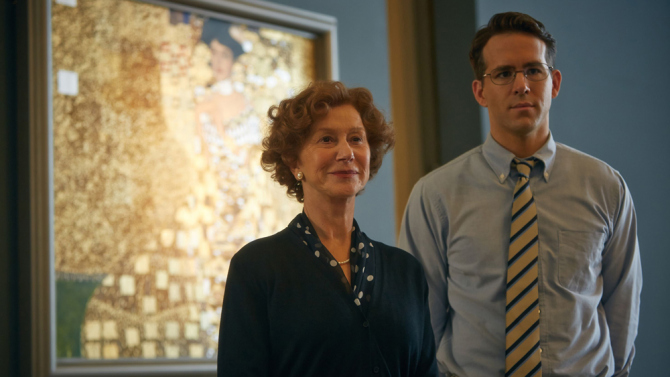
WOMAN IN GOLDThe very title is a form of theft. When Gustav Klimt painted the portrait that gives this film its name, he called it “Portrait of Adele Bloch-Bauer.” She was a warm, vibrant young woman who was a vital part of the extraordinary period of intellectual and cultural life in Vienna known as the Sacred Spring era. Adele Bloch-Bauer died in 1925, and the portrait hung in a place of honor in the apartment her husband shared with his brother, sister-in-law, and two young nieces.

And then the Nazis invaded Germany, their atrocities included stealing the valuables of the Jews they were sending to concentration camps. They took the portrait of Adele Bloch-Bauer and hung it in a place of honor, after they renamed it to remove identity of the subject and the Jewish association of her name. “Portrait of Adele Bloch-Bauer” became the anonymous “The Woman in Gold.” The beautiful choker necklace she wore in the painting was also stolen and given to the wife of Nazi officer Hermann Goering.

More than half a century later, Maria Altmann, the niece of Adele Bloch-Bauer, asked the grandson of her old friend from Vienna if he could help her get the painting back. This film is the story of the painting, the lawsuit, and Maria’s indomitable spirit.

Dame Helen Mirren is radiant as Maria, witty, spirited, an irresistible force who cannot give up. While we never doubt for a moment that she will prevail, Mirren makes us want to watch it all unfold. It is an extremely difficult case, with many arcane legal details, and the real-life story, like all real-life stories, is more complicated and controversial than any movie can convey. Director Simon Curtis (“My Week with Marilyn”) and first-time screenwriter Alexi Kaye Campbell keep the focus on the odd-couple relationship between Maria and the young lawyer (Ryan Reynolds), with flashbacks to show us Maria’s relationship with her Aunt Adele, and then her wedding to a handsome opera singer, just as the Germans are about to invade. Tatiana Maslany (“Orphan Black”) is lovely as the young Maria, and makes us believe she could grow up to become Helen Mirren.

The portrait of Adele Bloch-Bauer now hangs in the Neue Galerie. And now this movie is a part of its story, putting Adele back into the picture and giving us a portrait of the niece who insisted that her story be told.

Parents should know that this film includes WWII-era peril and violence, with references to concentration camps and genocide. There is brief strong language including anti-Semitic epithets.

Family discussion: Why did Maria refuse Ronald Lauder’s offer to get her more experienced lawyers? What was the most important discovery in winning the case?

If you like this, try: the documentary about Nazi art theft, “The Rape of Europa” and learn more about the lawsuit and read up on the real story

Related Tags:


Based on a book Based on a true story Courtroom Drama DVD/Blu-Ray Pick of the Week War
THE MOVIE MOM® is a registered trademark of Nell Minow. Use of the mark without express consent from Nell Minow constitutes trademark infringement and unfair competition in violation of federal and state laws. All material © Nell Minow 1995-2026, all rights reserved, and no use or republication is permitted without explicit permission. This site hosts Nell Minow’s Movie Mom® archive, with material that originally appeared on Yahoo! Movies, Beliefnet, and other sources. Much of her new material can be found at Rogerebert.com, Huffington Post, and WheretoWatch. Her books include The Movie Mom’s Guide to Family Movies and 101 Must-See Movie Moments, and she can be heard each week on radio stations across the country.

Website Designed by Max LaZebnik