Happy 200th Birthday to Pride and Prejudice

Posted on January 31, 2013 at 3:56 pm

Jane Austen’s beloved story of the headstrong Elizabeth Bennett and the arrogant Mr. Darcy is one of the most popular and influential books ever written.  Pretty much any story that involves a couple who battle until they fall in love is based in part on Austen’s story.  There are many movie versions, but the best are:

Pride and Prejudice (1940): The classic Hollywood version won an Oscar for art direction and features an all-star cast, including Greer Garson as Elizabeth and Sir Laurence Olivier as Darcy.  Maureen O’Sullivan (Mia Farrow’s mother) is a lovely Jane and Edna May Oliver is a wonderfully haughty Lady Catherine de Bourgh.  The witty script was written by the legendary Aldous Huxley, but I can’t forgive him for one important departure from the book in softening the Lady Catherine scene.

Pride and Prejudice (1995 mini-series): This is a magnificent version of the story, long enough to include all of the book’s most important scenes and characters.  Colin Firth makes a sensational Darcy (the addition of a scene where he cools off by diving into a lake caused some controversy but was popular with the fans) and Jennifer Ehle (an American actress who can be seen with Firth in “The King’s Speech” and also appears in “Zero Dark Thirty”) has the “fine eyes” Austen described.

Pride & Prejudice (2005) Director Joe Wright directed a magnificently natural version of the story starring Kiera Knightley and Matthew Macfadyen (who play brother and sister in his latest film, “Anna Karenina.”)


Related Tags:


Based on a book Classic Comedy Drama Romance

Downton Abbey 3rd Season DVD!

Posted on January 27, 2013 at 8:00 am

A
Lowest Recommended Age: Middle School
MPAA Rating: NA
Profanity: Mild language
Alcohol/ Drugs: Drinking, smoking
Violence/ Scariness: Illness and death
Diversity Issues: A theme of the movie
Date Released to DVD: January 28, 2013
Amazon.com ASIN: B0099Y2MYK

The most popular television show in the world has a gorgeous new DVD/Blu-Ray release this week, Season 3 and some marvelous extras:

–    Downton Abbey Behind the Drama
–    Shirley MacLaine at Downton
–    The Men of Downton
–    Downton in 1920
–    Season 3 Christmas Special bonus episode “A Journey to the Highlands”
–    and much more!

The returning cast includes Hugh Bonneville, Dame Maggie Smith, Elizabeth McGovern, Dan Stevens, Michelle Dockery, Jim Carter, Penelope Wilton, Joanne Froggatt, Brendan Coyle and a host of others, joined by Shirley MacLaine, who plays Martha Levinson, the very American mother of Cora, Countess of Grantham. Written and created by Julian Fellowes, Downton Abbey, Season 3 is a Carnival Films and Masterpiece co-production, in association with NBCUniversal.  I have one Blu-Ray to give away!  Send me an email at moviemom@moviemom.com with “Downton” in the subject line and tell me your favorite character in the series.  Don’t forget your address!  (US addresses only)  I will pick a winner at random on February 2.  Good luck!
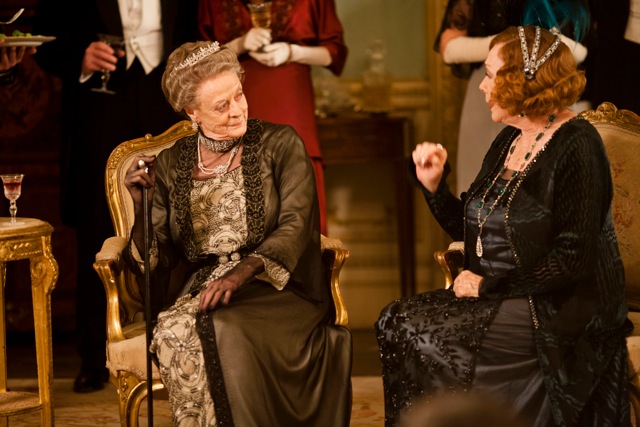
Photo caption: The Great War is over and a long-awaited engagement is on, but all is not tranquil at Downton Abbey as wrenching social changes, romantic intrigues, and personal crises grip the majestic English country estate for a third thrilling season. With the return of its all-star cast plus guest star Academy Award®-winner Shirley MacLaine, Downton Abbey, Season 3 airs over seven Sundays on PBS beginning on January 6, 2013. Shown in the photo from left to right: Maggie Smith as Violet, Dowager Countess of Grantham and Shirley MacLaine as Martha Levinson

Related Tags:


Contests and Giveaways Drama DVD/Blu-Ray Pick of the Week Television

Zero Dark Thirty

Posted on January 10, 2013 at 6:00 pm

A-
Lowest Recommended Age: Mature High Schooler
MPAA Rating: Rated R for strong violence including brutal disturbing images, and for language
Profanity: Constant very strong language
Alcohol/ Drugs: Drinking, smoking
Violence/ Scariness: Intense and disturbing wartime images including torture and terrorism
Diversity Issues: Diverse characters
Date Released to Theaters: January 11, 2013
Date Released to DVD: March 18, 2013
Amazon.com ASIN: B00B1E6FF8

It begins with heart-breaking audio of 911 calls from the World Trade Center on September 11, 2001.  A frantic woman who asks if she is going to die is soothed by the operator until she is suddenly gone and we hear the operator’s dawning understanding of the magnitude of the disaster.

And then it is two years later and we are watching the torture-aided interrogation of a detainee in Pakistan.  Dan (Jason Clarke) is forthright and almost clinical as he tells Ammar (Reda Kateb) that he will hurt him for every lie.  The interrogation is witnessed by a new arrival who we will know only as Maya (Jessica Chastain).  She turns down the chance to stay outside the room.  “There’s no shame if you want to watch from the monitor.”  Maybe she is proving something to Dan, maybe she is proving something to herself, maybe she is so intent on finding Osama Bin Laden that she wants to make sure she does not miss a detail.  Probably all three.

Director Kathryn Bigelow brings that same intensity of focus to telling the story that Maya brings to the search.  After “The Hurt Locker,” Bigelow, the first woman to win the Best Director Oscar, re-teamed with screenwriter Mark Boal to make a movie about what they thought would be the unsuccessful search for Bin Laden.  Their project was overtaken by events as Bigelow and Boal were all but embedded with the military and CIA to do their research in real time, giving the movie an intimate, gritty, documentary feel.

Maya goes to work.  “You don’t think she’s a little young for the hard stuff?” one of her new colleagues asks.  “Washington says she’s a killer.”  This is not a movie where we go home with the heroes and see them hug their children.  It is not a movie where we see them struggle with their demons or sit down over drinks to give us endearing details about their lives or explain why they do what they do.  At one point, Maya is asked about her background and she says she has done nothing since she got out of school but look for Bin Laden.  She acknowledges that there is a reason she was particularly suited for this task, but she never reveals it.  This is the story of hard-working, even driven professionals who have to make life or death decisions all the time, about what it takes and about the price they pay.

People come and go in the story.  A new President is elected and the policy on torture changes.*  The policy on the level of certainty required as a basis for action changes, too.  Dan goes back home.  “I need to do something normal for a while.  I’ve seen too many guys naked.” And, he says, “You don’t want to be the last one holding a dog collar when the oversight committee comes.”  Some of the CIA and military investigators are killed and she is attacked.  But then there is a breakthrough and she has another challenge — persuading the military and the politicians that she is right about where Bin Laden is hiding.  James Gandolfini, Mark Strong, Jennifer Ehele, and Kyle Chandler are all outstanding as Maya’s colleagues.

And then it is time to bring in Seal Team 6.  The attack is brilliantly staged, much of it through night goggles that let us see the compound and the shoot-out through their eyes.

It is also a gripping, masterfully assembled story.  Even though we know how it ends, it will leave you breathless.


Parents should know that this film includes terrorism, war, and torture scenes with some very graphic images, characters injured and killed, some sexual references, very strong language, and drinking and smoking.

Family discussion: What does this movie stay about torture?  Was Mya right to be so confident?  What made her good at her job?

If you like this, try:  the documentaries “Restrepo,” “Gunner Palace,” and “Standard Operating Procedure”

*Those who claim that this movie is pro-torture are not paying attention.  While some people in the movie may be pro-torture, that is not the same thing as having the movie promote torture.  The movie makes clear that establishing a high probability of Bin Laden’s location depended on years of intensive research and was based on correlating many, many sources of information.  Mya gets critical data other ways.  And the movie’s unblinking portrayal of torture is there to remind of what happened, and, perhaps, of Golda Meier’s famous comment about the true tragedy of war: “When peace comes we will perhaps in time be able to forgive the Arabs for killing our sons, but it will be harder for us to forgive them for having forced us to kill their sons.”


Related Tags:


Action/Adventure Based on a true story Drama DVD/Blu-Ray Pick of the Week

Promised Land

Posted on January 3, 2013 at 6:00 pm

Promised Land,” written by stars Matt Damon and John Krasinski is smart, sincere, and timely, well directed by Gus Van Sant and with thoughtful, intelligent performances by everyone, especially Frances McDormand (“Fargo”) and Titus Welliver (“The Good Wife”). It’s a very good movie until it goes completely off the rails at the end.

Steve Butler (Damon) is about to get promoted for his outstanding record selling fracking to farmers.  He says what makes him successful is that he grew up in communities like the ones he is selling to (“football Fridays and cow tipping”), and he knows enough to stop at the local bar (Welliver is the bartender) when he gets to town to get acquainted and buy clothes from the local store to help him fit in.  He’s a modern day Professor Harold Hill, telling the people in the town that they’ve got trouble with a capital T and that rhymes with B — for bankruptcy.  The answer is a capital G for gas, and that may not rhyme with M for millionaire, but it still sounds pretty good.

But what really makes him successful is that he truly believes that he is helping them.  No, more than helping them; he believes he is saving them.  Steve saw his own farm community collapse when a factory closed down.  So when he sits across the kitchen table from a farm family and says he understands exactly what their financial struggles feel like, he is telling the truth.  “I’m not selling them natural gas,” he says, “I’m selling them a way to get back.”  When he tells the farmers — or lets them believe — that this is a great way for them to make money selling something they never even knew they had and will never miss, he almost believes that, too.

Steve’s partner is Sue Thomason (Frances McDormand), who cherishes very few illusions about what she is doing, and is very clear about why she is doing it — to support the son she Skypes with from too many hotel rooms.  She knows how to talk to the women, mom to mom, about what the fracking money can mean to the community.  “There’s no reason you shouldn’t have a state-0f-the-art high school,” she tells them.  More money means better opportunities for the next generation. And Steve and Sue have a couple of additional and very powerful means of persuasion.  When the local mayor says he might put up a fight, they pay him off (but not too much).  And when farmers hesitate, they bring up that special quality of the gas they want to “harvest.”  If the farmer says no, they can go to his neighbor and get it that way.  So, it isn’t will you or won’t you say yes.  It’s will you before they do?  And Steve reminds them that “if you’re against this, you are for oil and coal, period.”

All seems to be going smoothly until two people who are not going to be bought off start to object.  One is a local science teacher with a PhD (Hal Holbrook) who says that “the potential for error is just too high” and “money can lead very often to bad decisions.”  The other is an cheerful environmentalist named — wait for it — Dustin Noble (Krasinski) who says that he, too, is from a farm community, and he has pictures of dead cows that he says were killed by fracking.  He visits local schoolrooms and shows the children what it looks like when fields go up in flames.  And because this is a movie, it isn’t enough that Steve and Dustin are on opposite sides in the struggle for the gas drilling rights and the soul of the town.  There’s also a pretty teacher (Rosemary DeWitt) in town and both of them like her, too.

The battle escalates as Steve and Sue spread some money around and Dustin’s pictures shake up some of the local people.  There is a Frank Capra-esque gathering in the school gym as everyone gets together for a big vote and Steve has to examine his own soul. As soon as Steve says, “None of this can be true, right?  We would have heard about it,” we know that his essential goodness and passion for doing the right thing is creating an intolerable conflict.  Up to that point, the movie has some respect for its audience and the complexity of its subject.  But then it takes a big, dumb, veer into Hollywood nonsense that cheapens its message and leaves us feeling sullied.

Parents should know that this film has constant very strong language, some sexual references, drinking, a drinking game, and drunkenness.  A character throws a punch.

Family discussion:  How did Steve, Sue, and Dustin differ most in their priorities?  What made them effective in persuading people in the town?  Did you change your mind about who was right?

If you like this, try: “Gasland,” the documentary about fracking, and do some research into the extent of natural gas extraction and the scientific data about its impact.  The movie “Local Hero” is a lighthearted story about a similar situation.

Related Tags:


Drama Environment/Green

Django Unchained

Posted on December 24, 2012 at 6:00 pm

How do you solve a problem like Tarantino?

The prodigiously talented writer/director is a master of style, sensation, and a uniquely muscular kind of cinematic storytelling that builds on a stunning ability to mash up high and low art in a singular and wildly entertaining combination shot through with pure cinematic testosterone and filled with saucy variations on dozens of other films.

But then there is the content of the films, which it seems that Tarantino looks at as just another tool for jacking up a movie’s adrenalin.  In “Pulp Fiction,” there was the shock of a literal shot of adrenalin to the heart of an overdosing character and the frisson of hired killers whose biggest concern about blowing someone’s head off is the challenge of getting the blood off the car upholstery.  The purest expression of Tarantino’s art is in the “Kill Bill” movies, where he wastes no time on plot, just the minimum nod to the simplest and most relatable of  motives — revenge.

In “Django Unchained,” as in his last film, Tarantino uses an actual historic atrocity almost as an afterthought or a placeholder.  Like The Bride’s revenge motive, the Holocaust and slavery — and endless uses of the n-word by both black and white characters — are used to justify massive carnage, and, apparently, for no other reason.  With “Kill Bill,” the less we knew about the specifics of the reason for the revenge, the better.  With “Inglourious Basterds” and “Django Unchained,” we are already aware of the horrors that give the characters license to wreak destruction (artfully).  But it is, ultimately, empty.  Put another way: sound and fury, check.  Signifying: nothing.

Foxx plays the title character.  As the movie begins, slave dealers are marching a group of slaves in leg irons and with the scars of whip marks along their backs, through the wilderness.  A cheerful man with an elegant, cultured manner pulls up in a cart with a big tooth mounted on a spring.  He is passing as a dentist.  He cordially offers to buy a slave but when the brutish, dull-witted men refuse, and the first massive slaughter of the story is underway, and all the other slaves set free.  The man is Dr. King Schultz (Christoph Waltz, who won an Oscar as a Nazi for Tarantino’s “Inglourious Basterds”).  He is a bounty hunter who hunts down “wanted dead or alive” men and kills them to collect the reward.  In those pre-Google image search days, he needs Django to identify three brothers.  The information on the wanted posters is not enough for a positive identification.  He is opposed to slavery, so he makes a deal.  He will keep Django a slave only long enough to complete the job.

Django proves so adept at the bounty hunter business that Schultz offers to bring him on as a partner.  “Kill white people and get paid for it? What’s not to like?” Django replies.  Django wants to rescue his wife, Broomhilda (Kerry Washington).  When they tried to escape from their owner, they were separated and sold.  Schultz says that Django will not be able to do it alone, and promises to help him get her back.  Their travels take them through several different adventures and many nods and winks to other films (Franco Nero, the original Django, shows up in a brothel bar), including a completely hilarious scene with a bunch of proto-Klan types who can’t get the eyeholes right in their masks and some completely horrifying scenes with a slave torn apart by dogs and a seemingly endless “mandingo fight” to the death.  Broomhilda is now owned by a man named Candy (his plantation is called Candyland).  He is utterly corrupt and despicable, but even worse is his house slave (Samuel L. Jackson), because he betrays other slaves.

Tarantino gets top marks for style, as always.  The violence and historical reversals are possibly intended to be empowering (oddly, Broomhilda is surprisingly less powerful than the usual Tarantino female characters).  On the contrary, it is dispiritingly disrespectful to the people who suffered unspeakable atrocities.  And Tarantino’s increasing distance between style and substance grows less palatable with each film.

Parents should know that this film includes extremely brutal, graphic, bloody, and disturbing violence with many characters injured and killed, an extended fight to the death, whipping and torture, prostitutes, slaves, some nudity, and constant very strong language including many uses of the n-word.

Family discussion:  Why did Stephen tell Calvin his suspicions about Django?  How does this movie show the influences of spaghetti westerns, American westerns, and “Blazing Saddles?”  Any other inspirations?

If you like this, try: “Inglourious Basterds” and “Kill Bill”

Related Tags:


Action/Adventure Drama Epic/Historical Western
THE MOVIE MOM® is a registered trademark of Nell Minow. Use of the mark without express consent from Nell Minow constitutes trademark infringement and unfair competition in violation of federal and state laws. All material © Nell Minow 1995-2026, all rights reserved, and no use or republication is permitted without explicit permission. This site hosts Nell Minow’s Movie Mom® archive, with material that originally appeared on Yahoo! Movies, Beliefnet, and other sources. Much of her new material can be found at Rogerebert.com, Huffington Post, and WheretoWatch. Her books include The Movie Mom’s Guide to Family Movies and 101 Must-See Movie Moments, and she can be heard each week on radio stations across the country.

Website Designed by Max LaZebnik