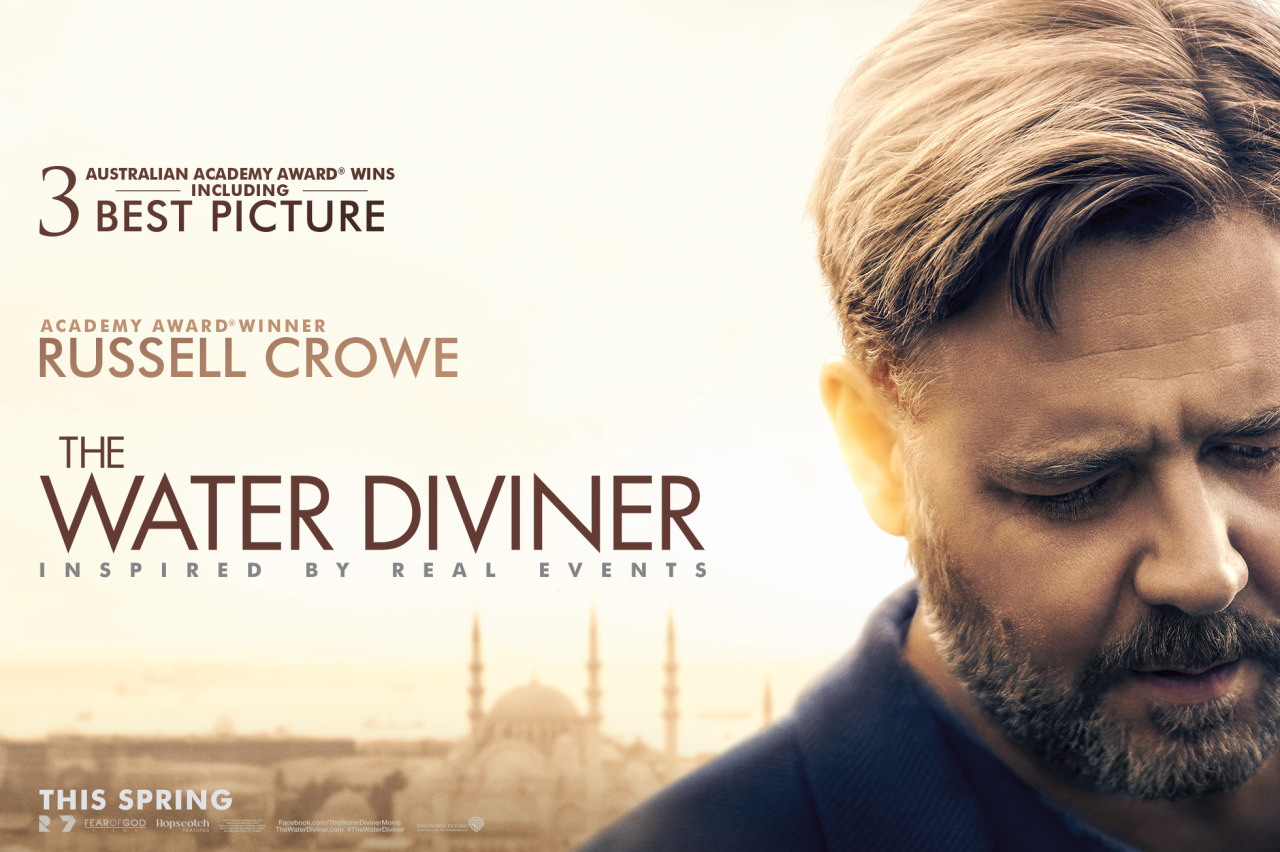
The Water Diviner

Posted on April 23, 2015 at 5:58 pm

B-
Lowest Recommended Age: Mature High Schooler
MPAA Rating: Rated R for war violence including some disturbing images
Profanity: Brief language
Alcohol/ Drugs: Drinking, smoking
Violence/ Scariness: Wartime violence with battles and terrorist attacks, characters injured and killed, graphic and disturbing images, suicide, mercy killing
Diversity Issues: A theme of the movie
Date Released to Theaters: April 24, 2015
Amazon.com ASIN: B00WFNPPVY
Copyright 2015 Warner Brothers

Before it detours into not one, not two, but at least three preposterous Hollywood twists, “The Water Diviner” is an absorbing drama about Joshua Connor, an Australian farmer (Russell Crowe, making his directing debut as well) who travels to Turkey to find the remains of his three sons, all killed in the battle of Gallipoli, so he can bring them home for burial. We first see Joshua dowsing for water. He selects the spot he is drawn to, then digs with skill, focus, and determination, until he hits water. He has a well.

He returns to the house where his wife tells him to read a bedtime story to their three sons. It is too much for her to accept that they are long gone to war and killed in battle. Finally, she is so overwhelmed by grief that she commits suicide. Joshua insists that she be buried in the church cemetery, and then leaves to bring their sons home and bury them next to her.

Crowe’s greatest asset as a director is himself as leading man, and his performance is powerful, with a muscular masculinity and sense of honor, but shredded by the loss of his family and by his fears that he may be responsible because he “filled their heads with heroic nonsense.” The clash of cultures and the unthinkable tragedies are intriguing. The best part of the film is the depiction of the way the defeated Australian command must work with the Turkish nationals to bury their dead as respectfully as possible, the tensions are inevitable. Was the end of the battle a “retreat” or an “evacuation?” “You killed my sons.” “You sent them. You invaded us.” Both, of course, are right. When one says, “I don’t know if I forgive any of us,” the other side has to agree.

“Four years ago you’d have given me a VC for shooting that bastard,” one of the ANZAC (Australian/New Zealand) officers growls. “That bastard” is Major Hasan (Yılmaz Erdoğan). The former enemies must work together on a task of unimaginable sadness and defeat, creating a sacred burial ground for thousands of dead soldiers, who will remain for eternity in the site of their defeat. “This is the first war anyone has given a damn,” to do even that much, says an ANZAC officer. Previous war dead were piled into pit graves with the horses.

Joshua finds a place to stay — or rather, it finds him, as a boy takes his bag and runs to the home where his mother and uncle have established a small hotel. They do not want an Australian there, but they need the money, so they gingerly make him welcome. The boy’s mother, Ayshe (Olga Kurylenko), is still insisting that her husband will return from battle, to keep her son’s hope alive more than her own, and perhaps also to protect her from the pressures put on a single mother to remarry. Joshua is forbidden from going to the burial ground, but Ayshe helps him find a way. Once he gets there, no one wants to help him. But “because he is the only father who came looking,” they grudgingly allow him to look through the piles of bones.

And then it starts to get Hollywood. The water diviner somehow uses that same skill to locate the remains of two of his sons. And then it may be that the third is still alive. The last section of the film takes a turn that even Indiana Jones would find daunting and a romance even Nicholas Sparks would find improbable. It is too bad that the earlier part of the film’s appreciation of conflicts and complexity is followed by a fairy tale ending.

Parents should know that this movie features wartime scenes of battle violence and terrorism with some disturbing and graphic images and a suicide and a mercy killing. Characters are wounded and killed. In addition, it includes some strong language, domestic abuse, sexual references, drinking, and smoking.

Family discussion: What did Joshua and Major Hasan have in common? What do we learn from the flashback to the sandstorm? What should Arthur have done?

If you like this, try: Gallipoli and “A Very Long Engagement”
Related Tags:


Drama Inspired by a true story Movies -- format War

Danny Collins

Posted on March 19, 2015 at 5:50 pm

B+
Lowest Recommended Age: Mature High Schooler
MPAA Rating: Rated R for language, drug use and some nudity
Profanity: Very strong language
Alcohol/ Drugs: Drinking and drugs
Violence/ Scariness: Tense family confrontations, illness
Diversity Issues: None
Date Released to Theaters: March 20, 2015
Date Released to DVD: June 29, 2015
Amazon.com ASIN: B00UZJO7UA
Copyright 2015 Big Indie Pictures

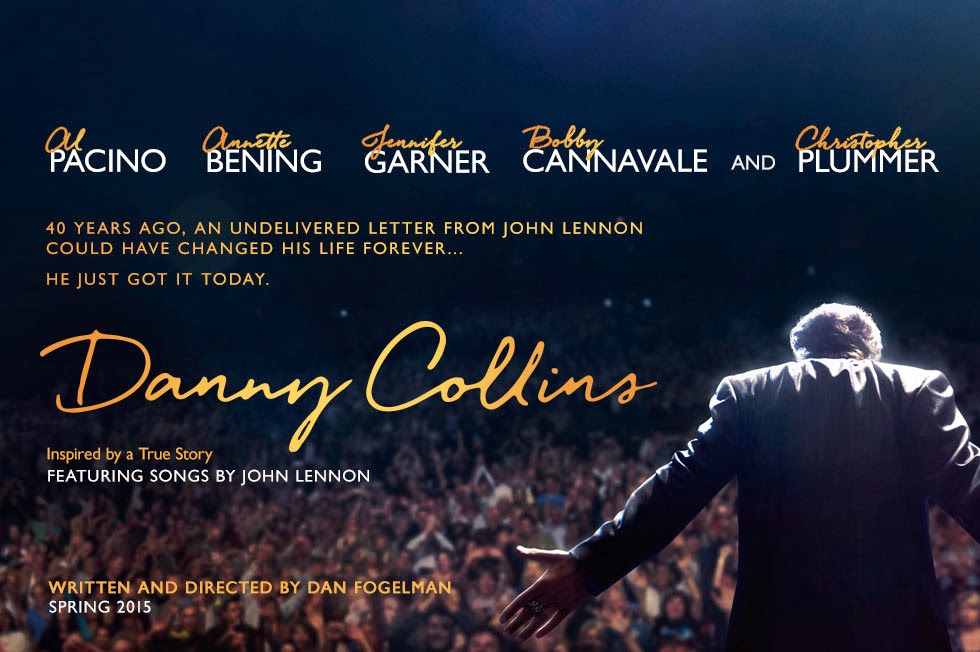
Movie stories often begin with the hero or heroine having everything and then losing it or having nothing and then finding it. But some of the best combine them both, as Writer/director Dan Fogelman (“Cars,” “Tangled,” “Crazy Stupid Love”) has with “Danny Collins,” a heartwarming story of a one time rock star (Al Pacino) who can fill a stadium with his baby boomer fans but has an empty life that even a hot young fiancee and constant partying cannot hide.

And then he discovers that 40 years ago, when he admitted in an interview that he was afraid of becoming successful because it might impair his integrity as an artist, John Lennon sent him a letter saying that it did not have to happen that way and encouraging him to call. The letter never reached him until four decades later, when Collins’ longtime manager and best friend (Christopher Plummer) found it from a collector and bought it as a surprise birthday gift. (This part of the story is inspired by a real-life musician in the UK who did find out 34 years after it was written that John Lennon had sent him a letter almost identical to the one in the film, as we see in the closing credits.)

The letter serves as a wake-up call, instantly connecting Danny to the musician he once was. He cancels his tour, breaks up with the fiancee, and orders his private plane to New Jersey, where he moves into a suburban hotel managed by Mary (a deliciously crisp Annette Bening). He buys a new piano and has it delivered to his hotel room so he can start composing. And he reaches out to the son he has never met (Bobby Cannavale), who lives in New Jersey with his pregnant wife (Jennifer Garner) and young daughter (the delightful Giselle Eisenberg).

It is a treat to see the flamboyant rock star being checked into the numbingly generic hotel by an agog college student (Melissa Benoist of “Whiplash” and the Supergirl TV series) as stunning a transition for him as if he was Alice through the Looking Glass. Pacino is not entirely convincing as a rock star on stage but his genially raffish charm is as endearing to us as it is to the civilians he charms along the way. The highlight of the film is what he calls his “patter” with Mary, a sparkling throwback to the kind of romantic banter that might have been tossed back and forth by Tracy and Hepburn.

Immune to his charm, at least at first, is his son, even after Danny performs some rock star magic to help the family. But that’s what movies are for — to let us see Danny overcome his son’s efforts not to give in, all to the tune of some of Lennon’s most moving songs. And to wonder what we might do differently if we got a long-lost letter from Lennon.

Note: Danny’s catchy song, “Hey Baby Doll” was written by INXS replacement frontman Ciaran Gribbin, selected in a competition with top Hollywood songwriters for a tune that could sound like a real hit from the 60’s.

Parents should know that this film includes rock star behavior including sexual references and nudity, drinking and drug use, and very strong language, as well as family issues including abandonment and illness.

Family discussion: Who would you most like to get a letter from and what would you want it to say? Why did getting the letter make Danny decide to change his life? How often do get to enjoy patter?

If you like this, try: “One Trick Pony” and “The Last Waltz”

Related Tags:


Comedy Drama DVD/Blu-Ray Pick of the Week Family Issues Inspired by a true story Romance

Trailer: A Royal Night Out

Posted on March 2, 2015 at 6:30 pm

It’s like a real-life “Roman Holiday.”  According to this film, on the night victory was declared in WWII, Princess Elizabeth (now Queen Elizabeth II) and her sister, Princess Margaret were given permission by their father (the “King’s Speech” guy) for an incognito night of celebration.  It looks like a lot of fun.

Related Tags:


Inspired by a true story Trailers, Previews, and Clips

Black or White

Posted on January 29, 2015 at 5:58 pm

Copyright 2014 Relativity

Writer-director Mike Binder sure likes to get Kevin Costner drunk. As in his uneven but impressive “The Upside of Anger,” Binder once again has Costner playing a man who is a little lost and usually shnockered, a role well suited for Costner’s loose-limbed, naturalist wryness. Binder’s strengths are evident here. He creates complex, unhappy characters who are articulate without being artificially quippy. He casts superb actors and gets outstanding performances (“The Upside of Anger,” flawed as it was, is worth seeing just to watch Joan Allen work through so many variations on ferocity, loss, and doubt). And in this film, he takes a highly charged situation that could easily be overly melodramatic, formulaic, or polemical and gives it nuance and dignity. No matter what your inclination on the custody dispute over a biracial child at the center of the film, you will rethink it.

Costner plays Elliot, a lawyer who learns in the first moments of the film that his wife Carol (Jennifer Ehle) has been killed in a car accident. She has had most of the responsibility of caring for their granddaughter Eloise (Jillian Estell), who has lived with them since she was born, because her mother, then just 17 years old, died in childbirth.

Elliot is so overwhelmed by loss that the next morning he takes Eloise to school without telling her what happened. He has no idea of what the morning routine is, how to fix Eloise’s hair, or even where exactly the school is located.

That afternoon, with some bolstering of his courage via alcohol and his law partner, Elliot finally tells Eloise that her grandmother has died. He is committed to continuing to care for her. But her other grandmother, Rowena (a terrific Octavia Spencer) wants to have a bigger role in Eloise’s life. She files for joint custody. Her brother Jeremiah (Anthony Mackie), a successful litigator, tells her that if she wants to succeed, she will have to have a more powerful argument than her rights as the child’s grandmother. She will have to claim that Elliot is not a suitable guardian for a black child. “Do you want what is best for the child?” asked Jeremiah. “Then has a problem with black people.” Elliot’s counsel urges him to be aggressive. “Are you okay getting ugly?”

Rowena and Elliot respect, even have some affection for one another. Each knows the other is far more than the extremes alleged in the court filings. But the system is not set up for anything but extremes. Jeremiah is successful in getting the case before a black woman judge (the excellent Paula Newsome), and both sides think she will be inclined to give Eloise to her black relatives.

But both sides are vulnerable, and, as the judge has warned them, once a child is in the system it is within her power to decide that neither grandparent should have custody. Elliot and Rowena both understand that the litigation will bring them to the brink of mutually assured destruction. But things heat up. Rowena brings in her son Reggie (André Holland), Eloise’s father and amends the suit to call for full custody, saying Elliot is not fit to raise Eloise because he drinks.  While his legal claim is stronger on paper because he is her parent, his claim is also weaker because he has a record of drug use and criminal behavior and has never cared for or even spent time with his daughter. We see the contrast between Elliot’s big, luxurious, but empty house and Rowena’s crowded, chaotic, but loving home. Elliot is white and male. Can he understand Eloise? Both of Eloise’s grandparents are still struggling with their failures as parents the first time around as well.

Binder continues to be better with the small moments than the big ones, and there are affecting one-on-one moments with Reggie and his mother and uncle, and with Elliot and Rowena. But he still has trouble with finding a good way to end a story, and he has no idea of how to write for a child. Estell has a likeable screen presence, but is asked to deliver some unforgivable lines that are far too idealized and age-inappropriate for her character. It is too bad that a film that shows exceptional sensitivity to its adult characters so badly fails the girl on whose behalf they are fighting.

Parents should know that this film includes some strong language, including racist epithets, drug and alcohol abuse, and sad offscreen deaths.  The family issues and custody battle may be upsetting to some viewers.

Family discussion: If you were the judge, where would you put Eloise? Why does Duvon write so many papers? Why does he learn so many languages?

If you like this, try: Clover and “Losing Isaiah”

Related Tags:


Courtroom Drama Family Issues Inspired by a true story Race and Diversity

Featurette: “The Good Lie” the Faith of the Lost Boys of Sudan

Posted on October 7, 2014 at 11:37 am

The Good Lie” is a moving, inspiring story of Lost Boys (and a girl) from Sudan to immigrate to the US, a must-see for middle and high schoolers and their families.  This featurette takes us behind the scenes and focuses on the role that faith plays in the lives of these courageous survivors.

Related Tags:


Drama Inspired by a true story Spiritual films
THE MOVIE MOM® is a registered trademark of Nell Minow. Use of the mark without express consent from Nell Minow constitutes trademark infringement and unfair competition in violation of federal and state laws. All material © Nell Minow 1995-2026, all rights reserved, and no use or republication is permitted without explicit permission. This site hosts Nell Minow’s Movie Mom® archive, with material that originally appeared on Yahoo! Movies, Beliefnet, and other sources. Much of her new material can be found at Rogerebert.com, Huffington Post, and WheretoWatch. Her books include The Movie Mom’s Guide to Family Movies and 101 Must-See Movie Moments, and she can be heard each week on radio stations across the country.

Website Designed by Max LaZebnik