There are always these first and only stories, where it’s like, the first black person to do this, or the first woman to do this, and we need those stores. They are super inspirational. But the thing that’s so exciting to me about this is that none of these women had to be the first or the only. Like the first white computer pool was five women, the first black computer pool was five women. Over time, each of those pools grew tremendously to prove over and over that women are very adaptive and have the right temperament, the right skill set, the right intellectual firepower for this work. That’s truly confidence-inspiring, because you don’t have to face the objections of like, “Yeah, well, there’s just one woman. We know that most women are like this.” It’s like, No, no, no. This is a revolution. The technological revolution that was the space race was carried out with two women and their mathematical talents, because of other women.
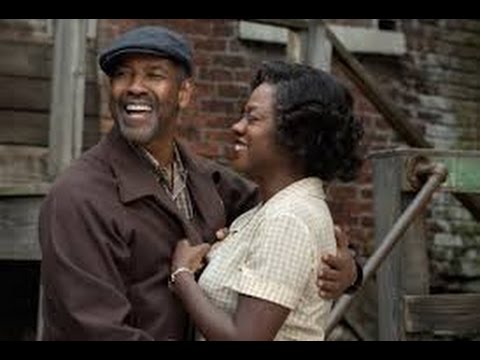
August Wilson’s towering play, the winner of the Tony and Pulitzer prizes, has been magnificently put on screen by director/star Denzel Washington, who won a Tony for the play’s 2012 Broadway revival, and who works with much of that show’s cast in this version.
Wilson’s own screenplay wisely avoids the usual impulse to “open up” a play by adding locations and reducing the dialogue. The best known of Wilson’s ten-play “Pittsburgh cycle,” one for each decade of the 20th century, “Fences” is a story of epic scope and mythic resonance. The gorgeous dialog makes poetry out of the kind of talk we hear around us all day: the jokes, mock insults, and bragging of co-workers and long-time friends, the intimate humor of a longtime couple, anguished confrontation, bitter recollection, back-and-forth that skims the surface while the emotions roil and explode below. To the extent that it preserves the artificiality of a theatrical performance, it emphasizes its ambitious reach. If a play has a character named Gabriel (Mykelti Williamson) who is cognitively impaired following a war injury, who carries a trumpet, and who constantly reminds his brother of a betrayal and survivor guilt, if the tile “Fences” is literal and metaphorical and the character building the fence talks about keeping out the actual angel of death, the audience must recognize these signals of serious, profound, dramatic engagement with eternal themes and be grateful for the chance to be a part of it.
Washington plays Troy, a garbageman who was once a star of a Negro Leagues baseball team but was too old to cross over into the Major Leagues the way Jackie Robinson did. He still keeps a bat and ball in the back yard. He still holds onto the bitterness and dashed dreams of his years as a player. But now, he just wants a promotion to driver, a job only held by white men where he works.
His wife is Rose (Oscar-winner Viola Davis, who also won a Tony for her performance in the revival). We first see Troy bragging to his best friend Bono (Stephen McKinley Henderson) about how he laid down the law when he met Rose, telling her he was not interested in marriage. She laughs indulgently and affectionately, but makes it clear that it was quite the contrary. “I told him if he wasn’t the marrying kind, then move out the way so the marrying kind could find me.”
Troy and Rose have a son in high school, Cory (Jovan Adepo), a talented football player. Rose sees football as a chance for Cory to attend college, and Cory desperately wants to play. But Troy refuses, saying “The white man ain’t gonna let you get nowhere with that football noway.” His mind and spirit have been so constricted by what he has faced that he cannot bring himself to believe that real opportunity exists for Cory. Or perhaps he cannot face the possibility that Cory will do what he could not.
Troy also has an older son, Lyons (Russell Hornsby), with a woman he never married. Lyons, a musician, asks Troy for a loan, mostly as a way to find a way to talk to him, to find a way to see if he means anything to him. Troy tells him he should not need to ask for money, and Lyons responds, “If you wanted to change me, you should’ve been there when I was growing up.”
And Troy worries about his brother Gabriel, who lived with Troy and and Rose in a home they bought with his disability money, but who has moved down the street because he wants more independence. Troy feels guilty for not taking care of him, and for living in a house he would not have been able to afford but for his brother’s disability.
And so, he makes a bad decision that will shatter his family’s foundation. The scene where Davis goes from disbelief to shock to fury will be used for decades in acting class, but she is just as impressive in the movie’s final moments. While Troy occupies much of the screen time and dialogue, it is really Rose who is the heart of the story. Troy can brood, but cannot change. He can hurt, but he cannot heal. He is so damaged that he cannot offer his sons love or respect. But see Rose’s strength. Her resolve is not grounded in compromise or concession. Her soul has expanded to encompass all of life’s contradictions. And it is the great gift of this film that it expands ours, too.
Parents should know that this film includes themes of racism and adultery, some strong language, sexual references, and a sad death.
Family discussion: Do you agree with Rose’s choice? Why didn’t Troy want Cory to play football? What do we learn from Troy’s relationship with Gabriel?
If you like this, try: “A Raisin in the Sun” and “Desire Under the Elms”
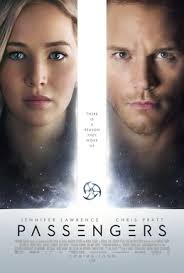
“Passengers” is beautiful to look at, a pretty story about pretty people in a pretty (outer space) setting, but it cannot overcome the ick factor of its premise.
Everyone’s favorite boy we wish lived next door, Chris Pratt, plays a likeable ordinary guy who works with his hands named Jim Preston, one of 5000 passengers and 250 crew in a spaceship on a hundred-year journey to a hospitable colonized planet. Like the spaceship in “Wall-E,” it is set up with every luxury, from sushi restaurant to a genial robot bartender (Michael Sheen). The people on board are in suspended animation for a hundred years, to be awakened four months before arrival, to enjoy the ship’s amenities and prepare for their new home. The ship is gorgeous, though I am not sure how practical it is.
But somehow Jim awakens 90 years early and there is no way to return to his hibernation. He is alone on the spaceship and his plan to emigrate to the new planet is not going to happen. Instead of being a pioneer in a fresh, optimistic new world, he is doomed to spend the rest of his days stranded, sure to die before anyone else on the ship is awake. The ship’s help kiosks briskly inform him that malfunction of the hibernation units is impossible, a reminder of the Titanic’s “unsinkable” hubris. He tries to send a message to the home base on earth, only to learn that it will be more than 30 years before he can get an answer.
So, he basically turns the spaceship into a man cave, living in dirty sweats, growing a beard, drinking, and playing one on no one basketball and one on avatar dance video game. Finally, almost mad with loneliness, he starts looking at the files of the 4999 people still sleeping on the ship, and finds himself captivated with one of them, a journalist from New York with the fantasy name Aurora Lane (Jennifer Lawrence). After many discussions with the robot bartender, he can no longer help himself. He knows it is wrong, but he wakes her up, and he lets her think it was due to the same malfunction that woke him.
Decades ago, movies used to have scenes where the guy grabbed the girl and she beat her fists helplessly against his chest, crying, “I hate you!” until he forced her into a passionate kiss, after which she melted into his arms. These were mostly romantic comedies, but we saw some of this and worse in drama, too. Remember Rhett carrying Scarlett up the stairs in “Gone With the Wind,” and 30 years later, Laura falling for her rapist, Luke, on “General Hospital.” (Also see: Zeus and Europa, the Sabine women, the silent classics “The Sheik” and “Son of the Sheik”) But that just doesn’t work any more.
Aurora is entirely a fantasy figure. Even her nudity is highly sexualized, where his is not. By taking away any shred of agency or consent the script sets up an insurmountable obstacle to any kind of relationship for Jim and Aurora, which it makes the fatal mistake of treating as surmountable. There’s the getting-to-know-you part, and then she she-learns-the-truth part and then the not-talking-to-him part, and then the work-together-or-everyone-dies part, but nothing can really support the idea of the romance it tries to persuade us is happening.
Parents should know that this film includes extended sci-fi action and peril, sad death with characters injured and a sad death, some disturbing images, issues of predatory behavior and consent, brief strong language, alcohol, sexual references and situations, and nudity.
Family discussion: Why did Aurora make that choice at the end of the film? What would you do if you were left alone?
If you like this, try: “Gravity” and “The Martian”
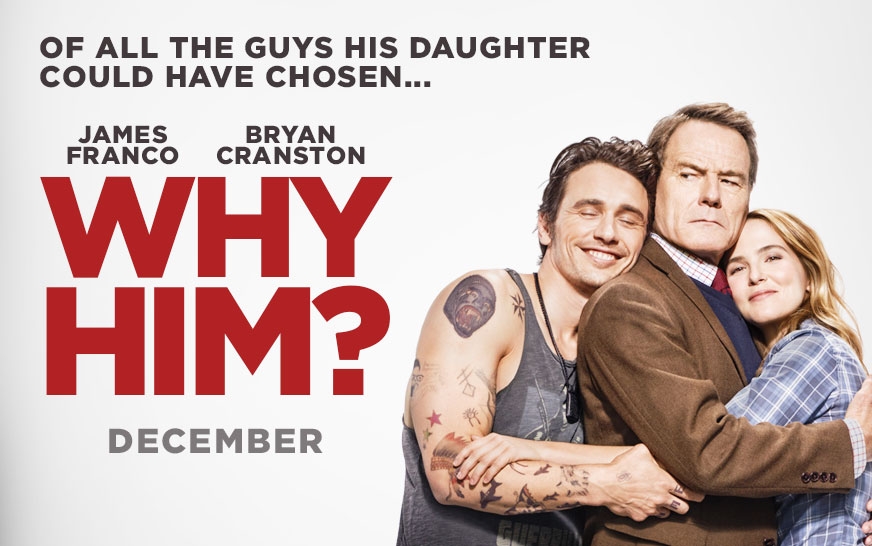
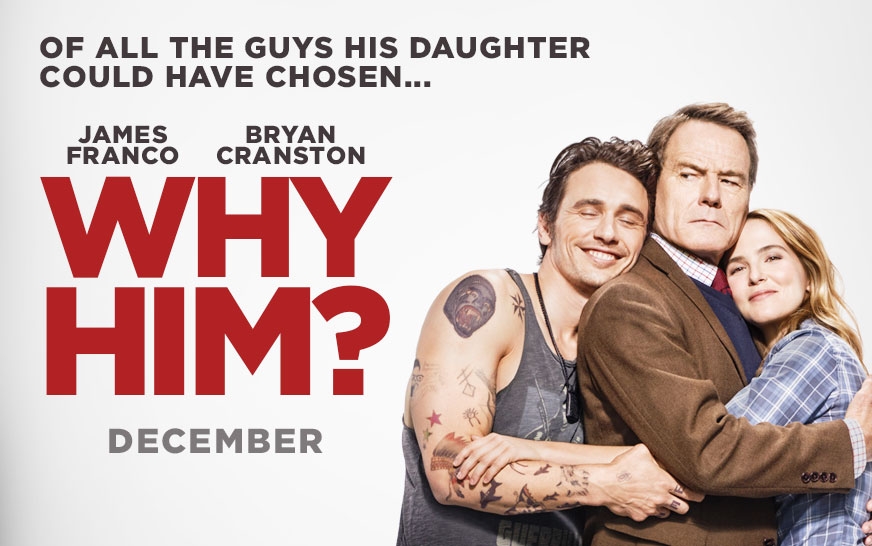
If you go to see “Why Him?” you will ask yourself, “Why Me?”
Some of the people behind “Meet the Parents” had the idea of basically making the same movie all over again. Of course they made it all over again twice with the sequels, but hey, this time let’s try a twist! How about if the dad is the normal one and it is the prospective son-in-law who is outrageous! And maybe if we have extended scenes of Bryan Cranston and Megan Mullally sitting on toilets, and enjoying it, and the cast getting drenched in moose urine, no one will notice that it is not actually funny. Believe me, I noticed. Over and over and over again.
Cranston plays Ned Fleming, a nice guy who loves his family. We first see him celebrating his birthday with his wife Barb (Mullally), teenage son Scotty (Griffin Gluck), and the employees of his printing business, who are like family, too. Ned’s daughter Stephanie (Zoey Deutch of “Everybody Wants Some!!”) Skypes in from her dorm room at Stanford. Her boyfriend, not realizing anyone can see her, comes into her room and takes his clothes off, thus letting Ned know, in front of all his friends, that she has a boyfriend with whom she has sex. So we’re in that skeezy category of films going back to “Take Her She’s Mine” and “The Impossible Years,” in which daddies are obsessed with their daughters’ sex lives.
It turns out that Stephanie’s beau is a daddy’s nightmare. Not only are they having sex, but Laird (James Franco)’s youth, sexuality, and wealth (he is a tech zillionaire) makes Ned feel emasculated and he hates not being Stephanie’s number one guy anymore. This come just as Ned has not told anyone that his business is doing poorly
The family goes to California to spend Christmas with Stephanie, and everything they learn about Laird just makes Ned feel more anguished. But have no feel — at some point following the moose urine and Japanese toilet jokes, there will be hugs all around.
Franco commits fully to the man-child Laird, and his charm and movie star smile makes up for some of the most appalling elements of the storyline and even gives us a hint of what Stephanie might see in him. Keegan-Michael Key adds some spark as Laird’s concierge/best friend, and there are a couple of clever lines. But disgusting and outrageous does not equal funny, no matter how much moose urine you pour onto it.
Parents should know that this film includes extremely crude and explicit humor including sexual references and situations and bathroom jokes, very strong and crude language, drinking, drugs, comic peril and violence.
Family discussion: How does your family treat the people who date its members? How were Laird and Ned alike?
“Sing” is an often-adorable, often-puzzlingly off-kilter animated film about animal singers putting on a show despite many obstacles, for the love of music and performing. What’s best about the film is simple — seeing a wild assortment of animal characters sing an even wilder assortment of songs, everything from Lady Gaga to Frank Sinatra to Taylor Swift to Christopher Cross. It works every time, with a nifty score from Joby Talbot tying it all together. The story around it, though, keeps getting derailed.
The concept harks back to the musicals of the 1930’s — the old “let’s put on a show.” Koala Buster Moon (Matthew McConaughey) is a failing impresario who is about to lose his theater. He has a devoted assistant with an unfortunate habit of losing her glass eye. Even more unfortunate, the movie seems to think we will find that hilarious.
How about a singing competition! Great idea! Small problem — due to a mistake, the prize money has been vastly inflated and the invitations to participate widely distributed. Oh, well, on to the auditions! Hopefuls include a cynical mouse (Seth MacFarlane) who croons saloon songs, Ash, a punky hedgehog (Scarlett Johansson), a harried pig with dozens of children to care for (Reese Witherspoon), a strange pig named Gunter (Nick Kroll), Johnny, a teenage gorilla in a leather jacket and with a Cockney accent, (Taron Egerton), and Meena, a shy teenage elephant (real-life “American Idol” contestant Tori Kelly).
The singing is a delight and I was genuinely sorry that so many of the performances were just snippets. The same goes for the all-star cast, many of whom have just one or two lines. It never takes advantage of the animal setting and instead relies on overplotted backstories of the participants that are mostly a distraction, with one exception the Rube Goldberg contraption the mother pig creates to care for her children and oblivious husband while she is out singing. Johnny’s father leads a robbery gang, and they expect Johnny to act as lookout and getaway driver just when he needs to be at the theater. Ash has a boyfriend who does not realize how special she is. And Meena is just too shy to perform. The robbery sequence and subsequent visit to Johnny’s father in jail, a serious and scary fire, some predatory loan sharks, and that glass eye “humor” are all especially poor choices for a movie positioned for families with young children.
Parents should know that this film includes some slapstick humor, including a character whose false eye keeps popping out, criminal behavior involving a parent and teenage child, parent in prison, scary fire, business problems.
Family discussion: If you were going to perform, what song would you pick and why? What made Meena so shy and what helped her?
If you like this, try: “Zootopia” and “Despicable Me”