I’ve already written about great documentaries and feature films about the military to watch on Memorial Day. These recent documentaries about our 21st century conflicts give the military a chance to tell their own story. They are not pro-war or anti-war. They are pro-soldier.
The War Tapes Operation Iraqi Freedom was filmed by three soldiers on the front lines in 2006.
Restrepo This documentary tells the story of the deployment of a platoon of U.S. soldiers in Afghanistan’s Korengal Valley. The movie focuses on a remote 15-man outpost, “Restrepo,” named after a platoon medic who was killed in action.
Gunner Palace This film shows us the lives of soldiers from the 2/3 Field Artillery in a bombed-out former pleasure palace once belonging to Uday Hussein.
Bomb Hunters: Afghanistan The US Army’s 23rd Engineer Company is are charged with clearing routes in southern Afghanistan and disarming the military’s number one threat: IEDs.
Always Faithful Military dog teams are on the front lines of war in Iraq and Afghanistan. “Always Faithful” follows five young Marines and their four-legged partners.
Baghdad ER Like a real-life update on the kinds of facilities portrayed in “MASH,” this film looks at life and death at the 86th Combat Support Hospital, the U.S. Army’s premier medical facility in Iraq.
Post-traumatic stress disorder, or PTSD, affects almost 30 percent of the 834,467 Iraq and Afghanistan War veterans treated through the U.S. Department of Veterans Affairs. Consumed by anger and traumatic memories long after their return, soldiers often resort to drugs or suicide to end their suffering.
Filmmaker Laurent Bécue-Renard provides a searing account of how the disorder has affected veterans and their families in Of Men and War. The film offers an unparalleled look at the enduring consequences of PTSD and the role treatment can play in helping soldiers reclaim their lives. An Official Selection of the 2014 Cannes Film Festival, the documentary has its national broadcast premiere during the 29th season of POV(Point of View)on Memorial Day, Monday, May 30, 2016 at 10 p.m. on PBS. (Check local listings.)
Of Men and War, made between 2003 and 2014, begins with a scenic drive through California’s Napa Valley, where therapist and social worker Fred Gusman, who pioneered revolutionary PTSD programs at the Veterans Administration in the late 1970s, opened The Pathway Home residential treatment center in Yountville in 2008. The beauty of the surroundings stands in stark contrast to the intense inner turmoil suffered by the veterans arriving by van.
Bécue-Renard filmed the servicemen speaking for the first time about their experiences. Survival in a war zone required a hardened attitude—“Rage and anger carried me through everything,” says one veteran—accompanied by alienation even from those in their units. “He was there and then he was gone,” a soldier says of a friend killed during their deployment together in Iraq. “It’s hard being close to anybody because you know they’re going to leave any time.” These attitudes did not disappear when combat tours ended.
“The return to civilian life is not what they thought it would be,” says Gusman, Pathway’s lead therapist. One veteran says that he “woke up mad” and “took things out” on loved ones. “When you come back you feel like you should have died over there. It would have been a hell of a lot easier to just fall down over there and not get back up.” Something as ordinary as driving can cause severe distress; in the combat zone, a soldier explains, an approaching vehicle was always seen as potentially carrying a bomb. That fear returns if a car pulls too close to his in traffic.
The war resurfaces in nightmares and panic attacks. A sudden noise might trigger a flashback. Other times, all it takes is a disagreement with a spouse or an ambiguous look from a stranger. Then the groundswell takes over—all that was buried from the war boils up, and the veteran lashes out. “The day I came home from Iraq was the last time I saw my daughter,” says one soldier. “I was given a restraining order.”
The film underscores another problem: Seeking help for PTSD can be a difficult step to take. “What we have is embarrassing,” a soldier says. It makes him feel “small” and “defective.” Wives and girlfriends often feel helpless. “I’m scared he’s going to give up trying,” says one.
Bécue-Renard says his camera performed a significant role in the soldiers’ therapy. “They came to perceive the filming itself as an additional glimmer of hope. Consciously or not, the veterans began to sense that voicing their brutal experiences might uncover deeper meaning: Their stories might contribute to a greater public consciousness of the hardships veterans confront long after the war’s end.”
Of Men and War shows that for many veterans, recovery will be a lengthy process. Although therapists cite the necessity of forgiveness, one soldier, who killed a colleague by mistake, responds, “I think it would be really selfish for me to learn to forgive myself.”
“Of Men and War came out of a reflection on what was left unspoken by my grandfathers,” says Bécue-Renard. “They had died by the time I was born—but they had also staunchly refused to talk about their experiences from the First World War while they were alive. Of Men and War is my way of honoring them.
“It took 11 years between my first idea for the film—when the Iraq war began in 2003—and its completion in May 2014. I spent 14 months in the therapy center and returned many times in the four years that followed. Filming therapy was a way of acknowledging people who had decided to move forward with their lives. Some days I’d leave the therapy room overwhelmed. How was I to make sense out of this mess? How could I communicate it to an audience? I became convinced that from all this mud, I could eke out rays of light. In doing so, I could find meaning for the protagonists in Of Men and War as well as for its viewers.”
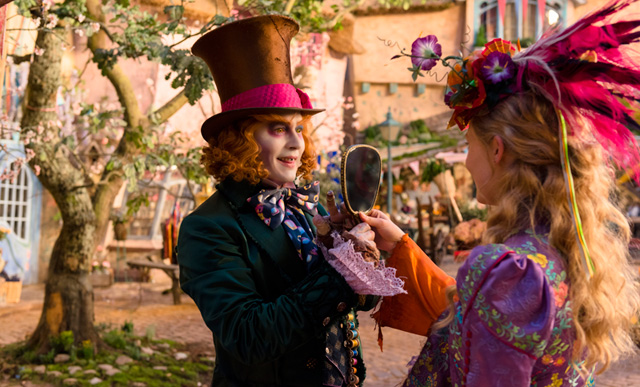
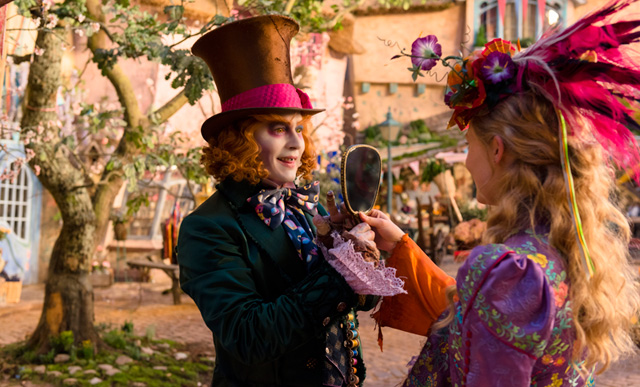
“Alice Through the Looking Glass” the movie has almost no relationship to Alice Through the Looking Glass, the book by Lewis Carroll in spirit, character, or storyline. That might possibly be all right if the spirit, character, or storyline were in any way worthwhile, but it is not. Gorgeous production design and some cool stunts do not make up for a story that begins as passable and ends as painful.
Tim Burton, who produced this one, previously gave us an “Alice in Wonderland” with an adult Alice (Mia Wasikowska) replacing the little girl of the story and spending way too much time in the above-ground “real” world as she attends a party, turns down a proposal of marriage from the odious Haimish (Leo Bill), and accepts instead the offer from his father to serve as crew on a merchant ship.
In “Looking Glass,” we first see Alice, now captain of the ship, in an exciting escape from pirates that show us her courage and love of adventure. But when the ship returns to port in London, she finds that Hamish’s father has died, leaving him in charge, and he refuses to let her go back to sea. In his home, she finds a mirror over a fireplace that is a portal back to Wonderland, led by the former caterpillar, now-butterfly (voice of of the much-missed Alan Rickman).
Having already imported the talking flowers, chess pieces, Tweedledum and Tweedledee, and the Jabberwocky from “Through the Looking Glass” into the first film, conflating the first story’s Queen of Hearts (the “Off with the head!” one) with the second story’s Red Queen (the chess one) this movie takes — but makes no use of — the first book’s characters like the Cheshire Cat and the White Rabbit, and then has a completely invented story about time travel.
This has many disagreeable aspects, but the worst is when it puts Sasha Baron Cohen as the embodiment of Time into a scene with Johnny Depp as the Mad Hatter and allows them to try to out-grotesque each other in a manner clearly intended to be charming. It is not.
Neither is the plot, which relies heavily on just the kind of treacly heartstrings-plucking backstories that Carroll would never have allowed, asking us to feel sympathy for outrageous behavior and affection for caricatures. The first film’s attempt to create a warm, devoted friendship between Alice and the Mad Hatter was rather ooky. In the sequel, we are asked to believe that she has returned to do whatever it takes to help him because they love each other so much.
To paraphrase the folks behind “Seinfeld,” in the Alice world, there should be no hugging and no apologizing — and no heartfelt professions of affection, especially when they are not in any way justified by the characters’ history with each other.
Alice is needed on the other side of the mirror because the Mad Hatter has found something that has convinced him that his family is still alive, and not killed by the Jabberwock as he had thought. Why is this so important? Is it because he misses them so? Not really. It is because he feels bad about his behavior and needs to see them again so he can be forgiven. The disconnect between the expressions of devotion and the narcissistic reality of behavior is disturbingly cynical. Alice decides the only way she can save his family is to go back in time to the Jabberwock battle, which means she has to retrieve the chronosphere from Time himself, and that leads to more time travel as she solves various not-very-mysterious mysteries and Time chases her to get it back. Not that any of it makes any sense, logically or emotionally.
The production design is imaginative and witty, but it is buried under a gormless, hyperactive mess of a film. The book is endlessly witty and imaginative and delightful with all kinds of wordplay, math puzzles, and chess references from Carroll (aka Charles Dodgson), a math professor. The movie wastes all of that opportunity. Look at the title — the movie should be about a reverse world, not a heist/time travel saga that only concludes you can’t change history. If I had the chronosphere, I’d use it to go back to the moment I sat down to watch this movie so I could go home.
Parents should know that this film has extended fantasy peril with many disturbing images, discussion of loss of parents, brief image of someone dying, and bullying.
Family discussion: If you could go back in time, what time would you pick? Why did the Hatter and the White Queen have a hard time telling their families how they felt?
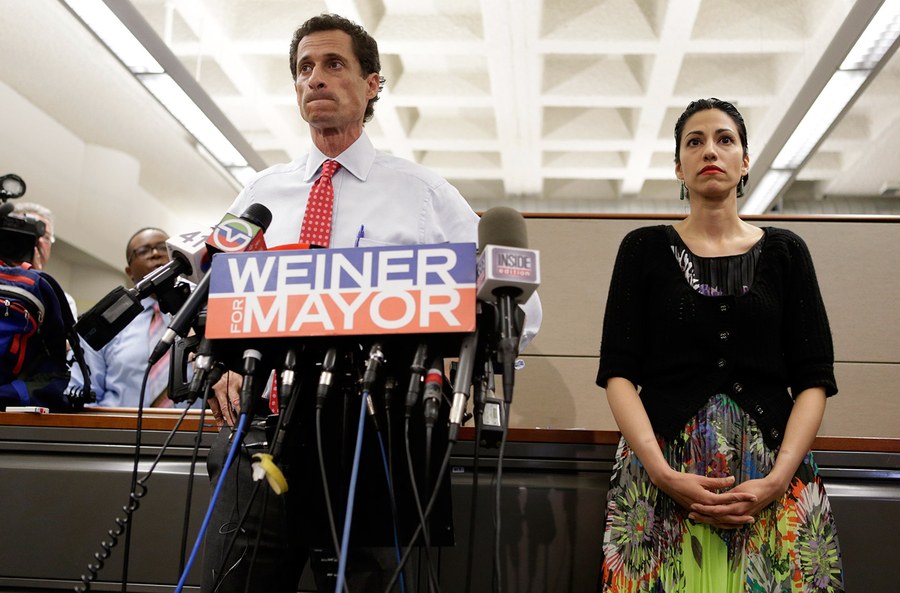
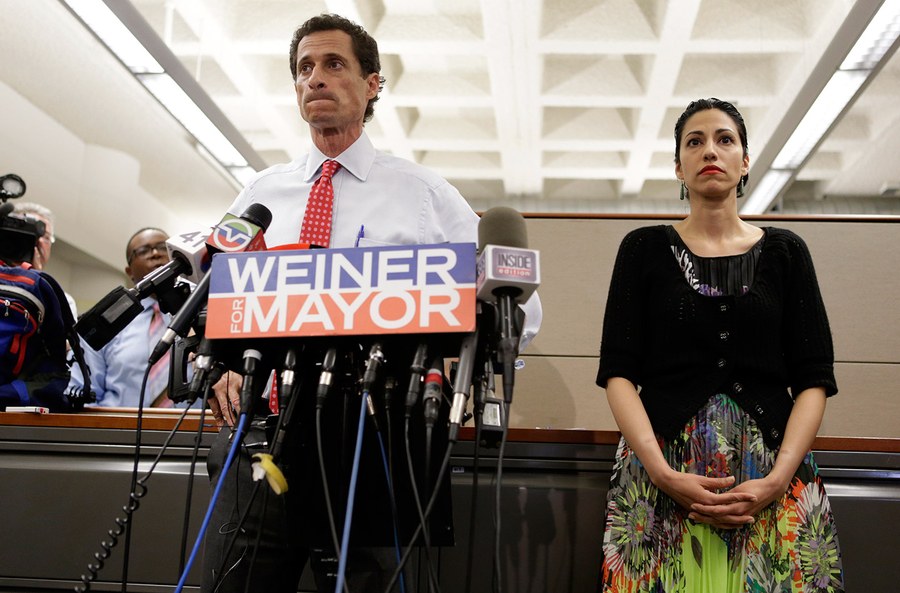
Copyright 2016 Motto Pictures“The name of a man is a numbing blow from which he never recovers.” This quote from Marshall McLuhan opens the sharp and illuminating new documentary about former Congressman and failed New York City mayoral candidate Anthony Weiner, whose political career was derailed by a sexting scandal that unfortunately resonated all-too-perfectly with a last name that is a sometime-slang term for the part of the body he was sharing online. “I did the thing,” Weiner says in what we see is a characteristic mix of candor and denial. And the only thing harder to understand is how he thought he could do “the thing” without bringing down his political career is the willingness of his anguished wife, Hillary Clinton aide Huma Abedin, to literally stand behind him.
And then there is the question of why they would agree to this very film, recording agonizingly painful moments, both public and private. Weiner agreed to allow access to his former staffer, Josh Kriegman and his co-writer/director Elyse Steinberg for what he clearly hoped would be a film about his comeback and instead documented yet another downfall.
Cue the montage of late-night hosts making jokes about scandal #1, when Weiner accidentally sent out what he meant to be a private tweet photo of his bulging underpants to the whole world, followed by archival footage of him insisting he would not resign from Congress, followed by his resignation.
And then, what he saw as his comeback. “To clean up the mess I had made by running for mayor was the straightest line to do it.” He does not want to “live in this defensive crouch.” And yet, he acknowledges, “I lied to them, I have a funny name, and they don’t do nuance.”
While some people resist the prospect of “a punchline as a mayor,” he was ahead in the polls, with a group of bright, dedicated, young staffers. We see Weiner at his best, reaching out to voters and contributors, marching in a parade, passionate about the issues. And then comes scandal #2, the one where he texted nude photos to a young escort known as “Sidney Leathers,” using the name “Carlos Danger.” The second-saddest image in the film is the stricken face of Weiner’s campaign communications director as she must ask him whether he plans to deny the latest round of allegations, struggling with the deep ickiness of the situation on the personal and professional levels.
This movie does not attempt to explain why Weiner would undertake such behavior when he had to be aware of the professional and reputational risks, or why his wife, who clearly hates any kind of public exposure, stays with him, even though, as she says at one point, it is a nightmare. But the superbly edited film, with extraordinary intimate access based on deep trust, has a lot of insights about celebrity culture, media, and what we expect from politicians. Inevitably, the story of the frog and the scorpion comes up. Why do we make decisions we know will doom us? Is it our nature? And who is the frog and who is the scorpion in American politics, media, and culture? This movie suggests that the American electorate may be both.
Parents should know that this film includes strong language, material concerning sex scandals, some brief graphic images, and crude references.
Family discussion: Would you vote for Anthony Weiner? How much should a candidate’s private life matter in considering his or her suitability for office?
If you like this, try: the political documentaries “A Perfect Candidate” and “The War Room”