Copyright 2015 IFC Films Comedies, especially dark ones, have a lot of freedom when it comes to narrative logic, but the emotional logic still has to ring true. No matter how crazy the storyline gets, the way the characters respond to it has to make sense, and that is where “The D Train” goes, well, off the rails.
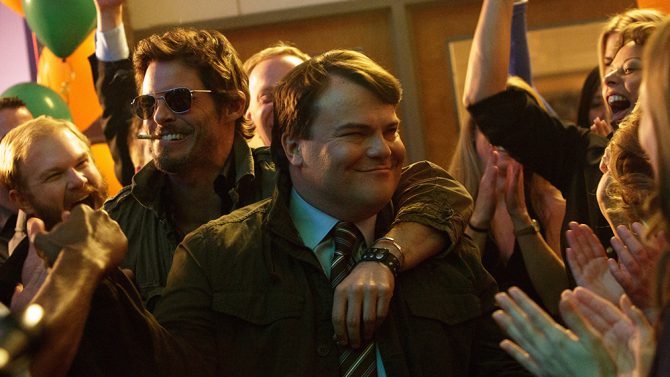
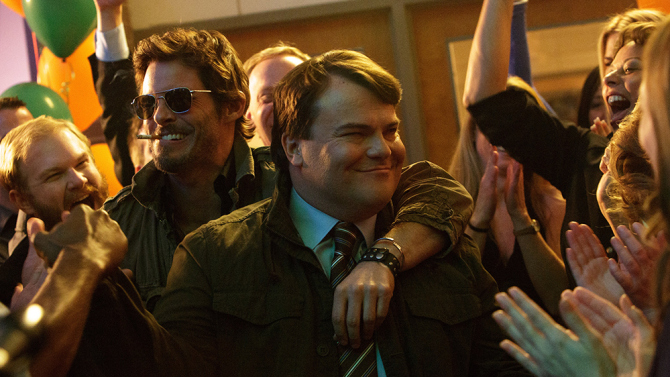
Jack Black plays Dan Landsman, who is helping to organize his high school’s 20th reunion. He keeps insisting he is the chairman of the planning committee, but none of the other members think he holds that title, even though he is the only one who knows the password to the reunion’s Facebook page. Dan organizes their meetings, rearranging the desks in the school library and setting up the phones to call the alumnae and encourage them to attend. He has a laminated sign with suction cups to stick on the door to make sure they are not disturbed. This reunion matters tremendously to him. He is married to a classmate (Kathryn Hahn) and seems stuck in high school, still hoping to find a way to be one of the popular kids and have a cool nickname.
Late one night, he sees a commercial for sunblock starring another classmate, Oliver Lawless (James Marsden). Dan decides that this means Oliver is a celebrity, and that if he can persuade him to attend the reunion, everyone else will want to come, too. So he lies to his tech-phobic boss (Jeffrey Tambor) to wrangle a business trip to LA, but makes it sound so promising that the boss insists on coming along.
In LA, Oliver is at first not even interested enough to be puzzled by Daniel’s attention. But then he begins to warm to Daniel’s enthusiastic approval. They have a couple of very debauched nights, especially the second one. What happens in LA does not stay in LA, and the fragility of Daniel’s most fundamental sense of himself is revealed. When Oliver does show up for the reunion, Daniel begins to unravel.
Marsden, always underestimated as an actor, is superb in this role, fully embracing the character’s darkness, narcissism, self-loathing, and vulnerability. But Black does not have enough to work with to make Daniel sympathetic enough for us to want him to succeed or evil enough for us to want him to fail.
Parents should know that this film has extremely strong and crude language and very explicit sexual references and situations, drinking, smoking, and drug use.
Family discussion: Why was the reunion so important to Daniel? Why was Daniel’s admiration (and his debauching) so important to Oliver?
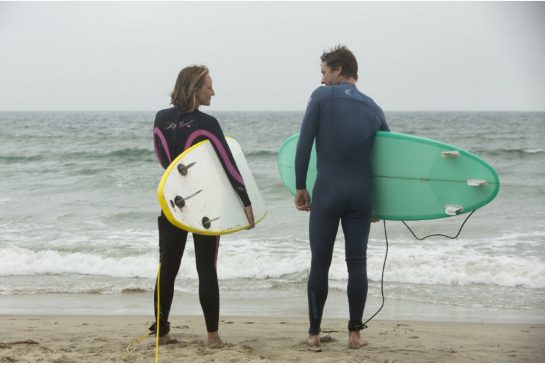
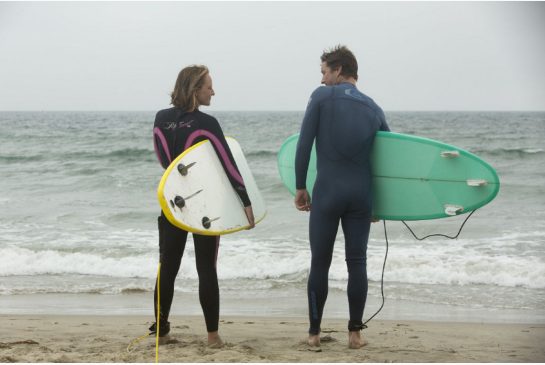
A surf bum named Ian (Luke Wilson) is explaining the physics of the interaction between surfboard and wave: it’s an inanimate object in an ever-changing environment. One doesn’t move. One never stops moving in powerful and highly unpredictable ways. And that is also the story of the woman who is not quite listening to Ian’s explanation.
Oscar-winner Helen Hunt writes, directs, and stars in “Ride,” the story of Jackie, an overprotective Manhattan mother whose son, Angelo (Brenton Thwaites) flees for California to surf. Her plan was for him to start college just 85 steps away from the apartment that they share, constantly calling back and forth to each other rapid-fire as they work on their laptops. He feels claustrophobic and over-managed, so when he visits his father in California he decides to stay. Jackie finds out when she visits his dorm to make his room more homey.
She follows him out to California and when he does not want to talk to her, the only way she can think of to stay close to him is to learn to surf. And so we will see her lose or relinquish everything she thought was essential to who she was: her black Manhattan editor wardrobe, her constantly buzzing phone, her willingness to be perpetually available to handle crises at the office, her reluctance to meet her ex-husband’s new family, the intensity of her connection to her son, and the equal intensity of her refusal to rely on anyone but herself. She has been an inanimate object in an ever-changing environment. Can she adapt?
Hunt’s script is clever and warm-hearted. As with her previous film, Then She Found Me, loosely adapted from novel by Elinor Lipman, the film explores the challenge of being a loving and supportive mother to an adult or almost-adult child while being a person at the same time — and letting the child be a person, too.
After a short introduction, where we see her sitting on the other side of her then-preschool son’s bedroom door all night, tiptoeing out of the way so he won’t see her when he gets up to go to the bathroom, we see them just before he is supposed to start college. He repeatedly asks her for help with his story, but she is an experienced editor who has worked with nervous authors for many years and she knows better than to do the work for him. “It just has to be surprising and inevitable,” she tells him. And clearly, that is advice that Hunt the screenwriter has taken to heart as well.
She has a great sense for writing say-able dialog that sounds smart and believably witty while letting us know who the characters are through what they say and how they say it.
Parents should know that this film includes strong language, sexual references and situations, drinking, and drug use.
Family discussion: Did the end of this story feel both inevitable and surprising? What will happen next?
Interview: Jonny Campbell, Director of J.K. Rowling’s “The Casual Vacancy”
Posted on May 7, 2015 at 12:53 pm
Copyright 2012 Little BrownJ.K. Rowling’s first book for adults was the dark, sometimes savage story of small town politics, The Casual Vacancy. The title refers to an elected office that is vacated before the term is up, which in this story occurs in Pagford, a small, cozy-looking English village. But its inhabitants are miserable. The town is filled with deceit, selfishness, betrayal, cruelty, and a government that alternates between negligence and incompetence for the poor and highly effective protection for the privileged.
I spoke to director Jonny Campbell about the two-part miniseries adaptation now appearing on HBO, which Slate’s Kay Waldman calls “infinitely better than the book.” At times melodramatic, at time satiric, at times comic, at times tragic, the story follows characters who are often desperate and always trying to protect themselves from hurt and loss.
J. K. Rowling called this story a comic tragedy or a tragic comedy. So how do you as a director signal to the audience what it is that they are seeing, especially since everyone is familiar with her very different Harry Potter books?
The screenplay and the story tell me what I’m supposed to convey to the audience and quite honestly I take great pleasure in the fact that sometimes the tone can be inconsistent, different. Tragic comedy — you don’t get much more extreme than that. People write articles and pieces and analyses of the show, criticisms, features, whatever, and you start to get a picture of how people receive it. I read one earlier today which said it was totally inconsistent and I was left not quite knowing what to feel at the end… Isn’t that brilliant?
For me the tone is the way I like to tell the story. but based on the script. I don’t try and spoon feed it to people. You need to leave people to make up their own mind about the character, rather than dictating and telling people. Now I’m not trying to claim that this is perfect or this is an in-depth insight into the myriad of characters. It just wouldn’t be possible to do that in three hours. What we did try and do is let each character be there on a need to get to know basis. So you kind of stir in the characters as and when you want to turn a new chapter or when the story develops and you feel the audience can withstand yet another new face and we are talking about not less than 30 characters here, you add them in. If people think it’s inconsistent I see that as a strength. Life is full of variation and equally at the end you hope people are moved. If some people are left floundering going, “I’m not quite sure what I’m supposed to feel,” that’s fine too.
You’ve got a community of people in Pagford that are living cheek by jowl. The danger is it can become a bit soapy. It’s very much my intention to try and not let it do that because while these people’s lives at the end of the book will still keep going, like the end of the movie you know you want to make people aware that they have stopped, the end of the story is here. And the other thing to say is one of J. K. Rowlings’ intentions in writing this was she wanted to write a contemporary novel which had the sensibilities of the 19th century novels. I didn’t realize this at first when I read the screenplay. And I hadn’t read the book at that point, so the penny dropped for me it when it sort of dawned on me that this was very much in the sort of vein of Charles Dickens in terms of shining a light on every aspect of every strata within society within the confines of the story. I’m a huge Dickens fan. In his books you you have a vulnerable teenage character whether it’s David Copperfield or Oliver Twist or Pip you have this central character who is being sort of bashed around like in a pinball machine through the sort of the straits of life by various eccentric characters who even in the Dickens context has to be sort of slightly heightened and caricature in their nature. But here people often see that as a weakness, saying “that character is stereotypical and caricature.” And yet if they were wearing wigs and bonnets then we never would level that criticism at all Because it is a contemporary setting it just shows what people’s expectations are and why I felt this was really original piece. If you watch it with an open mind you totally get it. If you don’t to be prejudiced by your sort of preconceptions about… I am being introduce to this character, I want to know everything about their story, everything about their journey it is like “hang on a second”, they are playing a part in this machine of telling the story about society, about the family in particular but to be patient and just watch it unfold. Don’t be impatient and let yourself go a bit.
As a director, you had a real challenge in managing so many characters and stories.
When you read the novel, it is one of the difficulties is trying to put a face to a name almost. In a way that makes it easier with an adaptation because at least you have an actor being that character. When you are reading it in a novel you kind of just have to close your eyes and keep reminding yourself as part of the joy of reading a book who is who, but here equally it was about not trying to introduce everybody at the same level one after the other but as and when they become necessary for the storytelling. You might not know their name at first. That might come a bit later.
So we wanted a sort of contrast in, both in terms of Sarah Phelps writing the screenplay and bring the characters in like a mixture of a recipe. You say, “Well, hang on, we are able to take another character at this point and if so is this the best time to name check them, is this the best time to have a visual cue?” When we first see Colin Wall you just see the back of his head. You’re forcing the audience a little bit to sort of go, “I guess that must be her husband and that’s her son” instead of telling them everything. I find that more interesting. One of the thrills of doing it is setting out all the chess pieces before you could really go to town on cranking up the story, hopefully ratcheting up the stakes.
I noticed several different times where you used images of reflections. What did that convey?
You get an extra mark for spotting that. Whether it’s a reflection in the mirror, or in the water, or in the river that goes around Pagford like a noose sort of tying itself, constricting the village, there’s a visual metaphor. In terms of the reflections that was deliberate in terms of distorting things, showing that things aren’t always what they seem and that it’s a way of holding the mirror up to ourselves. That’s what J. K. Rowling does in the novel very astutely. She has this uncanny ability within one sentence to sum up absolutely the motivation of a character to make a particular decision and that whole process. And I think what they ended up doing thought and action and that’s one of the fascinating joys of reading the book.
When you try to adopt that into a screenplay, it would be foolhardy to try and just verbatim transpose that into a screenplay, it just can’t do it. You would not be successful anyway so we had to make some decisions not everyone was going to agree with what but we did want to try and do was visually to be constantly challenging the viewer to think about those characters their own locations, their environment become a part of the storytelling part of them, sort of an echo of their own characters and there’s a lot of detail in the set design to visualize thoughts. We had to sort of use anything we could to sort of try and get that across. But the mirror itself was about in a very simplistic level about those in society, with a mottled old antique mirror indicating a timeless story and hopefully implicated by the typeface of the Casual Vacancy itself. This is a classic story in a temporary setting.
I was very struck in particular by the performance of Julia McKenzie, as this kindly-looking lady who is shockingly vicious.Copyright 2015 HBO
She’s a grand dame of the British acting establishment, a huge musical and operatic star and she’s been in lots of comedies over the years and more recently she was Ms. Marple. So she’s a perfect choice to play Shirley because she starts off as this of doddery, smiling, respected sort of harmless cardigan-wearing granny and then as the story progresses you see the Machiavellicome out and you realize that she’s pulling the strings and her husband is pretty much her puppet. And she’s Lady Macbeth by the end. I think she turns in an astonishing performance.
She says to her daughter-in-law, “You are not a victim. You are a failure.” It is devastating.
Yes, it all goes pear-shaped for her from that moment. It is like by speaking what she feels to be the truth, by seeing the inner workings of her mind, we know she is despicable in that moment. So it makes the scene where she’s forgiven all the more touching or at least more meaningful because because part of the story is having not a happy ending but just a sense of “hang on, some kind of change has to come through this village.” That moment of forgiveness is almost like a blessing. It is for me one of the really key moments.

 , loosely adapted from
 , the film explores the challenge of being a loving and supportive mother to an adult or almost-adult child while being a person at the same time — and letting the child be a person, too.
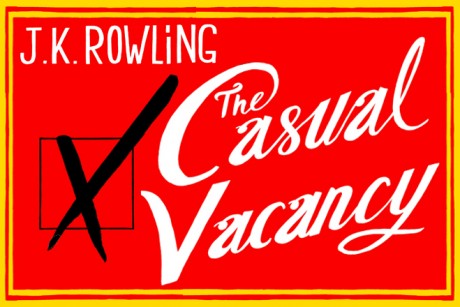

 . The title refers to an elected office that is vacated before the term is up, which in this story occurs in Pagford, a small, cozy-looking English village. But its inhabitants are miserable. The town is filled with deceit, selfishness, betrayal, cruelty, and a government that alternates between negligence and incompetence for the poor and highly effective protection for the privileged.
