Alex Cross

Posted on October 18, 2012 at 6:00 pm

In “Alex Cross,” Tyler Perry is called upon to: show devastating grief, show incendiary fury, make threats, throw punches, and take over a part played twice on screen by Morgan Freeman.  He is not up to any of those things.  Perry is a powerhouse as a writer/director/impressario and I am a fan of his unique blend of high melodrama, low humor, and true-hearted faith in God and family.  But here, in a prequel to the gritty detective films “Along Came a Spider” and “Kiss the Girls,” based on the best-selling thriller series by James Patterson, Tyler is not a good fit.  It opens with Tyler as Cross in run-with-a-gun mode, chasing after a bad guy, and then we see him bantering with his long-time best friend and partner (Edward Burns) and with his gorgeous wife (Carmen Ejogo).  There isn’t a persuasively authentic moment in any of that.  Indeed, the 6’5″ Perry’s most believable performance is when his character has to reach something from a high shelf.  That feels real.

Cross is supposed to be a Sherlock Holmes-style  hyper-observant detective with a degree in psychology who is also a devoted family man with a cute-cranky mother (Cecily Tyson) who is also gangbusters in chasing, shooting, and beating up bad guys, not to mention some vigilante-style rough justice.  He is always right.  How do we know?  His best friend/partner says, “Just once I would like it if you got something wrong because this is really getting annoying.”

And the bad guy here (an unrecognizably strung-out Matthew Fox) is also something of a super-villain who has mastered every kind of weapon and technology and has an evil genius command center with marked-up maps and mechanicals pinned to the wall (how retro) and a champion mixed martial arts combatant and specialist in torture and charcoal drawings, who leaves meticulously detailed clues that are only revealed by an Al Jaffee-style Mad fold-in.

The story begins with the murder of a gorgeous and very wealthy woman with a kinky side.  She explains a statue of the god of war in her bedroom: “War is a passionate undertaking of strategy and skill just like sex.  So it belongs beside the bed.”  She is butchered and her three bodyguards are shot and burned.  That leads to a botched attempt on one of her colleagues, an arrogant German guy who does something with money that is so important he has the kind of super-security they usually reserve for places where there is actual money and not just computers people use to move it around, except in movies where we have to show how smart the villain is by having him surmount all of the obstacles.  And then it all gets very personal and very, very ugly.  The body count rises, including a lot of collateral damage as well as some that hit close to home.  The exposition-heavy dialog is clunky (“But this building is impenetrable!” someone says as the building is being penetrated).  The banter is clunkier: “I’d rather take advice from a ham sandwich.” “Love you too, it goes without saying.”  And yet, he says it.

I was not a fan of the last Alex Cross film, Along Came a Spider, because of its plot holes and factual clangers.  (No, the Secret Service does not protect the children of Senators and the Russian President does not live in America.)  Once again, the plot becomes increasingly more preposterous when super-detective figures out that super-villain is targeting someone who is about to make a presentation to the city council.  Now, in that situation I might suggest moving the meeting to a different time or place, but no, these braniacs decide to send every cop in the city to the location to lock it down. For a presentation.  That must be some power-point.  It goes without saying that someone claims it’s the equivalent of impenetrable and it goes without saying that our Energizer bunny of a bad guy is way ahead of them.  But they say it anyway.

Parents should know that this is an R-level movie.  It has very intense and graphic violence for a PG-13 with torture including severed fingers as well as brutal fighting, guns, and bombs, very sad deaths of characters including a pregnant woman, explicit sexual situations for a PG-13 including bondage and partial nudity, some language, and references to drug use and drug dealing.

Family discussion: Who was right, Dr. Cross or his mother?  What makes him so aware of the revealing details all around him?

If you like this, try:  Morgan Freeman’s performances as Alex Cross in “Kiss the Girls” and “Along Came a Spider”


Related Tags:


Based on a book Crime Drama Series/Sequel

Brooklyn Castle

Posted on October 18, 2012 at 2:43 pm

A-
Lowest Recommended Age: All Ages
MPAA Rating: PG for some language
Profanity: Some schoolyard language
Alcohol/ Drugs: None
Violence/ Scariness: None
Diversity Issues: A theme of the movie
Date Released to Theaters: October 18, 2012

I.S. 318 is a below-the-poverty-line inner city junior high school.  And its students have won more national chess championships than any other in the country.  So this is a touching and inspiring story of triumph and what can be accomplished in spite of the most daunting of obstacles if there is someone who believes in you.  And it is a story of the joys of intellectual passion and a game that goes back centuries, even in an era of saturation in digital media. There is much of what you expect — gifted kids, dedicated teacher, tense anticipation, thrilling victories.  The characters are endearing and their stories are stirring.

This movie is also frank about the vulnerability of these programs.  We see so much that is made possible by so little, and how fragile even that little can be.  These children have endless spirit, skill, and devotion.  They can solve complex mathematical puzzles that involve intricate, multi-step strategies.  But the adults around them may not be able to show the same level of commitment or ability to think ahead to enable these kids to continue to benefit from the chess program.

Parents should know that this film includes the portrayal of children in difficult circumstances and some schoolyard language.

Family discussion: What do you have to be good at to succeed in chess?  What makes this chess program so important to the kids?

If you like this try: “Mad Hot Ballroom” and “Searching for Bobby Fischer” — and try a game of chess!

Related Tags:


Documentary For the Whole Family Movies -- format School Stories About Kids

Google Pays Tribute to Winsor McCay

Posted on October 15, 2012 at 12:38 pm

I am so happy that Google is paying tribute to one of my favorite artists, Winsor McCay, creator of Little Nemo in Slumberland and Dreams of the Rarebit Fiend.

McCay also invented animation.

He was the one who figured out that if movies were just a series of still pictures, he could draw a series of still pictures and make a movie out of them.  He personally drew thousands of pictures for his first animated movie, about Gertie the Dinosaur.

http://www.youtube.com/watch?v=UY40DHs9vc4

I was enchanted by the short films inspired by McCay Roger Ebert showed us at Ebertfest this year.  This one is by Thomas Edison, circa 1904.

And I am proud to be a Kickstarter supporter of animator Bill Plympton’s new film about McCay.


Related Tags:


Animation Directors Internet, Gaming, Podcasts, and Apps

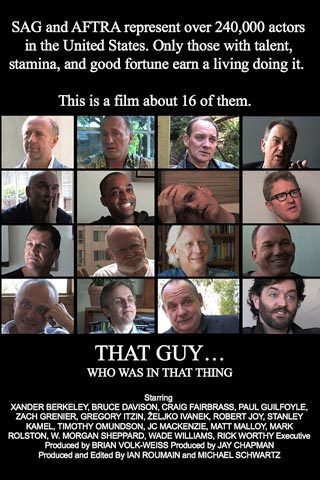
“That Guy” — Showtime’s Documentary About Character Actors

Posted on October 13, 2012 at 3:59 pm

I have a special affection for character actors.  They have to create a character and move the story forward without having the luxury of time and the audience’s primary attention, and they have to do it without overshadowing the star.  So I was delighted to see Showtime’s tribute to character actors, a documentary called, “That Guy….Who Was in That Thing.”  Candid interviews with actors who all look familiar but not instantly recognizable, who might be mistaken for someone you went to school with or once saw at a family reunion cover touchy subjects like auditions, being a guest star on a show where the stars do not think it is worthwhile even to introduce themselves, going for months without a job, family and financial stress, being stuck with a lot of technical talk or exposition, and the pure joy of having the opportunity to perform.  It’s On Demand through November 13 and well worth a look.

Related Tags:


Actors Documentary Television

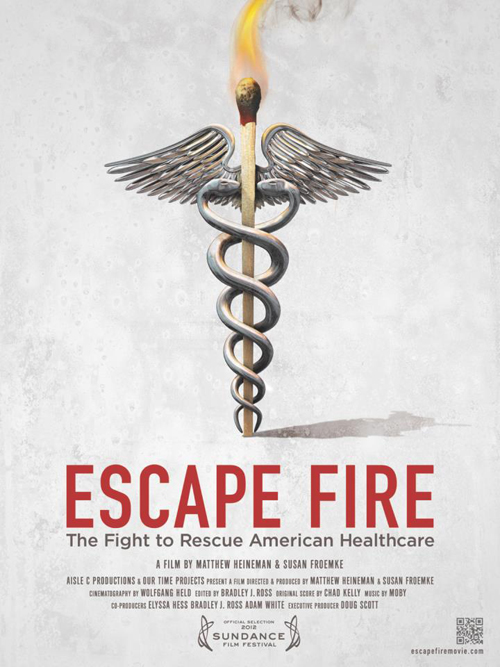
Interview: Matthew Heineman of the Health Care Documentary, “Escape Fire”

Posted on October 11, 2012 at 6:56 pm

“Escape Fire” is a new documentary about what does not work in our system for preventing and treating illness, and what some people are doing to make it better.  I spoke to Matthew Heineman, co-director and co-producer of the film.

Tell me about the reactions you have been getting from people who see this film.

I think one of the most inspiring things for us is to really see what happens when a local community screens the film. Just two weeks ago we screened the film at 62 medical schools across the country, all on one night.  There is an outpouring of optimism, that this is a problem that we can fix, a problem that we don’t have to wait, necessarily, for someone to come in from Washington, that change can really happen on the local level, sort of doctor-by-doctor community, system-by-system, and that’s how change can happen quickly.  One of the real goals of the film is to transform how our country views health and habit.  Medical school is the future, so their response is important.  We also screened last week at the Pentagon, hosted by the U.S. Army Surgeon General, and have sort of a room full of leadership generals and medical leadership at the Pentagon. And again, they recognize this problem that they have with over-medication, recognize that the status quo’s not working, and the Surgeon General said herself that she really thinks that this film can help change the culture of medicine in the army to begin with, but hopefully with the military at large. So it’s pretty amazing, we’re already seeing impact happening.

A big light-bulb moment for me comes fairly early in the film when somebody says, “We don’t have a healthcare system, we have a disease-management system.”

We did 6-8 months of research on the topic and almost everyone was saying that.  It’s a system that profits from sickness, not on health. 75% of healthcare costs go to preventable diseases, so how did this system come to be? Why did it not want to change? We wanted to try and find people out there who are trying to change it. Just to quickly mention one thing I didn’t say about your first question,

It seems to be that the problem which you touch on in the last part of the film, the inevitable corruption of corporate money and politics, is the real insoluble problem.  You can have the good will in the world and you can have all the data in the world, but when people are getting paid hundreds of millions of dollars under the current system, it’s very hard to get them to change it.

There’s no question about that.  As Andrew Weil says in our film, there’s rivers of money flowing to very few pockets, and the owners of those pockets don’t want to see anything changed.  I think what’s different now, and one of the reasons why we made the film is that things can’t get any worse.  We’re spending 2.7 trillion dollars a year on healthcare. That’s just a number, but when it comes down to individual companies or healthcare systems or cities or towns or small businesses or individual people, it’s bankrupting us. So, we’re being forced to change, we’re being forced to adapt, because what’s happening now is unsustainable.  We see that with the military in our film, we see that with Safeway Corporation in our film, we see that at the Cleveland clinic, that these major institutions are being forced to change, and so I think, yes, the system is making a lot of money out of the way things are, but many of the players in the system recognize how unsustainable it is and thus are being forced to change.

Your movie makes the case that when you spend more money it doesn’t necessarily correlate to better outcomes.

That was one of the most eye opening things for us.  In America we have this fascination with faster, bigger, better, now; we want the quick fix. We want that pill, we want that procedure, we view healthcare as something that somebody gives to us or does to us or something that we put in our throat, and I don’t think we really recognize that more isn’t necessarily better when it comes to healthcare, that more can often hurt us, that there’s this term called ‘over-treatment.”  We reward for quantity and not for quality. Doctors, we pay for the diabetics to get their foot amputated when they’re 60, but we don’t pay for simple nutritional counseling when they’re 20, 30 or 40 to prevent that from happening in the first place. It’s just a perverse system.

What got you interested in this as an issue?

We started the film three years ago just as the healthcare debate was heating up, and I think like many Americans we were just confused by the traditional media coverage of the topic, I mean, it was so hyperbolic and so confusing; healthcare was really dividing our country. So, I think we really wanted to try to understand, systemically, how it was broken, why it was broken, but also highlight people out there who were trying to fix it.  So many films like this are just polemics, that you walk out of there, head hanging low and just hopeless, and I think we knew from day one that we didn’t want to do that. We also knew from day one that we wanted to have real, powerful human narratives that would provoke audiences to want to keep watching.

What can a movie do that an op-ed or book or politician could not do?

I’m obviously biased; I’m a film-maker. I think documentary film has the power to really bring an issue that to life, with real human stories in a way that facts or articles or tweets don’t or can’t.  What we really tried to do was make a film that would not only move you intellectually but move you viscerally.  We look at healthcare through a number of different lessons and through a number of different characters that I think almost anyone in American can identify with, at least one, two, three or all of our characters in this film and say, “I know somebody like that,” “that’s sort of like me.”  It is just the power of film to associate at a more visceral level with an issue. I think that’s what documentary has the power to do.

Why did you choose to name the film after a technique for stopping a forest fire by setting a small controlled “escape fire?”

Escape fire is a metaphor between our healthcare system and a forest fire from 1949 that happened in Mann Gulch, Montana.  The fire fighters were filled with hubris, with the latest and greatest technology, they thought they’d have it beat by 10 o’clock the next morning—then the wind shifted directions and they found themselves running down this hill for dear life.  The foreman, the leader of this group, came up with this ingenious idea on the spot, where he lit a match and he burned the area around him to consume the fuel, so that when the fire came over to them, he’d be safe in what is now known as an “Escape Fire.”  He called to allow his fellow smoke-jumpers to join him, but nobody listened, and they kept running up the hill.  They all died, but he survived, basically, unharmed. And I think it’s a really powerful metaphor because it shows that the status quo is so strong, especially in healthcare, it’s so easy to keep doing what we’re doing, and we’re making a lot of money continuing to do what we’re doing, but we really need to look outside the box and think outside the box to come up with an escape fire for our system.  Otherwise we’re doomed.


Related Tags:


Directors Documentary Interview
THE MOVIE MOM® is a registered trademark of Nell Minow. Use of the mark without express consent from Nell Minow constitutes trademark infringement and unfair competition in violation of federal and state laws. All material © Nell Minow 1995-2026, all rights reserved, and no use or republication is permitted without explicit permission. This site hosts Nell Minow’s Movie Mom® archive, with material that originally appeared on Yahoo! Movies, Beliefnet, and other sources. Much of her new material can be found at Rogerebert.com, Huffington Post, and WheretoWatch. Her books include The Movie Mom’s Guide to Family Movies and 101 Must-See Movie Moments, and she can be heard each week on radio stations across the country.

Website Designed by Max LaZebnik