This movie may be too scary for kids under six, but older children and their families, particularly fans of the Roald Dahl book, will love this spectacular musical fantasy from Tim Burton and Henry Selick (“The Nightmare Before Christmas”).
James has a blissful life with loving parents until they are both killed by a rhinoceros. He then goes to live with his horribly mean aunts, until a mysterious stranger brings him a bag of magical crocodile tongues.
James trips and spills them on the ground, near a tree that then grows a giant peach. When James climbs inside, he meets a collection of human-sized insects, including the lovely Polish-accented spider (voice of Susan Sarandon) and violin-playing grasshopper (voice of Simon Callow). The peach takes off, and, tethered to 300 seagulls and flies to New York.
Exquisite stop-motion claymation, computer animation, and special effects combine to create real movie magic and an instant classic.
Kids who love Dahl will also enjoy the films of his other books, “Willie Wonka and the Chocolate Factory” and “The Witches” and Children will also enjoy Dahl’s “Matilda,” another story of a child overcoming cruel adults.
Like all Muppet movies, this latest entry has plenty of jokes to keep the parents happy while the kids are enjoying the story. This time, the story focuses on a question that has intrigued Muppet fans for years: exactly what IS Gonzo? Gonzo feels alone and outcast, even in the midst of the busy Muppet group house. He dreams that Noah refuses to let him on the ark because there is only one of him, and Noah wants only pairs. But then he begins receiving messages and learns that he is an alien, and that his alien family is coming to meet him.
There is a problem, though. Edgar Singer (Jeffrey Tambor of television’s “Larry Sanders Show”), who works at a mysterious government office that tracks aliens, captures Gonzo and orders a scientist to remove his brain for study. Gonzo’s pal Rizzo the Rat is put in a cage with lab rats. Kermit, Miss Piggy, Animal, and the others set out to rescue them.
The movie has sly references to just about every space movie classic, from “The Day the Earth Stood Still” to “Independence Day” and “Men in Black” (plus “The Shawshank Redemption”), cameos from stars including Andie MacDowell, Ray Liotta, and David Arquette, and a bouncy score of rock classics. While the score draws from performers like James Brown, The Commodores and Sly and the Family Stone, the human performers are overwhelmingly white, a mistake also too often committed by the sci-fi movies so lovingly parodied. With that caveat, and with the further warning that this may not be the Muppets’ all-time best, it is a very pleasant way to spend a quick 90 minutes, and the best movie of the summer for families with younger children.
This is a movie about teenagers who promise each other that they will have sex before the night of the prom, and then do whatever they can to make it happen. It is one of the raunchiest and most explicit movies ever released by a major studio. The title, for example, refers to an apple pie that the main character masturbates in. A girl explains that she used her flute to masturbate. A boy ejaculates into a glass of beer. Boys hide a camera so they can broadcast pictures of a girl changing her clothes over the internet. A little boy hides in a closet so he can see teens have sex.
Parents whose kids see this movie may want to see it themselves, so they can give kids their own ideas about the appropriate ways to make responsible choices about sex, showing respect for themselves and their partners.
If “Treasure Planet” is not Disney at its best, it is still Disney at its still-pretty-much-better-than-anyone else, and well worth a look with this 10th anniversary re-release. It is based on the classic Robert Louis Stevenson story “Treasure Island,” filmed many times before. This version is set in outer space, but it is not the galaxy NASA or even “Star Wars” ever dreamed of. It is a dazzling vision that has masted schooners sailing past stars and planets. Computer and hand animation are brilliantly combined, using the best of both worlds so that the characters have a full range of expressions while the vistas are magnificently three-dimensional. This is exactly what animation should be about, presenting us with a thrillingly imaginative adventure that is utterly liberated from trivialities like the laws of physics and possibility.
Jim Hawkins (voice of “Third Rock” star Joseph Gordon-Levitt) is a spirited kid who worries his single mother by getting into trouble with a contraption that is like a flying skateboard. A dying man gives him a map that can lead him to the planet where the greatest pirate in history hid all of his treasure. Dr. Doppler (voice of David Hyde Pierce), a family friend, finances an expedition to go in search of the treasure.
Doppler and Jim set off on a huge ship led by Captain Amelia (voice of Emma Thompson), with a crew that are better described as creatures than sailors. Jim is assigned to work with the ship’s cook, John Silver, a cyborg who is part human, part machine. John has a gruff manner with everyone but his shape-shifting pet. Jim thinks John is his friend until he overhears him talking to the crew about plans to take over and steal the treasure for themselves.
Once on the planet where the treasure is hidden, Jim meets BEN, an oddball robot with half his memory missing (voice of Martin Short). Jim, John, and the others race each other and the pirate’s booby-traps to get the treasure.
The movie is wonderfully visually inventive, with dozens of witty details. John Silver is a marvel of animation integration and form tied to content, his mechanical parts created by computer and his human parts created by hand. The voice talent is marvelous, especially Thompson, playing the captain as a sort of starchy governess who happens to be extremely brave and have a wicked sense of humor, and Short, who was born to be animated.
Parents should know that the movie has some scary moments, with extreme peril. A character is killed by being cast adrift. There is some potty humor, including a character whose language is called “Flatula.”
Families who see this movie should talk about why it was hard for Jim to behave before the trip and what will be different for him afterward. If you had all that treasure, what would you do with it?
Families who enjoy this film will also enjoy some of the movies based on Stevenson’s Treasure Island, especially Disney’s own 1950 version, starring Robert Newton as Long John Silver. And they will also enjoy Disney’s “The Emperor’s New Groove” and “The Rescuers.”
The cause of votes for women is presented as unimportant, even daffy; subtext that parents should spend time with their children in
Date Released to Theaters:
1964
Date Released to DVD:
December 09, 2013
Amazon.com ASIN:
B00E9ZAT4Y
In honor of the upcoming “Saving Mr. Banks” and the 50th anniversary of the original film, Disney is releasing a superclifragilisticexplialidocious new edition of Mary Poppins.
Based on books by P.L. Travers (whose reluctance to allow a film to be made is the subject of “Saving Mr. Banks,” the film switches the 1930’s-era setting to the more picturesque London of 1910, where the Banks family has a loving, if rather chaotic, household. A nanny has just stormed out, fed up with the “incorrigible” children, Jane and Michael. Mr. Banks (David Tomlinson) writes an ad for a new nanny and the children compose their own, which he tears up and throws into the fireplace. The pieces fly up the chimney, where they reassemble for Mary Poppins (Julie Andrews), who is sitting on a cloud. The next day, a great wind blows away all of the nannies waiting to be interviewed, as Mary floats down.
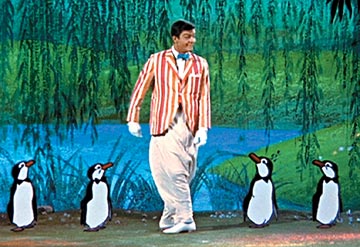
Somehow, she has a mended copy of the qualifications written by the children that Mr. Banks tore up and threw into the fireplace. To the children’s astonishment, she slides up the banister.Out of her magically capacious carpetbag she takes out a tape measure to determine the measure of the children (“stubborn and suspicious” and “prone to giggling and not tidying up”) and her own (“practically perfect in every way”). She directs them to clean up the nursery, and shows them how to make it into a game (“A Spoonful of Sugar Helps the Medicine Go Down”). Once it is clean, they go out for a walk, and they meet Mary Poppins’ friend Bert (Dick Van Dyke) drawing chalk pictures on the sidewalk. They hop into the picture and have a lovely time, or, rather, a “Jolly Holiday” in a mixture of live-action and animation that has Bert dancing with carousel horses and penguins.
Mary takes the children ato see her Uncle Arthur (Ed Wynn), who floats up to the ceiling when he laughs, and they find this delightfully buoyant condition is catching. Later, Mr. Banks takes the children to the bank where he works, and Michael embarasses him by refusing to deposit his tuppence because he wants to use it to buy crumbs to feed the birds. There is a misunderstanding, and this starts a run on the bank, with everyone taking out their money. Mr. Banks is fired.
Mr. Banks realizes that he has been too rigid and demanding. He invites the children to fly a kite with him. Mrs. Banks realizes that in working for the vote for women, she had neglected the children. Her work done, Mary Poppins says goodbye, and floats away.
This sumptuous production deserved its many awards (including Oscars for Andrews and for “Chim Chimeree” as best song) and its enormous box office. It is fresh and imaginative, and the performances are outstanding. (Watch the credits carefully to see that Van Dyke also plays the rubber-limbed Mr. Dawes.) The “jolly holiday” sequence, featuring the live-action characters interacting with animated ones, is superb, especially Van Dyke’s dance with the penguin waiters.
The resolution may grate a bit for today’s families with two working parents, but the real lesson is that parents should take time to enjoy their children, not that they should forego all other interests and responsibilities to spend all of their time with them.
Family discussion: If you were writing a job notice for a nanny, what would it include? Which of the children’s adventures did you most enjoy and why?

 .
. (whose reluctance to allow a film to be made is the subject of “Saving Mr. Banks,” the film switches the 1930’s-era setting to the more picturesque London of 1910, where the Banks family has a loving, if rather chaotic, household. A nanny has just stormed out, fed up with the “incorrigible” children, Jane and Michael. Mr. Banks (David Tomlinson) writes an ad for a new nanny and the children compose their own, which he tears up and throws into the fireplace. The pieces fly up the chimney, where they reassemble for Mary Poppins (Julie Andrews), who is sitting on a cloud. The next day, a great wind blows away all of the nannies waiting to be interviewed, as Mary floats down.
 . And go fly a kite!