“Heaven is for Real” opens tomorrow, with Greg Kinnear as Todd Burpo, a Nebraska pastor whose four-year-old son says that he visited heaven during surgery for a ruptured appendix. It is based on a best-selling book Heaven is for Real: A Little Boy’s Astounding Story of His Trip to Heaven and Back, by Burpo and Lynn Vincent (co-author of Sarah Palin’s book, Going Rogue). Burpo says that his son, Colton
talked about looking down to see the doctor operating and his dad praying in the waiting room. The family didn’t know what to believe but soon the evidence was clear.
In heaven, Colton met his miscarried sister whom no one ever had told him about and his great-grandfather who died 30 years before Colton was born. He shared impossible-to-know details about each. Colton went on to describe the horse that only Jesus could ride, about how “reaaally big” God and his chair are, and how the Holy Spirit “shoots down power” from heaven to help us.
The movie follows the essential elements of the book pretty closely. The Burpos dismiss Colton’s description of heaven at first. But when he describes where they were during the operation, identifies the great-grandfather who died before he was born and the sister his mother miscarried as people he met and spoke to, they are persuaded that he saw something real.
Noah may be controversial, but it is also a box office success. Literalists complained about its departure from the Biblical text. There were also some complaints about what some viewers interpreted as too much emphasis on environmentalism, and those who wanted to see Noah as an uncomplicated good man who prays using the term “God.” Writer/director Darren Aronofsky (“Black Swan,” “Requiem for a Dream”) made an ambitious, provocative film that at times wrestled with the story. Some of the responses have wrestled with the film. A Bible app tracking its users found the people accessing the Noah story more than tripled. Bible Gateway calculated a 223% increase and the American Bible Society found 87% of respondents to a Facebook survey said they were reading the story of Noah because of weekend conversations about the film.
while it’s true that Aronofsky’s Noah diverges from scripture, these critiques are ultimately an arrogant slight against beautiful Jewish tradition at work in the film. Worse, they imply that conservative biblical literalism somehow has a monopoly on Noah, a position which effectively ignores the billions of other non-literal religious people who also take the story seriously — especially Jews.
Firstly, when Aronofsky says that his film is less “Biblical,” that doesn’t mean that his film is “subversive” or any less religious — it’s just religious in ways that are unfamiliar to most biblical literalists, but common practice for most Jews and non-literal Christians. When asked how he compiled the script, Aronofsky and co-writer Ari Handel, who is also Jewish, explained that they pulled heavily from Jewish Rabbinic midrash. For the uninitiated,midrash, literally “to search out,” is an ancient Jewish tradition in which Rabbis essentially add stories to the Biblical/Tanakhical narrative for educative effect. These stories aren’t meant to be given the same authority as scripture, but are instead designed to both resolve problems of interpretation as well as expose aspects of the holy narrative that would be otherwise difficult to grasp.
In The Atlantic, Christopher Orr writes about “the fierce moral intensity of Aronofsky’s vision, which is, if anything, more Old Testament than the Old Testament itself.”
As Aronofsky’s film progresses, it becomes an implicit dialectic between the competing moral visions espoused by Tubal-Cain (on behalf of a sinful human race) and Noah (on behalf of a ruthless God). And to say that neither option is an appealing one—violent chaos versus obedient self-extinction—would be an obvious understatement. A third way between these polar alternatives is of course found, as anyone familiar with the Noah story would presume. (Aronofsky may grant himself the latitude to devise a few additional moral quandaries, but he’s not going to rewrite the ending.)
Noah is a strange and occasionally messy hybrid of a film, and some viewers will be unhappy not only with the liberties it takes but also with the conclusions it draws (in the latter case, perhaps, from both ends of the ideological-theological spectrum). Aronofsky has created an epic melodrama that is at the same time a heartfelt, personal plea for the reconciliation of often-competing moral codes. “A man isn’t ruled by the heavens,” argues Tubal-Cain late in the movie. “He is ruled by his will.” In the end, Aronofsky suggests, neither is sufficient on its own.
Aronowsky was raised Jewish but now considers himself a non-believer. Phil Cooke asks whether Christians should watch a movie directed by an atheist. The answer is yes. “God uses more than we imagine to tell His story…As a result, perhaps we shouldn’t be so quick to limit God – particularly when it comes to artistic expression.”
God is now on the Hollywood A-List. With the release over the last month of both Son of God and Noah, studios have clearly bet on the popularity of religious themes. Will they succeed? The answer depends on what we mean by success. If success is studio profits, the answer is probably yes. Religious themes resonate with Americans. We know the stories and recognize their power. If success is spiritual growth, however, the answer is no. The purposes of film and faith differ fundamentally. To say a film can teach faith is like saying a great tennis coach would also make a great basketball coach.
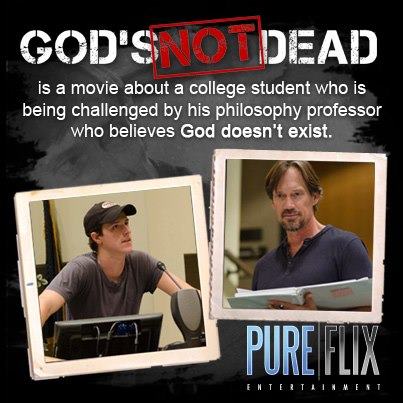
It was great to catch up with Kevin Sorbo to hear about his new role as an atheist professor with a student who is a committed Christian in “God’s Not Dead” from Pure Flix.
Not really. It’s always in the script. Great writing on this and a great story. I was hooked as I read it for the first time. I have met enough atheists in my day to get a grasp for the character anyway.
People always struggle with the eternal question about where God is when bad things happen. What does this movie want them to know?
Free will. God gave us that. Can’t have good without evil. Evil will always be there. It is how we act and react to evil that defines who we are. Life is all about choices. We know what is right and we know what is wrong. We don’t always make the right choice. So what we do after we fall is what builds, or destroys, one’s character.
Why did you want to play this role?
Loved the script. As an actor I am drawn to many personalities and this one just seemed like a chance to show people no matter where you are in your life, you can make find a place and time to redeem yourself and find the hope you either shut out or thought was no longer available to you.
Poster (c)Pure Flix
Preachers, professors, and actors all perform in front of an audience. How did your experience as an actor help you create this character’s classroom persona?
As i said…..it was in the wonderful script. I have done the college life and I drew from professors in my past.
You have worked with David A.R. White before — what does he bring to a film?
This was the first time David and i worked together as actors. I shot a movie he produced a few years ago called “What If….” and I did a Christmas movie called, “Christmas Angel.” David is a pro and was easy to work with on and off the set.
Who should see this film?
I hate to preach to the choir, so I hope the choir comes to see this movie just because it is a wonderful family film. I really want the fence sitters out there to come and form their own opinions about if there is a God. I would love atheists to come and see this film as well. I realize we can’t change everyone’s mind out there, but hopefully we make some of them reflect and wonder.
What do you hope families will talk about when they see this movie?
This movie will create dialogue. That is good. It means it has struck a chord with people enough to make them bring up the issues this movie exposes.
Hollywood is producing some big Bible stories this year. Why does this seem to be the moment for these films?
People want these movies. Simple as that. They want to have movies that have a positive message and the whole family can watch. I don’t think its going to slow down anytime soon.


 says,
says,