Interview: Joel Smallbone of “The Book of Esther” and For King and Country

Posted on June 19, 2013 at 8:00 am

Joel Smallbone of King and Country plays Xerxes in “The Book of Esther,” his first film role.  He was nice enough to take some time off from his For King and Country tour to talk to me about playing the Biblical king.

http://www.youtube.com/watch?v=Ko63DUcc8i4

How did you get involved with this project?

I’ve always had a real passion for film and music — the arts in general.  I’m one of seven children, five boys and two girls, and I’m in the middle.  The brother just above me, Ben, we did films growing up together.  We just had a Super 8 camera and we’d run around the property making films and submitting them to festivals.  And then I got older and the brother just under me, Luke, said, “Hey, what do you think about giving this music thing a shot?”  So he and I started leaning into music but the passion for film has always been alive in me.  My father, who also manages us, has some connections in the film world and he was in touch with David White of PureFlix.  When they were looking at doing “The Book of Esther,” David said, “I might have a role for Joel.”  They were so gracious — we were in the middle of a tour and I had just five days off.  We flew out from Virginia early Monday morning and was on set in LA Monday evening.  I did my whole role in five days and flew out the morning of the show from LA to Phoenix and performed that night.

It was really fulfilling, kind of a dream come true to be involved in film after all those years.

So you had no time to rehearse!

I’d gotten a script a month or so before.  What I wasn’t familiar with at that point was that they change the script all the time, up to the last minute.  And this film in particular is a period piece.  In order to make it feel more like the day and time, everything was spoken in old English.  Sometimes when you’re memorizing something it’s easy because you think, “I could say something like that.”  But this is all thees and thous and noblemen and stuff like that.  I spent about a month prior preparing each day.  I had a lot of dialogue.  About five or six days before the shoot, as we’re on our first headlining tour, I get the revised script.  And it’s not just a few changes.  It was dramatically changed.  I was pulling aside everyone in the band to help me memorize the lines.  I focused on the first few days so I could feel good about that and build my confidence going into it.  David White was very gracious and when I had to do a page-long monologue he really helped me pick it up and didn’t blow a gasket when I didn’t know a line.

What about the technical stuff, learning how to hit marks and where the lights are?

In music you have a cue and a spot on stage but not in the same way.  If you move your head a little bit you might be out of frame or out of focus.  So it was a trial by fire.  But fortunately, my character was stoic and pretty immobile.  Most of the scenes I was sitting on the throne or sitting at a table.  Which creates its own challenges itself because you’ve only got so much to work with, hand movements, facial expressions.  I stepped into it  not knowing a lot and after that five days I really felt like I had a good handle on what needs to happen in film.  Since then I made another film with Billy Ray Cyrus, “Like a Country Song,” and having “The Book of Esther” experience under my belt allowed me to step into this role with confidence.

How did you approach the character of Xerxes?

If you read Esther in the Bible you have to use some imagination.  What excited me about the story is that you can read these epic stories from history and never quite dive into the reality of what was going on.  Here’s a young man.  He’s just lost his father and is one of the most powerful people in the world.  The irony is that rather than being a bit of a narcissist and making decisions on his own and doing away with his advisors.  Instead he leaned into counsel, people who counseled his father, and he hung onto them for better or worse. And he really, desperately wanted to find love. He looked in the wrong places and made a political decision rather than from the heart with Vashti, which was a mistake.  Even when you look through the six months of preparation and the nonsense, in the end, if you really boil it down, the decision he made about Esther were about more than her physical beauty.  There was a love.  We really wanted to turn the lens on these four characters.  What are some of the pressures and strains and motives?  What were their fears?  That was he heartbeat of the film at the end.


Related Tags:


Actors Interview Music Spiritual films

Fill the Void

Posted on June 13, 2013 at 6:25 pm

B+
Lowest Recommended Age: High School
MPAA Rating: Rated PG for mild thematic elements and brief smoking
Profanity: None
Alcohol/ Drugs: Drinking and drunkenness, smoking
Violence/ Scariness: Sad offscreen death
Diversity Issues: Role of women in traditional orthodox community
Date Released to Theaters: June 14, 2013

A young woman about to choose the man she will marry is torn between her own desires and the wishes of her devout family, ultra-Orthodox Jews.  We know where the American version of this story would go — the triumph of individual happiness over the antiquated strictures of the community.  But Israel’s official entry for the foreign language Oscar is a sympathetic, layered portrayal, rich with detail, that earns its more complex and resonant conclusion.

Writer-director Rama Burshtein was born in the United States, grew up in Israel in a non-Orthodox home, studied film, and chose to become “baal teshuva” or one who “returns” to the the practice of traditionally observant Judaism.  This movie reflects her deep understanding of both liberal and conservative notions of religious practice as a connection to the divine and the many variations in between.  She is a gifted filmmaker who understands the way the tiniest details tell the story and evokes utterly natural, intimate performances from her actors.  She shows us a world of very strict and demanding tradition, but it is the context for characters who are never caricatured.  They are vividly drawn and portrayed with respect and affection.Fill_the_Void_(2012_film)

Like a Jane Austen novel, the primary concern for Shira (a shimmeringly lovely Hadas Yaron) and her family is a propitious match, and the cultural structures for making this decision are clearly defined.  In this community, young men and women have no opportunities for interaction until they are identified as potential partners by their parents.  Then they have one heart-wrenchingly awkward meeting to decide whether they can spend a lifetime together.  As the invariable small plate of cookies goes untouched, there is no shilly-shallying about what they majored in or their favorite music.  A few simple questions about their aspirations for family life are all they get.

We first see Shira and her mother sneaking a look at a prospective groom in the aisles of a the grocery store.  Shira believes he could be the one.  She is excited and happy.  But then a terrible tragedy strikes.  Her sister, Esther (Renana Raz) dies in childbirth.  And then the widower, Yochay (a smolderingly handsome Yiftach Klein) has an offer to marry a woman from Belgium, which would mean moving there and taking the baby with him.  The only way to keep Esther’s child close to the family is for Yochay to marry Shira.

Suddenly, Shira has to cope with an entirely different set of pressures and an entirely new sense of power.  She has to sort through her feelings without any real opportunity to learn how Yochay is responding.  Could he want her?  Or is he being forced?  What would it be like to be married to someone who has not just been married before, but who was married to her sister?

American films have ranged from clumsy to dreadful in portraying the Orthodox community, with Renee Zellwegger in “A Price Above Rubies” and Melanie Griffith’s “A Stranger Among Us” as notorious failures.  Burshtein’s perspective as someone who chose that life is refreshing in its focus on the lives, relationships, and choices of the characters.  The details of their religious practice draw us in as illumination, not anthropology.  The dynamics of Shira’s parents’ relationship play out in the celebration of Purim, a holiday less observant Jews may think of as a minor celebration for children to wear costumes and shake noisemakers.  For these people, it is also a time to encourage those the community who needs help to ask for it and for those who can to give it.  It is Shira’s father who receives the requests.  But it is her mother who brings the money.  And in the oblique discussions they have about Shira’s choice and the factors to be considered, we see the many layers of family, community, and religious observance twined together.

Parents should know that this film includes drinking and drunkenness and brief smoking.  There is a sad off-screen death.

Family discussion:  What does Shira decide and why?  Do you agree?  Will she be happy?

If you like this, try: “Ushpizin,” another film about the Orthodox community made by a baal teshuva


Related Tags:


Family Issues Movies -- format Spiritual films

Beyond Belief: SundanceNOW Doc Club Series on Faith

Posted on May 31, 2013 at 3:59 pm

Starting tomorrow, SundanceNOW Doc Club will premiere its “Beyond Belief” series of documentaries that provide an intimate look at what motivates and affirms belief, examining and challenging the limits of religious conviction.  Highlights of the series include: “Raw Faith, an intimate look at Unitarian Minister Marilyn Sewell’s exploration of faith; “Living Goddess,” a powerful portrait of a young girl venerated as a goddess growing up in Nepal on the brink of war; “So Help Me God,” the warmly funny story of documentarian Simon Cole as he traverses America in search of the Almighty; and “American Mystic,” a lyrical film that celebrates the separatist spirit of early America by following three young Americans on the fringes of alternative religion. Watch these films to be informed, inspired, and moved.

http://www.youtube.com/watch?v=OXAS8ezUIaY http://www.youtube.com/watch?v=5qhIWz4Lp-E

SundanceNOW’s Doc Club, which is curated by renowned film festival programmer Thom Powers, offers subscribers streaming access to a monthly-themed selection of documentaries, along with the entire archive of previous months. For of $4.99/month, $19.99/six months or $29.99/year, doc lovers have access to many of the most acclaimed documentaries in recent years as well as many classics from filmmakers like Joe Berlinger, Errol Morris, Alain Berliner and many, many others

Related Tags:


Documentary Spiritual films

Interview: Brian Bosworth of “Revelation Road 2”

Posted on May 7, 2013 at 8:00 am

Football star-turned actor Brian Bosworth spoke to me about his new role in Revelation Road: The Beginning of the End, the second in an end of days series from Pure Flix Entertainment.  He spoke to me about how making the movie was a critical part of his own faith journey.

http://www.youtube.com/watch?v=RQ_KNZ4ADGQ

Let’s start by having you describe your character, a biker named Hawg.

Not a guy you want to bring home to mama.

I think that’s fair. I’d add angry to that too. I felt a lot of anger coming off of Hawg.

The second one describes in great detail why I’m so vengeful and angry. And it was important that we were able to get that out because I was in fear what when I read the script originally that there wasn’t enough definition behind the purpose behind Hawg and his vengefulness towards God. And the way I wanted to play it I needed to have that purpose and what I  did was I substituted my own anger and my grudge with God for the last 25 years into to something that I think people have the ability to identify with because it happens every day in our lives. When people that we love are taken from us and we don’t have control over it.

It feels like the easier choice to go with the anger rather than be honest with ourselves?

It’s a human choice. And it’s the test and as I’ve learned and as I’ve gone through the process and now that I’ve been saved and released all that anger and I’m starting to study the Word and understand the history of what the lesson is. It’s a lesson from day one. In time and it resonates. It doesn’t matter where you are and what era the same challenges occur for humans 5000 years ago to today to whatever time that we do have left. It’s just a matter of how you deal with those challenges and the instructions are clearly written in that Book.  You just accept that fact that you don’t have control of what happens in your life. Only God has control of that. It’s a temporary thing that we are experiencing in this thing that we call life. And there are things that happen that are beyond or control. And of course we are going to get angry. I know if my child was taken from me unexpectedly and without reason or cause, the first thing to do is to be angry. But there’s instructions on how to deal with that and know that your purpose.  Now I understand I don’t own every soul. Just because they are my kids, they are not my souls. I don’t own them. I’m just their guardian and I have to give them instructions that I am given so that I can pass on the ability that one they’ll make that choice independently that they will fill their heart up and be saved themselves but I can’t save them.revelation-road-620x320
Just like nobody could save me. And I had to make that choice. Life is hard. Life is tough. And it was not easy and the thing that I replaced in the movie of my character’s wife being killed was my career. When I lost my career I felt that was God breaking his promise to me because I made a promise to him when I was young. Give me this because I need this in my life and yet without purpose at least in my mind he took that away from me. It was more clear now than it was then. It’s hard to deal with things.

At the moment.

At the moment it is.

In the case of being a professional athlete you kind of feel like you make a bargain because you give up so much to achieve that level of skill and you’re entitled to get that success in return.

Well I think entitled that’s one of the words that I might not use unless you act entitled. And I think you know when I go back and describe my change and my demeanor when I was in college. When I give testimony about it. To me there’s a direct correlation to what you’re blessed with and what you feel you are entitled to. And I felt like I was blessed with a God given ability to play football and that was when I was Brian Bosworth. But then when I turned into the Bos and the Bos took me over I allowed things to happen in my life then I started to follow a different path. That’s when the entitlement so to use that’s really when God stepped in and said you know what you’re not entitled to anything.  You’re blessed with everything but you’re not entitled to any of it.

Isn’t that the difference between pride versus humility?  When you feel blessed you have a sense of humility when you feel entitled you have a sense of pride.

There’s no question, yeah. The way I describe it is I took my training wheels of my relationship with God off and I said, “I got it from here, thank you for the push.” That’s my pride saying that I don’t need you anymore. And lack of humility to me is the mistake that we all make when success is abundant in our life and we have the audacity to think that we’ve done that on our own. That’s just all our doing. And unfortunately is really the key ingredient to our undoing.

What do you want people to think about as they walk out of this movie?  What do you want them to say to each other?

It’s not what they say to each other it’s when they go back home and they look at themselves in the mirror. When I did a screening in Oklahoma, I said, “If this event were to happen today or tomorrow or next week, are you ready to go?”  You can’t fake God out. That’s one thing. We can fake each other out. And I’ve done that before and I’ve seen that happen. You can talk about it in a lot of different ways. But the one thing you can’t do is you can’t lie to yourself because your heart knows the truth. When you do something wrong your heart inherently knows “I’m doing this and I know I shouldn’t.” No matter what it is. No matter if it’s small or big. Your heart tells you whether it’s right or wrong. And that’s God’s way of talking to you. So when you look in the mirror and say, “Am I a Christian? Am I walking the walk? Am I doing it the way Jesus would do it?” Only you can answer that question so when the rapture comes — and it is coming — are you going to be able to say with 100 percent certainty when you raise your hand, “I’m going; I have a ticket” or “I’m not sure.” You can fix that but you have to do that now and don’t wait until tomorrow or think you have until tomorrow because God is the only one who has our clock.

For me the most moving part of the film was when the Jesus figure says, “Have you asked?”

Yeah, it’s the most important question. For me in my journey I chose to turn my back. It wasn’t a question of whether I believed that God was there. I felt that he was there and either he or I or we broke a promise and therefore I am choosing to not engage him. I already know the answer to the question of where my heart is. If I ask the answer is going to be no because my eyes aren’t ready to see, my ears aren’t ready to hear and my heart isn’t ready to receive him. Not only until I get to the bottom of where I am to where I have to be on my knees begging and asking. I can’t do this alone.  And I know without Your help I can’t get home.  Are you ever going to be able to ask that question and then hear that answer?

Do you feel that some of the same discipline and focus that you brought to being an athlete was helpful to you in becoming an actor?

It’s the only thing I know how to draw from. I wasn’t trained as an actor and I never really wanted to be an actor, to be honest with you. That’s part of my anger that I had to let go. All those movies that I ever did back in the past was somebody else vision, somebody else’s vehicle, somebody else’s choice and I had to take ownership and allow somebody else to choose a path in my life. Should I then take credit for it? So I consider this really my first movie because it’s the first movie I sat down and I read and even though I was reluctant I looked at it and it spoke right to my heart and it said “this is exactly who you are today.” And it was a godsend because it was like I know that I am this dark vengeful angry man because I choose to be. Hopefully through the process it will stir up something and it will bring me back to me knees and make me ask, “Do you want to still be that person” because you can be or you can choose not to be. But only you can decide that.  But yeah from a discipline standpoint I only know how to work in the way in which I was trained. And I go through a routine disciplined and when I know I’m working I turn and shut everything else out. So every day you are working is like game day. You go and you prepare and you discover and every play is not exactly the way it is drawn up on the board. You have to be open to allow the play to develop. And then you have to be instinctual about your responses to that. You have to be real you can’t fake your way through it. It actually comes from a place that you know is real.

So I’m getting the feeling from talking to you that the very process of playing this character was a part of your journey.

It’s the quintessential part of my faith. I wasn’t even really acting in this movie. That character was exactly who I was. I didn’t have to draw from anything other than my own anger. And it was the triggering point to find my salvation because if I hadn’t accepted that movie I wouldn’t be standing her today talking about being saved. I would still be standing here angry, mad, and vengeful and not at peace with where I am knowing that the journey I’m on now has an ending point of a place called home.

Do you have a favorite Bible verse?

I have several different bible verses that I love but the one that spoke to me the most is Isaiah. It spoke to me on the day that I got saved. And I just happened to be reading it.  Isaiah 1:18-20 “Come now let’s settle this lord though your sins are like scarlet I will make them white as snow.  Although they are red like crimson I will turn them white as wool. If ye be willing and obedient, ye shall eat the good of the land: But if ye refuse and rebel, ye shall be devoured with the sword.”

It’s exactly the last 27 years of my life.

And it’s right there. Until I was ready to listen and hear it those were just words and they could have been in Mandarin it wouldn’t matter. It’s clear. It’s like the picture of your life. It’s like “Wow, that’s it.” It’s exactly what I have chosen to take that path and because I decided not to obey Him he’s taken and devoured everything. But He will turn around and give it all right back to you just like  Job. And that is a man who deserves to be angry at God. Here’s a man who has every blessing you could want.  

And did nothing wrong.

He was the best subject for Satan to prove man’s faith. He still sits down and says thank you Lord. Even though you take everything away I still love you.

Will you be a part of Part 3?

If we get to do a Part 3, yes. I would like to do it.  And you saw at the end I’m just kind of sitting there. We shot that last scene and this is how providential the whole movie was. I told them before I took it I’m getting married on May 5th. You guys are starting this movie on April 2nd. And I know how movies go. There’s going to be run over days. You’re not going to get all your shots. I’m leaving on May 2nd because I got to get my marriage license so if there’s any issues with that I guess I can’t do this movie. And back in that time I was kind of hoping for them to say, “Okay, yeah let’s pass on you.”

They waited til the very last day to do all those stunts and they waited until the last day to get my most emotional scene. That scene isn’t written in the script. David, the producer, and the guy that plays Josh in the movie is aware enough of where I was. The sun was down. We were in the desert and it was dark. And he said, “Let’s stop the rest of the shooting. Brian is leaving tomorrow and we got one shot to get and I know what he has to do to end this scene correctly.” So we never rehearsed it. We didn’t do any dialogue changes.  There was no dialogue. I said, “Just roll the camera and I’m just going to let it run.” And it came out at one time. And I was hoping at the end that they would finish it the way they did because it leaves something for the audience to go, “Okay, he has at least let go of his anger, not for his daughter and not for his wife, but he’s let go of the anger for Him.” And when you finally relinquish that and you do it for Him then that’s when your life begins.  It at least gives Hawg a moment of redemption.  I have told people this whether you walk the walk or think you’re the most righteous person in the world and you read the scripture that doesn’t give you an automatic ticket to heaven and just because you may have done the most abominable things known to man and you might be the worst human being on this planet it doesn’t mean you don’t have a day of redemption.

Turn around and ask. And that’s all that I did that day. I stopped and I asked.

 

Related Tags:


Actors Interview Spiritual films

42

Posted on April 11, 2013 at 12:08 pm

B+
Lowest Recommended Age: Middle School
MPAA Rating: Rated PG-13 for thematic elements including language
Profanity: Racist epithets, crude and ugly insults, some additional strong language (s-words)
Alcohol/ Drugs: Drinking, smoking
Violence/ Scariness: Threats of violence, some scuffles, some injuries
Diversity Issues: A theme of the movie, brief homophobic humor
Date Released to Theaters: April 12, 2013
Date Released to DVD: July 15, 2013
Amazon.com ASIN: B009NNM9OA

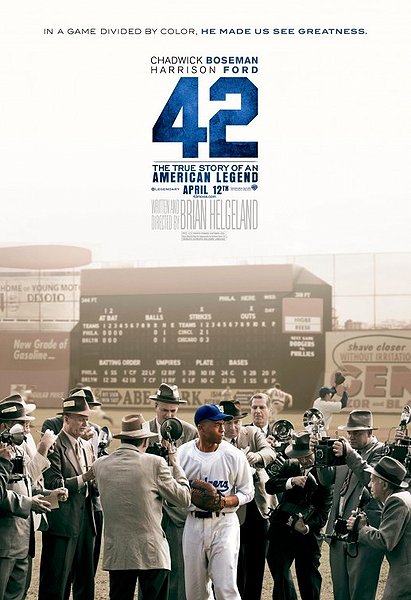
Jackie Robinson was the first black man to play major league baseball. His number, 42, is worn by every player once a year to commemorate his achievements as a baseball player and as a man.  This version of the story of the year the Brooklyn Dodgers broke the color barrier in baseball from writer/director Brian Helgeland is a little superficial, it still packs a lot of power, thanks to an evocative sense of its period and star-making performances by Chadwick Boseman as Robinson and Nichole Beharie as his wife.  If what we see is a small part of the courage and integrity of this extraordinary man in taking on the virulent racism of his era, it is still enough to make this movie deeply moving.

It is just after the end of WWII.  Black soliders returned home from fighting for freedom on behalf of a country that was still segregated, from the separate fighting divisions in the military to the “Whites Only” laws of the Jim Crow South.  Brooklyn Dodgers manager Branch Rickey (a cigar-chomping Harrison Ford, in full growl) decides it is time to integrate baseball.  He needs to find a player who is not only an athlete of unquestionable ability but someone who has the temperament to stay cool despite the constant attacks he will face from his own team, opposing teams, and the fans.  Rickey decides that Roy Campanella was too sweet and Satchel Paige was too old (both would follow Robinson into the major leagues).

Rickey picked Robinson.  He had the skill, he has played with white teammates in college, and he is tough.  He was courtmartialed  for refusing to go to the back of a military bus — and won.  Rickey asks Robinson, “Can you control your temper?” “You want a player that doesn’t have the guts to fight back.” “I want a player who has the guts not to fight back.”  Rickey knows that no matter what the provocation, any show of temper from Robinson will only give ammunition to the bigots.  What would be called “spirit” in a white player will be called something different coming from him.

It is solidly entertaining, delivering all of the expected notes, and if it seems heavy-handed to anyone old enough to remember a time before the Montgomery bus boycott and the passage of the Civil Rights Act, it is perhaps understandable that Hollywood does not take for granted that younger audience members remember there was once a time when segregation was not only legal; it was the law.  It harks back to the Sidney Poitier era of saintly black characters, which is understandable.  But it is a movie about tolerance that cannot resist a homophobic joke about teammates showering together, which is not.

Parents should know that this movie features frank portrayals of bigoted behavior including a stream of racist invective, with crude insults.  There are some sexual references, including adultery.  Characters drink and smoke, and there are some scuffles and injuries.

Family discussion:  Why was Jackie the best choice to be the first?  How did he challenge the beliefs of his teammates?   Read more about Jackie Robinson.


If you like this, try: “The Bingo Long Traveling All-Stars & Motor Kings,” Ken Burns’ “Baseball” series, “Brian’s Song,” and “A League of Their Own”

Related Tags:


Based on a true story Biography Drama DVD/Blu-Ray Pick of the Week Spiritual films Sports
THE MOVIE MOM® is a registered trademark of Nell Minow. Use of the mark without express consent from Nell Minow constitutes trademark infringement and unfair competition in violation of federal and state laws. All material © Nell Minow 1995-2026, all rights reserved, and no use or republication is permitted without explicit permission. This site hosts Nell Minow’s Movie Mom® archive, with material that originally appeared on Yahoo! Movies, Beliefnet, and other sources. Much of her new material can be found at Rogerebert.com, Huffington Post, and WheretoWatch. Her books include The Movie Mom’s Guide to Family Movies and 101 Must-See Movie Moments, and she can be heard each week on radio stations across the country.

Website Designed by Max LaZebnik