Sherlock Holmes: A Game of Shadows

Sherlock Holmes: A Game of Shadows

Posted on December 15, 2011 at 7:10 pm

All Sherlockians know that the only villain who could match the most famous and celebrated of all fictional detectives is the fiendish Professor Moriarty.  As we were promised in the postscript to the first Sherlock Holmes movie from Guy Ritchie, Robert Downey, Jr., and Jude Law, this sequel pits the two masterminds against each other in a match to the death.

Watson is about to get married and this produces two responses in Holmes.  He feels abandoned and is jealous of Watson’s fiancée.  This emotion is mostly childish and narcissistic but, as in the first film, there is a frisson of homoeroticism as well.  But he does have moments of generosity and concern for others.  He fears that their association will put Watson and his new wife at risk.  In one of the high-octane film’s best and quietest moments, he visits Moriarty (played by Jared Harris, son of Richard Harris of “Camelot” and the original Dumbledore in the first Harry Potter movies) to ask whether they can agree to let Watson be free of any entanglement in the unpleasantness ahead.  But Moriarty does not play by any rules, which is what makes him so dangerous.

There are silly disguises and wild stunts.  We meet Sherlock’s brother Mycroft (Stephen Fry) — in the books a brilliant recluse, even more eccentric than his violin-playing detective sibling but here a rather foppish quasi-diplomat who calls his younger brother “Sherley” and walks around his home in the nude despite the presence of a young lady.  There is a brief appearance by Rachel McAdams as Irene Adler (“To Sherlock Holmes she is always the woman,” says Watson in “A Scandal in Bohemia”).  Noomi Rapace from the Swedish “Girl with a Dragon Tattoo” series is criminally underused as a gypsy woman trying to find her brother.  Director Guy Ritchie makes the most of the steampunk sensibility by matching analog gears with camera tricks that hyper-rewind and tricked-up slo-mo to show us Holmes’ observations and analysis.  He also draws some parallels to our time.  Anarchists were the terrorists of that era, technology was making possible more devastating destruction, national borders were dissolving, and, as always, money is the great motivator.  “Though politics may divide us, business will unite us,” says a character.

“Come at once if convenient,” Holmes says in a note to Watson.  “If inconvenient, come all the same.”  As we see in the meeting with Moriarty, this is an era on the cusp, the first World War just over 20 years in the future, and Holmes knows that Moriarty is not the only one who will not be willing to abide by a playing fields of Eton-style veneer of gentility.  Like the first film, what holds our interest is Downey, whose vision of Holmes, if not what Conan Doyle had in mind, is arresting.  Today he might be diagnosed as having sensory integration or autism spectrum issues.  “What do you see?” the gypsy woman asks Holmes. “Everything.  That is my curse.”


(more…)

Related Tags:


Action/Adventure Based on a book Drama Mystery Series/Sequel Thriller
Margin Call

Margin Call

Posted on October 20, 2011 at 6:50 pm

A
Lowest Recommended Age: High School
MPAA Rating: Rated R for language
Profanity: Constant profanity and bad language
Alcohol/ Drugs: Drinking, smoking
Violence/ Scariness: Tense confrontations, job loss, betrayal
Diversity Issues: None
Date Released to Theaters: October 21, 2011
Date Released to DVD: May 1, 2011
Amazon.com ASIN: B005FITIGO
Copyright Roadside Attractions 2011

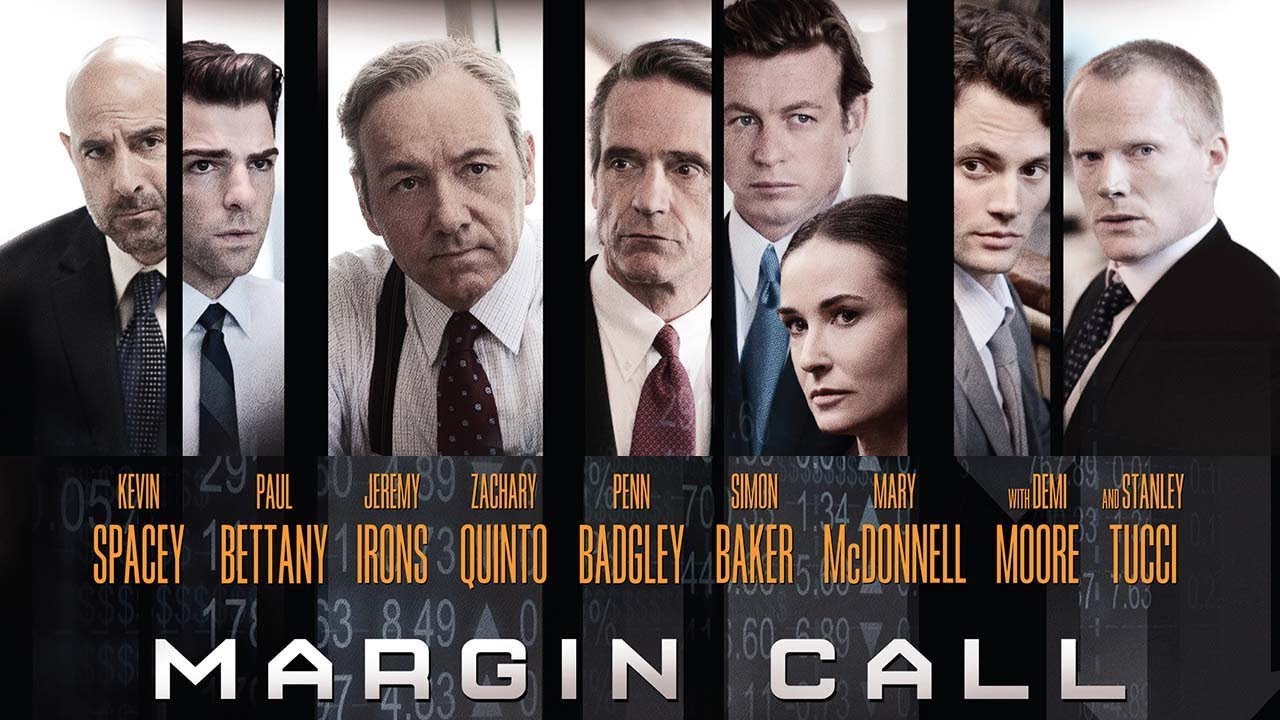
Investors can make bets by promising to buy stock at a higher or lower price than the current day’s valuation.  If all goes well, they never actually have to buy the stock.  They can keep buying and selling the bets with borrowed money without ever having to buy the underlying securities.  But if it does not go well, the investor gets what is known as a margin call and has to come up with the cash.

The financial meltdown of 2008 was like a margin call for America, and we will be paying off that debt for a long time.  This movie, as tightly wound as a thriller, takes us through a fictionalized version of the night when it all tipped over from going well to not going well at an enormous Wall Street company, and it was time to pay the piper and a lot of others as well.

“You guys ever been through this before?” asks Will (Paul Bettany), as some serious looking people in suits start tapping people on the shoulder and saying, “I’m afraid we have to speak with you” to the people in cubicles  “Best to ignore it, keep your head down, go back to work.  Don’t watch.”

“The majority of this floor is being let go today,” says the serious woman in a suit.  She speaks of “certain precautions that may seem punitive.”  She glances down at the paperwork when she speaks of “your — 19 — years” with the (never-named) company.  And then we see people carrying cardboard boxes of belongings out the front door of a shiny skyscraper, their eyes blinking in the unaccustomed sunlight.

This is nothing new, as Will’s comment informs us.  It is a routine, if brutal pruning of the staff.  This is a cutthroat business and periodically some throats get cut.  And periodically Will has to speak to those left behind: “These were good people and they were good at their jobs, but you are better.  We will not think of them again.”  Back to work watching all those screens with all those numbers.

But one of the departed has left something behind.  There is evident irony in the name of the division that has been gutted.  It is the Risk Management group.  And the 19-year veteran who has been shown the door has been working on a new analysis of the firm’s position.  He turns his thumb drive over to the young colleague who has been kept on, Peter Sullivan (Zachary Quinto), a literal rocket scientist with “a PhD in propulsion,” who plugs a few holes in the formula that reveal that the firm is in their terms, “projected losses are greater than the current value of the company.”  In other words, on the verge of collapse.  That is when it gets interesting.  Sullivan has proven that there are going to be some devastating losses.  The question is who will pay for them.

The rest of the long night will be devoted to answering that question.  It is like a long game of musical chairs, except that these people get to decide when to stop the music so they can get to the chairs before everyone else.

The guy at the top is John Tuld (Jeremy Irons).  Given a choice between reputation and money, he has no hesitation in choosing money.  He tells the head of sales, Sam Rogers (Kevin Spacey) to sell the ticking time bomb securities by assuring their clients that they are solid investments, even though Rogers points out that no one will ever trust them again.  “You’re selling something you know has no value.”  “We’re selling to willing buyers at fair market value so that we can survive.”

Rogers is not the only one who raises concerns, moral and financial.  But writer-director J.C. Chandor lets us see when and how each of them topple, and what makes them topple, which turns out to be money.  Dale repeatedly says there is nothing that can get him to go back inside the building and yet there he is, back in the building.  Rogers says he will not sell these risky securities to clients because “you don’t sell anything to anybody unless they’ll come back to you for more.”  But he does.

This could just as easily be set in the scuzzy world of the real-estate salesmen of “Glengarry Glen Ross” or the “leave the gun, take the cannoli” world of “The Godfather.”  Chandor keeps enough of the real story to keep things vivid and meaningful but does not get mired in jargon.  Crisp performances by everyone keep things taut until a surprising detour at the end.  For the first time we leave the world of glass and concrete for an intensely personal moment of loss and grief.  “Our talents have been used for the greater good,” one character says, reminding us that the very selection process that takes people who are capable of more tangible contributions are unable to resist the big money that pays them a many-times multiple for financial engineering over mechanical engineering.  And reminding us, too, that if we let people who care only about money make the decisions they will make decisions that are only about money for them.


(more…)

Related Tags:


Drama DVD/Blu-Ray Inspired by a true story Movies -- format Thriller
Green Lantern

Green Lantern

Posted on June 16, 2011 at 9:52 am

Let’s get right down to it with the superhero essentials checklist.  Cool powers?  Check.  Interesting villain?  Check.  Interesting girlfriend?  Half a check.  Aliens?  Check.  Fancy gala party?  I’m not sure why that appears to be a crucial part of every superhero movie, but it’s here.  Working through some angsty parental issues?  Check.  Special effects and action sequences?  Maybe three-quarters of a check.  Does the superhero outfit avoid looking silly?  Half a check.  Is the 3D worth it?  No check.

Another month, another superhero, this time DC (home of Batman and Superman), not Marvel (home of the Fantastic Four, Iron Man, and Thor).  Hal Jordan (a very buff Ryan Reynolds) is an irresponsible but irresistible rogue and a test pilot for a company that makes planes for the military.  He has an on- and off relationship with the test pilot/executive daughter of the head of the company, Carol Ferris (“Gossip Girl’s” Blake Lively).  When four members of the intergalactic force for peace and justice — think outer space Seal Team 6 — are killed by a creature who looks like a spider made of smoke, their special green lantern rings seek out the successors.  For the first time, a human is invited to join the Green Lanterns.  The alien dies, telling Hal only that he has to use the ring and lantern and say the oath.  Hal tries the only oaths he can think of — pledge of allegiance, He-Man — before the ring and lantern lights up and he gets it right: “In brightest day, in blackest night, No evil shall escape my sight. Let those who worship evil’s might, Beware my power… Green Lantern’s light!“

It is fun as long as you don’t think too hard.  There’s so much nattering about Will versus Fear that it could have been written by Ayn Rand and directed by Leni Riefenstahl.  (Carol would be right at home with Dominique and Dagny.)  The Lanterns’ power includes calling into being anything they can imagine, which undercuts any peril and dramatic tension in the big confrontations.  It makes the struggle internal, one of strategic imagination and determination, not the best idea for a big special effects film.  The bad guys include a nerdy scientist whose exposure to the evil smoke-spider turns him into a misshapen, anger- and jealousy-driven madman, and the smoke-spider, whose surprising connection to the Lanterns makes him even more dangerous. But it seems unfocused, overly fussy and most likely re-cut following a poor reaction to an earlier version — characters like Hal’s nephew and best friend are introduced and then disappear and Angela Bassett barely appears as a scientist.  Mark Strong is a skeptical alien with a ridiculous mustache and even more ridiculous dialog, and the elders look like first-draft Yodas.  And everybody has father issues.  What, no one has a father who’s present and supportive? Aren’t there any mothers left?  Reynolds does fine as Hal but Lively never lives up to her name, swanning around in elegant sheaths and high heels but without any of the wit or energy of Gwenyth Paltrow’s Pepper Potts.  The credit sequence ends with a sneak peek at the villain for the next episode.  Let’s hope they have the will to call up something a little more fearless next time.

(more…)

Related Tags:


3D Action/Adventure Comic book/Comic Strip/Graphic Novel Fantasy Science-Fiction Thriller

Hanna

Posted on April 8, 2011 at 7:15 am

Director Joe Wright is fascinated with Saoirse Ronan’s blue eyes, entirely understandable. Her cerulean gaze is so pure, so clear, so direct, and at the same time knowing and innocent that it is perfect for the role of Hanna, a 16-year-old girl who has been trained as an assassin by her father, Erik (Eric Bana) and lived since she was a baby. They live in a frozen and remote corner of Finland, eating the wild deer and wearing skins to stay warm.

When Erik gives Hanna the choice to leave, here is what she knows: several languages and more than several ways to kill people, to be on guard even when she is asleep, that people will try to capture or kill her, and a fake backstory complete with the names of her school, best friends, and dog. Here is what she does not know: tea kettles and ceiling fans, music, other teenagers, families, small talk, and whether there is anyone she can trust.

She also knows that she is ready to leave Finland and ready to stop pretending to defend herself and do it for real. So Erik puts on a suit and walks off into the snow, leaving Hanna to be captured and fight her way back to meet up with him. Wright, known for classy literary adaptations “Pride and Prejudice” and “Atonement” makes this a thinking person’s action film with stylish fight scenes and a “Bourne”-like existential core. Hanna’s age and inexperience make her vulnerable despite her training. And like all teenagers, she is thrilled and a bit terrified by her discovery that her father did not tell her everything and does not know everything.

Only someone who has spent the past 15 years in a remote, snowed-in corner of Finland will not figure out where this is all going, but there is much to enjoy along the way. There’s a Luc Besson-ish detour as Hanna meets up with a traveling English family and is as flummoxed by their bickering and cultural references as she is beguiled by the song they sing together as they drive. We get our first look at Hanna’s nemesis, CIA hotshot Marissa (Cate Blanchett) in her apartment, all in shades of pewter except for her red hair, brushing her teeth with a ferocity that shows us her steely resolve, as slender and focused as a whippet. Marissa brings in a kinky free-lance agent played by Tom Hollander (Mr. Collins in Wright’s “Pride and Prejudice”).

Wright sets actions scenes on a loading dock and in a fairytale amusement park. A Hansel and Gretel candy house is a literally upside-down version of the snow-covered cabin she shared with her father. The references to Grimm work as well as the gritty chases and hand-to-hand combat. It’s a stylish thriller with a lot to watch and a lot to ponder.

(more…)

Related Tags:


Action/Adventure Spies Thriller

Source Code

Posted on March 31, 2011 at 6:08 pm

B+
Lowest Recommended Age: Middle School
MPAA Rating: Rated PG-13 for some violence including disturbing images, and for language
Profanity: Some strong language
Alcohol/ Drugs: None
Violence/ Scariness: Intense peril and violence, bombs, huge explosions, characters injured and killed, brief graphic images of wounded character
Diversity Issues: Brief reference to racial profiling
Date Released to Theaters: April 1, 2011
Date Released to DVD: July 26, 2011
Amazon.com ASIN: B0053F042G

Director Duncan Jones (“Moon”) has produced a first-rate thriller with Jake Gyllenhaal as Captain Colter Stevens, sent back in time and into the body of a man on a commuter train eight minutes before it will explode, to see if he can find the bomber.

At first, we are as confused as Stevens, as he comes to on a Chicago-bound commuter train, apparently mid-conversation with a beautiful woman (Michelle Monaghan), with no idea of who or where he is. He goes into the bathroom and sees someone else’s face in the mirror, as in the old television series “Quantum Leap.” And then everything explodes and he is in some sort of capsule, talking to an officer in some sort of operations center on the other side of a window, (Vera Farmiga as Colleen Goodwin), trying to understand his mission though she answers most of his questions with “not relevant.” Her sense of urgency is clear, though. He must find the bomber on the train before he makes it into downtown Chicago to set off an even deadlier bomb.

Like an action-adventure version of “Groundhog Day,” Stevens is sent back over and over to re-live the same eight minutes to try to notice as much as he can about the people around him. He is in the past, Goodwin tells him. Those events have happened. There is nothing he can do to stop the bomber from killing everyone on the train, including the man whose body he is temporarily occupying. Those people are already dead. His mission is limited to identifying the bomber so that he can prevent the even greater tragedy that is yet to happen. As Stevens goes back and back again over the final eight minutes before the explosion, he is able to learn from his mistakes and start over. But it also means that whatever he has to do must be accomplished in eight minutes. And he re-experiences those minutes over and over again, learning more about what is happening on the train, and in his reports to Goodwin more about what the program he is working for it all about, his ideas about what his mission entails begin to enlarge.

Jones makes each replay different and enthralling as we work with Stevens to find the bomber and then to solve the bigger issues he uncovers as well. It is fast, fun, and exciting and bolstered with a top-notch cast to make some of the wilder elements of the science fiction work (though no one ever really figures out how to manage temporal anomalies). Gyllenhaal is believably dashing, dedicated, and dreamy, and Monaghan is believably someone it would take far less than eight minutes to fall for. Jeffrey Wright clearly relishes his role as the single-minded creator of the system that sends Stevens back in time and Farmiga is ineffably moving as the officer whose conflicts about what she is asking Stevens to do deepen as she keeps hitting the rewind button. Jones shows a sure hand in delivering on the concept and the action but he has already mastered pacing, story-telling, and heart. He makes each of the replays vital and engaging and knows just when to lighten things up. And he even sneaks in an affectionate “Quantum Leap” reference, with Scott Bakula providing the voice of Stevens’ father and even throwing in a signature “Oh boy.” It is the wit and attention to detail (pay close attention to that last shot) that makes this story worth going back to a few extra times.

(more…)

Related Tags:


Action/Adventure DVD/Blu-Ray Pick of the Week Fantasy Romance Science-Fiction Thriller
THE MOVIE MOM® is a registered trademark of Nell Minow. Use of the mark without express consent from Nell Minow constitutes trademark infringement and unfair competition in violation of federal and state laws. All material © Nell Minow 1995-2025, all rights reserved, and no use or republication is permitted without explicit permission. This site hosts Nell Minow’s Movie Mom® archive, with material that originally appeared on Yahoo! Movies, Beliefnet, and other sources. Much of her new material can be found at Rogerebert.com, Huffington Post, and WheretoWatch. Her books include The Movie Mom’s Guide to Family Movies and 101 Must-See Movie Moments, and she can be heard each week on radio stations across the country.

Website Designed by Max LaZebnik