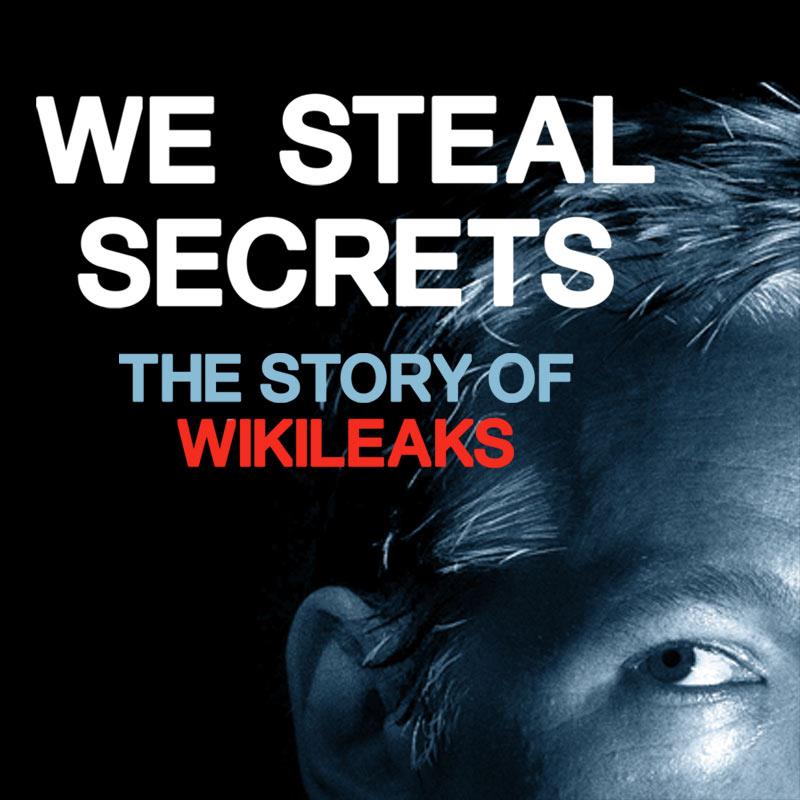
We Steal Secrets: The Story Of Wikileaks

Posted on May 31, 2013 at 8:07 am

A-
Lowest Recommended Age: Mature High Schooler
MPAA Rating: Rated R for some disturbing violent images, language, and sexual material
Profanity: Some very strong language
Alcohol/ Drugs: Substance abuse references
Violence/ Scariness: War violence
Diversity Issues: Diverse characters, homophobia
Date Released to Theaters: May 31, 2013
Amazon.com ASIN: B00CUWL1VI

We-Steal-Secrets-The-Story-of-WikiLeaks-movie-poster-2The internet has made it possible to share all of the world’s knowledge. Sometimes that is a good thing, whether we’re able to track down just the exact item we want at the lowest possible price or make micro-loans to entrepreneurs in emerging economies, tracking down lost friends and family, or crowd-sourcing complex problems. Sometimes it is a bad thing as when personal or embarrassing information we think of as private becomes very public. In essence, it is great when we have access to other people’s information; not so great when they have access to ours.

So, who decides what stays secret? This brilliant documentary from Alex Gibney (“Enron: The Smartest Guys in the Room,” “Taxi to the Dark Side”) explores that question through the stories of two mesmerizing personalities, itself a meta-narrative as the documentarian is exposing the secrets of the secret-sharers.

In 1989, a worm infected more than 300,000 computer systems throughout the world.  Like a real-life “WarGames,” it was the work of a smart-alecky teenager.  It was Julian Assange, who would grow up to found Wikileaks, a website set up to receive and make public confidential material, protecting the people — whistle-blowers or thieves, depending on your point of view — who provided it.

And then there was Bradley Manning, a private in the U.S. military.  Like Assange, he had exceptional computer skills.  He had personal and philosophical reasons to be angry at the U.S. government.  He was struggling with issues of sexuality and gender identity.  He was isolated.  And no one thought he was a risk.

http://www.youtube.com/watch?v=rVYl9NiW3wM

The combination was like gasoline and a match, or maybe the Enola Gay and Fat Man.  This is the story of two men who think of themselves as following in the tradition of Daniel Ellsberg in exposing the secrets of military operations, while at the same time they are exposing the vulnerability of our systems for keeping information restricted.  If what is released brings to light shameful violations of core principles of honor and integrity, is it honorable to make it public?  What if it exposes our operations to our enemies?

Gibney’s portrayal is itself a model of even-handed, serious consideration of these issues, as highly principled and professional organizations (the New York Times and The Guardian) play a responsible filtering function in sorting through “a mountain of secrets dumped into the public domain” and providing perspective and judgment, and as Assange and Manning themselves find their own secrets exposed to the world and are charged with crimes that have led to Manning’s being imprisoned under the severest of conditions and Assange essentially a prisoner unable to leave the Ecuadorian embassy in London without being extradited to Sweden to be prosecuted for sexual assault.  The film explains that 9/11 was a “watershed moment for the world of secrets,” for both keepers and sharers.  There was an unprecedented need to track terrorists and that meant an unprecedented sharing of information.  And that meant that a young private had easy access to endless classified material.  It was routine for the bored young soldiers to bring in blank CD’s to download music while they worked.  It appeared that is what he was doing, but he was downloading hundreds of thousands of documents.

“Was it once not considered patriotic to stand up to our government when it’s wrong?” someone asks.  Well, maybe.  But not at the time.  There is a lot of blaming the messenger for the bad news in this movie, perhaps most sickeningly in the attacks on the women who have accused Assange of abuse.  And, as is so often the case, heroes are not the lantern-jawed Boy Scouts we want them to be.  That’s in the movies.  No fictional story could have come up with the almost sociopathic arrogance of Assange, who likes to brag that “I’m a combative person so I like crushing bastards” or the anguished Manning, whose betrayal of his country is matched by his betrayal by the one person he trusted, an online-only friend who gave his name to the authorities.

The government will always try to control information, whether it is George W. Bush prohibiting the release of images of coffins of dead soldiers or protecting the names of CIA field personnel.  The government will aways try to get information, whether it is tracking down Bin Laden or seizing the phone records of reporters.  This thoughtful, balanced, essential examination of the clash between privacy and transparency exemplifies the best that intelligence, dedication, and honor can bring to illuminating these issues — and the devastating impact of leaving those decisions to the arrogant and unstable.

Parents should know that this film includes some images of war violence and discussions of sexual assault and gender identity issues.

Family discussion: How do we “destroy corruption?”  How do we achieve “a more civilized and just society?”  Is there a way to keep secrets?  Should there be?

If you like this, try: “The Most Dangerous Man in the America: Daniel Ellsberg and the Pentagon Papers” and “Gatekeepers,” with the former heads of the Israeli secret service revealing their own most classified secrets about shameful episodes in the conduct of their efforts to keep Israel safe.

Related Tags:


Documentary Movies -- format

Hava Nagila

Posted on April 25, 2013 at 4:57 pm

B+
Lowest Recommended Age: 4th - 6th Grades
MPAA Rating: Not rated
Profanity: None
Alcohol/ Drugs: None
Violence/ Scariness: References to the Holocaust
Diversity Issues: A theme of the movie
Date Released to Theaters: April 26, 2013
Amazon.com ASIN: B00BEIYLGQ

It is annoying, frustrating, embarrassing, and irresistible.  It is a tradition that has transcended its origins and yet calls us back to the complicated feelings of our past.

All of which makes it a perfect Rorschach test and intriguing metaphor for many elements of the contemporary Jewish identity.

“Hava Nagila” is a song that has been performed by pretty nearly everyone.  Harry Belafonte had one of his biggest hits — he says the two songs people alway ask him for are “Day-O” and “Hava Nagila.” It was also a big hit for Connie Francis (she jokes that when asked if she is Jewish, she says, “Ten percent on my manager’s side.”).  Glen Campbell sang it.  Parodist Alan “Camp Granada” Sherman sang it in a duet with opera star Roberta Peters.  A highlight of the movie is the clips from “The Simpsons,” the Muppets, Monty Python, “Curb Your Enthusiasm,” “House,” and performers from China, Iran, Egypt, Thailand, the UK, Serbia, Estonia, South Korea, Mexico, and, wearing cowboy hats and bandanas, Texas.

Unquestionably the strangest version is only about 30 second long and features yodeling.  It’s the one music scholar Josh Kum calls “both an embrace and a refusal” and “the smartest song about Jewish identity I’ve ever heard.” It’s by Bob Dylan.

We learn something of “Hava Nagila’s” origins as a “niggun” (wordless song) and its evolution into an anthem of the post-WWII era of suburban Jewish simchas (celebrations of happy occasions).  Like “Hokey Pokey” and “The Macarena,” it benefits from its catchy tune, limited range, and association with a dance that can be performed by pre-schoolers and grandparents.  Like the song it celebrates, this film can be annoying, but it is hard to resist.  As one person says in this documentary about “Hava Nagila,” “they played it at my bar mitzvah — but not at my wedding!”  It is clear that when he was old enough to call the shots, he did not want to hear that corny old song again.  And yet, we will not be surprised if Hava Nagila returns when his own children become b’nai mitzvot.  Bet you a quarter you find yourself humming it.

Parents should know that this film includes references to the Holocaust.

Family discussion: Which version of the song do you like best?  Why?  Why do you think it is so enduringly popular?

If you like this, try: “The Tribe” and some of the movies and performers featured in this film.

Related Tags:


Documentary Movies -- format Music

Disconnect

Posted on April 18, 2013 at 6:00 pm

B+
Lowest Recommended Age: Mature High Schooler
MPAA Rating: Rate R for sexual content, some graphic nudity, language, violence, and drug use, some involving teens
Profanity: Very strong language
Alcohol/ Drugs: Drinking, drug use
Violence/ Scariness: Tense emotional confrontations, some violence, gun
Diversity Issues: Diverse characters
Date Released to Theaters: April 19, 2013

Viewers will spend much of this movie mentally imploring the characters on screen not to do what it is all too disturbingly clear that they are ineluctably drawn to do.  This is a very scary movie with three stories about the disastrous consequences of revealing too much online.  And the scariest part is off-line.  Far more devastating than the painful consequences of the bad choices they make is the reason they make them, the yearning for connection.

Grief over the death of a baby drives a couple apart and they separately seek online support to make them feel less helpless and isolated and are ensnared by an identity thief.  A devoted but distracted father does not know that his shy, sensitive son is being catfished by a couple of classmates, much less that the boy .  An ambitious television reporter wants to write a story about an underage online sex worker, and that means she must get him to trust her.  In their own ways, each of them is seducing the other for professional reasons.

These fact-based stories could easily come across as cheesy Lifetime dramas, but documentary director Henry-Alex Rubin (“Murderball”) gives it an intimate, natural tone.  Sensitive performances from the entire cast are absorbing, especially Jason Bateman in his first full-on dramatic role as the father of the boy who thinks he has an online girlfriend and that she has asked him to send her a nude photo and Frank Grillo as the single father of one of the boys whose prank turns tragic.

The weakest of the stories involves the grieving couple, who decide to take things into their own hands when identify theft drives them to the brink of financial ruin and the revelations of their online activities drive them to the brink of marital disaster.  But even that storyline has some gripping moments as the experience shocks them into talking to each other with more singularity of purpose and honesty than they have shared in a long time.  The journalist’s involvement with the underage online sex worker has some superficially sleazy moments, but Andrea Riseborough (Wallis Simpson in Madonna’s “W.E.”) is  excellent in showing us the character’s struggle with ambition, compassion, professionalism, and vulnerability.  “It’s my job!” various characters cry out at different moments in the movie.  It is just a way of declaring how that makes them responsible, and how it defines them.

As we have had to develop a new term, catfishing, to describe online relationships based on fictional character attributes, and even an entire television series  on the subject, we are only just beginning to understand the way our brains are constructed to fill in the missing elements of these connections with elements from our own subconscious, a sort of romantic Rorschach test.   What draws us in to these stories is the recognition that we bring so much hope and need to these online connections.  But what keeps us thinking afterward is its reminder that while the in-person, real-life connections are what scare us most, it is because that is what we long for so deeply.

Parents should know that this cautionary tale includes nudity, explicit sexual references, very strong language, drinking and drugs, and underage sex workers.

Family discussion: Does this movie make you think differently about your online presence?  How should the rules be changed?  Why was it easier for these people to open up online than in person?

If you like this, try: “Trust”


Related Tags:


Drama Movies -- format

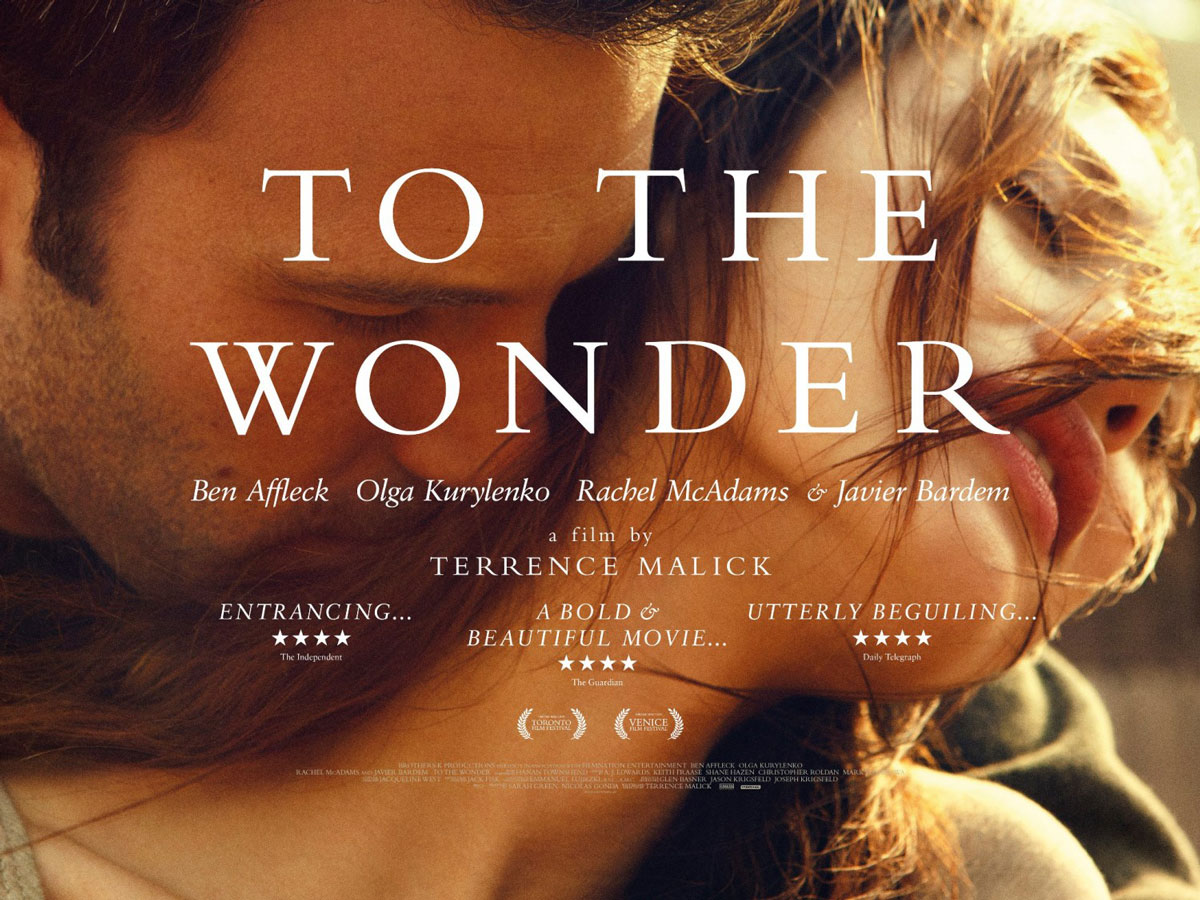
To the Wonder

Posted on April 11, 2013 at 5:51 pm

B-
Lowest Recommended Age: Mature High Schooler
MPAA Rating: Rated R for some sexuality/nudity
Profanity: None
Alcohol/ Drugs: Drinking
Violence/ Scariness: Tense confrontations
Diversity Issues: None
Date Released to Theaters: April 12, 2013
Amazon.com ASIN: B00BU22HCQ

Director Terrence Malick has made a movie for those fans who loved “Tree of Life” but thought it was too linear and easy to follow.

“To the Wonder” is an impressionistic story of love and loss.  Theoretically it stars Ben Affleck, Rachel McAdams, Javier Bardem, and Olga Kurylenko, but in reality the star is the sun,.  It seems to be the focus of almost every exquisitely framed shot, with sunlight flaring always just so through the meticulously arranged tree branches behind the beautiful woman who loves to twirl.  This movie has a lot of sunlight and a lot of twirling.  Also a lot of what I will call affectionate rough-housing, which I think — can’t be sure about anything here — is the primary, if middle-school-ish, way these characters indicate that they like each other.

It does not have a lot of dialogue, and what conversations we do overhear are almost incidental.  The talk we hear is mostly the murmured, diary-like narration of a French single mother who falls in love with an American and brings her daughter to live with him in a barren house in a barren landscape that is in sharp contrast with the “wonder” of the rich environment she left behind.  Malick seems to have a devilish pleasure in withholding information.  The daughter, Tatiana, is the only character whose name we are allowed to know.

It is maddeningly opaque at times but undeniably lyrical.  It does not just break free from narrative; it explodes it into an almost-pointillist kaleidoscope of images, whispers, and detours.  Where “Tree of Life” had a dinosaur, “To the Wonder” has a zig into an underwater scene with sea turtles before it zags into a separate segment (I can’t say story) about a sad priest (Bardem).

If is more tone poem than movie, it is an intriguing one, touching on themes of connection and disconnection, love and betrayal, at the level of society and individuals.  At times it is annoyingly opaque, but there are also moments of stunning beauty.  If he continues down this road, Malick’s next movie will be delivered to the theater in individual frames, to be tossed toward the screen in random order, and many of them will feature sun flares.  But I’ll still go to see it.

Parents should know that this movie includes sexual references and situations, briefly explicit, including adultery, nudity, smoking, and drinking.

Family discussion:  Why is the story told through narration instead of dialogue?  How does the issue of contamination of the soil and water relate to the story?  Why is the house unfurnished?

If you like this, try: “Tree of Life”


Parents should know that this movie includes some nudity and explicit sexual situations, including adultery.  Characters drink alcohol.

Related Tags:


Drama Movies -- format

The Host

Posted on March 28, 2013 at 6:00 pm

C-
Lowest Recommended Age: Middle School
MPAA Rating: PG-13 for some sensuality and violence
Profanity: Some mild language
Alcohol/ Drugs: Drinking
Violence/ Scariness: Extended sci-fi peril and violence, characters injured and killed, attempted suicide, character shot with gun, some disturbing images
Diversity Issues: A theme of the movie
Date Released to Theaters: March 29, 2013
Amazon.com ASIN: B0090SI4OC

The author of the Twilight series was showing signs of running out of ideas around the middle of the second volume, and this latest story shows more evidence of the pressure of producing a new series than anything approaching inspiration. Howlers that can slide by in print are impossible to ignore in a thuddingly dumb story of an alien takeover and the girl who is able to hold onto her own consciousness as the “host” of glowing millipede from outer space.

Problem #1: If you’re going to make a movie about aliens taking over human bodies, the indicator of possession should not be glowing blue eyes that eliminate a critical element of the actors’ ability to communicate.

Melanie Stryder (Saoirse Ronan) is one of the few remaining humans who have not been overtaken by alien invaders who have inhabited almost every person on earth and eliminated suffering, illness,  and conflict — also passion, independence, innovation, and any notion of the individual.  Everything is smooth and civil and orderly.  It is like the whole planet moves to Muzak.  But they have excellent healthcare.

Melanie is captured by the aliens, led by Seeker, who heal her injuries and implant one of their aliens inside her.  But instead of taking over her consciousness, the invader, known as Wanderer, exists side by side, leading to a series of back-and-forth conversations intended to be touching but are more often mundane.  She’s like a bad ventriloquist with two invisible dummies.  It is clunky and dull when she talks to herself but not much better when the characters talk to one another.  “What’s it like in there?” a character asks Melanie/Wanda.  “It’s crowded.”  “Kiss me like you want to get slapped.”

Ronan is a superb actress, but even she cannot make real the idea of these two equally drippy characters as distinctive individuals, especially after she hides out with a secret rebel group led by Jeb (William Hurt), and in “Twilight” love triangle  fashion becomes involved with two different cute guys, one who loves Melanie and one who loves the Wanderer, now known as Wanda.  “If you could hold me — me — in your hand, you’d be disgusted,” Wanda explains to the guy who wants to kiss her.  When he finally does see what the alien looks like and tries to gaze tenderly at a glowing bug is just silly.

And then things really go nuts as the Seeker (Diane Kruger) goes after the human rebels, insisting, “I am not weak.  I am in control.”  Kruger is more believable as an alien than she usually is as a human, at least until a ridiculous twist near the end.  Melanie had two voices in her head.  I only had one, but it was clearly telling me that this movie is a mess.

This rebel group seems weirdly retro, with almost no women, and a social structure that resembles the 18th century.

Parents should know that this film includes extended sci-fi style peril and violence with some disturbing images, a car crash, aliens, possession, characters injured, some teen kissing and sensual embraces.

Family discussion: Why could Melanie and Wanda exist together?  How do Ian and Jared see her differently?  Why are the aliens able to achieve societal benefits humans have failed to? How does she earn the trust of the humans?  What do you think will happen next?

If you like this, try: “Invasion of the Body Snatchers” and “I Am Number Four” and the book by Stephenie Meyer


Related Tags:


Based on a book Movies -- format Romance Series/Sequel
THE MOVIE MOM® is a registered trademark of Nell Minow. Use of the mark without express consent from Nell Minow constitutes trademark infringement and unfair competition in violation of federal and state laws. All material © Nell Minow 1995-2026, all rights reserved, and no use or republication is permitted without explicit permission. This site hosts Nell Minow’s Movie Mom® archive, with material that originally appeared on Yahoo! Movies, Beliefnet, and other sources. Much of her new material can be found at Rogerebert.com, Huffington Post, and WheretoWatch. Her books include The Movie Mom’s Guide to Family Movies and 101 Must-See Movie Moments, and she can be heard each week on radio stations across the country.

Website Designed by Max LaZebnik