

What kind of movie do you feel like?

Ask Movie Mom

Find the Perfect Movie

Good Luck Chuck

Posted on January 15, 2008 at 8:00 am

At age 10, following an awkward Spin the Bottle encounter, a little goth girl puts a hex on Charlie so that he will be surrounded by love but never find it himself. But it is the audience who will feel cursed. It is hard to tell which is more painfully difficult to sit through — the awful premise of this film or the dull filler that occupies the rest of the time onscreen.


Charlie grows up into stand-up comedian Dane Cook and becomes a dentist. When word gets out that sex with him is a quicker path to marriage than eHarmony, every gorgeous woman in town wants to sleep with him so that she can find her one true love as soon as it is over. His best friend Stu (Tony award-winner Dan Fogler), a plastic surgeon specializing in breast enhancement, disgusting, sex-obsessed conversation, and having sex with citrus, persuades Charlie that this is practically a public service, helping women to find love while having lots and lots and lots of sex. Charlie gives in and has sex with just about every unattached female in the state.


And then he meets the adorably klutzy Cam (Jessica Alba), who runs the penguin house at the local equivalent of Sea World. But he worries that if he has sex with her, she’ll meet the man of her dreams. So he has to find a way to romance her without sex.


Cook is an observational comic who thinks that referring to something is the same as making a joke about it. He is physically energetic but intellectually lazy. His appeal comes from his utter lack of embarrassment and complete absence of boundaries, making college kids feel understood and connected. His stand-up routine is the equivalent of a Facebook page. This movie is like one of his jokes, all set-up, and then a lot of energy in the hopes the audience won’t notice there is no real pay-off. We get that it is supposed to be funny that Charlie has a lot of sex with pretty girls. But they drag the joke on forever, showing Cook in a dozen different positions, not because it is particularly funny or sexy but because they have 90 minutes to fill and hope we will be distracted by all those breasts. Any movie that has to fall back on a climactic race to the airport for drama and having sex with food for comedy has run out of ideas before it began. Oh, and please don’t bother to stay for the last little improvised “joke” over the credits.


One more aspect of this film that is particularly troubling is that it is an extremely raunchy R-rated film but its humor is so juvenile its most likely audience is young teenagers, the only group likely to find it funny just because it has naughty words and naked ladies. Anyone old enough to see this movie is likely to be too old to find much to laugh at.

Parents should know that this film has extremely explicit and crude sexual references and situations and a great deal of nudity that would rate an NC-17 if in anything but a comedy. Characters use very strong and vulgar language. There is comic violence (no one badly hurt). Characters drink, including one who drinks to deal with stress, and one character is a pothead, a frequent source of humor.


Audiences who see this movie should talk about which time-honored techniques the film uses to keep Charlie a sympathetic character, despite some crass, selfish, and exploitive behavior. What made him see Cam differently?


Audiences who enjoy this film will also enjoy The 40-Year-Old Virgin and Knocked Up.

Mr. Woodcock

Posted on January 15, 2008 at 8:00 am

If Sophocles knew that this would be the result, he would never have allowed “Oedipus” to see the light of day. “Mr. Woodcock” is an Oedipal comedy about a man who loves his mother and who becomes very, very upset when she falls for the man who terrorized his childhood, his middle school PE teacher.


John Farley (Seann William Scott) is now a very successful author with a self-help book about letting go of the past. When his Nebraska home town wants to give him its highest honor, he cancels his book tour obligations and flies home.


That’s when he finds out that his mother is now in love with the PE teacher whose pedagogical technique consisted of humiliation and harassment. Or, maybe he was just a bully.


John comes home to accept an award and instantly all of his carefully-built confidence and maturity evaporate and the idea of breaking up his mother’s engagement to Mr. Woodcock becomes all-consuming.


And so we go from a brief opening scene showing John being humiliated by Mr. Woodcock in gym class to an entire movie that humiliates him in just about every possible context from being stuck under the bed as Mr. Woodcock and his mother make loud, passionate love to having a chunk of hair shaved off at Mr. Woodcock’s barber, dunking Mr. Woodcock’s whistle in the toilet, and being a bad sport in cute county fair competitions. Or, rather, cornpetitions — this movie’s idea of witty wordplay is to substitute the word “corn” for every possible syllable.


Thornton and Scott have nothing to work with here. Thornton carries over the mean thing that was already not funny in “The Bad News Bears” and “The School for Scoundrels,” and Scott has to do his best with a character whose characteristics shift from one scene to the next. Poor Sarandon is limited to 50’s sit-com lines like “Isn’t that sweet?” and “Can’t you two try to get along?”

The pacing is slack and slapdash, the comedy based primarily on cruelty, injury, intimidation, and humiliation. It also throws in some irresponsibility, selfishness, alcoholism, and general skankiness. Then, instead of ending, it all just gives up with a sort of “never mind” ending that even Mr. Woodcock would have to call a foul on. Indeed, that is the best possible assessment of the movie as a whole.

Parents should know that this film has extremely strong material for a PG-13, right up at the edge of an R. It includes very crude and insulting epithets and very vulgar sexual humor and situations, including John hiding under the bed as his mother and Jasper have loud sex. Woodcock humiliates his students and others by calling them “ladies” and impugning their manhood. Characters drink (including jokes about alcoholism and scenes in bars), smoke, and use very strong and crude language include a vulgar word for sexual organs used as an insult and a joke about child molesting. There is a good deal of comic violence, with many characters getting hit on the head and crotch by various blunt instruments.


Families who see this movie should talk about why John and his mother saw Mr. Woodcock so differently.

Families who enjoy this movie will also enjoy Anchorman – The Legend Of Ron Burgundy and Old School (both with mature material).

Flanagan’s Infuriating Mis-Read of “Juno”

Posted on January 14, 2008 at 7:54 am

Caitlan Flanagan’s elegant prose and exceptional grasp of vital detail make it easy to miss the single most important fact about what she writes — her absence of any insight about anything outside her own experience and her own head. In the New York Times, she wrote an op-ed about the movie Juno that has a mind-boggling misread of the movie’s conclusion.

The final scene of the movie shows Juno and her boyfriend returned to their carefree adolescence, the baby — safely in the hands of his rapturous and responsible new mother — all but forgotten.

On the contrary. The final scene is bittersweet. The screenplay notes their “ambiguous smiles” at each other. Everyone in the film is changed in unexpected ways as a result of the sexual encounter that begins the film, one which, as Paulie reminds her, was not the impulsive act of a bored teenager but a deliberate choice. And that conversation in particular and the film as a whole make clear that Juno fully recognizes the consequences of her choice for herself and for her child.
Flanagan’s review of a new book about Katie Couric appears in the current issue of “The Atlantic.” As usual, the first third of the piece is not about the book or about Katie Couric but about Flanagan herself and how she used to feel watching the pre-Couric “Today Show” when she was in college. As usual, when she does get to the topic she is supposed to be discussing whatever she has to say about Couric is more about her than it is about her subject. It would be one thing if she decided to be this generation’s Joyce Maynard, obsessive self-awareness redeemed by felicitious writing, provocative opinions, and entertaining candor. But her self-awareness does not extend to awareness of how limited her vision is. She cannot keep from extrapolating every thought and feeling to her entire generation or to women everywhere.
I was sorry to see, at the end of the op-ed, a note that Flanagan is working on a book about “the emotional lives of pubescent girls.” I hope she lets them speak for themselves instead of making her own emotional life the template for everyone else.

J.J. Abrams: “Sometimes Mystery is More Important than Knowledge”

Posted on January 11, 2008 at 12:00 pm

At Ted Talks, J.J. Abrams spoke about his lifelong love of mystery because of its “infinite possibility and a sense of potential” and how that passion influences his creation of stories like Lost and the upcoming movie “Cloverfield.”

And here is the first trailer for “Cloverfield, ” a sublime example of a Mystery Box:

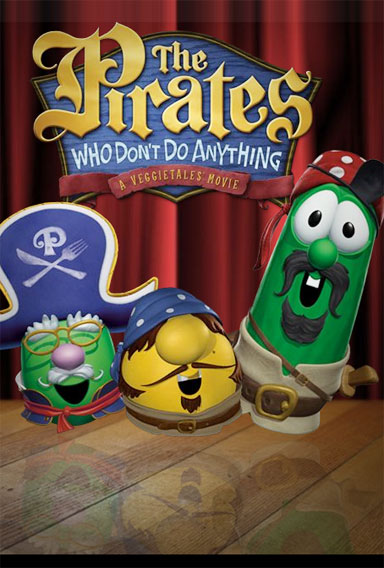
The Pirates Who Don’t Do Anything-A Veggie Tales Movie

Posted on January 11, 2008 at 9:14 am

B-
Lowest Recommended Age: Preschool
MPAA Rating: G
Profanity: None
Nudity/ Sex: Brief potty humor
Alcohol/ Drugs: None
Violence/ Scariness: Some mild peril and briefly scary monsters
Diversity Issues: None
Date Released to Theaters: January 11, 2008

veggiepirates.jpgThe Veggie Tales have produced a series of popular computer-animated videos for children and their families, with fruit and vegetable-inspired characters in engaging and funny stories with gentle moral overtones. Their new feature film does not mention God, as the videos do (briefly but explicitly). It is a fable-like story of three unlikely heros who find themselves called upon to rescue a captured prince and princess. They have been captured by their evil pirate uncle, who is planning to usurp the throne. We know he must be a bad guy because like all classic movie villains, he has a deep voice with an English accent. Unlike the other characters, he also has arms and legs, or rather one leg and one peg.
Princess Eloise, in a Princess Leia-like desperate call for help, throws a golden ball into the ocean and tells it to find her some heroes. But the people, or rather, vegetables it finds do not seem very heroic and certainly do not think of themselves that way. They are “cabin boys” (waiters) in a pirate-themed dinner theater called “Pieces of Ate” who can’t even manage to get up the nerve to try out for the show. Elliot is afraid of so many things that he keeps a fight list. Sedgewick is lazy and thinks trying is too much work. And George, who has the husky cadences of a Borscht Belt comic, does not respect himself and realizes that his children do not respect him, either.
But the golden ball finds them and soon they find themselves on a rowboat in the ocean, on their way to rescue Princess Eloise and her brother Prince Alexander. Each of our trio will face important challenges and learn important lessons. And of course there will be a little adventure and a lot of silliness and a couple of musical numbers along the way.
The Veggie Tales’ colorful but limited animation can seem static on the big screen, and children used adventures that conclude in a brisk half hour may find this feature film a little long. But the gentle humor and equally gentle lessons will be appealing to younger children and long-time fans.

(more…)