
SDCC 2018: Women in Hollywood, Location Managers, Superhero Composers, Top Sitcoms, and A Motion-Capture Monster

SDCC 2018: Women in Hollywood, Location Managers, Superhero Composers, Top Sitcoms, and A Motion-Capture Monster

Posted on July 29, 2018 at 8:00 am

Some of what I saw at San Diego Comic-Con 2018, with excerpts from my coverage at Rogerebert.com and Thecredits.org:

Behind the scenes of The Big Bang Theory, The Good Place, and Crazy Ex-Girlfriend.
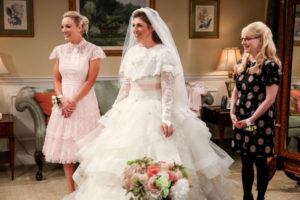
Photo by Michael Yarish/CBS via Getty Images Copyright 2018

Though it was billed as a panel of “The Big Bang Theory” writers, two of the stars showed up, Kunal Nayyar and Mayim Bialik.

Bialik said about the dress Sheldon described on the show as “looking like a pile of swans,” “We wanted Amy to have a dress that embodied all of her dreams and wishes. Why have just one? If she loves it, it’s not going to look silly.” Nayyar was not impressed with her description of the difficulties of the hoop skirt. “Did you have to ride a seahorse as Aquaman?”

On “The Good Place,”

Kristen Bell (Eleanor) envies her character’s forthright snark. “Eleanor is the ticker tape in my head of nasty, sassy things, not necessarily that I want to say, but I’m definitely thinking about anyone that I see. I don’t find that I get good results in real life when I say that, and I’m looking for good results, guys. I’m looking for smiles and happiness. And so I don’t say them but I do share that wicked, dark sensibility with Eleanor.”

They found Jumanji in Hawaii, Skull Island in Vietnam, Hogwarts in England, and Wakanda in South Africa. The script calls for a 1970’s gas station or a Jane Austen-era house of an earl or the topography of another planet? Location scouts are the visual artists and logistical wizards who find the places that you see on the screen and oversee all of the details to make sure the crew has what they need and that, like Boy Scouts, they leave the place better than they found it. A panel of location managers talked about finding a way for three helicopters to land in London’s Trafalgar Square. Their job is to take the creative vision of the writer, director, and production designer and “turn it into reality. We give them options, narrow it down, and then handle all of the permits, trashcans, port-a-potties, places to prepare and serve food, and parking spaces” for a crew that could include hundreds of people and all of their equipment. “It’s kind of like a moving circus.” They have to coordinate with local police and fire crews and make sure the area is safe for the cast and crew. “And most important,” he said, “is preservation. We leave it the way it was, if not better.” Sometimes pre-production schedules are so long that they come on board before the director, and just do the best they can, based on the script, preparing a number of options to present when the director is selected.

Composers talked about creating music for superheroes to save the world by.

Christophe Beck composed the music for the “Ant-Man” movies, matching the tone of the movie’s visuals and storyline. “It had to be quirky and off-beat but still making sure it was in the Marvel universe.” He explained that most popular music is in four beats to the bar, but he created this score in 7/8. “There’s like an extra beat in every bar.” For the Wasp character, he did five beats to the bar “to give her forward movement and great energy.” He found himself creating “a darker version of the theme” that was not right for the film but matched the end credit sequence.

I saw two panels of women working in Hollywood.
Copyright Nell Minow 2018

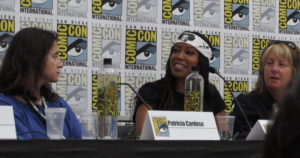
There was some good news at Leslie Combemale’s third annual Women Rocking Hollywood panel at San Diego Comic-Con. Women in Film LA director Kirsten Schaffer told the packed room that in the era of #MeToo and inclusion riders, “every studio and network has a program” to encourage and support women at every level of film production. When studios were invited sign up for WIF’s Reframe initiative, which is designed to work inside the system through conversations, resources, and data to assess progress, 35 immediately agreed. WIF is also going to be issuing a gender parity stamp—“think LEED certified or USDA organic—to let the public know which productions are close to 50/50. Their “Flip the Script” series of short films uses humor and empathy to show what women in film productions go through by using actual dialogue but switching the gender of the characters…A panel called “You Do What? Women in Film Production” featured Lauren Haroutunian (cinematographer, “Fangirling”), Alicia Varela (first AC, “Video Game High School”), Lolita Ritmanis (composer, “Batman Beyond”), Sylwia Dudzinska (AD, “You’re the Worst”), and Maritte Go (line producer, “Sleight”) discussing work in traditionally male-dominated fields of production, moderated by publicist Brittany Sandler.

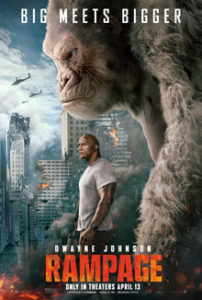
And I really loved talking to Jason Liles about playing a gorilla in “Rampage” and two monsters in the upcoming “Godzilla” movie.
Copyright New Line Cinema 2018

I started studying my butt off, going to the L.A. Zoo just watching gorillas for hours, watching them be still but also watching them be alive in stillness. That’s really key, not just running around but just being. I watched “Planet of the Apes” behind the scenes, “King Kong” behind the scenes and anything with Andy Serkis or Terry Notary. I watched a lot of Koko the gorilla who learned to sign, every bit of footage I could find on her, and tons of documentaries. You just type in “gorilla documentary” on YouTube. It’s incredible the amount of stuff that comes up. So I found what was the most useful for me and just rewatched it and studied it.

Then I got brought on to the film and trained with Terry Notary who is King Kong and Kong in “Kong: Skull Island” and Rocket in “Planet of the Apes.” He’s done so many characters and coached some incredible performances out of actors. He trained me for three weeks in the Santa Monica mountains on all fours, hundreds of hours of miles with these arm extensions, learning to engage my senses as a gorilla and strip down what makes me Jason and a man and an American and a human and just be an ape. So it was a huge process. He got it to where I could basically lucid dream while awake as a gorilla. I can’t even describe it; I felt like I could fly at some moments. It was crazy.

Related Tags:


Festivals

Mental Illness in Media Can Be Therapeutic: Angelica Jade Bastien

Posted on December 16, 2017 at 9:30 pm

I’ve written before about my admiration for writer Angelica Jade Bastien, who writes beautifully and with great passion about film and television, especially about the portrayal of black and female characters. She also writes forthrightly about her own struggles with mental illness. In two recent essays she pays tribute to portrayals of mental illness on the large and small screen that are more than authentic; they are therapeutic.

One is a classic, Bette Davis’ Now Voyager, one of my favorites as well. It was an early depiction of the struggle of Charlotte Vale, a young woman from an upper-class Boston family, who has so much anxiety over feelings of being unloved and unworthy that she has a breakdown. With the help of a sympathetic psychiatrist played with enormous patience and compassion by Claude Rains, she has one of the cinema’s great transformations, inside and out. Bastien writes:

Now, Voyager remains a timeless portrait of a woman who pulls herself back from the edge of madness to create a life she’s proud to live, with the help of both psychiatry and her own willpower. The film is buttressed by sleek, highly efficient Hollywood production and the moving performances of the cast, notably Davis and Claude Rains as Dr. Jaquith, who helps usher Charlotte into this next phase of her life. Most poignantly, Now, Voyager is a curious outlier in the pantheon of American cinema that concerns itself with women living with mental illness. Few films offer the kind of blistering hope and empathy that has made Now, Voyager endure.

Unlike the “emotional distance” in other movies about mentally ill women, whether they are treated as villains (Glenn Close in “Fatal Attraction,” Fairuza Balk in “The Craft”) or quirky misfits, Bastien says that “Now Voyager” “centers on Charlotte’s interior life, including her mental illness, above all else, and how Davis capably brings this to life.”

She also wrote about a view of mental illness made 75 years later, Rachel Bloom’s television series “Crazy Ex-Girlfriend.”

It has an elasticity few other shows come close to, let alone pull off with such regularity, in the way it melds cutting emotional truths with audacious musical numbers that reference everything from Gentlemen Prefer Blondes to 1980s hair-metal bands. But I was always left cold by it. It took until season three, which takes a gimlet-eyed approach to Rebecca’s mental-health concerns, for me to realize that my chilliness toward the series wasn’t a mark of any inauthenticity I witnessed in its narrative. In fact, it isn’t that I didn’t see much of my own journey with mental illness on Crazy Ex-Girlfriend; I saw too much of myself in the overachieving, myopic Rebecca Bunch.

One of the greatest pleasures of the series is watching Rachel Bloom inhabit this character. She is at her best when she interrogates Rebecca’s mania, capturing the seductive quality of a manic episode. Its garish, bright intensity fools you into believing this is your best self as you dive headfirst into a series of self-destructive and often exhilarating behaviors. I can see myself in Rebecca’s relationship with mania, the vivacity of her daydreams, and her fraught relationship with her mother….In Rebecca’s shifting emotions, I saw my own history: the giddy elation of a new diagnosis she believes can solve everything, the buoyant mania that often follows a suicide attempt, the careful navigation that comes when you’ve tried to set fire to your own life and still have to move forward.

As is increasingly recognized, representation matters. Bloom has been frank in acknowledging her own mental health issues and her determination to present, even in a heightened, comic setting, an authentic depiction of a character for whom mental health is just one of her character attributes. That, in and of itself, can be therapeutic in educating the members of the audience who do not understand these issues and validating the experience of those who understand them only too well.

Related Tags:


Critics Understanding Media and Pop Culture

This Year’s Best New Show: Crazy Ex-Girlfriend

Posted on November 9, 2015 at 3:23 pm

The only new show to make it to my DVR series list is “Crazy Ex-Girlfriend,” co-created by its sensationally talented star, Rachel Bloom. Each episode is a full-on original musical that takes place mostly inside the head of its slightly demented heroine, Rebecca, a Harvard and Yale-educated lawyer who walked away from her type-A career in a New York City law firm to move to West Covina, California, where her boyfriend from summer camp lives.

https://www.youtube.com/watch?v=-ctFmXGm_yE

It has a tremendous cast of singers and dancers, most with Broadway experience, including Donna Lynne Champlin, who plays Rebecca’s new friend, Paula, Santino Fontana (from the Broadway “Cinderella”) as a bartender who for some reason he cannot understand is drawn to Rebecca, and Vincent Rodriguez III as Josh, the object of Rebecca’s obsessional affection.

My favorite musical number so far is NSFW, the very funny “Sexy Getting Ready Song.” Here’s my runner-up, Rebecca’s boy band fantasy song, performed by four Joshes.

https://www.youtube.com/watch?v=4C5fHfG_ptE

And here’s an Astaire-and-Rogers themed song with Fontana.

The songs are by Fountains of Wayne’s Adam Schlesinger, who created the pitch perfect title number for “That Thing You Do” and the songs for the Drew Barrymore/Hugh Grant film “Words and Music.” They are funny and smart and earwormy in the nicest possible way. It’s on the CW Monday nights at 8/7 central and you can catch up on the previous episodes on Hulu.

Related Tags:


After the kids go to bed Comedy Television
THE MOVIE MOM® is a registered trademark of Nell Minow. Use of the mark without express consent from Nell Minow constitutes trademark infringement and unfair competition in violation of federal and state laws. All material © Nell Minow 1995-2026, all rights reserved, and no use or republication is permitted without explicit permission. This site hosts Nell Minow’s Movie Mom® archive, with material that originally appeared on Yahoo! Movies, Beliefnet, and other sources. Much of her new material can be found at Rogerebert.com, Huffington Post, and WheretoWatch. Her books include The Movie Mom’s Guide to Family Movies and 101 Must-See Movie Moments, and she can be heard each week on radio stations across the country.

Website Designed by Max LaZebnik