Thunderbolts*
Posted on May 1, 2025 at 2:06 pm
B +| Lowest Recommended Age: | Middle School |
| MPAA Rating: | Rated PG-13 for strong violence, language, thematic elements, and some suggestive and drug references |
| Profanity: | Some strong language |
| Alcohol/ Drugs: | Drug references |
| Violence/ Scariness: | Non-stop action-style peril and violence, child is killed, automatic weapons, military weapons, chases, explosions, characters injured and killed |
| Diversity Issues: | Diverse characters, mental illness sympathetically portrayed |
| Date Released to Theaters: | May 2, 2025 |
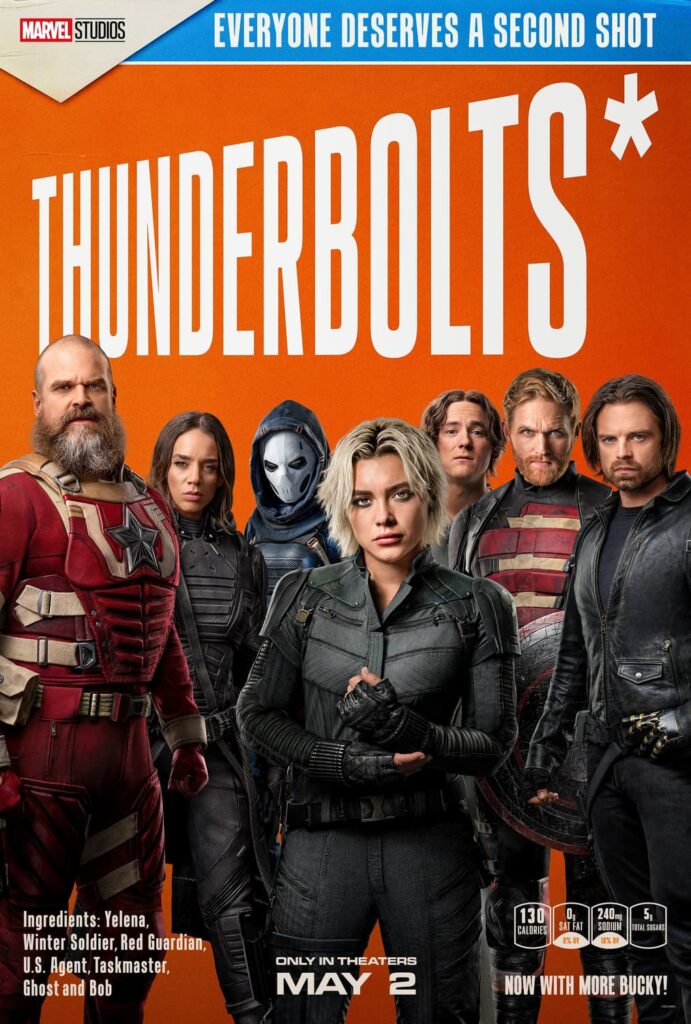
I liked “Thunderbolts* (note the asterisk) a lot, but it will be divisive. Some people don’t want to delve into the mental health struggles of anyone, including a superhero or supervillain. They’re just there for the punches, powers, explosions, and special effects. But as I watched the film, I thought about how many superheroes experienced devastating trauma before gaining their powers and/or dedication to saving the world. Bruce Wayne saw his parents killed by a mugger when he was a child. Superman lost his family and his whole planet. Spidey was living with his aunt and uncle, so had already lost his parents before Uncle Ben was killed. Tony Stark had dad issues. Black Widow was trained to be a child assassin.
“Thunderbolts*” is a “Suicide Squad”/”Guardians of the Galaxy”-style superhero story about a group of damaged, distrustful loners with superpowers who have to do more than just band together for all the punching and explosions. They have to begin to heal themselves. And I am completely here for it, plus for finding out the meaning of the asterisk, which I enjoyed very much. And yes, you do need to stay all the way through the credits for a final scene that teases what’s coming next.
Before I get to the superheroes, I want to talk about the villain(s). I always say that it is the villains more than the heroes that matter most in a comic book movie (and in some other places as well, as Milton showed us in Paradise Lost). Julia Louis-Dreyfus is one of the all-time great villains as Valentina, the ultra-wealthy corporate CEO turned Director of the CIA (though with current Director of National Intelligence Tulsi Gabbard’s streak of silver hair, just a coincidence, I’m sure). Some villains have great evil smiles. Louis-Dreyfus has a great social smile exuding the supreme confidence and power of the .001% while all-but-hiding the voracious all-consuming drive for power and utter disregard of the rights or value of anyone in her way.
We first see Yelena (Florence Pugh), still in mourning for her sister, Natasha (The Black Widow) and almost by rote working as an operative for Valentina. She is numb and lonely and lacks purpose. She tells Valentina she wants out, but agrees to one last job, in a remote lab where Valentina’s company once performed experiments, trying to find a formula to give superpowers to her subjects.
She ends up fighting Captain America (Wyatt Russell as John Walker), Ava Starr/Ghost (Hannah John-Kamen), and another super-character who doesn’t last long, before they figure out that they are all there for the same reason, to die, because they have become problems for Valentina. At this point, a guy who seems to be the opposite of super in any way wanders in wearing pajamas, with no memory of pretty much anything except his name. He is Bob (Lewis Pullman, in his second “just Bob” role after “Top Gun: Maverick”).
Yelena, John, and Ava do not trust each other, but the only way to stay alive is to work together. The escape works well in moving the plot and character development forward as well as being fun to watch. And that’s pretty much the vibe for the rest of the film.
Valentina thought her program to turn humans into supers failed, meaning they all died. But somehow Bob survived and that changes her plan. And the people she describes as “defective losers, anti-social tragedy in human form” may not have the cool powers and (mostly) good manners of the Avengers, but they are all struggling toward being something better. That means dealing with sad and scary feelings like loss and trauma, with the characters catapulted into immersive re-creations of their most painful moments. Will they finally find a way to become, a, what’s the word, team? The good news is that by the end of the film, we hope so.
NOTE: Stay through the credits for a mid-credit scene and a teaser at the end for what’s coming next.
Parents should know that this is a superhero movie with non-stop peril and action-style violence including automatic weapons and fantasy powers. Characters are injured and killed, including a child. Mental health and trauma are themes of the film. Characters use some strong language and there are drug references and alcohol.
Family discussion: What is the best way to discover your purpose? How did the childhood experiences of Yelena and Bob affect the way they saw themselves? How is Valentina different from other villains in superhero movies?
If you like this, try: “Guardians of the Galaxy” and the Avengers movies