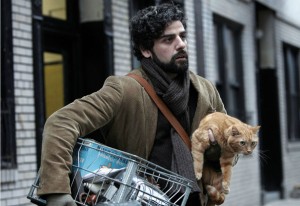
Oscar Isaac gives the best performance of the year as the title character in the most intimate and profound movie yet from the Coen brothers. The story is set in the New York folk music world of 1961 and the Coens insisted on filming the songs live rather than pre-recording, and one of the wonders of this film is the way that Isaac makes each song more than a musical performance — each is a part of his characterization that tells us who Davis is and where he is on a week-long journey we will see in near Sisyphian terms. The breaths and pauses are as much a part of the performance as the notes he plays and sings. When he is not singing, Davis reacts very little, and one of the great pleasures of this film is seeing Isaac convey immense conflict and sensitivity to us in the audience while those around him see only his superficial expressionlessness. In one scene, a doctor offhandedly gives him surprising news about someone else. In that one moment he says almost nothing but conveys a dozen different emotions and questions and losses. This is the story of a man who expresses himself only through his music. But he does not have the gifts to make him successful enough to support himself or achieve any sense of security and acceptance.
The Coens like to put their central characters under a lot of stress, and in this film Davis must deal with disappointment and anger all around him and his own sense of frustration in not being able to honor the songs that are his whole world by making them as important to others as they are to him. Ultimately, it becomes a larger story about the way all of us struggle to find meaning and a place for ourselves. And all of that is to the heavenly music impeccably curated by T. Bone Burnett and performed by a cast that includes Justin Timberlake, Carey Mulligan, and Broadway’s Stark Sands. The Coens also like to create physical environments that reflect the internal pressure (the peeling wallpaper in “Barton Fink” was almost another character). Here, the re-creation of early 60’s Greenwich Village is relatively low-key and naturalistic, but there are still cramped corridors with impossibly acute vectors to amplify Davis’ external manifestation of the grungy world that seems to have no exit.
The film’s title, “Inside Llewyn Davis,” is the also the name of a record album made by the early 1960’s folk singer played by Isaac. We first see him singing in a Greenwich Village club, performing “Hang Me, Oh Hang Me,” a song that “was never new and never gets old.”
The folk singers of the early 60‘s thought of themselves as truly authentic in a world where suburban materialism and conformity were idealized. A movement that presaged and in some ways helped to spark the counterculture and protest of the late 60’s was, of course, inherently inauthentic itself. Folk music is beautiful wherever it is sung, even in the kind of homogenized, commercial versions looked down on by Davis (and gently mocked in “A Mighty Wind”). But what makes it authentic is that it is music sung by folk in their community, not by professional musicians in a New York club. The essence of the struggle any artist — or any person — faces between integrity and selling out is explicit here. Davis criticizes his friend and sometime lover as “careerist” for trying to get ahead in the music business. But he himself makes a trip to an influential producer to see if he can get better bookings. And as authentic as Davis may think he is, he is contemptuous the performances by a soldier and a woman from the country, both of whom arguably have a better claim to “authenticity” than he does.
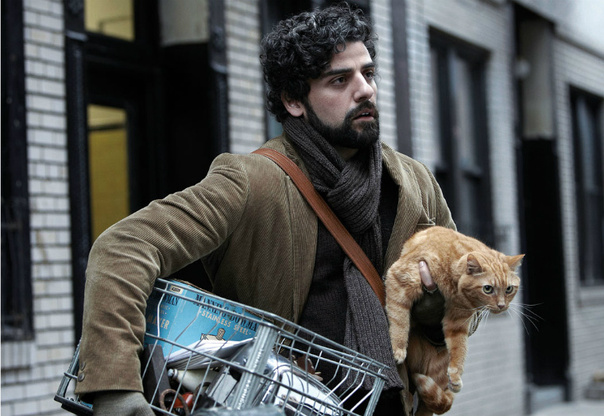
Like all Coen brothers anti-heroes, Davis is a man under pressure. He has nowhere to live, and sleeps on couches he scrounges from friends. He seems to have no sense of gratitude. He shows some sense of responsibility. He spends the night at the home of a benign Columbia professor who loves his music, stopping to play a cut from the album he made with his former partner (Isaac sings with Marcus Mumford). Then, when he is leaving, the professor’s marmelade cat slips out the apartment door just as it swings shut and locks behind him. Davis scoops up the cat and takes him on the subway, calling the professor’s office to let him know the cat is safe. He then drops the cat off at another apartment he often uses as a place to stay, the home of singing duo Jim (Justin Timberlake) and Jean (Isaac’s “Drive” wife, Carey Mulligan), where he finds out that Jean is (1) pregnant and (2) furious because it might be his. He again responds responsibly, if not graciously. And when Jim (of course not knowing anything about his relationship to Jean) arranges for Davis to get a quick gig as a session musician for a silly but irresistible little novelty ditty called “Please Mr. Kennedy,” he gives it his best.
We follow Davis over the course of a week, one frustrating encounter after another, with Jean, with the head of the tiny record label that produced his last record, a doctor who performs abortions, his silent father in a nursing home, his suburban sister, on a long ride to Chicago with a jazz musician (Coen brothers regular John Goodman) and his near-silent driver (Garrett Hedlund), a nerve-wracking audition with an important producer (F. Murray Abraham). In each of them, Davis is subdued. He has feelings, but he expresses them in his music. There is something in these ancient songs about death, betrayal, and injustice that touches his heart. Singing them is his deepest connection to himself. “Just exist?” he asks his sister, when she suggests he give up folk music. But even when he wants to give up, he can’t.
Davis knows that things seem hopeless for him. He tries to slide his box of remaindered LPs under a table only to find an almost-identical box of another singer’s records there already. He looks out of the car window at a highway exit that he and we know could lead to an important chance at connection and meaning. We see around Davis what he cannot. We see him make a decision as he leaves the recording studio that suits his purposes at the moment but that we know he will be bitter about forever. A young, tousled-hair singer goes on at the club and we know he will transform the world in a way Davis can not. But in a very real and very satisfying way, the Coens and Isaac have reclaimed him for us with their own story that was never new, and never gets old.
Parents should know that this film includes strong language, a fistfight, references to sex, adultery, abortion, and suicide, drinking, smoking, and drug use and overdose.
Family discussion: Why was it so hard for Llewyn to succeed? What do we learn about him from the decision not to go to Akron? From his heckling of another performer?
If you like this, try: “Don’t Look Back” and “A Mighty Wind” — and the Showtime concert featuring the music from the film, “Another Day, Another Time”

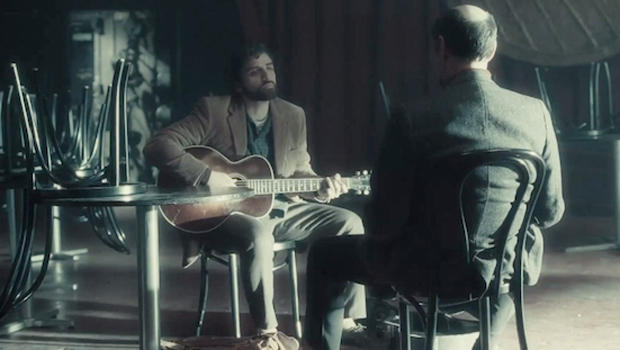 New York Magazine’s Vulture blog has some fascinating interviews with the screenwriters behind some of the year’s best films, “Fruitvale Station,” “Inside Llewyn Davis,” “Philomena,” “The Butler,” “Iron Man 3,” “12 Years a Slave,” “Before Midnight,” “The Spectacular Now,” “Saving Mr. Banks,” “Enough Said,” and “Gravity.” Each was asked to describe the toughest scene to write. Some of the choices are what you might expect — the fight scene in “Before Midnight,” Martin’s delivering the sad news in “Philomena,” the meeting with the alcoholic father that is a turning point in “The Spectacular Now,” the twist about the Ben Kingsley character in “Iron Man 3.” The way that the writers frame the problem and consider the options is fascinating. It is also fascinating to see some unexpected choices like the selection of the audition song in “Inside Llewyn Davis” or the scene with the two slave women having an unexpectedly civilized cup of tea in “12 Years a Slave.” The fact that those scenes are so fully organic that they do not seem to have been difficult is proof of the talent of these superb writers.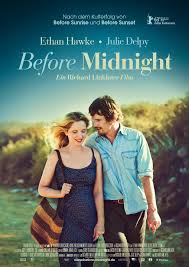








 , tells the story the 1960’s folk music scene in Greenwich Village, with encounters with young stars-to-be like Bob Dylan and Joni Mitchell and older luminaries like Woody Guthrie and Odetta. Isaac does not look or sing like the 6’5″ van Ronk. According to