Trailer: Inherent Vice

Posted on October 3, 2014 at 3:56 pm

P.T. Anderson is one of the most fascinating filmmakers of all time, writing and producing brilliant movies like “Boogie Nights” to “Magnolia,” “There Will Be Blood,” and “The Master.” His latest film looks like an Elmore Leonard-style story of low-down crime with colorful crooks, but it is based on Inherent Vice by the famously reclusive and opaque Thomas Pynchon. Here’s the trailer, featuring Joaquin Phoenix and his “Walk the Line” co-star Reese Witherspoon, along with Josh Brolin, Owen Wilson, and Benecio del Toro.

Related Tags:


Trailers, Previews, and Clips

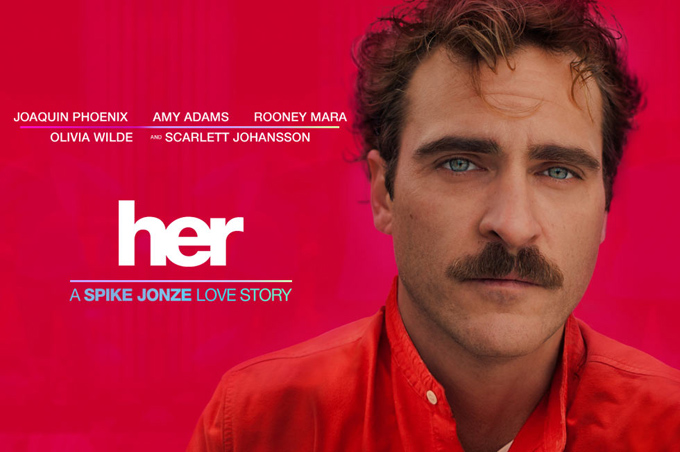
Her

Posted on December 24, 2013 at 6:00 pm

B+
Lowest Recommended Age: Mature High Schooler
MPAA Rating: Rated R for language, sexual content, and brief graphic nudity
Profanity: Very strong language
Alcohol/ Drugs: Drinking
Violence/ Scariness: Tense emotional confrontations and loss
Diversity Issues: None
Date Released to Theaters: December 25, 2013
Date Released to DVD: May 12, 2014
Amazon.com ASIN: B00HEKSZVK

her-joaquin-phoenix-spike-jonze

“Transition objects” are usually thought of as the stuffed toys toddlers hold onto so as a way of feeling more secure as they begin to separate from their parents and navigate the bigger world.  But we all have them.  We all carry real or virtual talismans to keep us from feeling adrift or abandoned.

And we all understand the bliss and torment of the Rorschach test stage of love, as what we project onto the objects of our physical and emotional desire has to give way to the reality of who they are.  If we’re lucky, it’s even better than we imagined and they feel that way about us, too.

Director Spike Jonze (“Being John Malcovich,” “Where the Wild Things Are”), working from his own screenplay, combines these two ideas in a wistful love story set slightly in the future simply called, in a reflection of its longing, “Her.”  Joaquin Phoenix plays Theodore and his job as a ghost writer of analog letters makes a kind of sense as the logical next step in a world where communication by text and Skype might make the idea of an old-school correspondence more valuable just as the ability to create them is barely vestigial.

Theodore spends his days writing letters of great tenderness and affection but there is none in his own life.  Recently divorced from Catherine (Rooney Mara) for reasons we never learn, he is withdrawn, isolated, alone.  When he is not working, he stays in his spare, generic apartment and plays a video game.  And then a new operating system comes on the market that is so responsive it virtually (in both senses of the word) achieves consciousness.  (Apparently, no one there has seen “Terminator,” because this sounds a lot like Skynet to me, but perhaps that is the weaponized version.)  Theodore decides to give it a try.

The new operating system calls herself “Samantha” and she has two enormously appealing qualities.  First, she has the throaty, intimate voice and delicious laugh of Scarlett Johansson (a performance of magnificent warmth and wit).  Second, she is utterly devoted to Theodore and utterly formed by him.  It is that most gratifying of relationships because he is everything to her and she is content for him to be so.  Plus, she is wonderfully competent, sorting through thousands of emails in a fraction of a second to organize them and, along the way, learn everything about him.

Theodore is not ready for a real relationship with a woman who might want something from him or be different from what he visualizes or idealizes.  But Samantha seems perfect, both in her innocence and in her progress.  He has the pleasure of explaining the world to her and his spirit opens up as he sees her curiosity, appreciation, and engagement.  He is reassured that the people around him (his boss, played by Chris Pratt, his neighbor and college friend, played by Amy Adams) seem to think it is perfectly normal to have a virtual girlfriend.  Samantha seems happy about it, too.

But as we have seen in “Lars and the Real Girl,” “Ruby Sparks,” George Bernard Shaw’s “Pygmalion” (which became the musical “My Fair Lady’), there’s no happily ever after in a relationship with a creation.  Samantha’s growth trajectory is astronomical.  No single human can really have her.  And the human qualities she lacks turn out to be important for a relationship, too.

Jonze’s story may be set in the future but it is an ancient one, going back to  the original Greek myth about the sculptor who fell in love with the statue he made and whose name became the title of Shaw’s play.  It is an eternal story because it is a more extreme version and thus a powerful metaphor about the risks and pleasures of intimacy.  Jonze tells that story here with great sensitivity and lyricism, the kind of artistry that machinery can never replace.

Parents should know that this movie includes strong language, sexual references and situations and nudity, and tense and sad experiences.

Family discussion:  Would you like to have an e-friend like Samantha?  What makes those relationships easier than interacting in real life?  What makes them harder?

If you like this, try: “Lars and the Real Girl,” “Ruby Sparks,” “Pygmalion,” “Catfish,” and “You’ve Got Mail”

Related Tags:


DVD/Blu-Ray Pick of the Week Romance Science-Fiction

The Master

Posted on September 20, 2012 at 5:58 pm

B+
Lowest Recommended Age: Adult
MPAA Rating: Rated R for sexual content, graphic nudity, and language
Profanity: Extremely strong, explicit, and crude language
Alcohol/ Drugs: Smoking, drinking and drunkenness
Date Released to Theaters: September 21, 2012
Amazon.com ASIN: B008V0OKGG

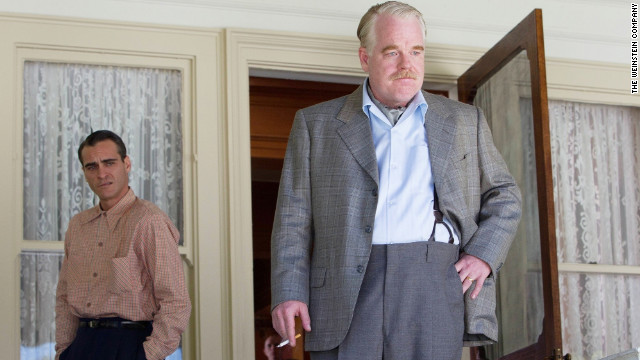
In the sixth movie from virtuoso writer-director P.T. Anderson (“There Will be Blood,” “Boogie Nights”), we see Freddie (Joaquin Phoenix) pause on the dock to look at what seems like the ultimate dream of civilization, a party on board a luxurious yacht filled with light, glamour, elegance, and belonging.  He served in the Navy in WWII and his adjustment to civilian life has been troubled.  Now, after losing his jobs as a department store portrait photographer and a field worker, with no connection to any thing or person or place or plan and no special skill except for the ability to make very potent alcoholic drinks out of whatever chemicals are at hand, the glow of the party and the people on the ship draws him in with a combination of the exotic and the familiar.  He hops over the railing like an experienced sailor and somehow both improbably and inevitably he is taken in by the group and its leader (Philip Seymour Hoffman), called Lancaster Dodd by the authorities but Master by everyone else.

The party is for Dodd’s daughter, who is getting married.  The Master himself is performing the ceremony, but more than that, as we will see him do throughout the story, he acts as a full-time master-of ceremonies as much as he is a teacher or leader of what seem to be a perpetual group of rapt followers.  He invites Freddie to join them, and to keep making his powerfully intoxicating (and memory-destroying) elixer.

The Master’s acolytes are subjected to a series of private and public interviews, where they are asked to reveal the most intimate details of their lives, and seemingly random and sometimes humiliating tasks.  The followers sit in chairs as though they are watching a play as Freddie paces back and forth between the window and the wall, ordered to describe what he sees.  The Master, who describes himself as to Freddie as “a writer, a doctor, a nuclear physicist and a theoretical philosopher, but above all, I am a man, a hopelessly inquisitive man, just like you.”  Self-aggrandizing, pompously un-pompous, and demonstrably false on its face.  If Dodd was in fact inquisitive, he would have noticed that Freddie is not at all inquisitive.  He operates entirely on instinct and lives almost entirely in the moment, musing only about his lost love, a 16-year-old neighbor he romantically idealizes though he has not seen or contacted her for years, and about his most animalistic carnal urges.  At the group’s evening gathering, he imagines all of the women naked — old, young, even the pregnant wife of the Master (Amy Adams).
It is sumptuously photographed in 70mm (try to see it on the big screen it was shot to fill), and has a jumpy, provocative score by Jonny Greenwood punctuated with retro standards from the American Songbook.  Ella Fitzgerald sings “Get Thee Behind Me Satan” as Freddie tries to keep his impulses in check.  The performances are breathtaking in their scope, commitment, intelligence, and humanity.  The frequent clashes of styles between Phoenix’s nearly feral Method approach, Hoffman’s more thoughtful, structure, and Adams’ iron-willed emotionalism are like timed flares going off to illuminate the story.  Freddie is referred to repeatedly as an able-bodied seaman but his body seems anything but able.  He is dark, stiff and hunched over, his elbows awkwardly extended back with his hands on his hips as his shoulders bend forward, his mouth twisted to one side when he speaks.  Hoffman’s blondness, brilliantly photographed by Mihai Malaimare Jr., makes him seem leonine.  He moves like a big, magnificent cat.  As in Anderson’s “Boogie Nights,” this is the story of a group of people who create a sort of family.  As in his “There Will Be Blood,” it is the story of two men held together by a complicated and sometimes toxic blend of fear, respect, longing, and power.  There is a chilliness and remove that keeps the struggle from feeling personal.  Perhaps it is a metaphor about post-WWII America, overwhelmed by its own success, audacious, overconfident, careless, and, as ever, struggling between head and heart, past and future, body and soul.

Parents should know that this film has very explicit sexual references and situations, including pornography, very explicit nudity, very strong language, and some disturbing themes.

Family discussion: Why did Dodd want to keep Freddie in the group?  What did they have in common?  Why was Helen upset by the change from “remember” to “imagine?”

If you like this, try:  “Magnolia” and “There Will Be Blood” by the same writer/director

Related Tags:


Drama Movies -- format
THE MOVIE MOM® is a registered trademark of Nell Minow. Use of the mark without express consent from Nell Minow constitutes trademark infringement and unfair competition in violation of federal and state laws. All material © Nell Minow 1995-2026, all rights reserved, and no use or republication is permitted without explicit permission. This site hosts Nell Minow’s Movie Mom® archive, with material that originally appeared on Yahoo! Movies, Beliefnet, and other sources. Much of her new material can be found at Rogerebert.com, Huffington Post, and WheretoWatch. Her books include The Movie Mom’s Guide to Family Movies and 101 Must-See Movie Moments, and she can be heard each week on radio stations across the country.

Website Designed by Max LaZebnik