
Napoleon

Napoleon

Posted on November 20, 2023 at 7:06 am

C
Lowest Recommended Age: Mature High Schooler
MPAA Rating: Rated R for strong violence, some grisly images, sexual content and brief language
Profanity: Some strong language
Alcohol/ Drugs: Alcohol
Violence/ Scariness: Very graphic and disturbing images in scenes of battle
Diversity Issues: None
Date Released to Theaters: November 22, 2023

Copyright 2023 Columbia
Napoleon Bonaparte is one of history’s most consequential figures but you will not understand him or his influence any better after watching Ridley Scott’s almost-three-hour epic. Joaquin Phoenix plays the general-turned emperor-turned exile-turned emperor again and then again turned exile, and Vanessa Kirby plays his wife, Josephine, to whom he wrote sizzling love letters, some included in the film, along with some of the gigantic battles he fought and won and one he lost so resoundingly that its name persists hundreds of years later as a term for career-ending failure.

The press notes for the film tell us that we will see Napoleon’s life “through the prism” of his volatile relationship with Josephine. It does not do either. Phoenix, who makes little effort to change his age or facial expression as the film covers decades, is burdened with some truly terrible dialogue, including what may be this year’s single worst line: “Fate has brought me to this lamb chop.” The legend of Napoleon inspired the name of the psychological syndrome of grandiosity, a supreme, all-encompassing sense of superiority. In this film, that is indicated with comments like, “I admit when I make a mistake. But I never make a mistake.”

As for that prism of the relationship, it does not live up to the love letters. Napoleon seems to be obsessed with Josephine, more about possessing her than being close to her or even considering her feelings in any way. He makes love like he wages battle — it’s about moving fast and destroying the other side.

Josephine’s feelings about Napoleon are more practical. When they meet, her confinement as a political prisoner is so recent her hair has not grown out. She showed her survival skill by escaping the fate of her first husband, who was executed, by getting pregnant. about her survival and then, as he rises in stature, she seems to enjoy the attention and fancy clothes and parties.

The movie careens back and forth between the zoomed-in, intimate but chilly portrayal of the marriage and the zoomed-out epic battle scenes, artfully staged but even with graphic carnage, remote. As the Duke of Wellington, Rupert Everett, arriving well past the two-hour mark, reminds us what a vivid and arresting performance brings to a film.

Director Ridley Scott has promised a four-hour version for streaming, so maybe that will be smoother and do a better job of integrating the different parts of the story. In that case, perhaps it is best to think of this as a very long trailer.

Parents should know that this is an R-rated film with graphic and disturbing images of battles that include guns and swords. As we are told before the closing credits, millions of people were killed, and we see some of the injuries and deaths in very explicit detail. A character is killed offscreen by guillotine, to the approving cheers of a crowd. There are sexual references, including adultery, and very explicit sexual situations. Characters drink and use some strong language.

Family discussion: What were Napoleon’s greatest strengths and weaknesses? Why did the French return to a monarchy?

If you like this, try: the silent Abel Gance classic, “Napoleon”
Related Tags:


Based on a true story Biography Drama Epic/Historical movie review Movies -- format Movies -- Reviews War
C’mon C’mon

C’mon C’mon

Posted on November 24, 2021 at 2:18 pm

A-
Lowest Recommended Age: Middle School
MPAA Rating: Rated R for language, graphic nudity, and some sexual references
Profanity: Strong language
Alcohol/ Drugs: None
Violence/ Scariness: Family stress, sad offscreen death, mental illness of a parent
Diversity Issues: None
Date Released to Theaters: November 19, 2021
Date Released to DVD: April 11, 2022

Copyright A24 2021
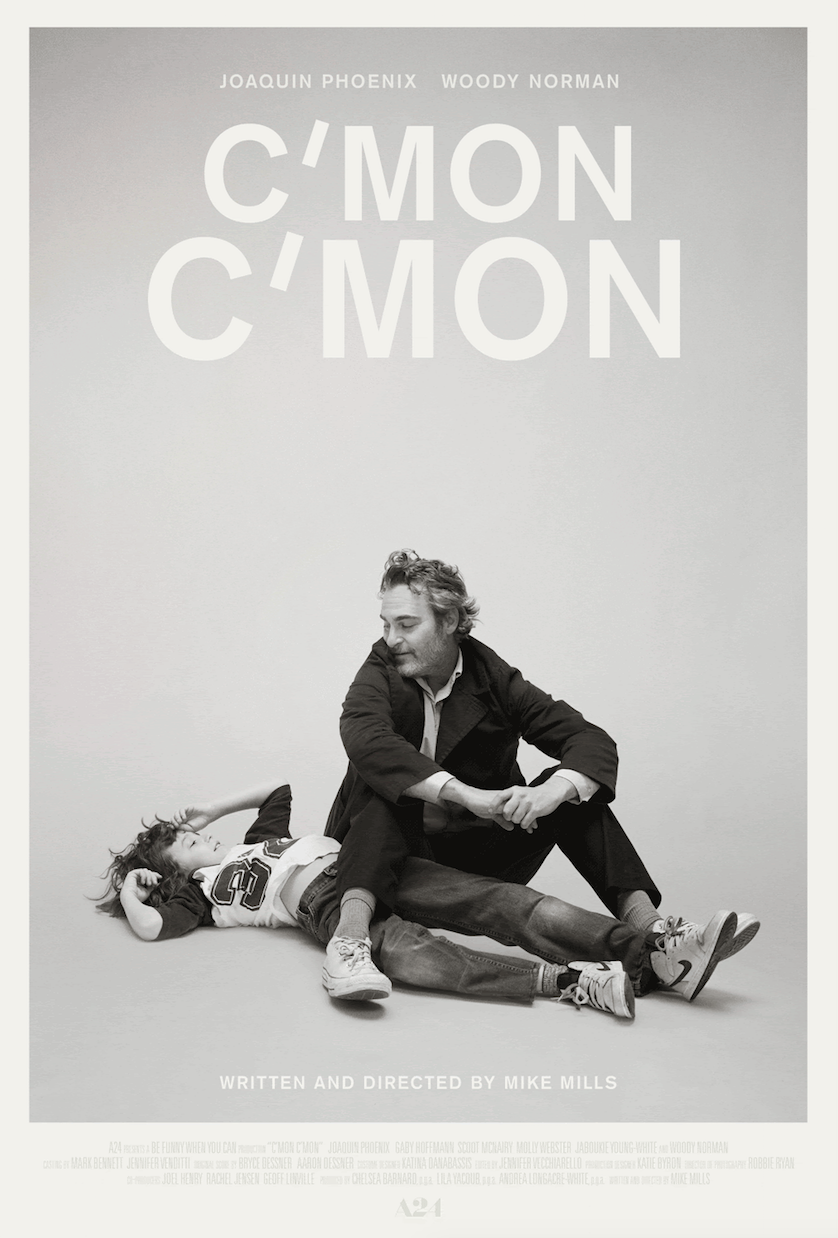
I can’t remember a movie that captured as well as Mike Mills’ “C’mon C’mon” the intense, constant feelings of terror, inadequacy, panic, exhaustion, that is parenthood, plus the tsunami of love and gratitude and hope and hilarity. He even captures the heartbreaking sorrow in understanding that childhood is fleeting and no matter what you do you cannot protect them from the injustices of the world. This is one of the best films of the year.

Writer/director Mills based his previous films on his parents. Christopher Plummer won an Oscar for his role in “Beginners,” based on Mills’ father, who came out as gay late in life. Annette Bening’s role in “20th Century Women” was based on Mills’ mother. In both films, there were son characters based on Mills himself. “C’mon C’mon,” filmed in gorgeous black and white and even more gorgeous, capacious humanity, was inspired by Mills’ experience of being a father.

Joaquin Phoenix plays Johnny, a “This American Life”-ish radio producer who is traveling around the country interviewing kids and teenagers about their thoughts on their lives, what superpower they’d like to have, and what the future holds (the interviews in the film are unscripted, real responses from students). His sister Viv (Gaby Hoffman), from whom he has been a bit estranged since the death of their mother, needs him to care for her nine-year-old son, Jesse (Woody Norman), as she deals with a family emergency. Her ex-husband Paul (Scoot McNairy) is bi-polar and is having a breakdown. And so Johnny, something of a loner who is most comfortable talking to others in the formalized — and one-sided — setting of an interview,” unexpectedly becomes the sole guardian of a nine-year-old for a period that keeps getting extended.

Johny and Viv are constantly on the phone as he needs advice or she needs reassurance that Jesse is okay. Johnny tells her, with mock mansplaining, “You know, as a mother, you’re not gonna understand this, but working all day and taking care of a kid is just a lot.”

There are so many movies that could be made about this set-up, and I think we’ve seen most of them, from cheesy slapstick to cheesy sentimental. Mills has something far more subtle, meaningful, and insightful in mind. Phoenix, known for showboaty roles like his Oscar-winning Joker, gives a career-best performance here as Johnny, and Norman is a wonder as Jesse, making it impossible to believe he can be acting because his performance is unaffected, pure, and in the moment. It is astonishing to learn that not only is he not Jesse from California; he is not even American. He is British and lives in London. His chemistry with Phoenix is so natural we do not just feel they’ve known each other forever; we feel we’ve known them both forever. They are our family; they are us.

Jesse, too, separates himself from the world by processing it through Johnny’s microphone. And, as children do, he processes the unthinkably sad and scary abandonments of his mentally ill father and devoted but conflicted mother through play and sometimes through acting out. Jesse pretends he is an orphan. Johnny looks away for a second and Jesse disappears. They laugh. They get angry. They make mistakes and they apologize. And Johnny begins to understand that you cannot be right all the time with a child and the best you can do is to be completely present, completely open. In its way, that is what the best movies do, and this is one of them.

Parents should know that this film includes very strong language, a sad offscreen death, and mental illness of a parent.

Family discussion: What mistakes did Johnny and Jesse make? What did they learn from them?

If you like this, try: “Beginners,” “Where the Wild Things Are,” and “20th Century Women”

Related Tags:


Comedy Drama DVD/Blu-Ray Family Issues movie review Movies -- format
Joker

Joker

Posted on October 3, 2019 at 12:42 pm

C
Lowest Recommended Age: Mature High Schooler
MPAA Rating: Rated R for strong bloody violence, disturbing behavior, language and brief sexual images
Profanity: Very strong language
Alcohol/ Drugs: Prescription drugs
Violence/ Scariness: Graphic bloody violence, murders, stabbing, guns, assaults
Diversity Issues: Some insults
Date Released to Theaters: October 4, 2019
Date Released to DVD: January 6, 2020

Copyright 2019 Warner Brothers
Joker” tries hard to be dark, disturbing, and meaningful. It is dark, but it is sour, superficial and gross, the darkness not especially significant and therefore not especially meaningful. Its call-outs to past and current real-life events and other movies are not illuminating in any way; they just seem like training wheels borrowed to keep the movie from falling over. And we’re stuck once again with the tired trope of disability leading to criminality.

One of the highest compliments an actor can give another actor is “committed.” And for sure Joaquin Phoenix is fully committed to the role of Arthur Fleck, a clown for hire and would-be stand-up comic who experiences repeated abuse and betrayal. After he is fired, learns a family secret, and then is cut off from counseling and medications, he spins out of control.

This is a non-canonical version of the origins of Joker, not connected to any of the previous depictions of the character in comics, movies, or television. In this version, Gotham resembles the New York City of the 70’s, when the city was teetering on financial insolvency. As it opens, they are in the midst of a garbage strike. Piles of trash are everywhere and large rats are running through the streets. Arthur is twirling an Everything Must Go sign in front of a store that is going out of business. Some boys grab the sign and, when he chases after them into an alley, they beat him with the sign until it shatters. Later, Arthur’s boss takes the cost of the sign out of his pay. Yeah, this movie is not subtle. The boys beat Arthur with the sign and the movie beats us with the metaphors.

Arthur lives in a squalid apartment building with his frail mother (Frances Conroy), and he cares for her tenderly. bringing her food, giving her baths, and sharing their favorite television shows including a late night talk show hosted by Murray Franklin (a badly miscast Robert De Niro). Arthur dreams of being on the show.

Arthur’s mother always told him his purpose in life was to make people happy. And he tries hard. He makes funny faces to get a toddler to laugh on a bus, but the child’s mother snaps at him. He gets fired for bringing a gun to the hospital where he is entertaining sick kids. He struggles with mental illness that undermines his grip on reality and a nervous condition that causes grotesque involuntary laughter when he is under stress. He has a little laminated card he hands out to explain this unsettling symptom to bystanders.

His fragile support system unravels. He loses his job. The city cannot afford a social safety net, so even the haphazard counseling he has been getting is cut off and he no longer has access to the seven different psychotropic medications. He loses his job. He feels betrayed by his mother. And then, on the subway, he is confronted by three arrogant finance bros.

Crossing the line to breaking the law feels liberating to Arthur and to similarly resentful protesters throughout Gotham, leading to some expressions of concern that this portrayal itself could inspire copycats. It does draw from current conflicts in the news to attempt a gravitas that this film cannot sustain, leaving only sensation and a bitter sense of entitlement in those who consider themselves victims. It teeters on the brink of telling us that if only we were all nicer to (listening to, having sex with) people who weird us out, they wouldn’t be weird anymore. Director Todd Phillips’ bitter comments recently about how it’s no fun to be funny now because you have to be so sensitive all the time underscore the resentment on display here.

Similarly, it litters the film with pieces (I’m sure they would call it homage, but it’s just stealing) from two Martin Scorsese classics, “Taxi Driver” (the descent into madness triggered by the despair and corruption around him) and “The King of Comedy” (the descent into madness triggered by a distorted obsession with acceptance and celebrity). Significantly, in case we miss the unmissable point, the star of those two movies, Robert De Niro, plays someone very much like the talk show host his “King of Comedy” character was obsessed with. As we saw in “Comedian,” De Niro, for all his immeasurable gifts, is not able to convey the oily geniality or vocal rhythms of a stand-up comedian, even if this one were far better written.

This movie wants to be daring and provocative but it is just depressing, less for the degrading, sordid storyline than for the failure of all of the time and effort and money that went into making it to produce anything worthwhile.

Parents should know that this film includes very disturbing and graphic images, peril and violence, mental illness, murders, stabbing, guns, strong language, sexual images

Family discussion: Could anyone have helped Arthur? What stories in the news or history or other movies inspired some of the plot developments? How does this Joker compare to other depictions of the character?

If you like this, try: Tim Burton’s “Batman” and “King of Comedy” and “Taxi Driver”

Related Tags:


Comic book/Comic Strip/Graphic Novel Drama DVD/Blu-Ray Fantasy movie review Movies -- format Thriller

Trailer: Woody Allen’s “Irrational Man”

Posted on May 3, 2015 at 8:00 am

Woody Allen’s new movie has Joaquin Phoenix as a depressed middle-aged professor who finds new joy and meaning in the love a beautiful young student. This is a recurring theme in Allen’s films, but this trailer suggests that it may take a different direction. I hope so!

Related Tags:


Trailers, Previews, and Clips

Inherent Vice

Posted on January 8, 2015 at 5:58 pm

B
Lowest Recommended Age: Adult
MPAA Rating: Rated R for drug use throughout, sexual content, graphic nudity, language and some violence
Profanity: Very strong, explicit, and crude language
Alcohol/ Drugs: Extensive substance abuse including drinking, smoking, and drugs, drug dealing
Violence/ Scariness: Peril and violence
Diversity Issues: Diverse characters
Date Released to Theaters: January 9, 2015
Copyright IAC films 2014

We love mystery stories because they reassure us that questions have answers and justice is possible. But some mystery stories are there to remind us that life is complicated and messy, and sometimes answers are just more questions. This is one of those stories.

Inherent Vice is a novel by the famously private author Thomas Pynchon, whose books are dense, complex, and thus rich fodder for grad students and intelligentsia. Writer/director Paul Thomas Anderson (“Boogie Nights,” “Magnolia,” “There Will Be Blood,” “The Master”) is also known for dense, complex stories, and he likes to focus on decay, corruption, and bruised innocence. They are well matched in this weed noir story, sort of Dashiell Hammett crossed with Hunter Thompson.

The original set-up is right out of a classic detective story. A beautiful woman named Shasta Fay Hepworth (Katherine Waterston) visits her ex-boyfriend, Doc (Joaquin Phoenix), some kind of hippie detective, to ask for his help. The narrator (singer Joanna Newsom), in a hypnotic, vocal fry deadpan, lets us know right away that Doc would be better off telling her to leave. But he cannot say no to Shasta or to a mystery, so he is on the case.

Shasta’s new boyfriend is a wealthy (and married) developer named Mickey Wolfman (Eric Roberts). Shasta believes that Wolfman’s wife and her boyfriend are trying to have him committed so they can get his money.  As Doc begins to look into this, he encounters many odd characters, most with their own unsolved mysteries, some of which begin to intersect with the Wolfman story or with each other or both.  And it all comes together, or doesn’t, in a haze of, yes, decay, corruption, and bruised innocence that is about the failure of the American Dream or existential chaos or the fragility of our concept of reality, or maybe just that the journey and those who accompany us along the way are more important than the destination.  Also, something about the optimism and passion for changing society of the 60’s giving way to the me-decade and passion for individual self-exploration of the 70’s.

Doc encounters a number of extremely colorful characters as he explores a series of mysteries that appear to be linked, or perhaps all part of one big mystery involving a secret and very powerful malevolent force.  The only one who seems to know what’s going on is the almost-never-seen narrator, and it’s not clear whether we’re supposed to root for the characters or laugh at them.  But as always, Anderson’s impeccable casting and music choices are captivating, and there is an amusing contrast between his attention to every detail of camera placement, editing, production design, and dialog and the convoluted storyline and druggy fog surrounding the characters.  I’m not sure what it was that I watched, but I have to admit I enjoyed watching it.

Parents should know that this film has just about everything we consider “adult content,” including constant very strong, explicit, and crude language, nudity and very explicit sexual references and situations including prostitution and adultery, drinking, drugs of all kinds and drug dealing, and violence including guns.

Family discussion: Why did Doc help Shasta? Why did he help Coy? Why is Doc a detective?

If you like this, try: “Boogie Nights” and “There Will Be Blood” by the same director and the book by Thomas Pynchon

Related Tags:


Based on a book Crime Drama Movies -- format Mystery
THE MOVIE MOM® is a registered trademark of Nell Minow. Use of the mark without express consent from Nell Minow constitutes trademark infringement and unfair competition in violation of federal and state laws. All material © Nell Minow 1995-2026, all rights reserved, and no use or republication is permitted without explicit permission. This site hosts Nell Minow’s Movie Mom® archive, with material that originally appeared on Yahoo! Movies, Beliefnet, and other sources. Much of her new material can be found at Rogerebert.com, Huffington Post, and WheretoWatch. Her books include The Movie Mom’s Guide to Family Movies and 101 Must-See Movie Moments, and she can be heard each week on radio stations across the country.

Website Designed by Max LaZebnik