Kubo and the Two Strings

Kubo and the Two Strings

Posted on August 18, 2016 at 8:00 am

A-
Lowest Recommended Age: Kindergarten - 3rd Grade
MPAA Rating: Rated PG for thematic elements, scary images, action and peril
Profanity: None
Alcohol/ Drugs: None
Violence/ Scariness: Monsters, peril, sad offscreen deaths
Diversity Issues: None
Date Released to Theaters: August 19, 2016
Date Released to DVD: November 20, 2016
Amazon.com ASIN: B01KMKM4TW
Copyright 2016 Focus

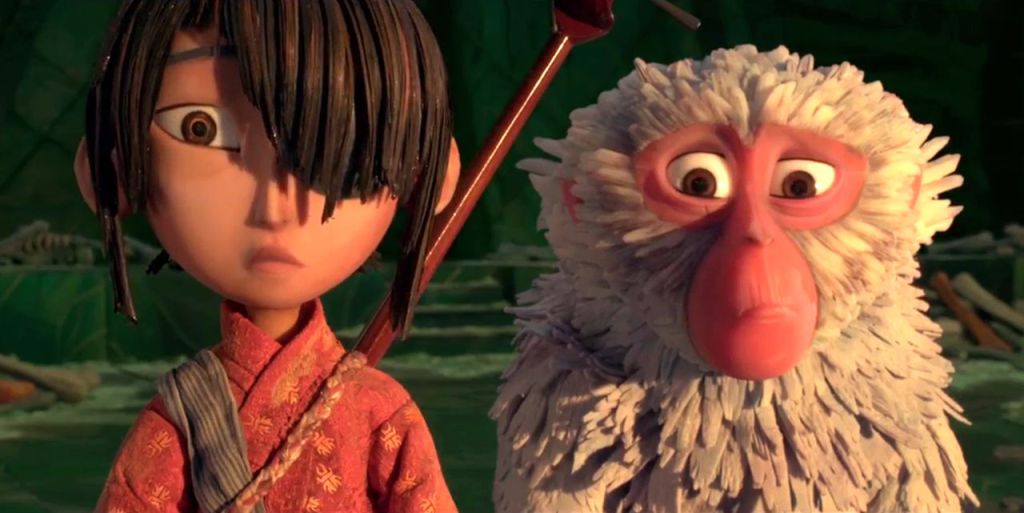
LAIKA Studios’ fourth film, “Kubo and the Two Strings,” is a fable of exquisite beauty and meaning, gorgeously produced in the most painstaking of all forms of filmmaking, stop-motion animation. They are the modern-day equivalent of the monks who labored for years on each page of illuminated manuscripts.

Every detail in every frame and every element of the story, set in a magical version of ancient Japan, reflects the simple profundity of the ancient and contemporary Japanese art that inspired it. LAIKA’s last film, “The Boxtrolls,” was set in a cluttered, sooty, steampunkish imaginary Victorian London, and the studio’s motto was “no square corners, no straight lines.” This time it went in the opposite direction, with the muted palette and spare, carefully balanced settings of Japanese woodblock prints and the sharp lines and perfect corners of origami.

One of the hardest elements to get right in stop-motion is water, because it is impossible to control it frame to frame. In “Boxtrolls,” the studio’s greatest technical triumph was an elaborate set-up for a brief scene in which a character touched standing water and created some ripples. LAIKA loves to challenge itself, and so this film starts with a storm at sea. A woman we will learn is Kubo’s mother is desperately trying to stay upright on a tiny boat. We know she is escaping someone or something, but we are not sure yet what or who it is. And we do not learn until she is washed up on the shore, exhausted and hurt, that she is not alone. In her backpack, there is a baby. It is Kubo.

Like Harry Potter, Kubo had a father who died trying to protect him from a danger so great that Kubo bears a wound. One of his eyes is gone. Kubo’s mother survived, but she used all of her magic to save him and now she is frail, forgetful, and inconsolable.

When we next see them, he is about 11, and has been caring for her all his life. Each day, he makes her food and feeds her. And then he walks from their home in a cave on top of a cliff into the nearest town, where he tells stories in the market. He has the power to bring origami characters to life to act out thrilling tales of the great samurai warrior Hanzo. The townspeople love his stories, which always end with a cliffhanger, and they toss him coins.

The community has an annual Obon festival, where they light lanterns and remember the dead. Kubo wants to go, so he violates his mother’s rule about never being out after dark. And the danger she protected him from years ago comes after him in the form of his mother’s two spooky sisters, both voiced by Rooney Mara and both wearing implacable-expression white masks and terrifying swoopy capes made of black feathers.

Kubo’s mother has just enough magic left to save him one more time. And then she is gone, and Kubo finds himself on a journey, accompanied by the live version of the small monkey charm he always carried in his pocket. He and Monkey (Charlize Theron) set off to find the three pieces of Hanzo’s armor that he will need to fight the sisters and their father, who wants Kubo’s other eye. Along the way they meet a samurai who has been cursed and turned into a giant beetle (Matthew McConaughey). And they meet and fight three different monsters, a giant skeleton, an underwater garden of eyes, and an enormous, floating, reticulated moon serpent, each giving Kubo a chance to discover his courage and power.

This is a gorgeous, epic adventure with grandeur, scope, and spectacular settings, every bit of it wonderfully imaginative. It reflects LAIKA’s own adventurous spirit in taking on narrative and technical challenges as daunting as that faced by any hero. Who else would try to create a stop-motion battle under water? Or take on, in a family movie, a quest that encompasses themes of family, story, courage, loss, destiny, and meaning? LAIKA understands that the most enduring fairy tales are not afraid to deal with darkness because that is the only way to understand its true message, here delivered in a breathtaking conclusion, of tenderness and forgiveness.

Parents should know that this film includes fantasy-style peril and violence with monsters and magic, and sad deaths of parents.

Family discussion: Why did Kubo answer his grandfather’s questions the way he did? Why didn’t Monkey tell Kubo where she came from? Why did the two strings make a difference?

If you like this, try: “Coraline,” “Paranorman,” and “The Boxtrolls”
Related Tags:


3D Action/Adventure DVD/Blu-Ray Pick of the Week Fantasy Scene After the Credits Stories About Kids
Interview: Travis Knight on “Kubo and the Two Strings”

Interview: Travis Knight on “Kubo and the Two Strings”

Posted on August 16, 2016 at 3:10 pm

On my visit to LAIKA, I spoke with producer/director Travis Knight about this week’s magical new release, “Kubo and the Two Strings,” one of my favorite films of the year.

Knight, who is also the CEO of LAIKA, said that the project started a decade ago, and “all of our lives poured this thing into the world….We have a multi-national crew pulled from around the world. We are magpies, scavengers, pulling from our lives, all swirled into a gumbo.”

This is LAIKA’s fourth film. All have created in their Portland, Oregon studio through stop-motion animation, but each has been a huge leap forward in ambitious use of materials and technology and each has been completely new in the world it has created. “There’s an inherent restlessness here.” And he believes that “there is an inherent humanity that comes in the process of creating art. You can’t separate it from the art itself. The act of creating things by hand imbues them with a humanity you can’t get any other way.” Stop-action animation “injects a different kind of life.

“Philosophically, it’s been important to tell new and original stories, reaching a kid in a darkened cinema, touching a part of yourself you didn’t really think of before. It is one of the prime functions of the mind. Good stories can change us and open up the way we connect to each other.” The basis for “Kubo” is an imaginary ancient Japan. Kubo is a boy with magical ability through origami who cares for his fragile mother, who relinquished her own magical power to protect him from his powerful grandfather and aunts. “The look is always rooted in the story. Each film has been different thematically and required a different look. This one was inspired by Japanese artists like Hiroshige and Hokusai.” The world of the film is inspired by Japanese woodblock prints, with strong colors, asymmetry, and striking, uncluttered composition. “We immersed ourselves” in the Japanese aesthetic, origami, poetry, late EDO period dolls, “the spareness and symmetry is woven through the design language.” The origami designs echo through the film in the simplified shapes, textures, and folds.

Copyright 2016 Focus

“I’m in no way a purist,” when it comes to what is a practical effect and what is CGI, Knight said. “But you want to capture as much in camera as you can to make sure it is unified.” He is grateful for the chance to combine art, science, and technology, “to make peace with it, embrace it, and use it. We have a big bag of tricks and will use whatever it takes to tell the story….It’s the astronaut and the caveman working together.”

Knight spoke about the films that moved him, starting with “E.T.” It was the first time a film made him cry. “The deep-seated loneliness and then the connection to the creature. That took me to Kurasawa.” He fell in love with “big fantasy epics.” He believes that the more specific the details, the more universal the reach of the story. But for him, this was very personal. “Kubo is me — a storyteller and an animator.”

Related Tags:


Behind the Scenes Directors Interview
Comic-Con 2016: Production Designers and Women Rocking Hollywood

Comic-Con 2016: Production Designers and Women Rocking Hollywood

Posted on July 24, 2016 at 9:41 am

Copyright Nell Minow 2016

On Day 3 of Comic-Con 2016, I:

Attended a panel of production designers whose work ranged from “The Avengers” to “Justified,” “True Blood,” and “America’s Top Model,” and learned that one of the most important distinctions between designing for movies and designing for television is: doors. For a movie, the entire story is spelled out so you know everything you will need for entrances and exits. But television series go on (if they’re lucky) for years, and you never know when you’ll need another door.

Attended a panel of top women producers and directors whose work included “Twilight,” “300” and the upcoming “Wonder Woman,” who talked about working to make sure we see more strong, independent female characters presented by more women behind the scenes,

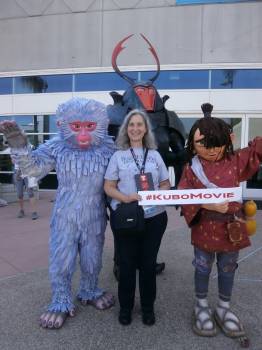
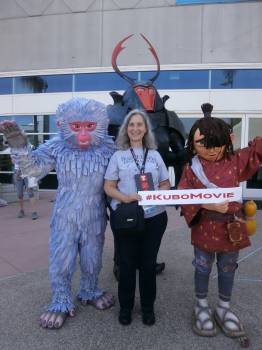
Had my picture taken with the characters from “Kubo and the Two Strings,” coming out next month.

Saw vinyl versions of the “Star Wars” soundtrack with holograms of the Millennium Falcon and X-Wing fighter suspended above them.

Realized that a lot of what I see involves not-scary things being made scary (zombie teletubbies), or scary things being made not scary (Funko Pop Freddy from “Nightmare on Elm Street”).

Heard the Captured Aural Phantasy Theatre perform stories from 1950’s and 60’s romance comics.

Attended the Masquerade costume competition, always one of the highlights of SDCC, with a sensational version of Lumiere from “Beauty and the Beast” and an Addams Family number that included “relatives” Sam, Patch, Douglas, and Grizzly. Both won top awards.  But the highlight of the evening was a re-enactment of the climactic fight scene between Kylo Ren and Rey in “Star Wars: The Force Awakens.”  When Rey held out her palm to use the Force, Kylo Ren dropped to one knee and pulled a red ring box out of his pocket. He was proposing!  And she accepted!  The crowd stood up and cheered.

Copyright Nell Minow 2016
Related Tags:


Festivals Understanding Media and Pop Culture
THE MOVIE MOM® is a registered trademark of Nell Minow. Use of the mark without express consent from Nell Minow constitutes trademark infringement and unfair competition in violation of federal and state laws. All material © Nell Minow 1995-2025, all rights reserved, and no use or republication is permitted without explicit permission. This site hosts Nell Minow’s Movie Mom® archive, with material that originally appeared on Yahoo! Movies, Beliefnet, and other sources. Much of her new material can be found at Rogerebert.com, Huffington Post, and WheretoWatch. Her books include The Movie Mom’s Guide to Family Movies and 101 Must-See Movie Moments, and she can be heard each week on radio stations across the country.

Website Designed by Max LaZebnik