Rated R for language, some sexual references, drug use, and disturbing behavior
Profanity:
Very strong language
Alcohol/ Drugs:
Alcohol, drugs, smoking (by a young teenager)
Violence/ Scariness:
Fatal car crash, guns, dangerous and destructive behavior
Diversity Issues:
None
Date Released to Theaters:
April 8, 2016
Copyright Fox Searchlight 2016As the title suggests, this is a movie about taking things apart, literally and spiritually. And Jake Gyllenhaal gives a performance of shattering intensity as Davis, a finance executive whose wife is killed in a car accident.
At the hospital, he puts five quarters into a vending machine, which fails to deliver the peanut M&Ms he has selected. So he goes home and writes a long, detailed letter of complaint to the vending machine company. And then another one. And then another one. And then another one.
And he begins to take things apart. Screenwriter Bryan Sipe says the idea was inspired by the time he spent knocking down damaged houses for his father’s insurance company. Davis says he feels numb. He says he did not really know his wife. And he really wants satisfaction for that undelivered bag of peanut M&Ms.
His father-in-law, also his boss (Chris Cooper, who played Gyllenhaal’s dad in “October Sky”), is devastated. He immediately plans a tribute to his daughter and wants Davis to support it. But Davis just wants to take things apart.
A call from the complaints department at the vending machine company leads to an adventure. Davis ends up spending time with an angry teenager (Judah Lewis) who has been suspended from school. They do things that would get him expelled and probably arrested. Those scenes are the best in the film as the kid who feels too much meets the adult who cannot feel at all.
The film, directed by “Dallas Buyers Club’s” Jean-Marc Vallee, is uneven but arresting and impressively ambitious. He maintains a fascinating, heightened tone that never interferes with the real humanity of the characters. Gyllenhaal, long one of the most underrated actors, shows once again that he can take on an exceptionally challenging role and bring enormous depth and authenticity. More important, even before Davis is able to connect to his own feelings, he is able to connect to ours.
Parents should know that this film includes a sad death, fatal accident, very strong language, drinking, drugs, smoking (by a child), sexual references including adultery, destructive and dangerous behavior, and guns.
Family discussion: Why did Davis write the letters? What do we learn from his decision about how best to honor his wife?
Copyright 2016 UniversalHere is what Judd Apatow and Paul Feig know that Melissa McCarthy and Ben Falcone do not: a character can be hilariously obnoxious or endearing but not both, even when played by the irresistible McCarthy. Apatow and Feig have made the best use of Melissa McCarthy’s endless comedic talents, and it is instructive to see how they did it. In “Bridesmaids” (produced by Apatow, directed by Paul Feig), McCarthy played a strange woman with some social deficits but capable (she was right about the air marshall, played by Falcone, who is her husband and co-screenwriter and director of “The Boss”), loyal and self-aware. In “Spy,” written and directed by Feig, McCarthy is awkward and deferential, but she is capable and brave, and she knows it. In “This is 40,” McCarthy has a small role as an angry mother complaining about the main characters’ child. Her fearlessness and improvisational skills, highlighted in a post-credit sequence, were a highlight of the film.
She gave a thoughtful performance in a dramatic role as a single mother in “St. Vincent,” and she was wonderful as a cheerful chef in “Gilmore Girls.” But in other films, including “Identity Thief,” “Tammy,” and now “The Boss,” McCarthy makes the fundamental mistake of committing to an obnoxious character given to outrageous and inappropriate behavior and then insisting that by the end of the movie the other characters and we in the audience have to love her. If she wants to play characters like that, the narrative of the movie has to be about thwarting or triumphing over her in some way. But she can’t insult and cheat everyone for ninety percent of the movie and then expect us to hope for her to have a happy ending.
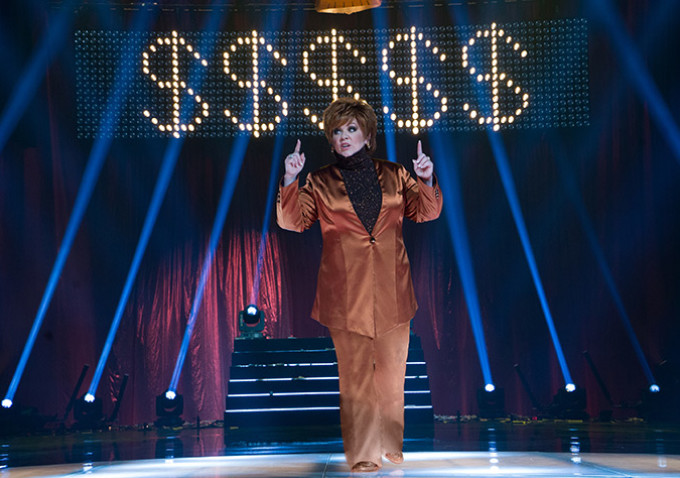
In “The Boss,” McCarthy plays Michelle, the 47th-richest woman in America and the CEO of three companies, at least one of which seems to be either a shady multi-level marketing scheme or some sort of “let me show you how to be rich scam.” She comes out to screaming applause from a huge crowd to brag about her wealth. Nice touch: some of the audience wearing Michelle-style red pixie-cut wigs. Less nice touch: she raps along with T-Pain. Michelle is rude to everyone and ruthless in business to a ridiculously counterproductive degree. For example, she brags to her rival (and ex-boyfriend) that she is making a fortune based on some insider information, which he then reports to the SEC, and which then gets her thrown in jail, Martha Stewart-style.
Five months of a country-club prison equipped with tennis courts (and, apparently, a manicurist because she has professionally done French tips), Michelle discovers she has lost her jobs and all her money. She drags her Vuitton luggage over to the apartment of her level-headed former assistant, Claire (a game Kristen Bell), a single mom with a daughter named Rachel (Ella Anderson). When Michelle tastes Claire’s delectable brownies and sees Rachel’s Dandelions troop (think Girl Scouts or, more accurately, think Troop Beverly Hills), she sees her path to a return to moguldom.
McCarthy, swathed to the chin in turtlenecks that make her look like she is recovering from whiplash, gives herself a one-note role. She is mean, she cheats, she says wildly inappropriate things to children, and she is selfish to a sociopathic degree. Michelle the character and McCarthy the co-scriptwriter give those around her very little to do, criminally under-using Bell, Kathy Bates, Margo Martindale, and Kristen Schaal. Peter Dinklage, as Michelle’s former colleague and boyfriend-turned rival is a bright spot, having a lot of fun going way over the top with pretentiousness, competitive fury, and lust. There’s an “Anchorman”-style rumble between the raspberry beret-topped brownie girls and their cookie-selling former troop. There’s a clever joke about finding just the right place to sell the brownies and there are a couple of very funny lines. But Michelle wears out her welcome very quickly and the resolution is unearned and cloying.
NOTE: There is an “unrated” DVD release. It is hard to imagine how much more offensive it could possibly get.
Parents should know that this film includes extensive strong and crude language, often directed at children, very crude sexual references, drinking, drugs, and comic peril and violence.
Family discussion: How did Michelle’s childhood experiences affect her relationships and priorities? What were the qualities that made her successful in business?
Peril and violence including guns, characters injured and killed
Diversity Issues:
None
Date Released to Theaters:
April 1, 2016
Date Released to DVD:
June 20, 2016
Amazon.com ASIN:
B01F5ZY4G0
Copyright Warner Brothers 2016What would happen if someone appeared with strange special powers? What if the person with special powers was an eight year old boy? Would a religious group consider him an angel or maybe a savior? Would the government consider him a threat? How would his parents protect him and teach him what he needed to know when in so many ways he would be teaching them?
In “Take Shelter,” writer/director Jeff Nichols gave us Michael Shannon as a man with apocalyptic visions that might have been a mental breakdown or might have been the real thing. In “Midnight Special,” Shannon again stars, this time as the father of a boy named Alton Meyer (Jaeden Lieberher of “St. Vincent”) who is being hunted both by a religious cult and the US government.
It takes a while to figure this out. We first hear an Amber alert about a missing child who has been taken from his parents and then we see two men in a seedy motel, the window covered with cardboard, and we have to suspect the worst. The child is sitting on the floor wearing goggles and industrial-grade earmuffs and is covered by a sheet.
It looks grim and gruesome, but as soon as Roy (Shannon) picks up the boy, it is clear that they are devoted to one another. Although the Amber alert referred to a couple as the missing boy’s parents, it is Roy who is Alton’s father. Roy and Alton are traveling with a man named Lucas (Joel Edgerton), who seems very committed to protecting them but not very knowledgeable. He often asks Roy questions about Alton, not to pry or to get to know him better but to be better able to protect the boy. At this point, we still don’t know what they are protecting him from, or why anyone would want to hurt him.
A religious group with women in the pastel prairie attire, with intricate braided hair, is led by Calvin Meyer (Sam Shepherd), who leads his congregation in a recital of a string of numbers. Their prayer service is interrupted by the FBI, which takes them all away in buses for questioning. They each send search teams to find the boy. Roy and Lucas take desperate measures to keep him from being found. An official from the NSA (Adam Driver, excellent) tries to figure out how an eight year old boy has access to encrypted national security data.
We begin to learn about Alton’s gifts and vulnerabilities and about the stress both have brought to Roy and the boy’s mother, Sarah (Kirsten Dunst). Lieberher is outstanding, with a gravity and dignity that tell us more about Alton than the special effects. In the movie’s most touching moment, he tells his father not to worry about him. “I like worrying about you,” Roy says.
Parents should know that this film has violence including guns, characters injured and killed, supernatural destruction, adult and child characters in peril, and brief strong language.
Family discussion: Why does Roy say he likes worrying about his son? Who is in the best position to protect someone like Alton?
If you like this, try: “Close Encounters of the Third Kind” and, for a silly and raunchy story with a similar plot, try “Paul”
Rated R for language throughout, sexual content, drug use and some nudity
Profanity:
Constant very strong and crude language
Alcohol/ Drugs:
Drinking, drugs
Violence/ Scariness:
None
Diversity Issues:
None
Date Released to Theaters:
April 1, 2016
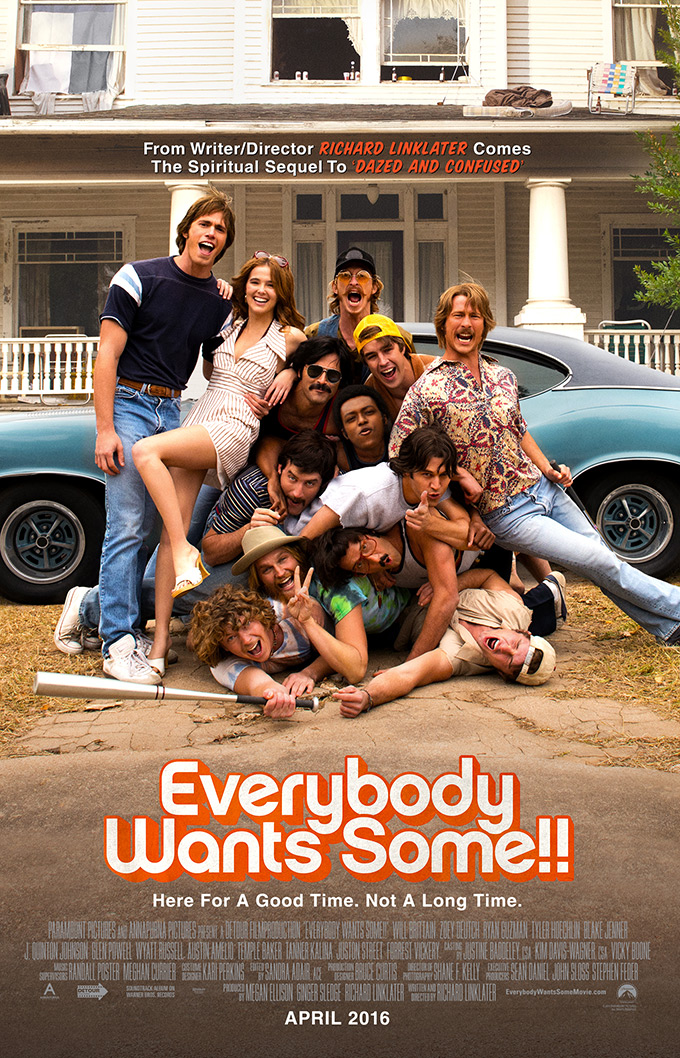
Copyright Annapurna Films 2016“Everybody Wants Some!!,” the “spiritual sequel” to Richard Linklater’s Dazed and Confused, is so much fun that it is easy to overlook how sweet it is and how smart it is. Those who are hoping for the same combination of slightly smug nostalgia, outrageous partying, smart, self-aware characters including at least one who is older than the others but prefers to hang out with teenagers, almost no grown-ups, and a superbly curated soundtrack will find all of that. Like “Dazed and Confused,” the title comes from a rock song with some smokin’ guitar licks, this one, two exclamation points and all, by Van Halen. But this film is subtler, more ambitious, heir not just to “Dazed and Confused” but also to Linklater’s impressionistic, existentialist film “Waking Life,” and even to his “Before” trilogy as well.
As in the earlier film, the time period is compressed. “Dazed and Confused” took place on the last day of high school. “Everybody Wants Some!!” takes place on the weekend before classes start at an unnamed Texas college. It opens with freshman Jake (Blake Jenner) driving to school in a convertible, blasting — of course — “My Sharona.” Welcome to 1980.
Jake is about to move into the house set aside for the members of the school’s baseball team, nationally ranked and the heroes of the school. (Linklater played college baseball for two years at Sam Houston State University.) As soon as he arrives and introduces himself to his new teammates, the dynamic that plays out through the rest of the film is established. These guys are athletes, so they are very competitive as individuals but also very aware that in order to be successful as a team they have to be competitive in a way that helps the team. Linklater and his exceptional young cast, all of whom had to audition both for acting and for ability to play baseball, perfectly capture the endless jockeying for position combined with an instinctive teamwork based on constant assessment of one another. They use a made-up word I can’t quote here to describe the way their physical and verbal interaction combines one-upmanship and more benign getting-to-know-you high spirits, both instinctively team building.
Not much happens in the movie, at least on the surface. The guys hang out and talk. There’s a ping pong game, some locker room hijinks, ingestion of various mood-altering substances, and of course a lot of discussion about and pursuit of the ladies. This leads them to several different venues and it is a lot of fun to see them adapt (including changes of clothes) as they go from a disco to a “kicker” (country music) bar, to a punk performance and finally a costume party given by the drama students.
But this is not the usual college comedy, thankfully avoiding the usual humiliation and clunky life lessons. The incoming freshmen are (mostly) smart, self-aware, and curious. The women (mostly) are not significant enough to merit much in the way of personality or storyline, and the male characters may tend to objectify or exploit them but the movie does not. They are smart, capable, looking for a good time, and self-aware, and the one we spend time with (Zoey Deutch, in a lovely performance as a drama student named Beverly) has a walk-and-talk (and float) conversation with Jake that reminds us this is a film from the writer/director of “Before Sunrise.”
The entire cast is superb, especially Jenner (“The Glee Project”), Wyatt Russell (“22 Jump Street”) as a transferring senior with a taste for philosophy and weed, Glenn Powell (“Expendables 3”) as the smooth-talking Finnigan, and J. Quinton Johnson as Dale, who is willing to explain to the newcomers what is going on.
Not much seems to be happening as the characters go from one party to another, but it does in fact cover a surprising range of ideas with a great deal of insight. It is a “spiritual sequel” in literal terms, if not grappling with then at least pondering the meaning of existence and the existence of meaning. The utterly perfect final shot brings that home perfectly.
As the characters keep changing their clothes to fit in at each venue, they ask themselves whether they are pretending or adapting. Jake talks about how each of them had always been the best baseball player at home, only to come to college and share a team with an entire group of best players. The guys think about who they are and what their goals are (hey, it’s a college movie; you know what their goal is, but there’s more there, too).
It takes place over a few days but Linklater’s perspective on existence, meaning, and the passage of time is subtly interwoven between the bong hits and the hitting of various balls. As the young baseball players reckon with their future prospects (and dream up a possible scout for the pros who could be hiding anywhere), they and we know that, like the movie itself, their time playing baseball is brief, and that’s all the more reason to enjoy the show.
NOTE: Stay through the credits to see a delightful musical number created by the cast
Parents should know that this film includes very strong and crude language, extensive partying with drinking and drugs, sexual references and situations, and nudity.
Family discussion: Did the guys’ competition with each other help or hurt the team? What are the biggest differences between what went on here and what would happen today?
If you like this, try: “Dazed and Confused,” “Waking Life,” and “Before Sunset” from the same writer/director
The original “My Big Fat Greek Wedding” was a charming surprise, a fresh, honest story about a young woman trying to find a way to be true to herself despite her loving but overwhelmingly intrusive Greek-American family. This 15-years-later sequel is an overstuffed, undercooked cash grab, operating at the low level of a basic cable sit-com with a juiced-up laugh track. There’s a big difference between finding it funny when a family has what therapists call boundary issues and bombarding the audience with overshares. Or, as Toula tells us just to make sure we understand, “We see no difference between hugging and suffocation.”
Copyright Universal 2016
The original was an exaggerated but affectionate portrayal of family dynamics that are familiar to anyone who struggled to find a distinctive individual direction despite family expectations to the contrary, which is pretty much everyone. The sequel is grotesque caricature, repeating and coarsening the humor of the first one, with repeated clunky set-ups for each of its obvious twists. The first one was a sleeper made for a shoestring that became one of the highest-profit films of all time, released in the same month as a big-budget special effects flop, “Pluto Nash,” with a mirror image record-breaking balance sheet — it lost almost as much as “Big Fat Greek Wedding” made. This sequel won’t set any records in either direction. It has some appealing characters and mild humor. But it devalues the franchise so badly that it is retroactive, diluting any remaining affection for the first one.
The couple who had the titular nuptials in the 2002 film were Toula (screenwriter Nia Vardalos), the daughter of Greek-American restaurant owners who dreamed of working with computers as a travel agent, and Ian (John Corbett), a WASP-y vegetarian teacher. At the engagement party, her parents brought a battalion of cousins named Nicky. His parents brought a bundt cake. An adorable culture clash! Is this a great country or what!
Fifteen years later, Toula, Ian, and their 17-year-old daughter Paris (Elena Kampouris, lovely even in ghoulish makeup) live next door to her parents, Gus (Michael Constantine), who still believes that the Greeks invented everything and Windex can cure anything, and Maria (Lainie Kazan), who still lets him think he runs everything. Toula tries hard to make everyone happy as she is sandwiched between a daughter who needs her less than she wants her to and parents who need her more than she wants them to. “Just when my daughter doesn’t want me around anymore, my parents need me more than ever.”
All the relatives live right nearby and everyone is up in each other’s business all the time and Hollywood Greek-Americans John Stamos and Rita Wilson, who produced the film, show up for an obvious gag and can the Stamos character, a TV newscaster really have a tagline involving shooting a finger-gun?
Toula’s big fat Greek family is supposed to be loveable, but they are just shrill and annoying. Either Aunt Voula (Andrea Martin) is going into excruciating detail on her sex life or her medical quirks or Gus is trying to find a nice Greek boyfriend for Paris to marry so she can have lots of Greek babies. Ian is now the high school principal and Tula is back where we first met her, working in her parents’ restaurant and even has to don her old glasses. They want Paris to stay near them in Chicago when she goes to college. Like Toula in the first film, Paris wants more independence. Like Toula’s parents in the first film, Toula and Ian do not want to let her go. Meanwhile, their focus on the family has led Toula and Ian to lose touch with one another. So, hey, why not another makeover for Toula?
And this is a Big Fat Greek Wedding film, so there must be another wedding. It turns out that Gus and Maria’s marriage license from half a century ago in Greece was never signed. So, Gus has to persuade Maria to marry him all over again and that means giving her the wedding of her dreams. Opa!
It is filled with the kind of stereotyping that would elicit howls of protest from anti-defamation groups if not made by Greeks themselves. That doesn’t prevent the ugly stereotyping of non-Greeks, all portrayed as thin-blooded and snobbish, except for Ian and the real-life Ian, the actor husband of Vardalos, as a kind-hearted cop who married into the family. A revelation about a family member who is gay could have led to some interesting moments, given the family’s very narrow concepts of masculinity, but it is too busy with jokes about how gross an old man’s nudity is. Even Gus would agree that this is beyond the powers of Windex.
Parents should know that this movie has some crude humor, sexual references, and a non-explicit situation. There is some scuffling, a non-serious medical emergency, social drinking, and tipsiness.
Family discussion: Ask family members about how they handled parent-child conflicts about independence — and weddings. Why was it important for Maria that Gus propose to her?
If you like this, try: the first film and another film from Vardalos, “Connie and Carla”