Batman v Superman: Dawn of Justice

Batman v Superman: Dawn of Justice

Posted on March 23, 2016 at 11:00 am

Copyright Warner Brothers 2016

After the refreshing superhero palate-cleanser that was “Deadpool,” it’s tough to get back into the ponderous, self-important, choir-of-angels soundtrack, too long by at least 45 minutes. Even the title is much too long. Do we really need another scene (and then ANOTHER scene) of Bruce Wayne’s parents being shot in a comic book movie? But that is not going to daunt director Zack Snyder, who lives for this sort of thing, and so here we are. The movie is literally and metaphorically murky, with muddy cinematography that turns every character’s eyes into pupil-less, drone-looking pools, except for the guys who can make theirs glow, via effects so retro they could have come from the old Flash Gordon serials. The storyline is secondary at best, just a series of setups for action sequences. It’s no secret that if you want to have a human fight Superman, you have to find some kryptonite to make him susceptible to human weapons. But then when we need him to be back to full strength, there he is. At a crucial moment, the turning point is simply ridiculous. So much of the chaos could have been circumvented if a couple of the characters ever had a conversation — or a cell phone. And everything stops when character takes the time for a detour into computer files that do nothing but set up the next movie. Isn’t that what extra scenes after the credits are for?

Batman and Superman have a lot in common — they were both orphaned as children and long before Spider-Man learned that with great power comes great responsibility, they were both living that credo, standing for, as the Superman radio and television program said, “Truth, justice, and the American way.” Indeed, they had a long comic book bromance going until the 1980’s, when they began to be at odds, focusing on what separated them. They are, after all, literally from different worlds. Brooding loner Batman/Bruce Wayne (Ben Affleck) is a vastly wealthy industrialist, his only confidant the trusty butler Alfred (Jeremy Irons). Superman/Clark Kent (Henry Cavill), was sent to Earth from Krypton as a baby, then found, adopted, and raised with a lot of love and support on a bucolic farm by the Kents. When he grows up, Clark Kent works as a reporter alongside the woman he loves, Lois Lane (Amy Adams).

An alien attack on Gotham destroys Wayne Enterprises’ headquarters building in a brief action sequence more arresting and visually striking than the ones that follow. Wayne, watching Superman up in the sky and suffering devastating loss and guilt over the deaths of his employees, is not sure whose side Supe is on. After the attack, Superman is treated as a hero, but Wayne is not the only one who is suspicious and threatened by someone so powerful that no earth laws could stop him if he decided to go rogue. Later, when Lane is captured, Superman’s rescue operation ends up with many people dead and many questions unanswered.

Lex Luthor (Jesse Eisenberg, enjoying his twitches), as rich and powerful as Wayne, seems to be behind various nasty ventures, and is very, very interested in getting hold of some kryptonite, despite the objections of a Kentucky Senator (Holly Hunter). So, a lot of people here are concerned about power — how to use it, how to constrain it, how to balance it — and that would be a great issue to explore in a superhero movie in 2016, but this one is more interested in whether a rich guy with a utility belt can beat a guy with super-strength, invulnerability, laser-vision, super-speed, and the ability to fly, and then whether anyone can defeat a big monster who bursts from Kryptonian primordial ooze.

Any Batman movie has to have an elegant society party. This one is, hosted by Luthor, and a mysterious woman (Gal Gadot, by far the best part of the movie) shows up to tantalize Wayne with her beauty and steal the very data he was there to steal himself.

And any Superman movie has to have a trip to the Fortress of Solitude, so that happens, too, and all I could do was wish I was there instead of watching this film.

Parents should know that this film includes constant comic book style fantasy violence with many explosions, and massive destruction, nukes, supernatural and military weapons, scary monster, characters injured and killed, some strong language, alcohol including drinking to deal with stress, and non-explicit nudity and a sexual situation.

Family discussion: How would/should the world respond to a real-life superhero who could not be subjected to our laws? Or to a vigilante like Batman?

If you like this, try: the Tim Burton and Christopher Nolan Batman movies and the comic books
Related Tags:


Fantasy Series/Sequel Superhero
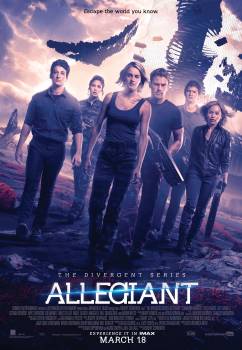
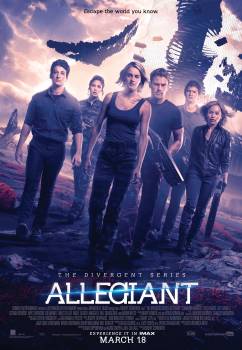
The Divergent Series: Allegiant Part 1

The Divergent Series: Allegiant Part 1

Posted on March 17, 2016 at 5:26 pm

Copyright 2016 Lionsgate
I can’t help it. They’re all beginning to run together in my head. How many post-apocalyptic stories featuring hot young stars as the brave teen heroes who are the only ones who can save the day for freedom and middle aged, classically trained actors as the totalitarian villains trying to stop them can we have?

At some point, I forget which one has Meryl Streep (“The Giver”), which one has Julianne Moore (“The Hunger Games”), which one has Patricia Clarkson (“Maze Runner”), and which one has Kate Winslet and Naomi Watts (“The Divergent Series”). When this latest and second-to-last installment of the “Divergent” series has its lead characters scaling an enormous wall in response to a message from an entirely unknown source outside (like “Maze Runner”) and the romance heats up (“Hunger Games”) and another distinguished actor shows up to explain what is going on (“The Giver”), the narratives all sort of begin to merge.

So, let’s try to get it straight. “Divergent” is the one where a post-apocalyptic Chicago had genetically modified its inhabitants so that they each had one strength: compassion, intelligence, courage, honesty, and peacefulness. At age 16, each person is tested and assigned to the appropriate faction. He or she must leave the family; the faction is the family now. The test reveals that Beatrice “Tris” Prior (Shailene Woodley) is “divergent,” with multiple strengths. That makes her a threat to the system and to the people who control it, led by Jeanine (Kate Winslet), who was killed at the end of the last chapter. As this film begins, Tris and Four (Theo James) are deciding what to do about a message calling on them to leave Chicago to find out more about what role the Divergents can play to solve the problems that led to the creation of the faction system. Tris believes she must answer the invitation, but Four worries that it could be a trap.

Four’s mother, Evelyn (Naomi Watts), formerly a leader of the rebel forces, is now beginning to show Jeannine-like tendencies (yes, this is a lot like “Hunger Games”), allowing public executions. She tells Four, her long-estranged son, she is doing it for him, but he sees what she is doing as yet another betrayal.

Tris and Four make it beyond the wall (an extreme version of rappelling is the film’s best action sequence and the only one to match the adrenalin-surge and dynamism of the earlier film’s zip-wire scene) and, behind a digital “camo wall” find a community of “pures,” non-genetically modified people, led by David (Jeff Daniels), who explains in near-folksy genial terms that Chicago was an experiment and its inhabitants were constantly monitored, somewhere between lab rats and “The Truman Show.” Meanwhile, Four, her brother Caleb (Ansel Elgort) and her friends have been assigned to either monitor or fight (with some cool new drone gear).

There are some fancy visuals but as with the earlier chapters no special effects are close to the impact of Woodley’s hazel-colored doe eyes or James’ smoulder. And there’s a bright spot when we meet a new character, Matthew, sympathetically played by Bill Skarsgård, who looks more like the younger brother of “Madame Secretary’s” Erich Bergen than the real-life brother of the various handsome members of the Skarsgård family.

But the plot is overly complicated on the surface, padded (really, can we stop turning three books into four movies?), confusing, and unsatisfying, without the exhilaration we felt as Tris discovered and deployed her power in the first two. She spends too much time in a room listening to David, and a visit to Providence for a meeting with the Council is poorly handled. If this movie had a faction, it would be: placeholder until the last chapter.

Parents should know that this film includes extensive sci-fi/action violence with guns, explosions, and crashes, with many characters injured and killed, brief strong language, and non-explicit nudity in shadow.

Family discussion: Why did Evelyn think she had to use force, despite what had happened before? How did Four and Triss look at the invitation from outside the wall differently? Why did David lie?

If you like this, try: the earlier films in the series and the “Hunger Games” and “Maze Runner” films

Related Tags:


Action/Adventure Based on a book Science-Fiction Series/Sequel Stories about Teens
Miracles from Heaven

Miracles from Heaven

Posted on March 15, 2016 at 10:11 am

B
Lowest Recommended Age: Middle School
MPAA Rating: Rated PG for thematic material, including accident and medical issues
Profanity: None
Alcohol/ Drugs: None
Violence/ Scariness: Serious illness and peril involving children, sad death (offscreen)
Diversity Issues: Diverse characters
Date Released to Theaters: March 16, 2016
Date Released to DVD: July 11, 2016
Amazon.com ASIN: B01D1U6V58
Copyright Sony Pictures Entertainment 2016

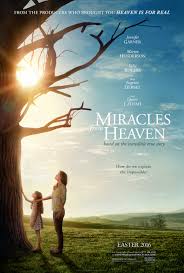
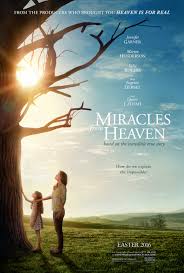
Christy Wilson Beam’s book title says it all: Miracles from Heaven: A Little Girl and Her Amazing Story of Healing. In the book, she tells the story of her daughter Annabel, critically ill with an incurable digestive disorder, who fell thirty feet from a tree branch. Incredibly, she was not injured. And even more incredibly, possibly even miraculously, she was cured.

All of this happens in the trailer, and the movie’s biggest challenge is that the entire story is not much more than that.

A happy, loving family is catapulted into crisis when their sweet-natured daughter becomes ill. It takes a long time to get the right diagnosis, and then it takes a long time to see the only doctor who may be able to help them. And then she gets sicker and sicker and the family is under more and more pressure. And then she climbs the tree and falls. The rest, despite the best efforts of the always-appealing Jennifer Garner, mostly seems like so much padding. So, so much padding.

Just to make sure we didn’t miss the title’s reminder of where miracles come from, we are told right at the beginning what a miracle is: not explainable by natural or scientific laws. And then we meet the Beam family, as adorable as the ray of sunlight of their name, living a life somewhere between a country song and a Hallmark commercial. Everyone is beautiful, loving, patient, and trusting in God. There are sun-dappled vistas and cute animals. They have a kindly preacher, played with warmth and good humor by John Carroll Lynch.

And then Annabel (a very sweet Kylie Rogers), the middle of their three daughters, gets sick. At first, doctors reassure them that it is a minor problem like lactose intolerance, but it turns out to be a major digestive disorder that distends her stomach and makes it impossible for her to eat.

They are told that there is just one doctor in Boston who may be able to help her, but he is so busy they cannot get an appointment. Desperate, Christy (Garner) brings Annabelle to Boston, goes to the doctor’s office, and begs for a chance to see him. While they wait, they meet a kind-hearted waitress (Queen Latifah in a role that verges on uncomfortably confined to quirky comic relief) who gives them a tour of the city (more padding), until they get a call that the doctor is available. Dr. Durko (an engaging Eugenio Derbez) has a great Patch Adams-style bedside manner, but his diagnosis is a heartbreaking one. Annabel is hospitalized, and shares a room with another very sick little girl, who is comforted by Annabel’s reassurance of God’s love and protection.

And then, back at home, Annabel climbs an old dead tree and falls 30 feet inside.

The most touching and inspiring part of the film is not the “miracle” cure of a fall that somehow caused no serious injuries and rebooted the part of Annabel’s brain that was not telling her digestive system how to work. It is when Christy thinks back and realizes how many miracles the family has experienced through kindness and compassion.

Parents should know that this film is about a very sick little girl and includes scenes of illness, with a sad (offscreen) death.

Family discussion: Why did some of the women in the congregation blame Christy? What tested the family’s faith most? Which moments of kindness meant the most to the family?

If you like this, try: “Heaven is for Real”

Related Tags:


Based on a book Based on a true story DVD/Blu-Ray Pick of the Week Illness, Medicine, and Health Care Spiritual films
Eye in the Sky

Eye in the Sky

Posted on March 10, 2016 at 5:43 pm

B+
Lowest Recommended Age: High School
MPAA Rating: Rated R for some violent images and language
Profanity: Very strong language
Alcohol/ Drugs: None
Violence/ Scariness: Military violence including terrorism, bombs, explosions, characters injured and killed, some disturbing images
Diversity Issues: Diverse characters
Date Released to Theaters: March 11, 2016
Date Released to DVD: June 27, 2016
Amazon.com ASIN: B01CUMHBJS
Copyright Bleeker Street 2016

“Eye in the Sky” is a rare thriller that grips the mind and heart equally. Drones take our military closer than we have ever been before to the people and the activities of the enemy as they remove us further than we have ever been before from the visceral reality of the actions we take based on what we have learned. This film takes us inside the tactical, political, legal, and moral choices faced by the international governments and military in combating terrorism. Director Gavin Hood and screenwriter Guy Hibbert show us the stakes rising and the options shrinking with each passing second, so we in the audience must constantly ask ourselves not just what the characters should do but what we would do.

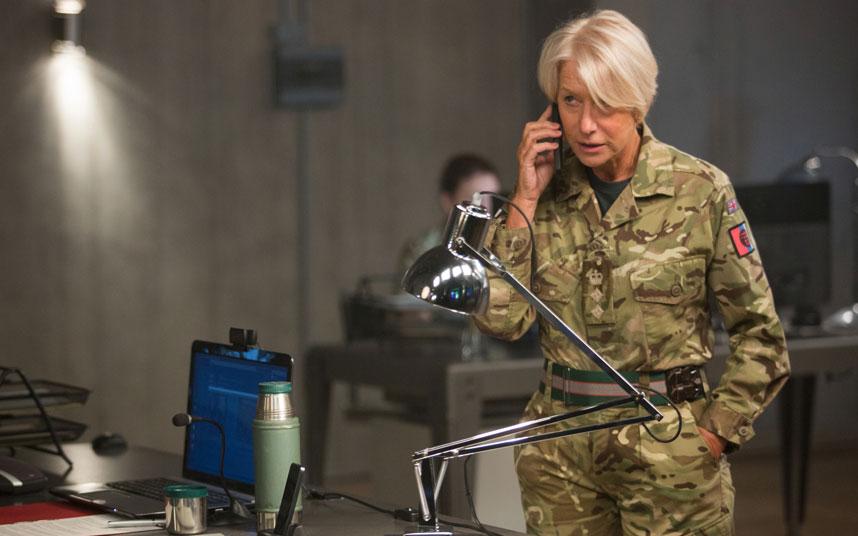
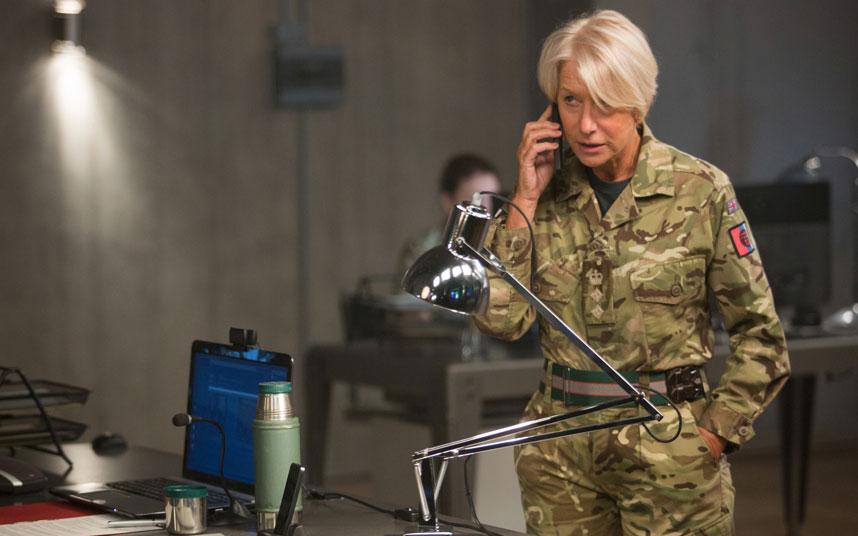
Colonel Katherine Powell of the British Army (Helen Mirren) is awakened by her phone. Intelligence received via drone indicates that three from the top ten international most wanted list of terrorists may possibly be together at a home in Kenya. The British and the US are especially interested in one couple they have been trying to find for six years. The wife is British and the husband is American. Both countries want them captured and tried at home.

If her team can positively identify the couple and the man they are meeting with, the mission will turn from reconnaissance to capture. But then the drone camera reveals that the danger is far more dire and imminent than they thought. The house is not just a meeting place. They are arming suicide bombers, taping their last statements, and presumably getting ready to send them into densely populated areas for maximum carnage. The people working on this are all over the world, with a military unit in Hawaii that analyzes images from a drone in Kenya, flown by a pilot in Las Vegas, commanded by military personnel in England, under the direction of elected officials who are both away from their countries on business.

The military has the capacity to prevent the suicide bombers from inflicting damage on civilians by blowing them up before they leave. But they are in the middle of a residential area. Is this warfare or an execution? Does it matter that two of the targets are British and US citizens? Does it matter that a little girl is selling bread just outside the house?

The international scope of the mission and the bureaucratic/political decision-making is fascinating. Information inside the house comes from a tiny mini-drone that looks like an insect, flown into the house by an operative nearby who is pretending to be both selling buckets in the open market and playing a video game on a phone. The operative is played by “Captain Phillips” star Barkhad Abdi, a very different and equally impressive performance of great intelligence and thoughtfulness. Information from the outside, including the biometric identification of the suspected terrorists, comes from drones monitored by Americans half a world away. Sitting at screens are Aaron Paul and Phoebe Fox as US military who are diligent and dedicated but not really prepared to blow up the people they’ve been spying on, especially that little girl.

There is a literal ticking time bomb in that house. We can see it. What should we do about it? Should we risk that child’s life to keep the suicide bombers from taking more lives? For the military, including Colonel Powell and her boss, Lieutenant General Frank Benson (the late Alan Rickman, making us miss him even more sharply), it is a mathematical calculus; not simple, but clear. They know they must consult the lawyers, who remind them of the criteria, almost a formula, they are required to apply. But the bureaucrats get nervous, and bump it up to the politicians. Calls must be made all over the world as the officials are participating in various diplomatic events; at one point it is even suggested that the question be put to the President of the United States.

But the film shows us that these questions have already been asked and answered. There is a calculus that is reassuringly quantitative and comprehensive but disturbingly clinical. As we see the people all over the world watching the people inside the house, trying to figure out how to apply those algorithms expressed in acronyms and percentages, the film forces us along with the characters to try to apply formulas to a world that will always confound them.

Parents should know that this movie features military violence including drones, guns, explosions, terrorism, suicide bombers, with some grisly and disturbing images, and very strong language. An extended part of the film focuses on potential “collateral damage” to civilians, including a child, from military action.

Family discussion: How would you improve the decision that was ultimately made? How would you improve the process for making it? Who should decide?

If you like this, try: the documentary “Drone”

Related Tags:


Drama DVD/Blu-Ray Pick of the Week Politics War
The Young Messiah

The Young Messiah

Posted on March 10, 2016 at 5:17 pm

Copyright 2016 Focus
We have a very clear picture of Jesus’s birth, and it is endlessly re-enacted and depicted each year at Christmas time. But we know almost nothing about His childhood, other than his astonishing the elders with his depth of knowledge.

“The Young Messiah,” “inspired by scripture and rooted in history,” shows us His early years. It is a reverential, respectful portrayal of Jesus at age 7, as the Romans were trying to find and kill Him, and as He was just beginning to understand His power and purpose. It is based on the book by Anne Rice.

Jesus is played by sweet-faced Adam Greaves-Neal. We first see Him listening to a young girl who is teaching him to draw a camel. When a bully gives her a hard time, Jesus steps in to defend her and the bully starts attacking Him. A mysterious hooded figure tosses an apple core to trip up the bully, who falls, hits his head on a rock, and dies. No one else could see the man in the hood, and Jesus is blamed for the boy’s death.

The young Messiah insists on visiting the body, and it is there He performs His first miracle, bringing the boy back to life. This is an extraordinary moment because no one, even Jesus himself, knew such a thing was possible or that He was capable of it. And yet Jesus is so young, and his compassion so deep, that it seems completely natural for him. It confirms the greatest hopes but also the greatest fears of Mary and Joseph as it makes him a target for the Romans. And, like all parents, they have to find a way to protect their child and to answer His questions, though both are difficult and both at the same time seem impossible. “How do we explain God to His own son?” Even more difficult, how can they explain to Him a world in which the road is lined with crucified Jews and babies were murdered because the Romans were so afraid of Him? And how should they guide Him in using a power no one really understands? Mary can only say, “Keep your power inside you until your Father in Heaven shows you the time to use it.”

As Jesus and his family travel from Egypt to Jerusalem, Herod sends a soldier named Severus (Sean Bean) to find the boy and kill Him. Severus is not worried about reports that the boy can perform miracles. “There’s only one miracle,” he says, brandishing his sword. “Roman steel.”

Greaves-Neal is not really an actor, but his performance has an appealing dignity and tenderness. “Am I dangerous?” he asks, not “Am I in danger?”

It is especially good to see the young Jesus portrayed as compassionate but also intensely curious about the world. That thirst for knowledge and understanding is as inspiring to those around Him as His miracles.

Parents should know that this film include Biblical violence including crucifixion, bullying, and characters are injured and killed.

Family discussion: What do we learn about Jesus from his reaction to the bully? How did his curiosity about the world and scripture help him understand his purpose?

If you like this, try: “Risen” and “The Gospel of John” and read my interview with director Cyrus Nowresteh

Related Tags:


Drama Epic/Historical Spiritual films
THE MOVIE MOM® is a registered trademark of Nell Minow. Use of the mark without express consent from Nell Minow constitutes trademark infringement and unfair competition in violation of federal and state laws. All material © Nell Minow 1995-2026, all rights reserved, and no use or republication is permitted without explicit permission. This site hosts Nell Minow’s Movie Mom® archive, with material that originally appeared on Yahoo! Movies, Beliefnet, and other sources. Much of her new material can be found at Rogerebert.com, Huffington Post, and WheretoWatch. Her books include The Movie Mom’s Guide to Family Movies and 101 Must-See Movie Moments, and she can be heard each week on radio stations across the country.

Website Designed by Max LaZebnik