The 33

The 33

Posted on November 12, 2015 at 5:55 pm

Copyright 2015 Warner Brothers
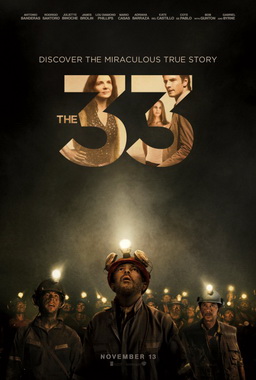
There are other numbers they could have used in the title. 121 — that is how old the Chilean Copiapó mine was when it collapsed in 2010. 2300 — that is how many feet underground the men were when it collapsed. 12,000 — the number of miners who die in accidents around the world, we are told as this movie begins. 69 — that is the number of days before they were rescued. Or just 3 — the number of international drilling teams that came to help, along with more than a dozen corporations. And there is some unknown but surely astronomical number that calculates the cost of the rescue, I am sure. But the movie is called “The 33” because it is less the story of the rescue than it is of the survival, the triumph, of the miners who were trapped, who stayed alive by sharing the woefully inadequate scraps of food left for them, along with the even worse facilities for escape in the case of an accident. In one of the movie’s most searing scenes, they learn that the ladders they had been assured could allow them to exit safely in the event of a collapse were never finished. The intercom for emergencies is not connected.

Director Patricia Riggen brings the skill at visual storytelling and tender-hearted but resilient optimism she showed in “Under the Same Moon” to this story. She insisted on filming underground, and the beams of light from the miners’ helmets, so small against the immense darkness of the caverns, are a powerful symbol of the fragility of the miners’ situation. And she opens up the setting just as it becomes unbearable with a poignant fantasy sequence as the starving miners imagine a glorious feast.

We meet the miners at a party and get a sense of who they are — the one who is about to retire, the one who has moved in with his mistress, to the fury of his wife, the one who likes to sing Elvis Presley songs. And we see them go to work, the long, perilous ride, the ominous response of the manager to the complaints of the safety officer. The shards of mirror they lodge in the walls of the mine are shattering, showing that the ground is shifting. “It’s my job to keep them safe,” the supervisor (Lou Diamond Phillips) tells the manager. “It’s your job to keep them pulling out 250 tons a day,” is the reply. “It’s good for another 20 years.” It would not be good for another 20 hours.

Once it has collapsed, the manager refuses to take any action. Either the miners are dead or they will soon be, and there is no way to get them out. The government takes over the mine and sets up operations, with facilities for the families. Soon an entire village is operating outside the mine, including one miner’s pregnant wife, another’s estranged sister (Juliette Binoche), and the feuding wife and mistress. There is a school for the children, a commissary for supplies, a medical facility. They call it Camp Hope.

The first issue is finding out whether there are any survivors. The moment when the note is retrieved, “We are well in the shelter, the 33 of us,” is jubilant. Then there is the challenge of keeping them alive. Food and sleeping bags (and iPods) are sent down and Skype communications are established. But the greatest engineers in the world cannot figure out how to drill down enough of a hole for a rescue without endangering them further. International press has cameras everywhere.

Meanwhile, the stress on the 33 is severe. Who will be their leader? What if they do not agree?

This is a story that was made for the movies and Riggen tells it well. We join the vigil with the families, and the scene of the real miners at the end shows us why the number that really matters is the one that defines them as a group forever.

Parents should know that this film includes dire extended peril and near-starvation, some strong language, and sexual references, some crude, and alcohol abuse.

Family discussion: Was that the best way for the trapped miners to pick a leader? Who should make sure that corporate facilities are safe and what should the penalties be if they are not? Read about the current trial of the former Massey Energy CEO in the US, following a mining accident that killed 29 mine workers.

If you like this, try: the NOVA documentary shown on PBS about the rescue, focusing on the NASA scientists and engineers, and the documentary “Buried Alive”

Related Tags:


Not specified
My All American

My All American

Posted on November 12, 2015 at 5:32 pm

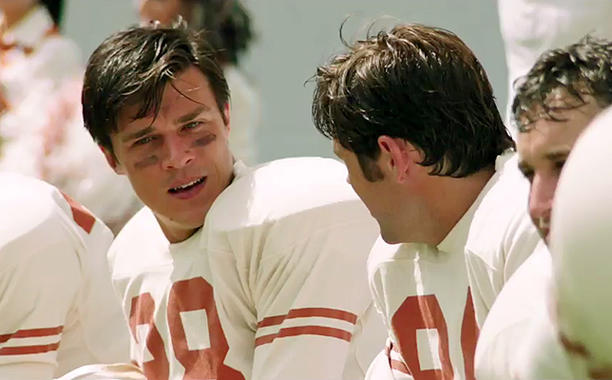
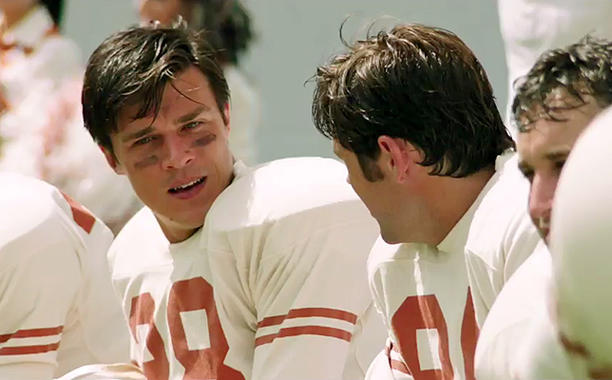
If I wrote this review the way writer-director Angelo Pizzo wrote the script for “My All American,” it would be something like this: I saw a movie. It was about football. Freddie Steinmark worked hard and inspired his team, but then got sick. It was sad.

Copyright 2015 Clarius Entertainment

Pizzo wrote two of the best sports films of all time, “Rudy” and “Hoosiers,” but here, in another real-life sports story, he has decided that the audience needs a kind of running commentary from every character to explain — instead of show — the audience what is going on. In an early scene, Steinmark’s mother (Robin Tunney) tells him that because he is smaller than his friends, he will have to work harder. Later, other characters tell us repeatedly what we should be able to see: that he works harder than everyone else, that he is religious, even that he is handsome. This is a movie where a coach actually says that Steinmark has courage and guts. The dialogue is so exposition-heavy that it is like sawing lumber.

It is good to see a biopic that does not rely on the usual scenes of the girlfriend complaining that the lead character does not spend enough time with her. But Steinmark is portrayed as such an all-around saint that he is bland, without any character beyond niceness and determination. All of the characterizations are paper-thin. It is as though everyone on the screen is just another color commentator, not a character.

Steinmark (Finn Wittrock of “The Big Short”) is the son of hard-working Catholics. His father has two jobs, security guard by day, cop at night, but is so dedicated to his son’s athletics that he never misses a practice or a game. When a teammate suggests that perhaps Steinmark’s father is living his own dreams of an athletic career through his son, Freddie says no and the subject never comes up again. Freddie wants to play for Notre Dame and then the Chicago Bears. But college coaches think he is too small — except for Darrell Royal (Aaron Eckhart) at the University of Texas, who recruits Steinmark and his best friend. Steinmark’s devoted girlfriend, Linda (Sarah Bolger, one of the adorable Irish girls from “In America”), is accepted to UT as well.

Steinmark is so remarkable (as everyone keeps telling us and telling us and telling us) that he is made first-string in his sophomore year. He leads the defense so successfully that the championship is within reach. And then he begins to have a problem with his leg.

There are very clumsy attempts to do what “Rudy” and “Hoosiers” did in creating a sense of time and place. Here, the references to the war in Vietnam (and the protests), the moon landing, long hair, and 60’s songs are jarring and haphazard. The absence of any person of color may be authentic as regards the team, but on the campus? In the hospital? It is so strange that it becomes a distraction. The framing story of an interview decades later with Royal adds nothing. The football scenes are capably staged, but do not move the story forward.

There are references to Steinmark’s faith — he goes to mass every day and we see him pray and encourage his friend to pray. But we never get a sense of what the faith means to him or how it helps him understand his illness. There is more drama and more character in a throwaway scene involving another player who loses his position than there is in the portrayal of Steinmark’s story.

And there is only the slightest reference to one of the most interesting parts of the story; the lack of treatment options for someone with cancer in 1969. Steinmark’s diagnosis came just before the United States made its first major commitment to a “war on cancer,” with federal funds being used for research. This is the kind of context that could have provided the story with the impact it fails to muster.

Parents should know that there is brief strong language and a brief view of a bare tush, as well as discussions of serious illness and a sad death.

Family discussion: Were you surprised by Bill’s reaction to being replaced? What was it about Steinmark that made him so important to his coach?

If you like this, try: “Rudy,” “Hoosiers,” and “The Express”

Related Tags:


Based on a true story Illness, Medicine, and Health Care Sports
Spotlight

Spotlight

Posted on November 12, 2015 at 5:30 pm

“Spotlight” is about the ultimate betrayal of trust from an institution that literally represented the Word of God to many people. And it is about whether we will continue to have institutions that serve the essential function of monitoring the gap between aspiration and actuality, between what people say they are and do and the reality.

Copyright Open Road Films 2015

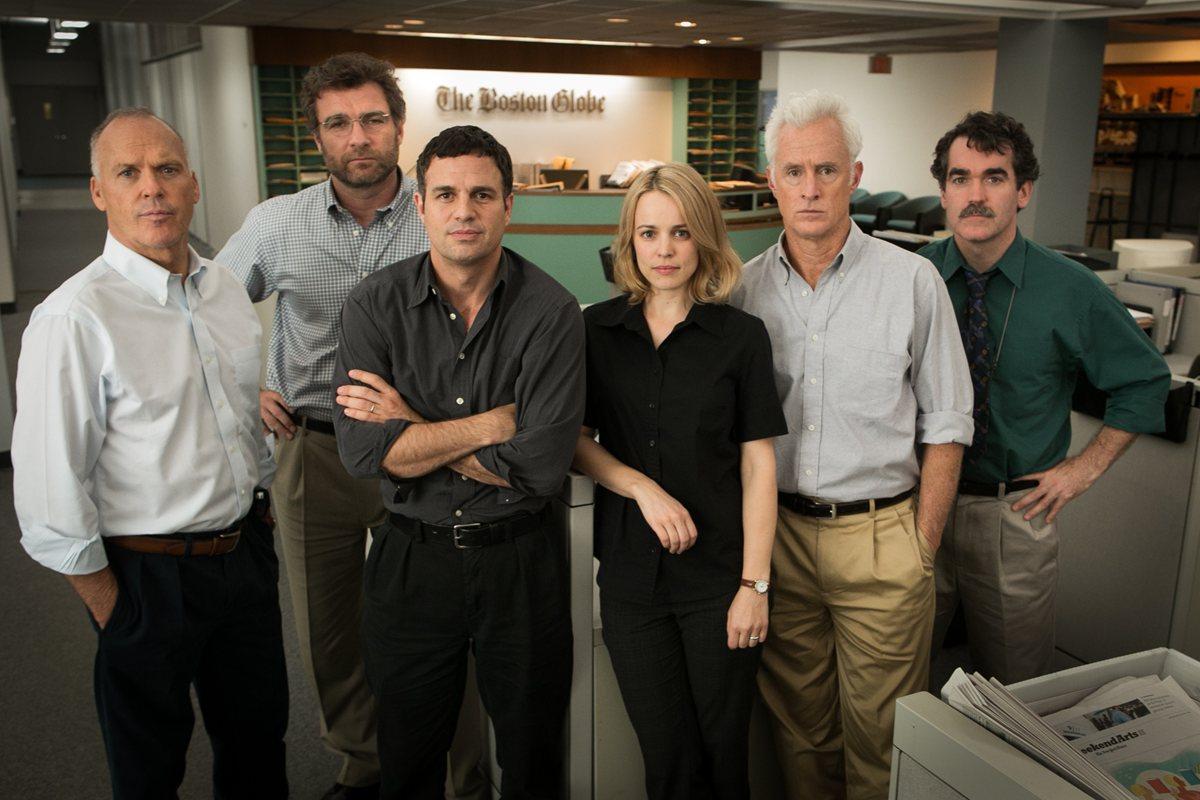
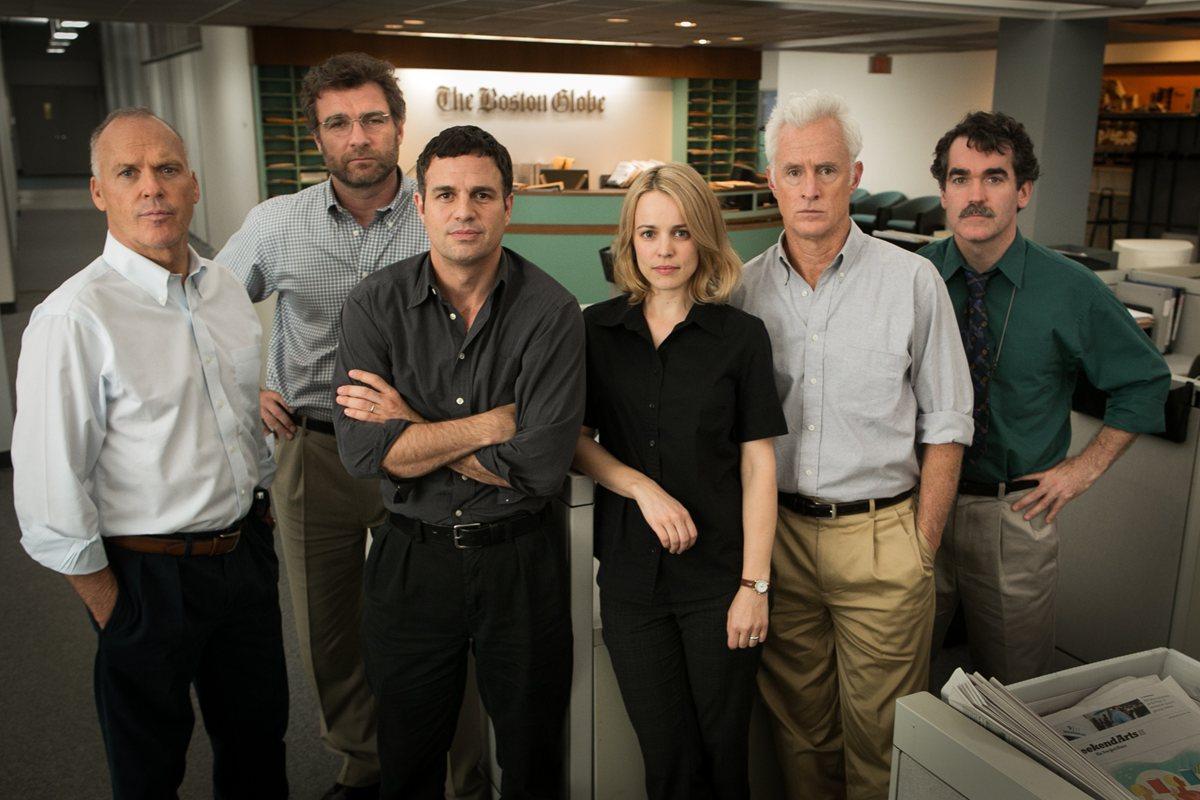
Spotlight is the name for the investigative group of journalists working for the Boston Globe. While their colleagues reported on stories that could be reported and written in days, the Spotlight group had the luxury and the responsibility of taking as much as a year to do the kind of in-depth original research necessary for more complex and difficult subjects.

The staff at Spotlight was let by Walter “Robby” Robinson (Michael Keaton) and included Mike Rezendes (Mark Ruffalo), Sacha Pfeiffer (Rachel McAdams), and Matt Carroll (Brian d’Arcy James).

Like most of the members of the Globe staff they were Boston born and bred, Red Sox fans to the end, and raised Catholic. They had just finished work on a long-term piece when their new editor arrived. He was not Boston born and bred, not a Sox fan, and not Catholic. And perhaps most important, he was not a Boston Globe lifer. He was Marty Baron (Liev Schreiber), most recently from Miami. He was an outsider in every way and they correctly suspected that the Globe was just a stop on his career trajectory. (He is now at the Washington Post.) They were not inclined to follow his idea of what stories they should cover.

But when he asked them about following up on a story about a priest who abused young boys, they could not come up with a reason not to other than it was too awful to imagine that it might be true. They begin to investigate. It turns out it was not one priest. It is a city-wide problem. A priest abuses children, is put on “medical leave” and transferred. The families of the boys are paid off and silenced. Then it happens again.

Director Tom McCarthy (“The Station Agent,” “Win Win”), writing with Josh Singer, really captures the culture of a newsroom, the stale coffee, the stale-er jokes, but the passionate curiosity that drives them all. This film will be compared to “All the President’s Men” because they are both true stories about young reporters getting huge stories everyone else missed. But the more important comparison is the way both movies capture the numbing work that goes into reporting. The doors knocked on. The doors slammed. And in this case, the nine years worth of diocese phone directories gone over, line by line (this was one of the last of the eras of off-line, analog document searches) to follow the “medical leave” priests took weeks of meticulous checking. It shows us reporting on the cusp of monumental technological change as well, when the paper makes the then-innovative decision to make the underlying documents available to readers online.

The reporters face enormous obstacles, starting with overcoming their own assumptions and then the powerful people who try to stop them. The church is an overwhelming force, politically and culturally. Do readers really want to know? Will the paper lose subscribers and advertisers?

There is no betrayal more devastating than to have the most trusted of institutions, the one most intimately involved in family joys and sorrows to be countenancing the abuse of those most deserving of its protection. But by the end of the film, that atrocity, already known to us, is not as troubling as the idea that news organizations may not be able to bring us the next one.

Parents should know that the theme of the movie is the investigation of widespread child sexual abuse and its cover-up, with sexual references, some graphic, and some strong language.

Family discussion: How did the arrival of an outsider affect the decision to do this story? Do today’s newspapers have the resources and support they need to do in-depth investigations like this one?

If you like this, try: “All the President’s Men” and “Truth” and the documentaries “Deliver Us from Evil” and “Twist of Faith”

Related Tags:


Based on a true story Drama Journalism
Trumbo

Trumbo

Posted on November 12, 2015 at 5:29 pm

Copyright 2015 Bleeker Street
The post-WWII era was one of great relief and great fear. The Nazis had been defeated, but at the cost of bringing into the world the horror of atomic weapons. It was a certainty that the next war would be the last. The US could not last as the only superpower. The communists would do anything to get the bomb, and once they had it, no one was safe.

And that is why, just after the United States fought to preserve liberty and freedom of speech, those very ideals began to seem like a threat to our safety. And when there is a threat, there will be demagogues who prey on people’s fears to make themselves more powerful. That was the case in the late 1940’s and early 1950’s when Americans became so terrified of communism that the very idea someone might have been or known a communist was enough to get them fired and blacklisted — unless they were willing to “name names” and give investigators a list of other people to investigate. It was a kind of perverse pyramid scheme.

That is what happened to Dalton Trumbo (Bryan Cranston), one of Hollywood’s most successful and highest paid screenwriters. He was also a member of the Communist Party. The idea that somehow screenwriters would brainwash moviegoers into becoming communists was such a threat that he and nine other writers who refused to cooperate with the House Un-American Activities Committee were blacklisted (not allowed to work in Hollywood anymore). Trumbo was sent to prison for contempt (refusal to cooperate).

When he came out, he managed to find work by getting other writers to put their names on the scripts he created (including two Oscar-winners) and by writing scripts at a fraction of his previous salary for a schlock producer (hilariously played by John Goodman).

Director Jay Roach creates the world of Trumbo, fiercely intelligent and committed. Cranston is excellent as Trumbo, every line of his posture and every gesture showing us the the active intelligence of the man who took his own struggle for freedom and turned it into one of the greatest lines in movie history: “I am Spartacus!” As he types madly away from his bathtub (to ease his back pain) and fights to find work for the other blacklisted writers, he never loses his sense of amusement at the folly around him. He is skeptical, even cynical at times but never loses his sense of optimism that even something good can be made better.

Parents should know that this film includes strong language, some crude references, brief non-sexual nudity, drinking, smoking, and drug use, and some tense and disturbing scenes.

Family discussion: What themes of this film are particularly relevant today? What should Trumbo have done? How did his experience influence his films? Why was it important to pay back the money?

If you like this, try: Trumbo’s films, including “Spartacus,” “Roman Holiday,” and “Lonely Are the Brave” and other films about this ear like “The Front” and “Goodnight and Good Luck”

Related Tags:


Not specified
Spectre

Spectre

Posted on November 5, 2015 at 5:52 pm

B+
Lowest Recommended Age: High School
MPAA Rating: Rated PG-13 for intense sequences of action and violence, some disturbing images, sensuality and languag
Profanity: Some strong language
Alcohol/ Drugs: Drinking
Violence/ Scariness: Spy-style action violence with chases, shootouts, and explosions, characters injured and killed, torture, suicide
Diversity Issues: None
Date Released to Theaters: November 6, 2015
Date Released to DVD: February 8, 2016
Amazon.com ASIN: B018WXLFSM

Copyright MGM 2015
Copyright MGM 2015
I thought “Skyfall” was the best Bond film ever, from the Adele theme song to the storyline that literally brought Bond (Daniel Craig) home. “Spectre” picks up where “Skyfall” left off, M (Dame Judi Dench) dead, the headquarters destroyed, the future of the double-O program in jeopardy. If this chapter, reportedly Craig’s last as Bond, is not up to the “Skyfall” level, it is still a solid entry in this series, more than half a century since the elegantly attired agent with a license to kill first appeared on screen.

The opening scene is brilliantly staged by returning director Sam Mendes. It takes place in Mexico City, in the midst of the Day of the Dead celebration and parade. Skeletons and signifiers of mortality are everywhere. An masked man with a man bun (so he must be a bad guy) passes by. Another masked man seems to be paying attention only to the beautiful woman he is escorting, but we can tell by the elegantly tailored suit that this must be Bond and therefore he is paying attention to everything. Sure enough soon he is spying, shooting, and chasing in one bravura shot that takes him through the crowd and the parade and into a fight inside a swooping helicopter.

Great beginning! And then we go into the credit sequence, which is pretentious and silly, with a sub-par song from Sam Smith. Ah, well.

It continues along those lines, with some set pieces that are exactly what we want from a Bond film, but other elements that show the uneasy bridge the Broccoli family, which controls the franchise, is trying to develop between the late 20th century Bond (Grace Jones! Space! Denise Richards as a nuclear physicist named Christmas! Infomercial level product placement!) and the grittier, more down-to-earth geopolitics of the 21st century, whether on screen (the Bourne series) or in the news (9/11). The film raises the question both in its storyline and in its presentation about whether the era of the shaken-not-stirred martini drinker who never carries a suitcase but always seems to have a dinner jacket on hand is over.

The dinner jacket, the beautiful women who find Bond irresistible, the martini, the cool car, the exotic locations, and the guns and gadgets are all there. A nice twist is that the car was designed for another agent, so Bond has no idea what the various buttons do. And the new gadget actually assigned to him is below the technology level of Maxwell Smart’s shoe phone. The gadgets that matter here are lines of code, and in this movie they serve as the MacGuffin as well. All of that works, though there were some snickers in the crowd during a brief pause in the action where Bond and the new Bond Girl (Lea Seydoux) get all dressed up for dinner on a train. The cinematography by Hoyte Van Hoytema finds a nice consistency through all of the globe-hopping ports of call, with lots of white space around our increasingly isolated hero. Craig, as he has done in all of his Bond films, gives a performance of depth as well as charm. He faces some choices with moral complexity, especially when he meets with a former adversary, and it is intriguing to see how he thinks them through. The somber tone is Bourne-ish, but the storyline teeters too close to recent stories like the last “Mission Impossible” and even “Captain America: Winter Soldier.” The final resolution exemplifies what is best and worst about the film, taking the “Skyfall” revelations about his past further, but going completely overboard with a brilliant villainous strategist who puts way too much time into an elaborate trap. And an otherwise sensible Bond girl who picks a very bad moment to discuss the relationship.

“Bond will return,” we are reassured once again at the end of the film. And by then we’re already looking forward to the next reboot.

Parents should know that this film has extended and graphic scenes of action-style spy violence with many crashes, explosions, chases and shootouts. There is a suicide and and some torture, with characters injured and killed, as well as some strong language, some sexual references and situations, and alcohol.

Family discussion: Who should decide what information is available to government agencies? How did childhood trauma affect three of the main characters?

If you like this, try: “Skyfall” and some of the Sean Connery and Pierce Brosnan Bond films

Related Tags:


Action/Adventure DVD/Blu-Ray Pick of the Week Series/Sequel Spies
THE MOVIE MOM® is a registered trademark of Nell Minow. Use of the mark without express consent from Nell Minow constitutes trademark infringement and unfair competition in violation of federal and state laws. All material © Nell Minow 1995-2026, all rights reserved, and no use or republication is permitted without explicit permission. This site hosts Nell Minow’s Movie Mom® archive, with material that originally appeared on Yahoo! Movies, Beliefnet, and other sources. Much of her new material can be found at Rogerebert.com, Huffington Post, and WheretoWatch. Her books include The Movie Mom’s Guide to Family Movies and 101 Must-See Movie Moments, and she can be heard each week on radio stations across the country.

Website Designed by Max LaZebnik