Irreplaceable

Posted on May 5, 2014 at 8:00 am

F
Lowest Recommended Age: Middle School
Profanity: None
Alcohol/ Drugs: None
Violence/ Scariness: None
Diversity Issues: Expressions of intolerance
Date Released to Theaters: May 6, 2014

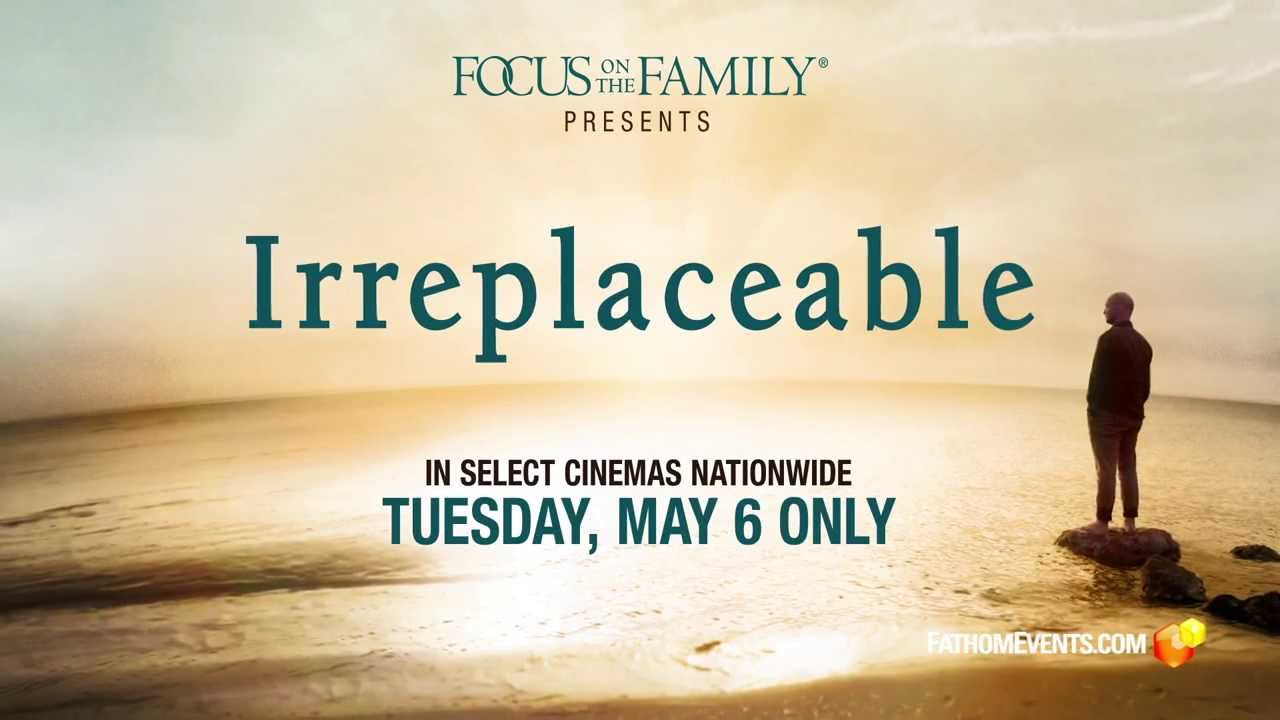
Irreplaceable” is indefensible.

My parents taught me that you automatically lose an argument if you (1) fail to state the other side’s views in a manner they approve or (2) fail to attribute to the other side the same good intentions you assume for your own. Focus on the Family’s faux documentary “Irreplaceable” fails on both grounds.  It probably also violates one of the Commandments as well, the one prohibiting the bearing of false witness.

I’m in favor of strong, loving families with responsible parents. You’re in favor of strong. loving, families with responsible parents. It is safe to say that there is just about no one who is not in favor of strong, loving families with responsible parents. It is about the least controversial position imaginable. But this film uses the rhetoric of support for family as a thin and increasingly cynical and specious cover for a pernicious agenda disguised as a “conversation.” It’s so smug, constricted, and phony that it does not even qualify as one-sided.

irreplaceable movieThe unctuous tones of the participants are intended to convey concern. But the false humility is merely an attempt to distract the audience from a poisonous message. Though some vague generalities acknowledge that in some cases marriages cannot be made safe and spouses must leave, the real message is that there is only one kind of family and everything else is unstable for its members and for culture and society. If it had any faith in its positions, Focus on the Family would accurately explain the views of those who embrace a variety of family structures and roles, allowing each family to find what is best for them.  Instead it slants and distorts those messages because it knows it has no effective arguments to make honestly.  It relies on innuendo and the basest slur to keep its base too scared to be anything but compliant.

The “experts” in the film tell us that the problem is that we are getting cultural messages about valuing self, possessions, and pleasure over the family.  Those are serious questions and worth exploring.  But they fall back on an imagined war between faith and culture without any exploration of why the faith community has failed to communicate its message more effectively or how the faith community or society as a whole could provide more support for families in need.  There is no place in the world of these experts for families that do not fit into their one-size-fits-all vision of mother, father, children all living together.  Is it possible for strong, loving, intact families with gay parents to raise happy, healthy children?  For single parents and blended families to raise happy, healthy, children?  Are fathers today more deeply involved in their children’s lives than in the falsely idealized vision of the mid-20th century promoted here?  Statistics say yes, but you would not know that from this film.  If indeed that era was so ideal, why did the overwhelming majority of those who grew up that way advocate with such passion for alternatives?

Those who wish to persuade others can best do so by building a bridge to establish a common foundation, making it clear that what connects us is more important than what separates us. Or, as they have done here, they can build a moat around their shrinking base, reinforcing the condescending sense of superiority of their own little group by telling them that only their answers work for everyone and playing into their worst fears and stereotypes.

One of the “experts” in this film tells us, “If anyone says they can fix the world, run.”  Yet that is just what they do here, imagining that once there was a heavenly era of intact families living out God’s plan without acknowledging that the mid-century “ideal” was neither universal nor considered ideal by those living in it.  The dissatisfactions that model engendered led to a cultural upheaval that created its own problems, but none so grave to lead to a widespread call for a return to stultifying, rigidly conformist norms.  While commentators in this film make vague concessions to those whose situations are so intolerable that the marriage cannot survive, the essential condescension, arrogance, and total absence of grace or compassion is its primary message.

With this cynical, meretricious and hypocritical film, Focus on the Family has dug a moat and burned the drawbridge. It purports to be about the importance of fathers taking responsibility for their children (again, something everyone agrees on, but you would not know that from this film). It purports to be about forgiveness, something else everyone agrees on, but it engages in the most immoral tactics by demonizing anyone who does not meet its standards.

I am happy for the person in the film who is glad his mother stayed with his father even after he went to jail for stealing money but that does not mean that it would be right for all spouses. And it does not mean I will forgive Focus on the Family for this shoddy, hateful, and dishonest film.

Parents should know that this is a dishonest film that attempts to hide its biased agenda.

Family discussion:  What families do you admire and why?  What can you to do help your family be stronger?

If you like this, try: “A Family is a Family is a Family”

Related Tags:


Movies -- format

Moms’ Night Out

Posted on May 4, 2014 at 9:48 pm

B+
Lowest Recommended Age: 4th - 6th Grades
MPAA Rating: Rated PG for mild thematic elements and some action
Profanity: Mild language
Alcohol/ Drugs: Some drinking, references to substance abuse
Violence/ Scariness: Characters in peril, mostly comic, taser, tattoo parlor
Diversity Issues: Diverse characters
Date Released to Theaters: May 9, 2014
Date Released to DVD: September 1, 2014
Amazon.com ASIN: B00KO6EC4A
© 2014 AFFIRM Films/Sony Pictures Entertainment & Provident Films, LLC. All Rights Reserved.

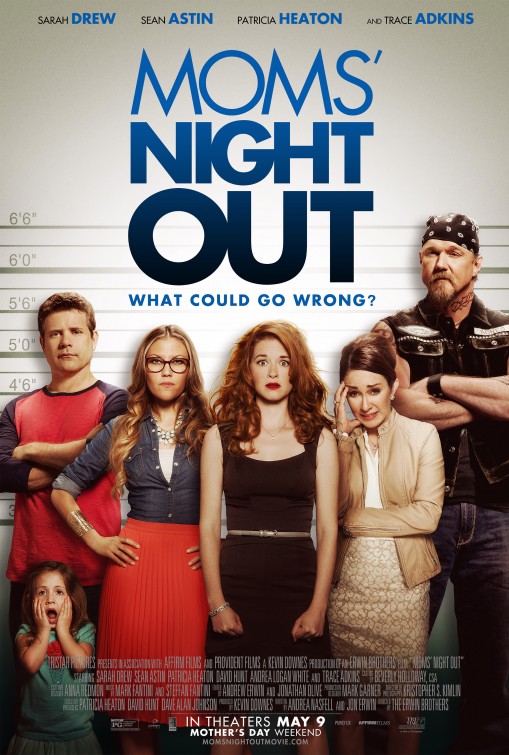
It may feel like a kinder, gentler, sweeter version of “Adventures in Babysitting” or “The Hangover,” but this charming story manages to avoid getting syrupy, even when everyone settles down in the midst of chaos for a little talk about God’s love. It helps that the conversation is with a scary-looking tattooed biker type played by country star Trace Adkins. It is a very funny movie with an exceptionally likeable cast and a warm-hearted, surprisingly touching tribute to moms and their families, as endearing as a Mother’s Day Card made from a paper plate covered with smeared finger paint and glittery macaroni.

Three moms are just hoping for a night away from cranky toddlers, crankier teenagers, and the perpetual chaos of parenthood, only to stumble into an even greater chaos that (spoiler alert) teaches everyone some important lessons about what really matters. Allyson (adorable Sarah Drew of “Grey’s Anatomy”), is a “clean freak” fighting a losing battle against the most powerful mess generators ever known, young children.  She thinks it would feel comforting to be locked away in a bare white room in a straight jacket. The result: Allyson feels like “the Bruce Banner of stay-at-home moms,” literally tackling a child about to put his finger in his mouth because she is worried about salmonella.  Danger seems to lurk around every corner.  Panic never subsides.

Allyson has a devoted, sympathetic husband (Sean Astin as Sean), but that only makes her feel that she is failing him, too.  Plus the readers of her mommy blog have dropped from four to three. Allyson looks up to Sondra (a nicely wry but heartfelt Patricia Heaton), her preacher’s wife, and thinks of her as “my Oprah, my Dr. Phil, my Gandalf.”  And her closest friend is Izzy (Andrea Logan White).  She has not quite figured out a way to tell her husband, who is very insecure about taking care of their twins, that another baby is on the way.

All three moms are in desperate need of some grown-up time, in grown-up clothes, eating food they did not cook and won’t have to clean up after, with purses emptied out of sippy cups and disinfectant wipes.  So, they make plans for an all-too-rare girls’ night out, get all dressed up, and head out for a very fancy restaurant.

Unfortunately, they never get past the snooty hostess (the always-great Anjelah Johnson-Reyes of “Bon Qui Qui”).  Instead, they find themselves caught up in a vortex that includes a missing car and a missing baby (the child of Sean’s sister), with trips to the emergency room and the police station, a tattoo parlor and cosmic bowling. Adkins has a nice scene as a tattooed biker with some surprisingly good advice. Every mom will relate to Allyson’s “pyramid of co-dependency” and the particular bleakness of feeling that you are living your dream and still cannot feel happy about it.  And to the mantra of the airplane directions for use of oxygen: If you are travelling with a child or someone who requires assistance, secure your mask on first, and then assist the other person.  And to “finding the meaning, joy, and purpose in all the craziness.”

Parents should know that the movie includes some peril (no one badly hurt), minor injuries, a character who gets tased, and references to alcoholism.

Family discussion: Why was it hard for Allyson to feel like she was doing a good job?  How do you find purpose in the craziness?

If you like this, try: “Adventures in Babysitting” and “Ramona and Beezus”

Related Tags:


Comedy DVD/Blu-Ray Pick of the Week Family Issues Spiritual films

Decoding Annie Parker

Posted on May 1, 2014 at 6:00 pm

B+
Lowest Recommended Age: Mature High Schooler
MPAA Rating: Rated R for language and some sexual content
Profanity: Very strong language, sexual references
Alcohol/ Drugs: Drinking
Violence/ Scariness: Serious illness with disturbing scenes of symptoms and treatment, very sad deaths
Diversity Issues: None
Date Released to Theaters: May 2, 2014
Rashida Jones and Samantha Morton in Decoding Annie Parker (courtesy of Dorado Media)

This is the true story of two women who share a goal but meet just once, for a few moments.  Oscar winner Helen Hunt plays scientist Dr. Mary-Claire King, whose pioneering research led to one of the most significant medical discoveries of the 2oth century, the BRCA1 genetic marker for early onset breast cancer.  And Samantha Morton plays Annie Parker, a young woman who lost her mother and sister to breast cancer and then, when she was diagnosed with it herself, became dedicated to learning everything she could about the disease.  An outstanding cast, a likeable narrator, and a thoughtful script co-authored by director Steven Bernstein take this out of the easy tears of the disease-of-the-week TV movie category.  It is an absorbing drama with a lot of respect for its characters and a welcome sense of humor.  “My life was a comedy,” a quote from the real Annie says as the movie begins.  “I just had to learn to laugh.”

Annie’s mother died of breast cancer when she was a child, and Annie and her sister (Marley Shelton as an adult) superstitiously believe — or pretend to believe — that Death sleeps in a locked room on the top floor of their house, and that their mother make the mistake of awakening it.  Their father dies when Annie is still in her teens, and we see her at the first of three funerals in the film, with fatuous remarks from the people attending and a skeezy funeral home employee hitting on her.  “A lot of women can’t be cool and in mourning at the same time, but you pull it off.”

A little lost, and overcome with ardor for her musician/pool cleaner boyfriend Paul (“Breaking Bad’s” Aaron Paul in a series of 70’s and 80’s hairdos that are both horribly ugly and fake-looking), Annie gets married.  They live in the house she grew up in and very soon they have a baby.  And then, the last member of her family, her sister Joan, gets breast cancer and dies, funeral number two, same fatuous remarks and skeezy guy.

And then Annie gets a lump in her breast.  It is cancer.  She has a radical mastectomy and removal of most of her lymph nodes under one arm, followed by chemotherapy.  She becomes determined to learn as much as she can about the disease, even building models of cancer and DNA.  And she becomes a warrior against cancer, checking her breasts and insisting everyone else check, too.  She even offers to check her husband for testicular cancer during an intimate moment.

Meanwhile, Dr. King is insisting that there is a genetic link and working to find it, despite a lack of support.  She is told it will take ten years for the computers available to her to analyze the data she is collecting from women who are in families with multiple cases of breast cancer.  But Bernstein wisely makes Annie Parker, rather than Dr. King, the focus of the film.  This adds warmth and drama to a story that would otherwise be a lot of people in lab coats getting turned down for grants and crunching data.  Parker makes an engaging guide to the years of struggle faced by both women, with a wry sense of humor and a steeliness of resolve that, endearingly, is as much a surprise to her as it is to everyone around her.  She is very funny quacking (really!) to get the attention of a bored doctor’s office receptionist (Rashida Jones), who later becomes her close friend and ally.  Morton is superb, showing us Parker’s vulnerability as well as her courage, and making us understand the scope and the human dimension of Dr. King’s work.  When they finally meet we see how in an important way they kept each other going.

Parent should know that this film has themes of cancer, illness, and loss, with sad deaths and some disturbing scenes of symptoms and treatment, sexual references and brief explicit situations, adultery, some very strong language, and drinking.

Family discussion: Why did Paul and Annie have such different reactions to illness? How did humor help Annie stay courageous? Read up on Dr. King and her opposition to patenting gene sequences.

If you like this, try: “50/50,” “Wit,” and “God Said Ha!”

Related Tags:


Based on a true story Drama Movies -- format

The Amazing Spider-Man 2

Posted on April 30, 2014 at 1:00 pm

B+
Lowest Recommended Age: Middle School
MPAA Rating: Rated PG-13 for sequences of sci-fi action/violence
Profanity: Some mild language
Alcohol/ Drugs: None
Violence/ Scariness: extended comic book/superhero violence with characters in peril, injured and killed, chases, explosions, bombs, very sad deaths
Diversity Issues: Diverse characters
Date Released to Theaters: May 2, 2014
Date Released to DVD: August 18, 2014
Amazon.com ASIN: B00JPS7HOA
TM and copyright Marvel 2014

This is not the angsty Spidey we know.  Just like the old television series theme song said, Peter Parker is “your friendly neighborhood Spider-Man.”  We first see him exuberantly swinging through the skyscrapers, deliciously vertiginous in 3D.  His disposition is so sunny that he cheerfully greets a crook driving a truck filled with highly volatile stolen cargo with a happy, “Hi, Criminal!” and, when his offer of a handshake gets no response, offers a hug.

But then it’s down to business, with a gloriously witty and dexterous action scene as Spidey (Andrew Garfield) has to use his web to scoop up every one of the explosive vials rattling out of the truck before they hit the ground.  No more of the dreary re-cap of the origin story that weighed down chapter one.  We’re in it right from the beginning.

All seems to be going well for Peter, though this little fracas is making him late for graduation (not important) and the valedictory speech delivered by his true love, Gwen Stacey (Emma Stone).  The special effects and action scenes are just fine in this film, but what makes it qualify as “amazing” is the chemistry between real-life couple Garfield and Stone, so electrifying that even super-villain Electro (Jamie Foxx), master of all power sources, seems to fizzle by comparison.  The warmth (and downright heat) between the two leads make this far and away the most romantic superhero movie ever.  As performers, they understand and respond to each other so completely in synch that we are immediately engaged in whatever is going on between them.  They never waste time with the usual movie couple worries about how they feel about one another or whether they can trust each other or whether she knows and understands who he really is.  “You’re Spider-Man and I love that.  But I love Peter Parker more,” she tells him.

They have a bigger problem.

Peter is literally haunted by visions of Gwen’s late father (Denis Leary), who made Peter promise he would not put Gwen at risk by letting her become involved with him.  Gwen is understandably frustrated with his struggle, and especially with his insistence that the decision is up to him.  And, while she completely supports all of his crime-fighting activities (another refreshing departure from the usual storyline — no “I’m worried about you” or “Be careful”), she is committed to her own dreams, which may take her to England to study at Oxford.

Oh, and there are a couple of super-villains coming after Spidey, too.

If that seems like an afterthought, the movie makes it feel that way, too.  It raises our expectations by starting right in the middle of the action and getting the obligatory Stan Lee appearance out of the way early (though not foregoing a corny line of dialog).  But then it turns out to be a bit over-long at two and a half hours, and the big confrontation scenes are oddly truncated at the end.  Normally, the most important character in a superhero movie is the villain (hello, Tom Hiddleston as Loki).  For mostly better but sometimes worse, the main character in “Amazing Spider-Man 2” is the Peter-Gwen romance.  It is more than fine; it is great.  But it is so powerful that it throws off the rest of the film.

As we often see in movies with young male heroes, there are plenty of daddy issues for everyone.  Gwen and Peter have both lost their fathers (Peter has also lost his surrogate father, Uncle Ben), and Peter’s old friend Harry Osborne (Dane DeHaan) loses his (Chris Cooper) early in the film.  Peter finds out more about his late father (Campbell Scott), uncovering a cool secret hideaway, though it takes too long for him to figure it all out.  Peter and Harry have a great moment of awkward reconnection before falling into a familiar pattern of bro-talk.  But Harry is sick, and he is convinced that the only thing that can keep him alive is a transfusion of Spider-Man’s blood.  Spider-Man visits him to explain why that can’t happen, but is unable to persuade the desperate Harry.  “Your blood can’t make me die more.”

Meanwhile, the shy, nebbishy Max Dillon (Foxx), overlooked and mistreated, has (of course, this is Marvel) a lab accident that turns him into a blue glowy guy (reminiscent of “Watchman’s” Dr. Manhattan) who can channel and harness all power sources.  The problem with this character is that both his powers and his motivations are underwritten and he just does not have enough to do until too late in the film.  Dane DeHaan is well cast as the spoiled rich kid who is bitter and wounded by his father’s neglect, and thank goodness his supervillain make-up and super-space-skateboard-y thing is much better than Willem-Dafoe’s.  But again, we wait a long time for him.  Paul Giamatti is wasted in a small part, much of which takes place inside a big robot that could have come from the final confrontation in “The Incredibles.”

But those big, swoopy swings through the skyscrapers and terrific performances by Garfield and Stone make this a great way to start the summer movie season. (And you don’t have to sit through all the credits — no stinger scene at the end.)

Parents should know that this film has extended comic book/superhero violence with characters in peril, injured and killed, chases, explosions, bombs, and sad deaths of a parent and a major character.

Family discussion: Should Peter have kept his promise to Gwen’s father? How did learning the truth about his own father make a difference to Peter? Could Peter have changed Harry’s mind?

If you like this, try: “The Amazing Spider-Man” and “The Avengers”

Related Tags:


3D Action/Adventure Comic book/Comic Strip/Graphic Novel DVD/Blu-Ray Pick of the Week Fantasy Series/Sequel Superhero

The Other Woman

Posted on April 24, 2014 at 6:00 pm

C-
Lowest Recommended Age: Mature High Schooler
MPAA Rating: Rated PG-13 for mature thematic material, sexual references and language (on appeal from the original R rating)
Profanity: Strong language
Alcohol/ Drugs: Drinking and drunkenness, brief reference to marijuana
Violence/ Scariness: Comic peril and violence
Diversity Issues: None
Date Released to Theaters: April 25, 2014
Date Released to DVD: July 29, 2014
Amazon.com ASIN: B00KNALRZ4

TheOtherWoman-posterThe latest in a female-centered revenge comedy genre that extends from “9 to 5” through “She-Devil,” “The Other Woman” is intended to be a merry little tale of female empowerment and grrrl power.  Instead it is soggy, haphazard, poorly paced slapstick mansplained by director Nick Cassavetes from a script by Melissa Stack.

Cameron Diaz (who gave one of her best performances in Cassavetes’ soapy “My Sister’s Keeper”) plays Carly, a tough-as-nails corporate lawyer with a beautiful office overlooking Central Park.  She meets handsome Mark King (“Game of Thrones'” Nikolaj Coster-Waldau, utterly lost in a thankless role).  For eight weeks he is thoughtful, attentive, and so hot that she has “cleared the bench” of other guys, she explains to a criminally underused Nicki Minaj as her secretary.  (The movie I’d like to see is Nicki Minaj going after a man who cheated on her.)  But then Carly discovers that Mark is married.  To Kate (Leslie Mann, in her “I’m going to pretend I don’t know I’m pretty and act like a total klutzy ditz” mode).  With a house in the Connecticut suburbs.  And a very big dog.

Kate falls apart.  Carly tells her to cry on on the inside “like a winner.”  How long before the big dog makes a mess of Carly’s impeccable white apartment?  How long before the two women are trying on clothes, discussing bikini waxes, doing each other’s hair and make-up and having a big sloppy drunk bonding moment?  How long before they discover that Mark was cheating on both of them with Sports Illustrated swimsuit issue cover girl Kate Upton?  How long before she goes running toward us on the beach in slo-mo wearing a tiny white bikini?

Except for that last one, the answer to all of the above is way, way too long.  But Kate Upton does look pretty great running in the bikini.

The trio decide that Mark must be punished.  So Kate gives him estrogen in his smoothie and depilatory in his shampoo and Carly puts laxative in his drink.  There’s an excruciating bathroom scene.  Though it is funny when the only replacement pants he can find are red skinny jeans from a hipster.

Then they go after his money.  All of this requires a lot of girly support group stuff, which is bad, and a lot of slapstick, which is much worse.  All but about two or three of the best moments (a relative concept) are in the trailer.  Comedic setups are poised to go off, then abandoned without resolution.  The woman exist for no reason except in relation to this unappealing man.

This is a movie about sisterhood and female empowerment that makes fun of Kate Upton’s character for being a dumb blonde and makes fun of Cameron Diaz for wishing she had Kate Upton’s figure.  This is a comedy that lets us know we are back in New York City by playing Frank Sinatra singing “New York, New York” and lets us know the women are having fun with their revenge plan by playing “Girls Just Want to Have Fun.”  The few witty lines and funny situations are lost in a headache-inducing cacophony, emphasis on the first two syllables.

Parents should know that the theme of the movie is adultery and betrayal.  It includes crude sexual references and non-explicit situations, drinking and drunkenness, smoking, drug reference, comic peril and violence, and gross potty humor.

Family discussion: Why did the women become friends? Why were they so misled by Mark?

If you like this, try: “The First Wives Club,” “She-Devil” (and the better original version, The Life and Loves of a She-Devil) and “9 to 5”

Related Tags:


Comedy Movies -- format
THE MOVIE MOM® is a registered trademark of Nell Minow. Use of the mark without express consent from Nell Minow constitutes trademark infringement and unfair competition in violation of federal and state laws. All material © Nell Minow 1995-2026, all rights reserved, and no use or republication is permitted without explicit permission. This site hosts Nell Minow’s Movie Mom® archive, with material that originally appeared on Yahoo! Movies, Beliefnet, and other sources. Much of her new material can be found at Rogerebert.com, Huffington Post, and WheretoWatch. Her books include The Movie Mom’s Guide to Family Movies and 101 Must-See Movie Moments, and she can be heard each week on radio stations across the country.

Website Designed by Max LaZebnik