
A Single Man

Posted on December 10, 2009 at 3:22 pm

B
Lowest Recommended Age: Mature High Schooler
MPAA Rating: Rated R for some disturbing images and nudity/sexual content
Profanity: Strong language
Alcohol/ Drugs: Drinking, drunkenness
Violence/ Scariness: Attempted suicide, aftermath of car crash with bloody body, themes of grief and loss
Diversity Issues: A theme of the movie
Date Released to Theaters: December 11, 2009

Designer Tom Ford has exquisite taste, and his first movie is an exquisite movie. Based on a story by Christopher Isherwood, as adapted by Ford, it is the story of one day in the life of a British literature professor in Los Angeles, shortly after the loss of his male lover in a car crash. It is November 30, 1962. And so the awful isolation of grief is multiplied by his inability to acknowledge what they were to each other and who he really is.

Ford’s images are so meticulously arranged they feel like a perfume commercial. There is a remote quality that distances us from what is going on. But there are moments, as when we see a flashback of the professor (Colin Firth) getting the news from a sympathetic relative who has to deliver the message that the funeral is “family only” where the grief and the pain of holding it in is raw and real and devastating.

Firth is revelatory as the professor who feels that his truest self and his deepest emotions are invisible in a world in which being gay is still “the love that dare not speak its name.” We see in memory the man he loved (the always-enticing Matthew Goode) and in the present his encounters with a curiously attentive but respectful student (Nicholas Hoult, all grown up since “About a Boy”). And he spends the evening with his closest friend, a boozy fellow British expatriate (Julianne Moore) with whom he believes he can be almost completely honest, but who still sees him as she wishes he was. There is a hint that all of what happens on this last day could be in his mind; I suspect that it is, but either way, we are caught up in his emotions and his story.

Related Tags:


Based on a book Drama Movies -- format Romance

Public Enemies

Posted on December 8, 2009 at 8:00 am

Back before the days when trashy faux celebrities from tawdry reality shows merited magazine covers and “gangsta” rappers postured and pretended to be killers, there was once a romanticized fascination with actual killers with names like “Baby Face” and “Pretty Boy.”

John Dillinger needed no infantalized nickname. He robbed at least 24 banks and killed several people, including police officers. But he had a rakish audacity and an innate populism that endeared him to people during the depths of the Depression. “I’m not here for your money,” he says to one bank customer who had the bad luck to be there during a robbery. “I’m here for the bank’s money.”

Dillinger became the most wanted man in America by law enforcement authorities and helped inspire the enactment of new federal laws and increases in budget and authority for the FBI. His story, ended when he was gunned down by the FBI coming out of the Biograph Theater in Chicago, has been the subject of many books and movies, and now this latest starring Johnny Depp as Dillinger, Christian Bale as FBI agent Melvin Purvis, and directed by Michael Mann (“Miami Vice,” “Collateral”).

In this diligent but somehow chilly and uninvolving retelling of the story the details seems right and Depp delivers a performance of enormous depth, maturity, and appeal. Bale, however, is a cipher as Pervis, leaving the story unbalanced.

It’s a forest and trees problem. The details are all careful and often arresting, but there’s no real sense of what the movie’s overall story is or why it is being told. We know how it will end, indeed we are there to see the big shootout, but that removes much of the suspense. Depp is fascinating as always but Dillinger himself is not all that interesting. Is he a sociopath? Is it desperation or rebellion? The focus on just the last portion of his short life does not give us enough of a clue. When he has the inevitable crime movie scene with Dillinger and his devoted girlfriend (Oscar-winner Marion Cotillard as a Depression-era Bess the landlord’s daughter), dreaming of escaping to a peaceful life, it is unconnected to anything about him we have seen before. What do we learn from this violent man’s devotion to one woman? He is impulsive but cagey, shrewd about today but not about next week, cocky but fatalistic.

And the movie fails to connect in any meaningful way to the parallels in today’s world. It’s a hat movie, pretty good but nothing more.

Once again, we now have a population that might secretly side with someone who robs banks, feeling that it is a just reversal of what the banks have done to us. But these days, we don’t glamorize criminals any more. We’re too busy keeping up with Jon and Kate.

Related Tags:


Based on a book Biography Crime Drama

Terminator: Salvation

Posted on December 1, 2009 at 8:00 am

How can you have a war between humans and machines when the line between them is hard to find?

In the first three Terminator movies, cyborgs from the future were sent back in time to prevent future leader of the resistance John Connor from being born and then from surviving. But in the fourth installment, set in a bleak, apocalyptic landscape of bleached-out rubble and belching fires (but apparently excellent dental care), the time that was foretold has arrived. The Skynet computer network has achieved self-awareness and now sees humans as a threat to its continued existence.

Connor (now played by Christian Bale) is a charismatic rebel who does not work well with the chain of command. He knows that his future will require him to send a man named Kyle Reese (Anton Yelchin) back in time to protect a young waitress named Sarah Connor, who will become his mother, from the Terminator sent to kill her. He knows that Reese, now a teenager, must not just rescue Sarah; he will fall in love with her and become John’s father. A bit of an ontological paradox, but if we were going to worry about that, we’d never get to the explosions and shoot-outs, so on we go.

The machines’ “awareness” and instinct for independence achieves a kind of humanity as the humans’ ruthlessness and desperation makes them increasingly mechanistic. Life is Hobbsian, “solitary, poor, nasty, brutish, and short.” The people and the machines are more alike than different — they can think of little but self-preservation, and humanity is defined not by how something or someone is created but by the capacity to sacrifice for others.

It does not live up to the first two films, which had astonishing special effects, arresting characters, and some emotional resonance. But it does have some enormously cool machines (what I would like to see is these guys up against the Transformers, now that would be a movie!), and an Australian actor named Sam Worthington, an enormously magnetic performer who will also be featured in the upcoming “Avatar” movie (coincidentally directed by James Cameron, who directed the first two “Terminator” films). Worthington is electrifying. He plays Marcus, a character who raises questions about what it means to be human but provides a definitive answer about what it means to be a star.

Related Tags:


Action/Adventure Science-Fiction Series/Sequel

Funny People

Posted on November 25, 2009 at 6:10 pm

“Funny People” combines two very different movies. The first is a typically crass, shallow Judd Apatow production, saturated with childish sexual antics and slapstick humor. The second is a dark, self-aware examination of a painful and ultimately meaningless life. What starts out as an intriguing dance between these two different themes ends up as a brawl in which crass and shallow wins by a TKO in the 23rd round.
In the first few minutes, we witness the transition of George Simmons (Adam Sandler) from a happy kid clowning around with prank phone calls and practical jokes to a wildly successful comedian and movie star, standing alone like an emperor on the balcony of his huge mansion by the sea. His crude instincts have become the foundation of a vast entertainment empire. The transition from Sandler’s grainy amateur videotapes with friends to his isolation above manicured lawns and swimming pools won’t exactly compete with Citizen Kane, but it is not unmoving. There even appears to be a glimmer of irony at the way society rewards childish behavior.
We witness Sandler through a day in the life: he wades through crowds of adoring fans who gather whenever he walks down the street. He has obviously become experienced at shaking hands and wisecracking while keeping his distance. He wades through stacks of proposed scripts and lucrative offers that have been submitted for his consideration. He wades through piles of possessions that now weigh him down and no longer give him pleasure. It becomes clear to us that his glitzy life is hollow at the core, and Sandler is forced to confront that fact as well when his doctor tells him that he has AML, a form of leukemia, and is likely to die.
Sandler first flails around in response to this news, sometimes in persuasive ways. After a particularly bitter and unsettling performance at a comedy club, Sandler meets Seth Rogen as Ira Wright, a young and aspiring comedian who works in a delicatessen and wants nothing more than to become a comedy star like Sandler. Sandler is reminded of his younger, purer days and takes Rogen under his wing as a joke writer and valet. Their adventures together take up most of the story. We see Sandler’s lavish lifestyle as well as his dark vices through the wide eyes of Rogen and occasionally we even care about which one of them will transform the other first.
At Rogen’s instigation, Sandler revisits his past, talks with his estranged family and friends, and even reaches out to the one true love of his life, the girlfriend who left him years before because he cheated on her. The former girlfriend, Laura (Apatow’s wife Leslie Mann) is now married to an Australian businessman (Eric Bana) and has a family life with two delightful daughters (played by the children of Apatow and Mann).
This movie is more interesting than typical Apatow fare and even has some good moments, but it cries out for an editor. It becomes less satisfying as it progresses (and it progresses for a long, loooonnnnng time).
Apparently, Apatow is only able to go so deep before resorting to his former self. At one point, Rogen yells at Sandler, “you didn’t learn anything from a near death experience! You are worse than you were before!” Words for Apatow to ponder.

Related Tags:


Comedy Drama
Bruno

Bruno

Posted on November 24, 2009 at 11:00 pm

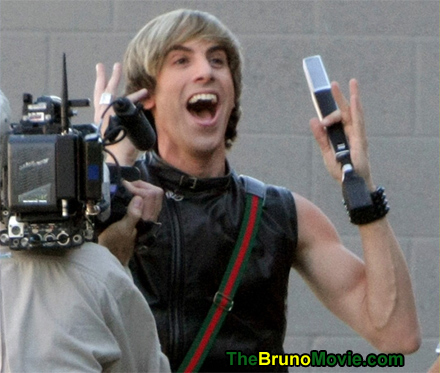
Sacha Baron Cohen is back, and once again he has created an outrageously offensive character from another country who crosses the ocean to interact with unsuspecting Americans so that we can laugh at their reactions, which range from befuddlement to extreme discomfort to outrage. But this time his scope is narrower, his character is shallower, and his meanderings are more random. His shtick is getting tired.
This time he plays Bruno, a flamboyantly gay Austrian fashionista who decides to come to America to seek fame, and his two themes are homophobia and the obsession with celebrity. But the homophobia is not as virulent as the worst revelations of “Borat.” When he goes camping with some good old boys, they roll their eyes and resist his efforts to bait them — until he takes off all his clothes and tries to crawl into one’s sleeping bag. The preachers who talk with him about gay conversion do their best to be sincerely patient with his questions. Even the boot camp sergeants barking at him to make his bed and drop and give them twenty handle his insubordination — and his designer additions to the overly “matchy-matchy” uniforms — with reasonably good humor. It’s a long way from “Full Metal Jacket.” The scariest people he encounters are the stage mothers who want him to pick their babies for a photo shoot. As he asks them increasingly appalling questions (“Could your baby lose some weight?” “Are you okay with the baby riding without a car seat?” “Being covered with bees?” “Being crucified?”), they all look him in the eye and assure him that would be just fine.
bruno.jpg
Baron Cohen wants to provoke. The movie opens with an extended sequence of very explicit, highly athletic, extremely creative, but logistically improbable sex acts between Bruno and his “pygmy flight attendant” boyfriend. But he stops short, oddly cautious for once, and avoids confrontation with the virulent anti-gay forces of Fred Phelps. When he goes to the Mideast and sits down with representatives of Israel and the Palestinians, he sticks with silliness like pretending to confuse hummus with Hamas. Baron Cohen is in trouble if his outrageousness is dwarfed by Jimmy Kimmel (the capper here does not come close to the Ben Affleck song) and by real life (the take on obsession with celebrity does not come close to Michael Jackson’s memorial). This is less what we expect from Baron Cohen that what we expect from Alan Funt or Ashton Kutcher.

(more…)

Related Tags:


Comedy
THE MOVIE MOM® is a registered trademark of Nell Minow. Use of the mark without express consent from Nell Minow constitutes trademark infringement and unfair competition in violation of federal and state laws. All material © Nell Minow 1995-2026, all rights reserved, and no use or republication is permitted without explicit permission. This site hosts Nell Minow’s Movie Mom® archive, with material that originally appeared on Yahoo! Movies, Beliefnet, and other sources. Much of her new material can be found at Rogerebert.com, Huffington Post, and WheretoWatch. Her books include The Movie Mom’s Guide to Family Movies and 101 Must-See Movie Moments, and she can be heard each week on radio stations across the country.

Website Designed by Max LaZebnik