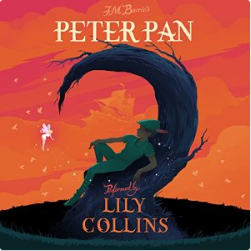
For more than a century James M. Barrie’s story of the boy who would not grow up has been enchanting families as a play, several theatrical musicals, and in many different television and movie versions. Now the Peter Pan novel by Barrie is available from Audible as an audiobook, beautifully read by one of my favorite young actresses, Lily Collins (“Mirror Mirror,” “The Blind Side”). Peter Pan is the title character, and Collins does a wonderful job with everyone in the story, including Captain Hook. But having her tell the story subtly reminds us that Wendy (a name Barrie invented, by the way) is the one who really sees and understands what is happening and learning what she needs to know to do what Peter won’t do — grow up. The novel has much more detail than the familiar play and movie versions and lets us hear the story as Barrie imagined it and as he told it to the young boys he befriended and who inspired it. Play this one in the car and you’ll find yourself coming home the long way so you can keep listening.
James M. Barrie’s play “Peter Pan” premiered in 1904 and the story of the boy who wouldn’t grow up is still one of the best-loved of all time. This week the prequel “Pan” opens up in theaters, with Hugh Jackman, Rooney Mara as Tiger Lily, and Garrett Hedlund as the young not-yet-captain Hook. And there’s a hit musical on Broadway called “Finding Neverland,” based on the Johnny Depp movie that was based on Barrie’s life, and the friendship with some children that inspired his most famous story.
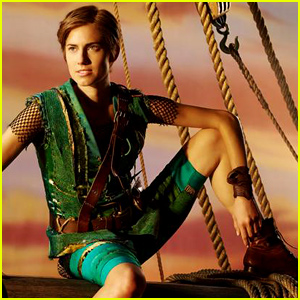
Peter Pan, the boy who would not grow up, has been enchanting children and their families for more than a century now. This week’s live broadcast of the Broadway musical version starred Alison Williams and Christopher Walken. And next year we’ll see Hugh Jackman as Blackbeard in “Pan,” which looks like a prequel that will tell us how Peter Pan and the Lost Boys made it to Neverland and how Hook (Garrett Hedlund) became Captain Hook.
Copyright NBC 2014As NBC prepares for the live production of “Peter Pan,” they are doing a bit of updating to the play, originally produced as a non-musical 100 years ago. This version is the musical best remembered as the Mary Martin production first produced 50 years later (also performed by Olympic gymnast Sandy Duncan and Cathy Rigby), with songs by Mark “Moose” Charlap, with additional music by Jule Styne. Most of the lyrics were written by Carolyn Leigh, with additional lyrics by Betty Comden and Adolph Green.
Times have changed, and it is no longer considered appropriate to have the Indians in the story sing nonsense syllables like “ugga wugga.” (This is still better than the really embarrassing song in the Disney version, “What Makes the Red Man Red?” which includes a passage that explains that Indians say “Ugh” because they see their mothers-in-law.) So, with the permission of the rights holders, the producers have brought in Jerod Impichchaachaaha’ Tate, an Emmy Award-winning classical composer and the artistic director of the Chickasaw Chamber Music Festival, to advise them. An interview with Tate in Salon explains
There were three things that I was able to bring to the table to help reconstitute the piece.
The first thing is the opening rhythm. There’s this very clever col legno that’s done with the strings in the very opening that sounds drum-like but also sounds stick-like, which is actually accurate to the Northeastern part of the country with Indians. We adjusted the accents of these constant eighth-note beats so it sounded more like an Iroquois smoke dance, rather than a stereotypical ONE-two-three-four, ONE-two-three-four, ONE-two-three-four, you know, that kind of thing. So we adjusted the opening rhythm so it sounded more authentic. It’s a small cleanup….
Yes, and the trick is — to be honest with you, most Americans aren’t going to know the difference. But at least we do. Intellectually we know, and musically we know, there was a small adjustment. It still sounds a little stereotypical. That can’t go away. Because we were also preserving the integrity of the original compositions and those original compositions were very stereotypical, but they weren’t just stereotypical about Indians. They’re stereotypical about all kinds of things they address within “Peter Pan.” That’s musical theater. That’s something we accept about musical theater. Musical theater thrives on stereotypes. It just does. It always has. So, that being said, there are still ways you can improve it a little bit to where it has a little more integrity. We don’t want to interfere with the original compositions. We want to respect the original composers. But again, just bring a little more authenticity and integrity to the work.
The next example is what I call the “Indian Breakdown.” In the “Ugg-a-Wugg” song — it’s a really campy, British musical theater song, and then it has the “Indian Breakdown,” where you have that tune that goes . It’s this stereotypical, Indian-sounding thing. We were kind of looking for different tunes, but it doesn’t matter what tune you use because the flavor of it is that stereotypical Indian sound. So the musical director was brilliant. He added some different rhythms that were — he flavored it in a way that sounded more entertaining than specific. He kind of veiled it, I guess, a little bit, with some fun rhythms that sound more party-like. I think he had a great solution for that. I thought it was right on the target.
And then the really big thing that we worked on was the replacement of “ugg-a-wugg.” Just a little background: In general, what we all know is that the Indian tribe that’s represented in Peter Pan was influenced by knowledge of Northeast Indians of the United States. So we’re talking Iroquois, Huron, Wyandotte, Algonquin, these kinds of cultural regions. So what I did was I set out to find a replacement word for “ugg-a-wugg” that was literally a Wyandotte word.
The most recent road tour of “Annie Get Your Gun” made some changes to the portrayal of Native American characters, too, though that show will never reflect contemporary sensibilities (or accurately depict the very egalitarian relationship of Annie Oakley and Frank Butler).
I’ll be looking forward to hearing what Tate describes.