Jon Favreau follows his big-budget special effects movies (“Iron Man,” “Cowboys and Aliens”) with a return to his small, indie roots (“Swingers”) as director/writer/star of the scrumptious-looking “Chef.” (WARNING: Some strong language)
This haunting, provocative film is the essence of what it means to call a work of art “adult,” not because of its explicit nudity and sexual situations but because of the way it presents and engages with them. It is fearless, it assumes the audience would rather ponder the questions than be fed the answers, and it has a performance of extraordinary sensitivity and insight from Scarlett Johansson as — well, we are not sure exactly what her character is or indeed if character is the right word.
We are unsure of what is going on right from the beginning, a beam of light with a dot that looks like an eye test. Is it a faraway planet or a star? Is it coming toward us? The only thing we know about where we are is that we will have to figure it out for ourselves and will never be sure if we are right. A man pulls the body of a fishnet stocking-wearing young woman out of a wooded area and loads her into a van. We then see a completely blank place, as though standing in front of a seamless, unpainted backdrop, not so much a space as an absence of everything except a naked young woman removing the clothes from the body. She is clinical and efficient manner if not especially experienced. Soon, she is wearing the clothes and shopping for more, including a fur jacket.
The young woman is beautiful, desirable. She drives around Glasgow, asking men for directions in a light London accent. As they chat, she finds out if they are on their way to meet friends or go home to family. When one says he is alone, she invites him to ride with her. Soon they are back in another void, this one black. He walks toward her, removing his clothes. She walks backward. In one of the most striking images we will see this year, she stays on one level as he begins to sink into liquid. And soon she is out in the van again, still asking for directions, luring another man to his death.
As the woman/alien (we never learn her name) goes about her tasks, at first she is like The Terminator, utterly single-minded, proceeding exactly according to formula. But she begins to develop — what is it? — doubts? Curiosity? She moves from the fur jacket to leather, to cloth, as she begins to be less willing? less able? to keep killing these men. She tries to partake of some human pleasures, but cannot, and finds herself lost, not one or the other or anything in between.
The imagery is powerful, with much made of eyes, reflections, blankness, and the Scottish landscape. Johansson gives a performance of tremendous subtlety, depth, sensitivity, and control, perhaps a reflection of years spent, like the creature she portrays, in the superficial seduction of being a star.
Adapted from the novel by Michel Faber by director Jonathan Glazer, some of the dialog is improvised and some of the men asked for directions did not know they were being filmed.
Parents should know that this movie includes very adult material, with graphic nudity and explicit sexual references and situations and violence including sexual assault. Characters drink, smoke, and use strong language.
Family discussion: Who is this character? Who is her companion? Why are they doing this? What makes her think about trying some of what humans enjoy?
If you like this, try: “Birth” by the same director, and some other films about aliens coming to earth like “Mars Attacks,” “Starman” and “What Planet Are You From?”
Chris Evans, left, as Steve Rogers (Captain America) and Anthony Mackie as Sam Wilson (Falcon) in “Captain America: The Winter Soldier.” (Zade Rosenthal / Marvel)
This is how you make a superhero movie. Director brothers Joe and Anthony Russo are best known for sitcoms with few but passionate fans (“Community,” “Happy Endings,” “Arrested Development”) and the underrated crime comedy “Welcome to Collinwood.” That is not the kind of credential that usually leads to a big budget comic book movie. But they prove to be just what the doctor ordered, funny where it should be, exciting where it should be, smarter than it needs to be, and just plain fun. Plus, I may be late to the party, but now I totally get the shield thing now as offensive and defensive weapons and it is very cool.
This is the sequel to the WWII-era origin story, where Steve Rogers (Chris Evans) a 98-pound weakling, volunteered for a government experiment that turned him into a super-strong super-soldier. But he got frozen in a block of ice and was thawed out more than sixty years later in time to join “The Avengers.” the storyline continues Captain America’s adjustment to the 21st century. We first see him running around Washington D.C.’s monuments neighborhood, repeatedly lapping vet Sam Wilson (Anthony Mackie). Pretty soon, they’re talking some mild smack and Wilson is telling Rogers what he has to add to his catch-up list of cultural touchstones: Marvin Gaye’s Trouble Man. Also on the list “Star Trek/Wars” and Steve Jobs. Evans and Mackie have a natural chemistry that makes that scene very funny but also shows us how much both of them need a friend who understands what it’s like to be a soldier home from the war.
But then Captain is called into action again. Alongside the Black Widow, played by Scarlett Johansson, tough, smart, funny, and just a touch flirtatious, as she chats with Rogers about girls he might want to ask out while they trade blows with the bad guys. There’s a mission, a hijacked cargo ship (I kept looking for a captain-esque crossover from Captain Phillips). Straight-ahead Captain America, used to fighting Nazis and other incontrovertibly bad guys who dress the part, expects that the people on his side will treat him with the same trust and respect and integrity he gives them in return. But this is the 21st century, and it’s complicated.
Rogers knows how to follow orders and he knows how to fight. Now he must learn to understand who he is fighting and what he is fighting for. It’s one thing when the bad guy has a Red Skull and wants total world domination because he is a fascist. It is another when both the good guys and the bad guys wear suits and speak in tempered, diplomatic tones, and want total world domination because it is best for everyone. “Don’t trust anyone,” Nick Fury tells Rogers. And Rogers, used to trusting everyone (how many people today would allow the government to inject them with an experimental serum?), has to learn what that means.
And it is one thing to take on a dozen bad guys at a time, knowing none of them have superpowers. But here Rogers must face an assassin called The Winter Soldier, someone as strong as he is, someone without any of the second-guessing that comes from understanding the complexities of the situation, someone who cannot be reasoned with or argued with or appealed to. And someone Rogers knew and trusted in the past.
The easy chemistry between Cap, Sam, and Natasha/Black Widow adds depth and heart to the story. Natasha needs to learn to trust as Cap needs to learn when not to trust. “How do we know who the bad guys are?” Sam asks as they race into battle. “The ones who are shooting at us,” Cap tells him.
There is just enough depth and gloss and humor and heart to set off the action, gorgeously staged in and around Washington, D.C. The elevated Whitehurst Freeway along the Potomac River gets the super-fight it was built for and it is a beaut. Wait until you see what’s been going on under the Potomac. It was a whole other level of pleasure to see a movie that gets Washington’s geography right. Most important, this is a film that respects the genre and the audience. Captain America and his fans get the movie they deserve.
Parents should know that this film includes constant comic book, action-style, superhero violence with many characters injured and killed, guns, bombs, chases, crashes, explosions, weapons of mass destruction, discussion of genocide, torture, fights, and brief strong language.
Family discussion: If you were advising Captain America on cultural developments while he was gone, what would you suggest? What is the biggest problem he faces in trying to adjust to modern times? How do the plans under consideration here relate to current discussions on world affairs?
If you like this, try: “The Avengers” and the other Marvel superhero movies
Rated R for language, sexual content, and brief graphic nudity
Profanity:
Very strong language
Alcohol/ Drugs:
Drinking
Violence/ Scariness:
Tense emotional confrontations and loss
Diversity Issues:
None
Date Released to Theaters:
December 25, 2013
Date Released to DVD:
May 12, 2014
Amazon.com ASIN:
B00HEKSZVK
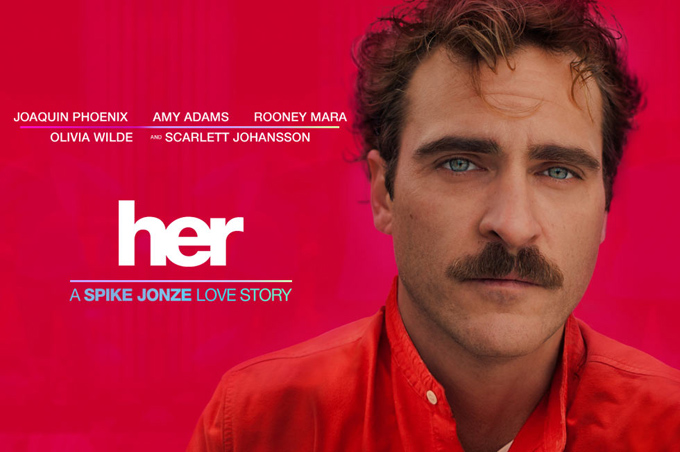
“Transition objects” are usually thought of as the stuffed toys toddlers hold onto so as a way of feeling more secure as they begin to separate from their parents and navigate the bigger world. But we all have them. We all carry real or virtual talismans to keep us from feeling adrift or abandoned.
And we all understand the bliss and torment of the Rorschach test stage of love, as what we project onto the objects of our physical and emotional desire has to give way to the reality of who they are. If we’re lucky, it’s even better than we imagined and they feel that way about us, too.
Director Spike Jonze (“Being John Malcovich,” “Where the Wild Things Are”), working from his own screenplay, combines these two ideas in a wistful love story set slightly in the future simply called, in a reflection of its longing, “Her.” Joaquin Phoenix plays Theodore and his job as a ghost writer of analog letters makes a kind of sense as the logical next step in a world where communication by text and Skype might make the idea of an old-school correspondence more valuable just as the ability to create them is barely vestigial.
Theodore spends his days writing letters of great tenderness and affection but there is none in his own life. Recently divorced from Catherine (Rooney Mara) for reasons we never learn, he is withdrawn, isolated, alone. When he is not working, he stays in his spare, generic apartment and plays a video game. And then a new operating system comes on the market that is so responsive it virtually (in both senses of the word) achieves consciousness. (Apparently, no one there has seen “Terminator,” because this sounds a lot like Skynet to me, but perhaps that is the weaponized version.) Theodore decides to give it a try.
The new operating system calls herself “Samantha” and she has two enormously appealing qualities. First, she has the throaty, intimate voice and delicious laugh of Scarlett Johansson (a performance of magnificent warmth and wit). Second, she is utterly devoted to Theodore and utterly formed by him. It is that most gratifying of relationships because he is everything to her and she is content for him to be so. Plus, she is wonderfully competent, sorting through thousands of emails in a fraction of a second to organize them and, along the way, learn everything about him.
Theodore is not ready for a real relationship with a woman who might want something from him or be different from what he visualizes or idealizes. But Samantha seems perfect, both in her innocence and in her progress. He has the pleasure of explaining the world to her and his spirit opens up as he sees her curiosity, appreciation, and engagement. He is reassured that the people around him (his boss, played by Chris Pratt, his neighbor and college friend, played by Amy Adams) seem to think it is perfectly normal to have a virtual girlfriend. Samantha seems happy about it, too.
But as we have seen in “Lars and the Real Girl,” “Ruby Sparks,” George Bernard Shaw’s “Pygmalion” (which became the musical “My Fair Lady’), there’s no happily ever after in a relationship with a creation. Samantha’s growth trajectory is astronomical. No single human can really have her. And the human qualities she lacks turn out to be important for a relationship, too.
Jonze’s story may be set in the future but it is an ancient one, going back to the original Greek myth about the sculptor who fell in love with the statue he made and whose name became the title of Shaw’s play. It is an eternal story because it is a more extreme version and thus a powerful metaphor about the risks and pleasures of intimacy. Jonze tells that story here with great sensitivity and lyricism, the kind of artistry that machinery can never replace.
Parents should know that this movie includes strong language, sexual references and situations and nudity, and tense and sad experiences.
Family discussion: Would you like to have an e-friend like Samantha? What makes those relationships easier than interacting in real life? What makes them harder?
If you like this, try: “Lars and the Real Girl,” “Ruby Sparks,” “Pygmalion,” “Catfish,” and “You’ve Got Mail”
Actor Joseph Gordon-Levitt has made a remarkably assured debut as writer/director, putting him in the front ranks of today’s filmmakers. Gordon-Levitt also plays the lead role, Jon, a New Jersey guy with a high and tight haircut and a spare and immaculate apartment decorated in gray and black. He reels off the list of things he cares about: his body (for working out), his car (for driving and looking cool), his boys (friends), his girls (for sex), his church (for confession), his family (for Sunday dinners), and porn (you know what that is for). Those are the parameters of his life, and that seems fine to him because he knows who he is and how things fit together. The title is a reference to the legendary libertine who symbolizes all men who seduce many women without forming any attachments to them.
Jon and his friends like to go to the club and rank the ladies, an endlessly fascinating conversation about various body parts and the optimal shapes and proportions of each. Sex with those ladies is primarily a contest between the men, and Jon is by far the leader. His success with nines and “dimes” (a ten) is about status and competition, and he tells us that he prefers pornography to sex with real girls. One night, Jon sees a solid dime named Barbara (Scarlett Johansson). For the first time, he becomes involved with a woman who is more than a one-night stand and he has to earn her affection. She has her own ideas of what a “dime” equivalent looks like, and he finds himself going to romantic comedy movies and taking a community college class. He even brings her home to meet his family, where she gets a very enthusiastic response from his parents (a wonderful Glenne Headley and Tony Danza).
And then things get more complicated. Gordon-Levitt has crafted a whip-smart, richly cinematic film with some very funny moments and a lot of heart. He makes it clear that Jon is not the only one who is numbing his feelings. His father is more absorbed in watching the football games than in talking to his family and Barbara’s aspirations are almost as based on fantasy as the images Jon connects to online. Watch how the settings help tell the story, and style of the movie changes as Jon goes from the techno-pumping macho world of his friends to the more romantic, orchestral environment of dating. And then it shifts again as other changes happen. Keep an eye on Jon’s sister, played by the superb Brie Larson (“The Spectacular Now,” “Short Term 12”), who appears to be as addicted to her devices as Jon, never saying a word to her family as she stares into her phone, texting back and forth. She will make it clear that she has been more connected to what is going on with the people she loves than anyone else in the film. And Julianne Moore gives an earthy but sensitive performance as a classmate of Jon’s who surprises and disconcerts him with her honesty.
Seeing Jon begin to learn to interact with the world with feelings, not just sensations, is a pleasure. But seeing one of today’s best young actors bloom into one of tomorrow’s best young filmmakers is even greater.
Parents should know that this movie is about a young man who is addicted to pornography. It includes very explicit sexual references and situations, nudity, very strong and crude language, drinking, and drugs.
Family discussion: How did other characters aside from Jon find ways to avoid their feelings? How did Joseph Gordon-Levitt use different film-making styles to show the different moods of his time with his friends, with Barbara, and with Esther?
If you like this, try: “Thanks for Sharing” and some of Joseph Gordon-Levitt’s other films like “Brick” and “Mysterious Skin”


 by director Jonathan Glazer, some of the dialog is improvised and some of the men asked for directions did not know they were being filmed.
 . Also on the list “Star Trek/Wars” and Steve Jobs. Evans and Mackie have a natural chemistry that makes that scene very funny but also shows us how much both of them need a friend who understands what it’s like to be a soldier home from the war.