Delivery Man

Posted on November 21, 2013 at 6:00 pm

B
Lowest Recommended Age: Mature High Schooler
MPAA Rating: Rated PG-13 for thematic elements, sexual content, some drug material, brief violence and language
Profanity: Very strong and crude language
Alcohol/ Drugs: Character grows marijuana, alcohol, hard drug abuse treated seriously but irresponsibly
Violence/ Scariness: Fight, drug abuse
Diversity Issues: Diverse characters
Date Released to Theaters: November 22, 2013
Amazon.com ASIN: B00GEKO51U

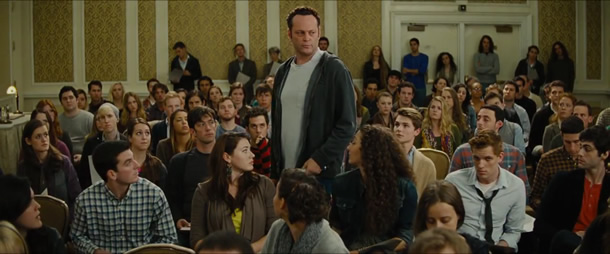
delivery-man-vaughnThe undeniable sweetness of “Delivery Man” makes its inherent silliness just about forgivable.  Or, it just might be the sense of relief that Vince Vaughn is finally making a movie that is just silly instead of crass and stupid like “Couples Retreat,” “Four Christmases,” “Fred Claus,” and pretty much most of what he’s done since “Wedding Crashers.”

Vaughn plays his usual likeable shlub, this time Dave, the son of a butcher.  His brothers work in the store with their father, but all Dave can do is drive the delivery truck, and he does not even do that very well.  “It’s like every day you find some new way to push the limits of incompetence.”

He also has the usual long-suffering girlfriend, a cop named Emma (Cobie Smulders), who, like all girlfriends in these arrested development movies, has only one responsibility in the story, which is to look beautiful when she tells him that it’s time for him to grow up.  It turns out that she is pregnant, and she does not believe he has it in him to be responsible enough to be a dad.

In the midst of all this, he discovers that he already is a dad, at least in the strictly biological  sense.  Some time ago, he was a “very, very frequent donor” at a sperm bank, which carelessly made it available to many more women than its guidelines allowed.  A lawyer shows up in Dave’s apartment to tell him that he is the biological father of 533 children, and 142 of them have sued the facility to find out the identity of the mysterious “Starbuck” whose genetic heritage they carry.  Starbuck is not related to the coffee shops or the Moby Dick character who inspired their name.  It is the name of the French-Canadian film adapted by its writer-director for this remake, and the name of a legendarily productive stud bull.

Dave is known only as “Starbuck” to the progeny, and his anonymity is guaranteed by the terms of his donor agreement.  His best friend is Brett (Chris Pratt, a highlight of the movie and quickly becoming one of our most indispensible comic actors), a lawyer who is beleaguered by his four young children.  “My children cannot pick up the frequency of my voice,” he explains, exhausted.  Brett gives Dave the folder of information on the 142 plaintiffs and tells him not to open it.  What was he thinking?

Dave reads just one file, and is thrilled with his connection to a very accomplished young man.  So he takes out another one, and then another, and finds that many of them need help.  And he finds that helping them gives him a great sense of satisfaction and purpose.  Most don’t need much help.  Dave covers a would-be actor’s day job (badly) so he can go on an audition.  He warns off catcallers harassing a young woman in a short skirt.  He helps an inebriated kid get home.  These are in the trailer and are fairly cute.

Some have serious problems.  One is a drug addict.  One is severely disabled and cannot communicate.  These are handled superficially at best and downright irresponsibly at worst.

It’s all just a matter of time before everyone finds out, generally in the most awkward of ways.  Cue the fake Jay Leno monologue.  But babies are heart-tugging, even twenty years later, and the longing for family from both the children and their bio-dad is so touching that even the most preposterous resolution somehow seems just fine.

Parents should know that the film is about a man who fathered more than 500 children through a series of donations to a fertility clinic and it includes explicit references and crude jokes about producing samples and fertility treatments.  Characters use strong and crude language, drink, grow marijuana and abuse harder drugs (the movie implies that addicts can quit easily without any help), and there is some brief violence.

Family discussion: How should Dave prove that he “deserves” to be the baby’s father?  What did the children want from the lawsuit?  How did he help them?

If you like this, try: “Baby Mama”

Related Tags:


Comedy Courtroom Family Issues Movies -- format

The Christmas Candle

Posted on November 21, 2013 at 9:58 am

B-
Lowest Recommended Age: 4th - 6th Grades
MPAA Rating: Rated PG for mild thematic elements
Profanity: None
Alcohol/ Drugs: None
Violence/ Scariness: Mild peril, sad stories, tense confrontations
Diversity Issues: None
Date Released to Theaters: November 22, 2013

Former Presidential candidate Rick Santorum is now in the faith-based movie business and his first film is based on christmascandleThe Christmas Candle by Max Lucado.

Just before the holidays, a progressive young clergyman named David (Hans Matheson) takes over a church in a small village called Gladbury in late 19th century England.  The town is known for its miracle — every 25 years an angel appears to touch one of the candle maker’s Christmas candles.  Whoever lights that candle receives a miracle.  This year, there is tremendous anticipation and there are many in the town who want the miracle for themselves, including the candle maker and his wife.  David encourages his parishioners not to wait for a miracle but to help each other through kindness, generosity, humility, and love.  And soon the village creates a more connected community and a more welcoming environment.

The evident sincerity of the production is appealing but it cannot disguise a not-ready-for-prime-time amateurish quality in the superficiality of the writing and pedestrian direction.  It is awkward and uneven, but it is also a little less sugary than most faith-based family fare.  Lesley Manville gives a subtle and touching performance that transcends the clunky dialogue and over-constructed plot and Susan Boyle looks very natural in 19th century garb and sings beautifully.  The emphasis on helping others rather than wishing for a selfish miracle is most welcome, though disappointingly undercut in the final half hour.

Parents should know that there are some mature themes, including an out of wedlock pregnancy and family estrangement.

Family discussion:  What would you wish for?  Who can you help?

If you like this, try: “Christmas with a Capital C”

Related Tags:


Fantasy Holidays Movies -- format Spiritual films

The Hunger Games: Catching Fire

Posted on November 20, 2013 at 11:35 am

Capitol-Portraits-The-Hunger-Games-Catching-FireIn the second chapter of the three-book, four-movie series, Katniss Everdeen has gone from being a shy unknown with extraordinary skills to being an acclaimed superstar. The same could be said for the actress who plays the part. When Jennifer Lawrence was selected to play the heroine of the blockbuster novels by Suzanne Collins, she was barely out of her teens. She had scored an Oscar nomination for a small, independent film called Winter’s Bone that was seen by about the number of people listed in the credits of this film. And in between the first and second in the “Hunger Games” series, she won a leading actress Oscar for Silver Linings Playbook.

In this deeper, smarter, politically sharper, and more emotionally resonant follow-up, she returns to the dystopian world of Panem as Katniss prepares for her victory tour, following an unprecedented triumph at the titular competition.  Once a year, two teenagers are selected from each of the twelve districts to compete to the death in televised combat that the totalitarian government imposes in a gruesome simulacrum of an athletic contest that promotes dedication, talent, and integrity.  As the previous film ended, Katniss and Peeta (Josh Hutcherson) defied the authorities to come up with a way that they could both come out alive — by pretending to be in love and be willing to sacrifice themselves to be together.  This has made them very popular, and the dictator, “President” Snow (a nicely corrupt Donald Sutherland) wants to make sure that this popularity is extended on behalf of his regime and will not inspire any rebellious uprisings.  When his own granddaughter begins to braid her hair to be like Katniss, he knows that if he cannot control the young archer, he will have to destroy her.  However, as the new Head Gamemaker, Plutarch Heavensbee (Philip Seymour Hoffman) reminds him, he must be careful to get rid of her in a way that will discredit her, to make sure she does not become a martyr and inspire the rebels even more in memory than she already does.

Snow tells Katniss she has to persuade not just the fans but him that she is truly in love with Peeta or he will destroy her and her family.  She does her best, and cares for Peeta deeply, but her heart is still with Gale (Liam Hemsworth), who is hurt and jealous.

Plutarch decides to mount an all-star game, pitting previous champions of the Hunger Games against each other in a ramped-up competition.  And no skirting the rules with a romance this time.  Katniss and Peeta go back to the Capital for another dress-up extravaganza (costume designer Trish Summerville ramps things up with costumes that are a mash-up between “Project Runway’s” unconventional materials and fashion forward challenges and an acid trip.  Elizabeth Banks carries off the wildest of the attire better than anyone else could (with the exception of Barbie), and manages to give the outrageous Effie Trinket a little bit of compassion under the Kabuki-like makeup. And Katniss, known as the “girl on fire” thanks to the costumes designed by the stylist Cinna (Lenny Kravitz) gets a wedding gown extravaganza with an unexpected political overlay.

And then, the games begin, as before, with the same race to get supplies and weapons while avoiding attack and assessing possible alliances that by definition will be short-term.  Plutarch has some challenges of his own to keep the contestants off-balance and on the run.  With each “tribute” a previous winner, the odds are not in anyone’s favor.

Director Francis Lawrence (“I am Legend,” no relation to his star), taking over from Gary Ross, manages the large cast and complicated action well and screenwriters Simon Beaufoy (“Salmon Fishing in the Yemen”) and Michael Arndt (“Toy Story III,” “Little Miss Sunshine”) adapted the book deftly.  They balance the small, intimate moments, brief humor, and intense emotion with the grand sweep of the games, acknowledging the over-arching themes of honor, freedom, and courage but keeping the focus on the relationships.  It tells us everything that in the short training/assessment/sponsorship-seeking period before the Games begin, Katniss reaches out to the weakest and most vulnerable of the other contestants, helping them with no agenda for her own protection.

The other additions to the series are exceptionally well-chosen, too, especially Hoffman, as a man who knows more about “counter-moves” than we may suspect at first, Sam Claflin as the high-spirited, faun-like Finnick Odair, Jeffrey Wright and Amanda Plummer as the wonkiest participants, and Jena Malone, a fiery delight as the furious  Johanna Mason.  But it is Lawrence who steals the show again as Katniss.  Be sure to keep your eyes on her face in that last scene; it’s a lulu that will have you counting the moments until the next episode (now in production).

Parents should know that the theme of these books concerns a totalitarian dictatorship that forces teenagers to battle to the death in a very intense and disturbing “game.”  Many characters are injured and killed and there are scary surprises, graphic images, and disturbing threats. Many teenage and adult characters are beaten, injured, and killed, with knives, guns, whips, arrows, spears, poison fog, animal attacks, psychological abuse, and more. Characters abuse alcohol, there are drug references, and characters use some strong language. There is kissing and some implied nudity in public — nothing shown.

Family discussion: What did Plutarch mean by “moves and countermoves?” Why did the tributes hold hands? Why wouldn’t Gale leave?

If you like this, try: the first movie and the books by Suzanne Collins

Related Tags:


Action/Adventure Based on a book Drama Romance

The Book Thief

Posted on November 14, 2013 at 6:00 pm

The title character in “The Book Thief” is Liesel (Sophie Nélisse), a little girl in pre-WWII Germany.  We first see her on a train with her mother and dying younger brother.  The children were both going to be delivered to foster parents but Liesel and her mother stop along the way to bury her brother.  As the gravedigger leans over, a book falls out of his pocket.  Liesel picks it up.book-thief

Her new parents are the frosty Rosa (Emily Watson) and the gentle Hans (Geoffrey Rush).  At first, Liesel is so traumatized she cannot speak.  But Hans hears her softly singing Brahms’ lullabye to herself at night and coaxes her into talking to him by playing the song on his accordion.  When he finds that she cannot read, he uses her book to teach her.  She tells him it is hers, but “it didn’t used to be.”  That was not hard to guess; it is a book about digging graves.

Liesel is befriended by a friendly classmate named Rudy (Nico Liersch), an athletic kid who wants to race like Olympic champion Jesse Owens.  Around them, the rise of the Nazi party is evident in omnipresent banners and badges.  A school choir sweetly sings an anti-Semitic song.  Hans’ skills as a house and sign painter prove useful when someone has to remove the insults painted on his Jewish neighbor’s store.  Liesel becomes a book thief again when Hitler’s birthday is celebrated with a huge book burning.  It is less a theft than a rescue, the book smouldering under her coat as she hides it from Hans.  The book is The Invisible Man by H.G. Wells.

The impact of the Nazi regime literally hits home when Max (Ben Schnetzer) arrives.  Max’s father sacrificed himself to save Hans’ life in the first World War.  It is his accordion that Hans cherishes so dearly.  Hans and Rosa talk about whether they are prepared to take the risk of hiding Max, but they know they have no choice.  Max becomes very ill and as Liesel helps to nurse him back to health, they become very devoted to one another.  She “borrows” books (without asking) from the home of the wealthiest man in town to read to him.

The young Australian author Markus Zusak was inspired to write The Book Thief by a story he heard from his mother, who emigrated from Germany following World War II.  A teenage boy in her village ran to give bread to a starving man who was being herded with other Jews by Nazis delivering them to a concentration camp.  Both the man and the boy who tried to help him were whipped by the Nazis.  This story of the very best and worst of humanity gave him the idea of a story set in Germany during the Holocaust.

Addressing the Holocaust through fiction is a daunting challenge and this film does not always master it.  An uncertain sense of its audience makes it feel off at times, too simplistic for adults and too disturbing for young audiences.  An episodic structure seems meandering and unfocused.  Most problematically, the choice of Death as a narrator works better on paper than on film.  But Rush’s performance and some touching moments make this what is perhaps the best we can hope for in grappling with the incomprehensible — a part of a conversation, even a conversation about what does not work, that keeps us striving to honor the memory of those who suffered and to strengthen our resolve once again to conquor the fear and ignorance that caused it.

Parents should know that this film is set during the Nazi atrocities of WWII Germany.  There are many sad deaths and references to the Holocaust, racist and anti-Semitic comments, fighting, and some war-time violence.

Family discussion:  Is Liesel a thief?  Why did she read to Max when he was ill?

If you like this, try: the book, “The Story of Anne Frank,” and “The Devil’s Arithmetic”


Related Tags:


Based on a book Drama
THE MOVIE MOM® is a registered trademark of Nell Minow. Use of the mark without express consent from Nell Minow constitutes trademark infringement and unfair competition in violation of federal and state laws. All material © Nell Minow 1995-2026, all rights reserved, and no use or republication is permitted without explicit permission. This site hosts Nell Minow’s Movie Mom® archive, with material that originally appeared on Yahoo! Movies, Beliefnet, and other sources. Much of her new material can be found at Rogerebert.com, Huffington Post, and WheretoWatch. Her books include The Movie Mom’s Guide to Family Movies and 101 Must-See Movie Moments, and she can be heard each week on radio stations across the country.

Website Designed by Max LaZebnik