War of the Worlds

Posted on June 26, 2005 at 1:50 pm

“Is it the terrorists?” a frightened child asks, because that is the scariest thing she knows. But what makes this thing scary is that it is something no one knows. It is beyond our knowledge, even beyond our imagination. Earth is under attack and no one knows by whom or what they want.

These are not the “let’s play musical notes together” aliens of Close Encounters of the Third Kind or the Reese’s Pieces-loving, bicycle-flying botanist alien from E.T.: The Extraterrestrial. There’s no “Take me to your leader,” or Klaatu Barada Niktu. These aliens don’t even want to keep humans on as slave labor as in Battlefield Earth. They don’t want us to understand or negotiate with them. It does not seem to be about power or plunder. They just want to destroy us. As one character says, “This is not a war any more than there’s a war between men and maggots. It’s an extermination.”

Steven Spielberg knows two things better than anyone else who ever made a movie, and both are in top form here. First is his extraordinarily evocative sense of family life, the way every detail of home and connection (even, maybe especially the most frayed of connections) tell the story and make us care about it. A ribbon, a mirror, a boot, a box of family photographs, a Beach Boys song –- the juxtaposition of the ordinary with the unthinkable sustains a “golly” factor that grabs our throats and our hearts at the same time.

The special effects in the movie are dazzling. Just when we thought that we were so accustomed to the limitless wonders of CGI that we could never be stunned in a theater again, Spielberg just plain knocks our socks off. My husband counted eight spontaneous “Oh my Gods” coming from me during the movie. It isn’t just that it all looks real, seamlessly integrating the effects. It’s that what looks so real is so “Oh my God.”

The images are fresh and imaginative and yet perfectly believable, mixing the normal with the inconceivable, from the vast alien machines to the buckling of the earth and the apocalyptic landscapes. The most vivid images are when we see the trappings of everyday life transformed. In one moment of complete insanity, the bells at a railroad crossing start to clang, and the striped barriers come down as though it is a perfectly ordinary day and the commuter train is about to arrive on schedule. Everyone stops and takes a breath and then the train comes in, filled with flames.

Spielberg’s other great trick is his mastery of scale, and again, that use of context brings the story literally home. At least half of the “Oh my Gods” were responses to wow-style reveals of new threats, new invasions.

And Spielberg makes invasion into a theme, from the very beginning, when with stunning economy he sets the stage for all that is to come.

Our hero-to-be, Ray (Tom Cruise) arrives home late. His ex-wife Mary Ann (Miranda Otto), pregnant by her new husband, is standing there with a hand on her hip. The new husband is handsome, a little sleek-looking in a black turtleneck, but clearly so nice you can’t even bring yourself to hate him, though Ray has clearly tried. Even though the ex-wife is late, she decides to carry their daughter’s suitcase into Ray’s house. Ray is very uncomfortable as she opens his all-but-empty refrigerator and peeks into his messy bedroom. He feels invaded. His children seem alien. And yet, in one of the most understated but meaningful moments in the movie, a shared joke between Ray and Mary Ann shows us a glimpse of Ray’s asperity and resolve.

But all of that is under the surface. When we meet him, Ray has long been used to disappointing people. It is not clear which is worse, the sullen animosity of his son Robbie (Ray wears a Yankees baseball cap; Robbie pulls out one with a Red Sox logo) or the patient lack of expectations from his daughter, Rachel (Dakota Fanning). But when it becomes clear that something very, very bad is happening, Ray will do anything to keep his family safe. This will be his story more than it is the story of the battles. The movie is at heart, well, heart.

And Cruise does heart well. He and Fanning anchor the film with outstanding performances of conviction and charisma. Rachel’s protection of her “space” and Ray’s efforts to care for her memory and spirit all echo the invasion theme. The story moves well from the large scale destruction of a city to a small-scale intrusion into a shattered basement retreat occupied by three people. Throughout, the focus is on Spielberg’s favorite subject, the family as fortress. The government barely exists, the army is dedicated and honorable but overmatched.

And, as Ray points out, the humans are almost as dangerous as the aliens. Ray is not the only one who will do anything to keep his family alive and the ochlochratic chaos means that nowhere is safe.

The story is affecting, the action scenes are thrilling, the issues are resonant. Yet it is not ultimately as satisfying as less skillful movies like Independence Day. It may be wiser and it may have more artistic validity, but summer explosion movies call out for a more complete resolution than the Wells book allows. A valid but subtle point is lost, not for lack of respectful presentation, but perhaps because ot it.

Spoilers alert: Parents should know that this is an extremely tense and intense movie, with constant peril and violence. Many characters are killed. Many are neatly vaporized, but there are scenes with dead bodies, a brutal off-camera murder, a death by impalement, guns, grenades, lasers, and other weapons, and some grisly images. Characters use brief strong language. There are tense confrontations between family members. Some viewers will find the behavior of the humans more disturbing than that of the aliens.

Someone once said that the aliens in movies tell us more about what we are thinking about than about any likely real-life extraterrestrials. The UFO movies of the cold war era were, under this analysis, a reflection of our fears about communism and the atomic bomb — with the 1956 version of Invasion of the Body Snatchers and The Day the Earth Stood Still as examples, contrasted with the more benign aliens of Spielberg’s other movies. What does this movie tell us about our current fears?

Families who see this movie should talk about how the story has changed since it was originally written by H.G. Wells more than 100 years ago. How was that era’s interest in the relatively recent scientific discoveries reflected in the book and how has the current version used modern concerns to connect to a contemporary audience? What do you think about the balance of the story between the action and the personal drama as Ray’s character has to become more responsible and
find a way to communicate with his children. How did both parts of the story help each other? In a situation like this, who do you help? Who do you accept help from?

Families who appreciate this film may enjoy listening to the legendary Orson Welles broadcast. This version of the book has the radio script as well. The text is also available online at Project Gutenberg. The new version has a small tribute to the George Pal movie. They will also enjoy Independence Day, one of the all-time best alien invasion movies, and they might get a kick out of Battlefield Earth, one of the worst, and Signs, one that has a bit of both.

Related Tags:


Action/Adventure Based on a book Science-Fiction

XXX: State of the Union

Posted on April 25, 2005 at 7:38 pm

C+
Lowest Recommended Age: Mature High Schooler
Profanity: Brief strong language, one f-word
Alcohol/ Drugs: None
Violence/ Scariness: Constant action-style violence, shooting, explosions, fighting, many characters killed
Diversity Issues: A theme of the movie
Date Released to Theaters: 2005

Can we ever see Ice Cube as a gangsta again after Barbershop and Are We There Yet?

Do we want to?

Ice Cube is a fine actor who can do a lot with a strong script (Boyz n The Hood and Three Kings). But he seems to be phoning this performance in between development deals. Since the writer and director appear to be on automatic pilot, too, even a movie that has no aspirations beyond generic guns and explosions multiplex fodder manages to disappoint.

The original XXX, starring Vin Diesel, was a sort of James Bond movie on crack, with an extreme sports nut brought in on a spy mission for “deep cover agents with special skills.” It had some cool stunts and got the job done.

In this sequel, as soon as Agent Augustus Gibbons (Samuel L. Jackson, returning from the first film) explains that the first Triple X is dead so they need to go off the grid again to find someone even tougher, it’s clear that this is less script than set-up. When Willem Dafoe turns up as the Secretary of Defense to give a report to the President (Peter Strauss), it’s clear that he’s not in the movie to be a second-tier good guy. I’d say it was less a movie than a cross between a rap song and a computer game, but it is not nearly as well-written as either. There’s no wit or imagination, just the thump thump thump of exposition and explosions.

Yes, there are barked orders about breaching the perimeter and guys in serious-looking black hoods with fancy guns and other toys, a handy nerdish hacker, and big shots asking each other “Who the hell is this guy?” The new Triple X is a former Navy Seal serving a 20-year prison sentence who gets sprung for a top-secret mission. The good guys have become the bad guys, so we need some bad guys to be the good guys.

There are competently filmed stunts and explosions at a variety of Washington DC locations, including a non-existent bullet train. There are a couple of good lines, including quotes from Thomas Jefferson and Tupac, and it is fun to see Ice Cube go undercover as two characters that play off of white expectations. But the movie has an unpleasantly sour tone that is too far off the grid to give the stunts any narrative or emotional heft. When Triple X is explaining to a friend why he should help save the day, the best he can do is tell him that they are fighting for the right to keep stealing cars. And the movie’s treatment of a standard-issue rich blonde ice queen in a slinky suit and a fast car is so rap-style misogynistic that it takes you out of the story. Nona Gaye (Ali) tries to channel Pam Grier as the woman Triple X can’t forget, and her scenes with Ice Cube have enough warmth and sparkle to remind you how much the rest of the film is lacking. Even with all the pounding music and ear-splitting explosions, this XXX should be rated zzzzzzz.

Parents should know that the movie has non-stop PG-13-style violence, with a lot of explosions and shoot-em-ups. Many characters are killed. Characters use brief bad language (one f-word, a few b-words) and there are some mild sexual references, including a prison rape joke.

Families who see this movie should talk about why Darius did not follow orders and how he decided what mattered to him. Characters use different arguments to try to persuade each other in this movie. Which are the strongest? Why?

Families who enjoy this movie will also enjoy the original, with Vin Diesel as the first Triple X and the classic The Dirty Dozen.

Related Tags:


Movies -- format

Son of the Mask

Posted on December 28, 2004 at 7:51 pm

The Mask had a clever and inventive director, striking design, wildly imaginative special effects, and Jim Carrey, who is something of a wildly imaginative special effect all by himself. ,P>

“Son of the Mask” is both watered down and jazzed up, like a kid who’s had way too much sugary bug juice. This semi-sequel (all new characters except for a cameo from Ben Stein) is directed at a younger audience, and despite some questionable material, it is more mild than wild. There’s not much by way of imagination and few of the effects qualify as “special.”

Jamie Kennedy (Malibu’s Most Wanted) may be many notches down the star pole from Jim Carrey, but he is a likeable and funny guy. For some reason, though, this film fails to make the best use of the talents he does have, making him the straight man. To a baby and a dog.

In the first film, a shy bank employee finds a Norse mask with magical powers. When he puts it on, it unleashes his hidden desires and removes all inhibitions, turning him into an infinitely malleable cartoon character transformed by every impulse. Whether he was performing in a nightclub or standing up to a gangster, he was always fearless.

At the end of the movie, the mask is once again thrown away.

In this sequel, Kennedy plays Tim Avery, awould-be animator who lives with his wife Tonya (Traylor Howard) in a cartoony-looking little house. She wants a baby, but he does not feel ready. One night, on his way to the office Halloween party, he finds the mask. Everyone at the party is impressed with his “costume” and the outrageous behavior just seems natural at an animator’s office party -– everyone assumes he is just trying out a new cartoon character. When he gets home, his wife is in bed. Perhaps it is because his inhibitions have been removed by the mask, or perhaps he is just feeling proud of himself for being asked to develop a character for a possible cartoon series. But he is willing to have a baby.

Nine months later, the baby is born. And because his father was wearing the mask when he was conceived, he has some of the mask’s powers. This comes to the attention of Loki (Alan Cummings), the Norse god of mischief and the original owner of the mask. His father, one-eyed Odin, king of the gods, orders him to get it back, so Loki begins checking out every baby born on Tim’s baby’s birthday.

Tim is looking for the mask, too, but it has been hidden by his dog, who is experiencing something like sibling rivalry. Tim has no idea of his baby’s unusual abilities; he just wants the mask back so that he can finish creating that cartoon character his boss is asking about.

As Loki gets closer and closer, Tonya leaves town on a business trip, with Tim on full-time daddy duty, just as the baby’s transformational powers really start to take over and Loki finds what he was looking for. The movie then gets turned over to the special effects department for some cartoon-ish fun.

Kids will enjoy the silly humor, but parents may question the appropriateness of some of the material in the movie, especially for younger children, who may be disturbed by the idea that some children may not be wanted. While there is nothing explicit in the film, some families will find it inappropriate that the baby’s powers were the result of his father’s wearing the mask when he was conceived.

The movie is dumb and loud, which some children will confuse with entertaining but others will just find overwhelming. It is a shame not to make better use of Kennedy’s talents; he is mostly limited to reaction shots. It’s a bigger shame to waste this technology and the goodwill left over from the first film on a dull story with forgettable characters.

Parents should know that this movie has strong language for a PG (“Hell, no” “The crappiest piece of crap in crap-town”). There is a lot of comic violence, including hits to the crotch that are supposed to be funny. There is some mild sexual material, including discussion of wanting (or not wanting) to have a baby, and the central plot point is based on Tonya getting pregnant while Tim is wearing the mask. Tonya jokes that she is going to make a baby with the neighbor. There is some vulgar humor, including potty jokes.

Families who see this movie should talk about how parents decide when they are ready to have a baby. Why was it so important to Tim that he be someone his child would be proud of? Why did Tim say that the baby helped him grow up? What is “positive reinforcement” and why is it important? Why are there stories about a god of mischief? What other characters in stories and myths like to cause trouble?

Families who enjoy this movie will also enjoy Spy Kids, also featuring Cummings, and Bill and Ted’s Excellent Adventure and its sequel Bill and Ted’s Bogus Journey, which, like this film, also features a game of Twister. Tim’s last name is a tribute to animator great Tex Avery, and families will enjoy some of his classic cartoons as well. And all families should learn about some of the great Norse myths, featuring Loki, Odin, and Thor.

Related Tags:


Not specified
White Chicks

White Chicks

Posted on June 23, 2004 at 4:58 am

C
Lowest Recommended Age: High School
MPAA Rating: Rated PG-13 for crude and sexual humor, language and some drug content
Profanity: Very strong language for a PG-13
Alcohol/ Drugs: Drug humor, drinking, smoking
Violence/ Scariness: Comic violence including guns, characters shot but no one badly hurt
Diversity Issues: A theme of the movie
Date Released to Theaters: June 23, 2004
Date Released to DVD: October 26, 2004

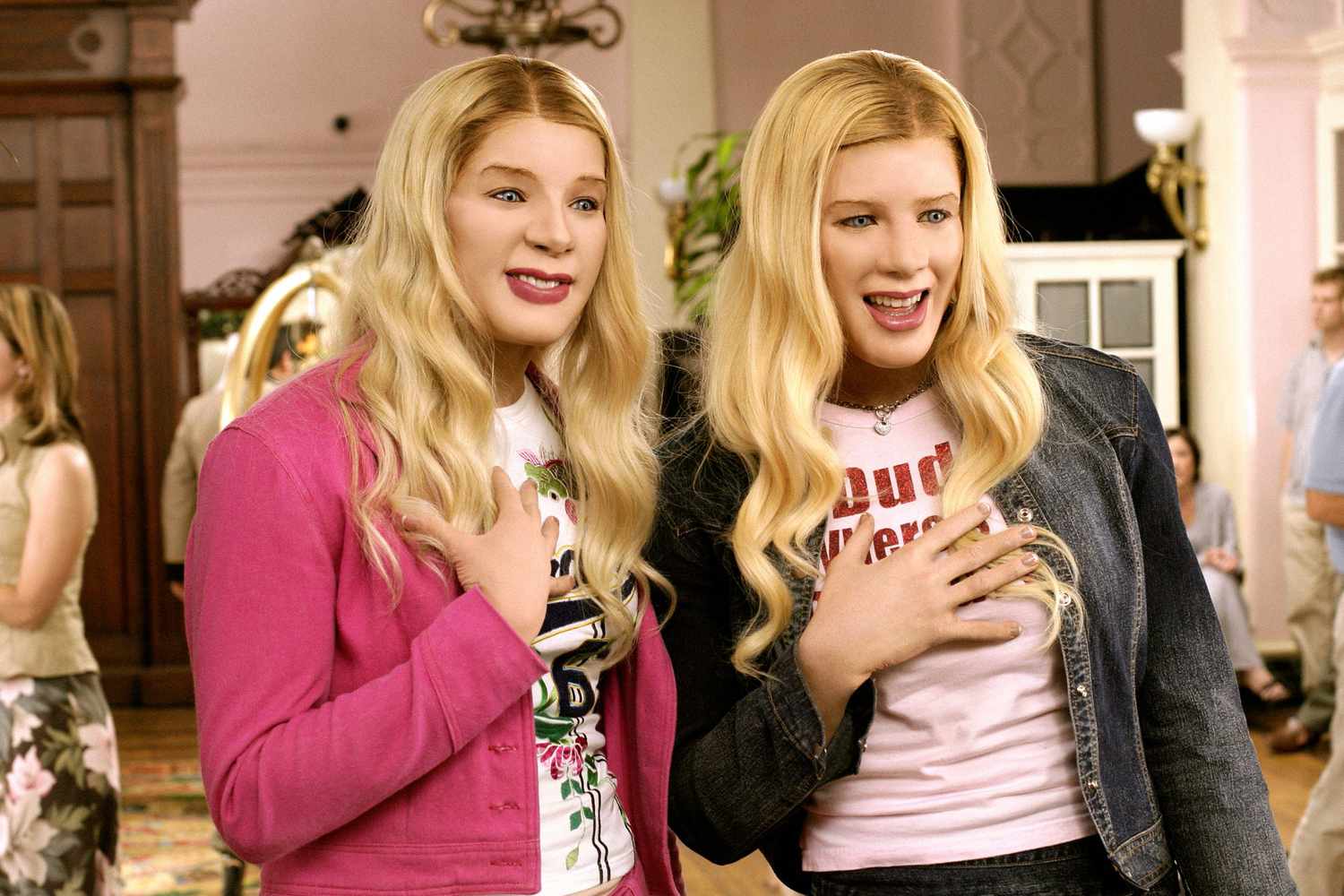
Appealing performers and a couple of very funny moments don’t make up for a lazy and generic script in this predictable farce about two black male FBI agents who go undercover as spoiled rich white girls. I knew we were in trouble when there was a “Hammer Time” joke in the first few minutes, a reference way past its sell-by date. And a Bjork swan-dress joke? In white chick terms, that’s so yesterday.

Copyright Columbia Pictures 2004

In rap music terms, this movie samples characters and plots from many other movies, including the already vastly over-used (attractive and principled but do-things-their-own-creative-way law enforcement types always getting chewed out by choleric superiors until one of their wacky schemes pays off and they get to be heroes) and the already done so brilliantly and distinctively that no one should ever try them again (whoever thought of appropriating the “Junior” plot twist from Some Like it Hot should be sent to the screenwriter equivalent of solitary confinement).

Even the movie doesn’t even appear to paying attention to its plot. Movies don’t have to be logical; they don’t even have to make sense. But sloppy inconsistencies like the ones here become a distraction that interferes with the ability of the audience to enjoy even the jokes that work.

Shawn and Marlon Wayans, apparently both the Zeppo Marxes of the talented Wayans family, play FBI agents Kevin and Marcus Copeland. It is typical of this movie’s problems that no one had the energy to give these characters anything resembling a personality. They are almost indistinguishable from each other except that one has a hysterically jealous wife and the other has a goatee and is single.

After they bungle a drug bust, they are assigned to escort the Wilson sisters (think Paris and Nicky Hilton), who may be targets for a kidnapper. They are on their way to a weekend at the Hamptons where they hope to be photographed for the cover of a magazine. A minor car accident on the way there leaves them with scratches on their faces and they refuse to be seen that way. So, the Copelands call in the FBI’s crackerjack undercover make-up team to transform them into the Wilsons. Conveniently, they both already have earrings.

Despite the fact that they are taller than the girls and the latex masks applied to their faces make them look like victims of Botox overkill, no one in the Hamptons seems to notice anything significantly different about “the girls” (one friend guesses that they’ve had collegen treatments to turn their lips from “Cameron Diaz to Jay-Z”). The Copelands squeal and giggle, shop with the girls, go all mean girls on the snooty rich snobs, and participate in a fashion show and a dance-off (okay, that dance-off is pretty funny). They also go out on dates, Marcus in drag with a smitten athlete (the very funny Terry Crews) and Kevin as a man but pretending to be someone else to impress a pretty reporter.

Gender and race-switching are inherently funny but the situations and jokes in this script do very little to build on that energy and sometimes actually get in the way. There are predictable culture clashes, as when the society girls sing along to Vanessa Carleton’s “1000 Miles” and the Copelands have to pretend to know the words. Then, when the rap song comes on…well, you know where this is going. (A twist on this scene later on provides the movie’s most sustained laugh.) There is a lot of gross-out humor involving various body parts and functions, and some leering double entendres. There are also predictable life lessons as the Copelands develop more empathy for women and encourage the society girls to have more self-respect, to insist on the best for and from themselves. Too bad the Wayans forgot to learn that lesson themselves; the insights are delivered with no more enthusiasm, sincerity, or imagination than the comedy.

Parents should know that the movie has very crude and vulgar material for a PG-13, with comedy based on sexual references (including a game where players have to choose between two unappealing sexual encounters), drug jokes, insult humor, and a lot of graphic potty humor. Characters use strong language, not just the usual “almost-R” words but also terms that may concern parents like “yeast infection,” “coke whore,” “bitch fit,” and the n-word. Racial insults and stereotyping are intended to be comic. The movie has some comic and action violence, meaning that a lot of punches are thrown and a few shots are fired but no one is seriously hurt.

Families who see this movie should talk about what Kevin and Marcus learn from pretending to be white women. Why was it so hard for Karen, Lisa, and Gina to feel good about themselves and their relationships?

Families who enjoy this movie will also enjoy the better movies it borrows from, like Some Like it Hot, which was first on the American Film Institute’s funniest movies of all time, and Tootsie, which was second. They may also enjoy Martin Lawrence in drag as an undercover cop in Big Momma’s House. The freshest and funniest Wayans film is still I’m Gonna Git You Sucka.

Related Tags:


Comedy movie review Movies -- format Movies -- Reviews

21 Grams

Posted on November 13, 2003 at 5:02 pm

In “21 Grams,” a terrible collision shatters more than the lives of three people. It shatters the very narrative of the story itself.


Director Alejandro Gonzalez Inarritu conveys the fractured disorientation of the three characters with clusters of brief scenes that act as a mosaic, gradually revealing what happened in that devastating moment and how it affected the events and emotions and that followed, even the impact on the very identities of the people involved.

Paul (Sean Penn) is dying. His heart is failing. His wife wants to find a way to have his child. Jack (Benicio Del Toro) is struggling. He has come out of prison with a fierce new religious faith that has his wife and children a little uneasy. Christina (Naomi Watts) is happy. She has overcome a substance abuse problem and is living happily with her husband and daughters.

Then a corner is turned. A driver — maybe in too much of a hurry to get to a birthday party, maybe having had a drink — hits three pedestrians. Lives are lost. Another life is restored. Another is devastated. Is there a way to go on?

Inarritu uses a hand-held camera and directs with a simple, intimate, very pure feeling similar in style to the Dogma 95 movies. Penn gives one of the most sensitive performances of his career. He usually plays characters who are not as smart as he is, but here he is completely convincing as a math professor and he shows us an extraordinary range of subtle and complex emotions. Watts and Del Toro are also outstanding.

Parents should know that the film includes tragic deaths and brutal violence with gory wounds. There are explicit sexual references and situations, including nudity and a brief glimpse of a porno film. Characters drink, smoke, and use drugs. A character attempts suicide. There is very strong language.

Families who see this movie should talk about why Inarritu chose to tell the story this way. How would its impact have been different if told in a more conventional structure? Why is the film called “21 Grams?” What do you think of Jack’s wife’s comment that his duty is to his family? Why do the different characters say, “Life goes on?”

Families who appreciate this film will also appreciate Amores Perros from the same director. They may also like more mainstream films on related subjects, like Return to Me and Bounce.

Related Tags:


Not specified
THE MOVIE MOM® is a registered trademark of Nell Minow. Use of the mark without express consent from Nell Minow constitutes trademark infringement and unfair competition in violation of federal and state laws. All material © Nell Minow 1995-2026, all rights reserved, and no use or republication is permitted without explicit permission. This site hosts Nell Minow’s Movie Mom® archive, with material that originally appeared on Yahoo! Movies, Beliefnet, and other sources. Much of her new material can be found at Rogerebert.com, Huffington Post, and WheretoWatch. Her books include The Movie Mom’s Guide to Family Movies and 101 Must-See Movie Moments, and she can be heard each week on radio stations across the country.

Website Designed by Max LaZebnik