Plot: Dolly Levi (Barbra Streisand) is a matchmaker in turn of the century Yonkers, outside of New York. She is hired by Horace Vandergelder (Walter Matthau) to find him a wife. He also hires her to take his niece Ermengarde (Joyce Ames) to New York City, to encourage her to forget about marrying her artist beau, Ambrose (long-legged Tommy Tune). Instead, Dolly makes matches for his two clerks (Michael Crawford and Danny Lockin), advises them on how to get promotions from Horace, and helps Ermengarde get permission to marry Ambrose. Finally, after a series of intricate maneuvers, Dolly makes a match for herself, with Horace.
Discussion: This is one of the last of the big-time, old-fashioned musicals, with lavish production values and a dozen hummable tunes. The very slight story is bolstered by terrific singing and dancing — staged by two masters of the genre: Gene Kelly, who directed, and Michael Kidd, who choreographed. The elaborate sets, costumes, and musical numbers make this movie a treat for the eyes and ears.
Dolly is almost a magical figure, with business cards for every purpose. When she tells Ermengarde and Ambrose they can earn the money they need by winning the dance contest at Harmonia Gardens, she produces one that says “Artists Taught to Dance.” With all the confidence it takes to transform the lives of everyone around her, she still hesitates when it comes to herself. She still mourns her late husband Ephraim, but she wants more out of life “Before the Parade Passes By.” Yet when Horace finally proposes, she waits for a sign of Ephraim’s approval. What she gets is a sign that Horace has the qualities she is looking for, that, as she suspected all along, his gruff exterior conceals a warm heart and a wish to help others.
Questions for Kids:
· Why doesn’t Dolly just tell Horace the truth about what she thinks is right for him and for Ermengarde?
· How does she help the people in the movie to think differently about themselves, and how does that help them change?
· What does Dolly mean when she sings “Before the Parade Passes By”?
· When the young couples sing “We’ve Got Elegance,” do they really think they are fancy?
· What would you do if you were Barnaby and Cornelius at the Harmonia Gardens?
· What is the difference between Dolly’s view of money and Horace’s view?
Connections: Michael Crawford went on from male ingenue parts (“A Funny Thing Happened on the Way to the Forum”) to star in the title role of “Phantom of the Opera.” This story, originally a German play, has been produced in a number of forms, including “The Matchmaker,” a non- musical play written by Thornton Wilder (of “Our Town”), filmed with Shirley Booth, and most recently redone by avant-garde playwright Tom Stoppard from the perspective of the two clerks as “On the Razzle.”
Activities: Take the kids to a parade, preferably one where they can march along. They might also enjoy making some hats inspired by the spectacular creations in the movie.
Plot: In 1869 Texas, Jim Coates (Fess Parker) says goodbye to his family, as he leaves for three months to sell their cattle. He tells his older son, Travis (Tommy Kirk) to take care of his mother, Katie (Dorothy McGuire) and his younger brother, Arliss (Kevin Corcoran). Travis asks his father to bring him back a horse. His father says that what he needs is a dog, but Travis does not want one. “Not a dog in this world like old Belle was.”
A stray dog comes to their farm and scares the horse, knocking over Travis and knocking down the fence. Travis throws rocks at the dog, saying, “That dog better not come around here while I got a gun.” But the dog comes back and Arliss “claims” him, over Travis’ objections. Later, Old Yeller saves Arliss from a bear. Travis admits, “He’s a heap more dog than I ever figured him for.” Yeller turns out to be an outstanding dog for farming and hunting.
Old Yeller fights a wolf that was about to attack Katie. She insists he be tied up, because the wolf would not have attacked unless he had hydrophobia, and Yeller may have been infected. When Yeller becomes vicious, Travis knows he must shoot him.
Jim returns, as Travis and his friend Elsbeth are burying Old Yeller. Jim tells him that the loss of Yeller is “not a thing you can forget. Maybe not a thing you want to forget…Now and then, for no good reason a man can figure out, life will just haul off and knock him flat. Slam him agin’ the ground so hard it seems like all his insides is busted. It’s not all like that. A lot of it’s mighty fine. You can’t afford to waste the good part worrying about the bad. That makes it all bad…Sayin’ it’s one thing and feelin’ it’s another. I’ll tell you a trick that’s sometimes a big help. Start looking around for something good to take the place of the bad. As a general rule, you can find it.” Jim has brought the horse Travis wanted, but says, “Reckon you ain’t in no shape to take pleasure in him yet.” Travis goes back to the house, where he sees Yeller’s pup, and knows that he won’t replace Old Yeller, but will be as good a friend as his father was.
Discussion: Jim’s talk with Travis is a model of parental wisdom, understanding, and patience. He accepts and validates Travis’ feelings completely, and does not try to minimize or talk him out of them. (Contrast that with Elsbeth, who tries to comfort Travis by encouraging him to “come to like the pup.”) Instead of telling him what to do, he says, “I’ll tell you a trick that’s sometimes a big help,” letting him decide for himself whether to take the advice and, if he does, letting him decide whether this is one of the times that it is a big help or not. By saying that Travis is not “in shape to take pleasure from the horse” yet, Jim is again letting him know that he respects his feelings of loss and sorrow, and that there will be time for him to feel happy about the horse later.
Travis is not just reluctant to adopt Old Yeller at first — he is downright hostile. The reason is his sense of loss over his first dog, Belle. His ability to accept Young Yeller more easily shows how much he has grown up.
This is one of the finest of the early Disney dramas. The fight scenes are exciting and the family scenes are sensitive and evocative. It is a classic of loss, and an excellent way to begin a discussion of those issues.
Questions for Kids:
· Why doesn’t Travis want Old Yeller at first? Why doesn’t he want the pup?
· How does he hurt Elsbeth’s feelings?
· Why does Katie say “No wonder they didn’t want him on no cow drive” about Elsbeth’s father?
· Why did Sanderson trade Old Yeller for the toad and a meal?
· Why did Sanderson say “that’s the way a man talks” when Travis told him that he was a little scared but would take Sanderson’s advice? What made that “manly”?
Connections: McGuire, Kirk, and Corcoran appeared together in “Swiss Family Robinson.”
Activities: Kids who like animal stories may enjoy the book by Fred Gipson, who co-wrote the screenplay.
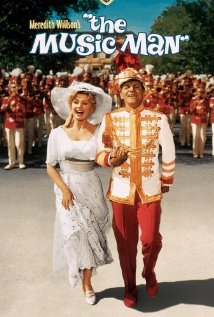
“Professor” Harold Hill (Robert Preston) is a con man posing as a salesman of band instruments and uniforms. He happens upon River City, a small town in Iowa. As the citizens explain in song, Iowa is a place of stubborn people who keep to themselves unless someone needs help. But Hill happens upon an old friend, Marcellus Washburn (Buddy Hackett), and is ready to run his favorite scam. He plans to sell the town on the idea of a boys band, with himself as leader, get them to order instruments and uniforms, and skip town with the money. Marcellus tells him a bit about the town and its people, and especially about the town librarian and music teacher, Marian Paroo (Shirley Jones).
Copyright Warner Brothers 1962
Marian lives with her mother (Pert Kelton) and her little brother Winthrop (Ronny Howard), a shy boy with a lisp, who deeply mourns his late father. In her own way, Marian, like Winthrop, is still grieving, and finds it hard to allow herself to become close to anyone. This is especially difficult because she is the subject of some gossip in the town. She has the job as librarian because an elderly man, a friend of her fathers, bequeathed the library building to the town, but left the books to her, to ensure that she would have permanent employment. This has caused some speculation about their relationship. And the ladies in the town also think the books she recommends (including the Rubiyat and Balzac) are improper. Despite her mother’s attempts to encourage her to be friendlier, Marian is very skeptical about Harold’s motives and his credentials. He is able to dazzle the town (with the famous patter song “Trouble,” offering the band as an alternative to the decadence of the town’s new pool parlor), but she vows to check his credentials.
The town gets caught up in the notion of the band. Harold’s charm and smooth promises enrapture everyone from the town council (he transforms them from four squabbling politicians into a harmonizing barbershop quartet) to the teen-age boy all the others look up to (Harold challenges him to invent an apparatus for holding the music so that the piccolo player can read it and encourages his romance with the mayor’s daughter). Harold even charms Winthrop, who is at last excited and happy about something. Harold tells all the parents that their children are wonderfully gifted and that the band will make them stars. Meanwhile, Harold’s attention to Marian is becoming more than just a way to help him get the money. And, despite evidence that he does not have the credentials he claims, and her certainty that he is not what he pretends to be, she finds herself softening toward him and protecting him.
Because of her, he stays too long, and he is arrested. As he says, “For the first time, I got my foot caught in the door.” But somehow, the boys force a few sounds out of the instruments, enough for their proud parents. And Harold stays on — it turns out that all along, deep inside, what he really wanted was to lead a band.
Discussion: Robert Preston brought his award-winning performance as Harold Hill on Broadway to the screen in this impeccable production, perfect in every detail. In addition to the glorious production, with some of the most gorgeous music and dancing ever filmed, there is a fine story with appealing characters. Marian learns about the importance of dreams from Harold, and he learns about the importance of responsibility from her.
Harold has made a life out of other people’s dreams, creating them and then spoiling them. He gives people an image of themselves as important and creative, and it is clear that this is what he loves about what he does, not stealing the money from them. Marian has faith in Harold. It is not the blind faith of the rest of the town, the people who see the seventy-six trombones he sings about. She sees what is good inside him, the real way that he affects people like Winthrop, the way he affects her. As she sings, “There were bells on the hills, but I never heard them ringing, oh, I never heard them at all, ’til there was you.” When Marian sees Harold and is willing to love him in spite of his past, he is for the first time able to move on from the notion of himself as a thief and a liar. Each finds the core of the other, allowing both of them to heal and take the risk necessary to make their dreams come true. For him, the risk is prison and disgrace. For her, the risk is the kind of hurt she felt when her father died, the risk we all take in loving someone. And because this is a musical, they live happily ever after.
Questions for Kids:
· Why is Winthrop so shy? What makes him change?
· How does Harold change people’s minds? Is that good or bad?
· How does the music help to tell the story? Listen to the songs “76 Trombones” and “Goodnight My Someone” again. They are very much alike, as you can tell when they are sung together. What did the composer want that to tell you about the people who sing them?
· Why were the parents worried about their children playing pool? What do parents worry about today?
· How is Marian’s library like yours? Do you know your librarian? Do people in your town ever argue about what books should be in the library?
Connections: This movie shows some of the most talented people of their time at the top of their form. Shirley Jones appeared in many musicals, including “Oklahoma” and “Carousel,” always exquisitely lovely in voice and appearance. She also won an Oscar for her dramatic role as a prostitute in “Elmer Gantry.” And of course she was the mother in television’s musical comedy series, “The Partridge Family.”
Robert Preston had more luck in theater than in movies finding roles that gave him a chance to show all he could do. But every one of his film appearances is worth watching, including “The Last Starfighter” and “All the Way Home.” Choreographer Oona White also did the sensational dance numbers in “Bye Bye Birdie.” Composer Meredith Willson never came close to the glorious score for “The Music Man,” but he produced some nice songs for “The Unsinkable Molly Brown.”
Plot: Lucy Honeychurch (Helena Bonham Carter) arrives in Italy with her strait-laced aunt Charlotte (Maggie Smith). Disappointed at not getting the room with a view they had been promised when making their reservations at the inn, they are not sure whether it is proper to accept the offer of Mr. Emerson (Denholm Elliot) and his son George (Julian Sands), staying at the same inn, to switch rooms so they may have a view after all. Reassured by the clergyman, Mr. Beebe (Simon Callow), they agree.
Later, out in the countryside, George impetuously kisses Lucy, and her aunt, horrified, whisks her back to England. There, Lucy is engaged to Cecil, a prissy man, who likes Lucy’s “freshness” and “subtlety,” and kisses her lightly, only after asking her permission. Mr. Beebe says that “If Miss Honeychurch ever takes to live as she plays (the piano), it will be very exciting–both for us and for her.” He clearly does not think the engagement to Cecil is evidence that she has.
The Emersons move into a cottage near the Honeychurch family, invited by Cecil, who does not realize that Lucy knows them. Lucy is distressed, partly because she wanted two elderly ladies she met in Italy to live there, and partly because having George so near is disturbing to her. She does her best to resist her attraction to him and to the passionate reality that he offers, but ultimately breaks the engagement to Cecil, marries George, and returns with him to the room with a view.
Discussion: Lush natural settings have a powerful affect on fictional characters, especially those in love, or wanting to fall in love. In Shakespeare, lovers go to the woods to straighten things out. In the British literature of the 19th and early 20th century, they often go to Italy, which represents freedom from repression, with “Enchanted April” and this film as prime examples. The wheat field where George kisses Lucy is in sharp contrast to the manicured lawns of the Honeychurch home, as the precise and cerebral Cecil is in contrast to the passionate George.
This is a movie about having the courage to face one’s feelings, and to risk intimacy, fully knowing and being known by another person. George never hesitates to take that risk. Cecil, sensitively played by Daniel Day-Lewis as a full character and not a caricature of a fop, has feelings but will never be able to “take to live as (he) plays.” Clearly, he does care deeply for Lucy, but he does not have the passionate nature to respond to hers fully, as George does. As George says, Cecil “is the sort who can’t know anyone intimately, least of all a woman,” someone who wants Lucy as an ornament, perhaps to enjoy her passionate nature by proxy, not realizing that his own proximity is likely to stifle it. George wants Lucy “to have ideas and thoughts and feelings, even when I hold you in my arms.”
Questions for Kids:
· Mr. Emerson refers to a “Yes! And a Yes! And a Yes” at the “side of the Everlasting Why.” What does this mean?
· What leads Lucy to break her engagement to Cecil? What leads her to accept her feelings for George?
· What is the meaning of the title?
Connections: Some of the themes of this movie are reminiscent of movies like “I Know Where I’m Going,” “Born Yesterday,” “Sabrina,” “Breakfast at Tiffany’s,” “It Happened One Night,” and others in which the leading lady ends up marrying someone other than the man she planned to marry, choosing true love and intimacy over comfort and a relationship that seemed safer.
Activities: Teenagers might enjoy the book by E.M. Forster, and some of his other books, including Howard’s End.
Plot: Marshal Will Kane (Gary Cooper) marries Amy (Grace Kelly) and turns in his badge. She is a Quaker, and he has promised her to hang up his gun and become a shopkeeper. But they get word that Frank Miller is coming to town on the noon train. Kane arrested Miller and sent him to jail, and Miller swore he would come back and kill him.
Will and Amy leave town quickly. But he cannot run away, and he turns around. He knows that they will never be safe; wherever they go, Miller will follow them. And he has a duty to the town. Their new marshal does not arrive until the next day.
Will seeks help from everyone, finally going to church, where services are in session. But he is turned down, over and over again. Amy says she will leave on the noon train. Will’s former deputy, Harvey (Lloyd Bridges) refuses to help, because he is resentful that Will did not recommend him as the new marshal. Will’s former girlfriend, Helen Ramirez (Katy Jurado), now Harvey’s girlfriend, will not help him, either. She sells her business and leaves town. Others say that it is not their problem, or tell him to run, for the town’s good as well as his own. The previous marshal, Will’s mentor, says he can’t use a gun any more. The one man who promised to help backs out when he finds out that no one else will join them. The only others who offer to help are a disabled man and a young boy. Will must face Miller and his three henchmen alone.
At noon, Frank Miller gets off the train. The four men come into town. Will is able to defeat them, with Amy’s unexpected help. As the townsfolk gather, Will throws his badge in the dust, and they drive away.
Discussion: This outstanding drama ticks by in real time, only 84 tense minutes long. Will gets the message about Frank Miller at 10:40, and we feel the same time pressure he does, as he tries to find someone to help him. We see and hear clocks throughout the movie, and as noon approaches, the clock looms larger and larger, the pendulum swinging like an executioner’s axe. In the brilliant score by Dimitri Tiomkin (sung by Tex Ritter) the sound of the beat suggests both the train’s approach and the passage of time.
This is like a grown-up “Little Red Hen” story. Will cannot find anyone to help him protect the town. Everyone seems to think it is someone else’s problem (or fault). Teenagers may be interested to know that many people consider this film an analogy for the political problems of the McCarthy era. It was written during the height of the Hollywood “red scare.” After completing this screenplay, the writer, an “unfriendly witness” before the House Un-American Activities Committee, was blacklisted. But this unforgettable drama of a man who will not run from his enemy, or his own fears, transcends all times and circumstances.
Questions for Kids:
· Everyone seems to have a different reason for not helping Will. How many can you identify? Which reasons seem the best to you? Which seem the worst? What makes Amy change her mind?
· Why does Will throw his badge in the dirt?
· Do you think the screenwriter chose the name “Will” for any special reason?
· How do you decide when to stay and fight and when to run? How do you evaluate the risks? What should the law be?
Connections: This movie was the first attempt at an “adult” Western, its stark black and white images a contrast to the gorgeous vistas in the Westerns of John Ford and Howard Hawks. It was included in the first list named to the National Film Registry, established by the Library of Congress to identify films that are “culturally, historically, or esthetically important.” It has had tremendous influence, and has inspired many imitations and variations. “Outland,” starring Sean Connery (and rated R) is a not-very-good attempt to transfer this plot to outer space. “Three O’Clock High” moves it to a high school, with a new student challenged by the school bully. Despite some directoral pyrotechnics, it is not very good, either. “The Principal” has another “High Noon”-style confrontation in a school, but this time it is the title character who must show his mettle. “The Baltimore Bullet” moves the confrontation to a pool hall.