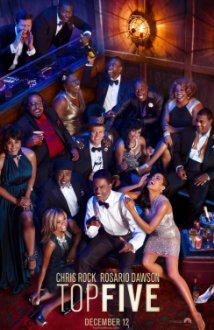
Top Five

Posted on December 11, 2014 at 5:59 pm

MPAA Rating: Rated R for strong sexual content, nudity, crude humor, language throughout and some drug use
Copyright 2014 Paramount Pictures

Why is it that we love to talk about our top five? Is it because it gives us a sense of order in the midst of chaos? Is it because we feel that if we can somehow distill the whole world into a definitive top five (with a possible but un-canonical sixth position just to make it interesting), that will reveal something essential about the person doing the ranking?

Writer/director/star Chris Rock plays Andre, a stand-up comic turned wildly successful movie star, with a series of dumb comedy blockbuster hits where he plays Hammy the Bear, an ursine cop with a gun as quick as his wisecracks and catch phrases. Like the director in “Sullivan’s Travels” and the stand-up comic turned actor and filmmaker in “Stardust Memories,” Andre wants to do something serious and meaningful. He has made a new film called “Uprize,” a drama based on the real-life slave rebellion in late 18th century Haiti, and he is on a publicity tour to promote it. He is also about to get married to a reality star (Gabrielle Union as the exquisitely airbrushed and relentlessly determined Erica), who has made every element of the wedding and their lives together a branding opportunity. And he has agreed to spend the day with Chelsea, a New York Times reporter (Rosario Dawson) who begins by asking him why he isn’t funny anymore and wants him to describe what it felt like to hit bottom before he became sober.

Andre and Chelsea travel all over the New York, visiting the inner city neighborhood where his friends and family jockey between pride and resentment. The girlfriend who was there at the beginning is sorry she quit before he hit it big. The old friends tease him about how he was never the funniest one in the group and remind him to keep it real. Andre also has a talk with some older men on the street. One calls him “Hollywood” — but asks for money. We learn his relationship to Andre. It is understated, but significant.

No one is buying tickets to “Uprize.” And “everyone in the barbershop wants to see in the bear costume” for Hammy 4.

Rock has often seemed awkward or uncomfortable on screen, even in “Head of State,” which he directed, especially in scenes with women. But here he shows a welcome naturalness and confidence. We got a glimpse of those qualities in his best previous performance, “2 Days in New York,” which has a similar intimate, improvisational vibe. This time, playing a central character who shares some of his experiences — and some of his friends, with Adam Sandler, Whoopi Goldberg, Jerry Seinfeld making cameos — Rock’s performance is nuanced, thoughtful, very, very funny, and touching as well.  It is the funniest movie of the year, in part because it is so sharply observed.  Andre may think the best way to deliver a message is with a serious drama, but Chris Rock knows better.

Parents should know that this film has extremely strong, explicit, and crude language including the n-word, extremely explicit sexual references and situations, and very crude humor, substance abuse including drugs, and mild comic peril.

Family discussion: What will Andre do next? Would you go to see his movie about the slave rebellion? What is “rigorous honesty?” Who’s in your top five and why is it fun to try to rank your favorites?

If you like this, try: “Sullivan’s Travels,” “Stardust Memories” and Chris Rock’s stand-up performance films and television series

Related Tags:


Comedy Movies -- format

Moms Mabley — A New Documentary on HBO

Posted on November 18, 2013 at 12:00 pm

Whoopi Goldberg pays long overdue tribute to a pioneering figure in the history of comedy, Moms Mabley in a new documentary premiering on HBO tonight.  In an era where stand-up comedy was almost entirely white and male and — as far as anyone knew — straight, she was a very successful gay black woman, first on “the chitlin’ circuit” of black theaters and clubs and then in more mainstream venues.  But Mabley was anything but mainstream.  She played Carnegie Hall and appeared on the Smothers Brothers and other television shows.  She appeared on stage as a bedraggled, toothless, soul, which helped disguise the sly sharpness of her comedy.  I hope Goldberg’s documentary will bring her the recognition she deserves and create a new generation of fans.

Related Tags:


Television

What Movie Could You Watch a Million Times?

Posted on July 24, 2012 at 8:00 am

We all have one.  I have several.  Very often, it’s not a classic.  Sometimes it is a guilty pleasure.  But each of us has a movie we could take to a desert island and be happy to watch over and over.  NPR’s “All Things Considered” asks people who make movies to talk about their selections and it is a joy to hear them talk about the movies they love and why they love them.  Movies I’ve Seen a Million Times has Whoopi Goldberg on “To Kill a Mockingbird,” Donald Faison on “The Empire Strikes Back,” Jared Harris (of “Sherlock Holmes” and “Mad Men”) on “Tootsie.”  Well worth a listen!  And I’d love to hear which movies you would pick.

Related Tags:


Understanding Media and Pop Culture

For Colored Girls

Posted on February 9, 2011 at 8:00 am

B-
Lowest Recommended Age: Mature High Schooler
MPAA Rating: Rated R for some disturbing violence including a rape, sexual content and language
Profanity: Very strong and explicit language
Alcohol/ Drugs: Drinking, drug references
Violence/ Scariness: Graphic rape and abortion scenes and tense confrontations
Diversity Issues: A theme of the movie
Date Released to Theaters: November 5, 2010
Date Released to DVD: February 8, 2011
Amazon.com ASIN: B003Y5H4ZC

Tyler Perry’s films frustrate critics and commentators, who are bothered by the awkward mash-ups of high melodrama and low humor and by what many people think is an exaggerated and biased portrayal of men as abusive, neglectful, incompetent, and/or disloyal. And yet, their unprecedented success — he has never had a flop — shows that they speak to the audience in a powerful way. His new film, the first based on material from another writer, reflects a more literary ambition but it is likely to create the same divide between those find that it feels true to their experience and those who think it still aims too low and is likely to perpetuate prejudice inside and outside the African-American community.

Ntozake Shange (born Paulette Williams) was only 23 years old when her groundbreaking “choreopoem” called “for colored girls who have considered suicide/when the rainbow is enuf” first astonished audiences in 1975. The ferocity and rage of the theatrical experience spoke to generations of women, especially women of color, who felt for the first time that they were seeing themselves and people they knew center stage. There was no Oprah back then. The idea of a black woman speaking honestly about her struggles for respect from others and from herself felt revolutionary.

The play’s characters were symbols, their only names the colors of the clothes they wore. They spoke very frankly about topics seldom addressed publicly, much less on stage, and much, much less from the woman’s side of the experience: rape, molestation, betrayal, and oppression. With dance and poetry they expressed their longing for love and acceptance despite the best efforts of individuals, religious organizations, and society at large to make them feel less than beautiful and less than lovable. This was an era when “the personal is political” was a mantra for women who were beginning to question millennia of traditional notions of what they were and how much potential there was for them.

A great deal has changed since 1975, including the emergence of Perry, one of the choreopoem’s biggest fans and clearly influenced by it, as a major power player in Hollywood. Perry has become an omnimedia mogul with live theater, DVDs, films like “Diary of a Mad Black Woman” and “Madea Goes to Jail” and the television series “Meet the Browns” and “House of Payne,” along with the best-seller, Don’t Make a Black Woman Take Off Her Earrings: Madea’s Uninhibited Commentaries on Love and Life. The very power behind and in front of the camera, with nine well-known actresses, provides some counterpoint that puts at risk the unrelenting direness of these characters’ lives.

And yet, these words and these stories may still resonate with any woman who has struggled to love herself enough to expect and deserve love from others. While the nine main characters in and out of each other’s lives have their own stories, they can be seen as different aspects of one woman, or of all women. Tangie (a sizzling Thandie Newton) is almost feral as a bartender who uses men for sex, thinking it makes her the strong one. Her mother, Alice (Whoopi Goldberg), who thinks she gets strength from religious fervor and judgment. Alice is furious with Tangie but thinks that her other daughter, Nyla (the incandescent Tessa Thompson), is close to perfect. Which is why Nyla can’t tell Alice the truth about how much trouble she is in.

Crystal (Kimberly Elise) thinks she has the strength to care for her children, her demanding employer, and the man in her life who loves her deeply but is mentally unstable following his experience in the military. Juanita (Loretta Devine) does not know if she can trust the man she loves. Jasmine (Anika Noni Rose) does not know that she cannot trust the man who seems so gentlemanly. Kelly (Kerry Washington), a social worker, is the only woman in this film who has a man she can trust and rely on, is so concerned about whether she can conceive (due to abuse from another man) that she neglects one of her clients, with tragic consequences. And Gilda (Phylicia Rashad) sees it all and does her best to warn, to teach, and to help.

Perry just sketches in enough story to provide settings for the poetic monologues and he shows some appealing delicacy in balancing the gritty reality of the women’s lives with the more lyrical qualities of their speeches, beautifully delivered by actresses of great talent and beauty. At its best, it has a dreamlike quality and some of the speeches are beautifully done. The film makes a brave effort to show that the victims of abuse have to take responsibility for acting as enablers. But some of the material seems as outdated as the title, and the unrelenting melodrama gets out of hand near the end with an unfortunate speech about being sorry that does not work, despite the best efforts of Janet Jackson. Perry clearly cherishes all of these women, the performers on screen and the characters they play, and the sincerity of his devotion to them and to the material keeps what is on screen watchable even when it does not work as a film.

Related Tags:


Based on a play Drama Movies -- format
THE MOVIE MOM® is a registered trademark of Nell Minow. Use of the mark without express consent from Nell Minow constitutes trademark infringement and unfair competition in violation of federal and state laws. All material © Nell Minow 1995-2026, all rights reserved, and no use or republication is permitted without explicit permission. This site hosts Nell Minow’s Movie Mom® archive, with material that originally appeared on Yahoo! Movies, Beliefnet, and other sources. Much of her new material can be found at Rogerebert.com, Huffington Post, and WheretoWatch. Her books include The Movie Mom’s Guide to Family Movies and 101 Must-See Movie Moments, and she can be heard each week on radio stations across the country.

Website Designed by Max LaZebnik