Interview: Matthew Llewellyn, Composer for Wally Lamb’s “Wishin’ and Hopin'”

Posted on December 20, 2014 at 9:40 am

Wishin’ and Hopin’ is Lifetime movie airing December 21, 2014, based on the novel by Wally Lamb. It stars Molly Ringwald and Meat Loaf with narration by Chevy Chase. Composer Matthew Llewellyn was kind enough to answer my questions about creating a score for this nostalgic holiday story.

How did you first come to this project and what were the guidelines for the score?

Copyright Matthew Llewellyn 2014

I first heard about the project back in June from producer Andrew Gernhard and director Colin Theys of Synthetic Cinema International. That’s when I learned that the film was to be based on the New York Times best-selling novel by Wally Lamb. It sounded like an amazing opportunity to write a period-sounding score that could be fun and light but also very dramatic and emotional. This would be a vastly different score from our last collaboration on the Chiller TV (NBCUniversal) horror film “Deep in the Darkness”. There weren’t any specific guidelines for the score other than it needed to be very thematic and really evoke the holiday spirit.

What did you to do evoke the retro/nostalgic vibe of the story?

The first step was to write memorable themes that could reappear throughout the film and help tell the story. Initially, we were only going to have a few themes just for the major characters (Felix, the Nuns, and Rosalie) but as I started getting further along in the composing process I ended up writing many more themes. (Madame Frechette and Zhenya) The most important thing I needed to do was to nail the tone of the film. We discussed a variety of styles for the score and eventually landed on a traditional orchestra sound. It just seemed like the right choice for this kind of movie and I couldn’t be happier with the result.

What are the special challenges of scoring a film set at Christmas? Do you make use of some of the season’s traditional music?

There was quite a bit of period music in the film that really helped ground it in the 1960’s. Before I started composing, Colin and I kicked around the idea of re-recording certain Christmas songs and possibly producing new arrangements but the schedule was too tight so they licensed all the songs heard in the film and I composed the film’s original score around them. I didn’t use any specific Christmas material in my score, however it was important that my score sounded “one” with the songs.

Molly Ringwald is the daughter of a musician and a singer. Did she have any comments or suggestions? Or did you begin work after all the shooting was done.

I started working on the film during the editing process so I’m not sure how involved she was in making those decisions.

Were there any scenes that were especially challenging to score?

The hardest scene to score was the climax of the film when the children have their Tableau Vivant performance. This was especially challenging because in the scene there are a group of kids singing on stage while all hell is breaking loose backstage. My job for this scene was to not only accentuate the madness backstage but also keep the energy up and hectic when the picture went back to the kids on stage.

What was the first score you ever worked on and what did you learn from that experience?

I actually didn’t start writing music until college so it’s hard for me to pinpoint what my first score actually was. I do however remember my first scoring project at Berklee, called “Salt Marsh”. It was a very short scene, only about ninety seconds, of birds in the wild. I thought about posting it recently as a “throwback-Thursday” on Facebook but it doesn’t represent my work today as a composer.

What music do you like to listen to at this time of year?

I have an extremely eclectic taste in music; I actually went to KROQ’s Almost Acoustic Christmas a few days ago and saw some of my favorite bands like Alt-J, Weezer, and No Doubt. I am definitely a sucker for Christmas music though, being a big fan of the classics. I find myself listening to a lot of Frank Sinatra around the holidays; he will always be the king in my book.

Related Tags:


Based on a book Composers Music Television

Wild’s Cheryl Strayed Has a New Advice Podcast

Posted on December 19, 2014 at 3:59 pm

Before Wild, Cheryl Strayed was the pseudonymous “Dear Sugar” advice columnist for The Rumpus. Her columns were collected in Tiny Beautiful Things: Advice on Love and Life from Dear Sugar. Writer Steve Almond (Candyfreak: A Journey through the Chocolate Underbelly of America) also wrote as Dear Sugar. And now Strayed and Almond are joining forces on a new Dear Sugar podcast, promising “radically empathic advice.” You can write in to dearsugar@wbur.org.

Related Tags:


Internet, Gaming, Podcasts, and Apps Writers

Actors Of Color Discuss Racial Stereotypes In Hollywood

Posted on December 19, 2014 at 8:00 am

Film Courage produced this excellent and very compelling film with actors of color talking about the challenges they face in Hollywood. If we did a better job of representing diversity in film, we would not just tell better stories and tell stories better, we would make better progress toward understanding, respect, and justice for all.

Related Tags:


Actors Race and Diversity

Annie

Posted on December 18, 2014 at 5:59 pm

Copyright Columbia Pictures 2014

The story of the plucky little Depression-era orphan with the curly red hair has been not just re-booted but re-imagined into the world of rent-a-bikes, viral videos, DNA tests, YOLO, corporate privacy invasions, and Katy Perry tweets. There are some nice shout-outs to the original version, with a character named for Little Orphan Annie creator Harold Gray and a music group named the Leapin’ Lizards after the redhead’s favorite way to express surprise.

A cheeky opening briskly bridges the decades. It begins with a red-headed girl named Annie giving a school report, concluding with a tap dance.  She looks like the Annie we remember.  But then the teacher calls on another Annie, and we meet our Annie, played by “Beasts of the Southern Wild’s” Quvenzhané Wallis.  She gives a rollicking report about Franklin Roosevelt and the New Deal that sounds like a call to action from Occupy Wall Street. The whole classroom bangs on their desks along with her. Annie is all about the 99 percent. (The famously very right-wing Gray would be horrified.)

And, as she repeatedly reminds us, she is not an orphan.  She is a foster kid.  Every Friday evening, she waits outside the restaurant where her parents were last seen, in hopes that they will return. She was four when they left her with a note and half of a locket, and since then she has gone from foster home to foster home, now living with Miss Hannigan (Cameron Diaz), a bitter, abusive, alcoholic woman who once sang with C&C Music Factory and was almost a Blowfish. She resents the girls who are her only source of income, and makes them do all the work in the apartment.

Will Stacks (Jamie Foxx) is a cell phone company billionaire running for mayor of New York. (That’s “Stacks” as in “stacks of money,” with “Warbucks” a bit too on the nose for our more euphemistic times.) When he grabs Annie to save her from getting hit by a truck, his approval numbers spike, and his aides encourage him to spend some time with her to give him a more relatable image. Grace (Rose Byrne) is his all-purpose, super-efficient second-in-command and Guy (Bobby Cannavale) is his whatever-it-takes spin-master campaign advisor. Annie, about to be thrown out by Miss Hannigan, persuades Stacks to let her stay in his mega-luxurious apartment, promising that her “game face” will get him good press, combating his image as “a rich elitist who can’t relate to regular people.”

It works for a while until some unscrupulous people hire a couple to pose as Annie’s real parents.

Some of the updates work well, and there is a nice energy in the opening scenes as Annie uses the last ten minutes of a bike share to navigate the city, passing street performers riffing on the well-known score. Co-writer/director Will Gluck keeps things bright and bouncy, but his filming of the dance numbers is clumsy to the point of incompetence, undermining even the nearly unkillable numbers like “It’s a Hard Knock Life” with angles and edits that take the energy out of the songs instead of boosting it.

Wallis is inconsistent, occasionally appearing checked out of the scene. She is better in the few scenes with the other girls, but she has very little chemistry with Byrne or Foxx. And one barfing scene is bad, but four? Plus a spit take? And a hooker joke? There is a movie-within-the-movie that is very cute, but the cameos are a distraction. The tweaking of the script works better in individual scenes than in the overall plot, which feels slapped together and unsatisfying. Ah, well, the sun will come out tomorrow, so maybe next time they’ll get it right.

Parents should know that this movie has themes of child abandonment and abuse, a character abuses alcohol and there is a joke about alcoholism, and there is some mild peril and potty humor.

Family discussion: What did Annie mean when she said Stacks did not know he was good yet? How is Annie different from the other girls?

If you like this, try: the other musical versions and “Game Plan”

Related Tags:


Comedy Comic book/Comic Strip/Graphic Novel Family Issues For the Whole Family Musical Remake Stories About Kids

Night at the Museum: Secret of the Tomb

Posted on December 18, 2014 at 5:23 pm

B-
Lowest Recommended Age: 4th - 6th Grades
MPAA Rating: Rated PG for mild action, some rude humor and brief language
Profanity: Brief schoolyard language
Alcohol/ Drugs: None
Violence/ Scariness: Comic peril and violence
Diversity Issues: None
Date Released to Theaters: December 19, 2014
Date Released to DVD: March 9, 2015
Amazon.com ASIN: B00SSI2PKO
Copyright 2014 Twentieth Century Fox

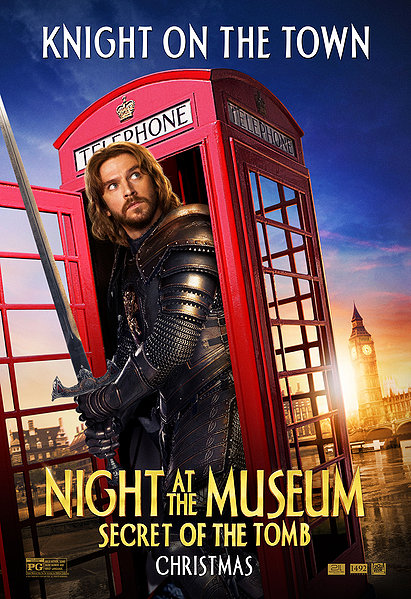
Fans of the first two “Night at the Museum” films will like this one because it is pretty much the same film. They go to another museum, this time the British Museum in London, and the exhibits come to life and create chaos. The good news: it’s a zippy 90 minutes. The bad news: way too many of those minutes involve a peeing monkey.

The most popular characters from the earlier films are back, including the late Robin Williams in an especially poignant role as Teddy Roosevelt and the late Mickey Rooney as a retired museum guard. Dick Van Dyke almost steals the movie in a brief appearance showing that he can still get down and boogie.

But once again the focus of the story is on Larry (Ben Stiller), museum security guard turned wrangler of the exhibit figures when they come to life at night. The museum director, Dr. McPhee (Ricky Gervais), thinks that Larry has created some sort of special effects, but when a fundraising gala is held at the museum after dark so the guests can marvel at what they think is some kind of animatronic display things go very wrong. The ancient Egyptian tablet that creates the magic is becoming corroded and the result is like a corrupted computer code. The exhibits go wild, and the director is fired.

Young Egyptian King Ahkmenrah (the terrific Rami Malek) says that the only way to figure out what is wrong with the tablet is to take it to his parents, who are exhibits at the British Museum. With Dr. McPhee’s help, Larry brings Ahkmenrah to the British Museum for “conservation.” Once he arrives, he finds that there are some stowaways — Teddy Roosevelt and Sacajawea (the lovely, elegant Mizuo Peck), a prehistoric man who looks very familiar (Stiller again as Laa), Dexter the monkey, and our fierce little toy soldier-sized friends Octavius the Roman centaurian (Steve Coogan) and Jedediah the cowboy (Owen Wilson).

Ahkmenrah is reunited with his parents (Sir Ben Kingsley and Anjali Jay) who explain the problem — like an iPhone, the tablet need to be recharged. All it needs is moonlight, but getting it there in time is a problem, especially when it is stolen by a very confused Sir Lancelot (“Downton Abbey’s” Dan Stevens). Lots of hijinks and slapstick stunts ensue, with a highlight being entry into a vertiginous M.C. Escher drawing.

There are Muppet Movie’s worth of guest appearances, including Rebel Wilson riffing as a security guard. It zips along briskly, not wasting any time in this episode on any kind of love interest for Larry, though there is a dreary detour about Larry’s high school senior son (Skyler Gisondo taking over for Nick Daley) not wanting to go to college. We’re there for the stunts and special effects, and mostly for the dream that maybe some night at some museum, it does all come to life.

Parents should know that this movie includes comic/fantasy peril. Some characters appear to be hurt but are fine. There is also potty humor and brief schoolyard language.

Family discussion: Do you agree with Nick’s decision about the tablet? Which museum would you like to see come to life and why?

If you like this, try: the first two movies — and read about the real legends and histories of Theodore Roosevelt, Camelot, Sacajawea, ancient Egypt, and M.C. Escher.  And visit your local museum to imagine your own adventures.

Related Tags:


Action/Adventure Comedy DVD/Blu-Ray Pick of the Week Fantasy Series/Sequel
THE MOVIE MOM® is a registered trademark of Nell Minow. Use of the mark without express consent from Nell Minow constitutes trademark infringement and unfair competition in violation of federal and state laws. All material © Nell Minow 1995-2026, all rights reserved, and no use or republication is permitted without explicit permission. This site hosts Nell Minow’s Movie Mom® archive, with material that originally appeared on Yahoo! Movies, Beliefnet, and other sources. Much of her new material can be found at Rogerebert.com, Huffington Post, and WheretoWatch. Her books include The Movie Mom’s Guide to Family Movies and 101 Must-See Movie Moments, and she can be heard each week on radio stations across the country.

Website Designed by Max LaZebnik