Mike Birbiglia‘s stories about his experiences with a rare form of sleepwalking became a part of his stand-up routine, a book, monologues on This American Life, and now a movie. He came to Washington for a screening of the film and was one of the friendliest and most open and engaging people I have ever interviewed.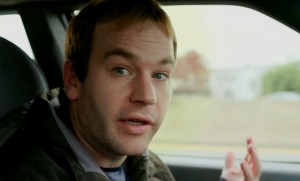
Were you raised in a religious family?
Iwas raised in Massachusetts in a small town where basically everyone was Catholic. I was raised Catholic and then I kind of wandered away, somewhere in high-school. I never got confirmed which is a big deal.
Then I moved to New York, and my wife is Jewish. When I was growing up, I didn’t know who Jewish people were, what it was to be Jewish. I’ve been thinking a lot about religion and beliefs recently…toying with doing a show about religion. I used to toy with a joke where I’d say, “I was raised Catholic,” and people go, Catholic guilt…and then I married a Jewish women, and it was “Oh, Jewish guilt!” And I’m like, “well, maybe people just have guilt…maybe that’s just human, maybe it’s not specific to religion.”
Was religion important to your parents?
My mother is very religious, goes to church every week, sometimes two or three times a week and my grandparents were very Catholic, they went to Latin Mass, so they were pre-Vatican 2. And I went to Catholic grade school, grade 1 through 6, and so whether I like it or not, I’m very much a product of Catholic teaching. At its really stripped-down elements, I love it. I love the Golden Rule; I think fundamentally, that when applied to all things, I think I would be very religious. I think when you get into the minutiae of the specific religion, I just tend to fall away.
How does something go from being a monologue to being a movie?
I studied film in college. I got into comedy because it was no overhead — literally, sometimes I was performing outside. When I had the show running off Broadway for about eight months I was called by a lot of people who said, “This could be a movie!” I think that’s sort of a standard thing. If something is sort of successful, “Now this should be in the king of media!” Find something successful and, now that it’s doing well in the minors, we could bring it up to the major leagues.
At the time I was working on the screenplay called “Waking Up Ben,” that was about similar issues but had a different story-line. It was about a guy sort of sleeping through his life who had a hard time waking up in the morning and it was metaphoric in a lot of things. And then Ira Glass and I were becoming friends by that time, we were working on This American Life. I said to him, “What do you think about this for a movie?” and the way Ira tells the story, is that I tricked him into making it.
Of course he would.
He says that this is how I deal with everyone, like my crew, actors, my cinematographers, I just have a way of just being like, “oh, it’ll be fun!” And the next thing you know, I’m climbing up a mountain, we’re in winter-gear. Cut to: disaster. And of course, it comes from Ira, the king of persuasion — he says, he’s never been so entertained by a pledge drive before…but yeah, so anyway, it came out of that and Ira said, “yeah, that seems like we should do that,” because they were getting into the business of making movies. A lot of movies had been made from their stories like “The Informant” with Matt Damon.
So, he’s interested in producing some stuff. It was very hard to translate the monologue.
What made you decide that you would not only talk to the audience but that you would really lead off by talking to the audience, and sort of break the fourth wall that way?
That was always in the script. That was the thing that Ira had always emphasized, to note that “you really ought to talk to the camera because that’s what you do.”
This is kind of an interesting story. I had written the camera monologues within the scenes in other words, we’d be talking like right here, and then I’d look at the camera which was here and I’d go, “well this didn’t go very well” and then I’d get back to talking to them. It was kind of like “Ferris Bueller.” What we found in the edit was that that wasn’t working because it was taking away from the reality of the theme. It needed to be in the future or I should say, the present, when things were okay. Here we have him driving the car, and here we see him in a good mood, because there’s something about the movie where it really rides the line between comedy and tragedy. So we found in the edit we had to go back and re-shoot them.
You’re making comedy out of getting glass picked out of your leg. How do you do that?
Oh, I know. I like comedy that is also tragic. One of my favorite comedies of all time is “Terms of Endearment,” that’s my pace.
You cast the wonderful actress Lauren Ambrose in a difficult role. She is so lovable your heart breaks for her. She is a very experienced actor, so what did you learn from her?
The audience loves her so much, they think: is she going to be okay? This is horrible! The whole movie is building up to this break-up and she goes off and we don’t know what happens to her? And we needed to not have to deal with that repercussion with the audience, so working with her was fascinating because that is home for her, you know? She’s very comfortable on a set, she’s very professional, she puts in the hours and she’s entirely unique.
One thing that is unusual about the film is that the take that it gives us in the life of a stand-up comic, just touring and dependent on the agent and being paid so little. Was it important to you to include that milieu and to make that a part of the story?
I think that was something that I lived in my 20’s in a very real way, and was able to describe in my book, in the film, in a pretty vivid way, and I didn’t even mean for it to become such a noted aspect of the film. Mark Maron, who has the WTF podcast about comedy and appears in the film, said, “No one has made a film about a road comic, no one has nailed it the way this one does.”Yeah, it just seems that I accidentally wrote a unique story. I guess I just lived it.
You re-enacted some painful and embarrassing real-life experiences — was that difficult?
You know the expression, “You’re only as sick as your secrets? I believe that, and I think I try to have my work live by that to a degree. I think that when you open up to people—or kind of when I’ve opened up to people, I’ve opened up to audiences, assuming that it’s funny, the connection with the audience is incomparable, from anything that I’ve experienced in my life, and that’s why I’m drawn to it so much.

 She has just been a guest blogger for the The Film Experience and her posts have been thoughtful, creative, and utterly captivating. In DVDs I Had to Own she charmingly lists classics like the tearjerker Terms of Endearment


 ,
,  , and
, and  , is now 44 years old and a mother in real life and on “The Secret Life of the American Teenager.” And she is the author of a new book,
  . In a piece that appeared in the New York Times this week she discusses the connection between acting and writing.
 , which also has a great dance number with garbage can lids.
