Interview: Michael Connelly of ‘The Lincoln Lawyer’

Interview: Michael Connelly of ‘The Lincoln Lawyer’

Posted on March 16, 2011 at 8:00 am

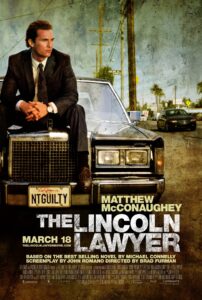
Michael Connelly is a journalist-turned novelist whose enormously successful crime stories have filled 18 novels, translated into 13 languages. This week’s release, “The Lincoln Lawyer,” starring Matthew McConaughey as defense lawyer Mick Haller, Marisa Tomei as his prosecuting attorney ex-wife, and Ryan Phillippe as his wealthy client accused of murder, is based on his book. That’s “Lincoln” as in town car, not President, by the way.
Copyright Lionsgate 2012

How did what you learned as a journalist help you as a novelist?

A lot of what I did has a journalist has carried over into the books. The key has been the observation skills, to watch things and look for details to flesh out the picture. And when you’re a journalist you never have enough room. So you look for the telling details, instead of fifty, you have to find one to open up a window in people’s imagination and understanding. You listen for the dialogue that is more than fluff that actually carries information. Those are all day in, day out practices of journalism. Even though I’ve shifted to the kind of canvas where I can write unlimited pages and words I still follow the journalistic style. It doesn’t matter if it’s 400 pages. What matters is that there is momentum on every page. Shorter sentences that carry import in every sentence is the way to go.

Your main character is called the Lincoln lawyer because his office is in a Lincoln town car that he rides in from court to court and client to client. Is there really a Lincoln lawyer?

He’s retired now, but this whole project, book and movie, began about ten years ago next month, when I went to the first game of the year for the LA Dodgers, the home opener. I was invited by a friend and sat next to another one of his friends, whom I’d never met. During the course of the game there, it was “Who are you, what you do?” I had covered the courts in LA and I knew that if he told me where his office was, I could tell what kind of work he did. The courts in LA are all over, Century City, the Valley. That’s when he said, “It’s actually my car.”

He was very quick to say, “That’s not because I’m a bad attorney or not successful; I live in Malibu. It’s because it’s the best way of taking this city, with 40 courthouses, and I have a guy driving my car who is working off his legal fees.” By the 9th inning I had what I was sure was an idea that could go the distance. I get lots of ideas, but I really need one where I can spend a year with this character, where I can find 400 pages of a story about him. It happened to be when I was looking for a new character to write about. I had a lot of books about a detective and wanted to go to the other side and write about an attorney. And I knew this was what I was looking for.

He was a stranger to me. He gave me the idea with his lifestyle, but then it happened I was moving away, back to where I’m from in Florida. I reconnected with a guy I had known since college there, who was a criminal defense attorney. I told him I needed to know the nuts and bolts of what his job was like. On and off for three years I shadowed him and his partner, drank with them after work, had lunch with them, went to jail, went to court. And there was a judge who let me sit in her courtroom, follow her into chambers, see how she ran her courtroom.

I like the story’s contrast between the theory of justice and the reality. Your main character is not easily categorized. He’s very moral within his own construct.

One of the things that impressed me in the people that I worked with was the stuggle between the idealism of our justice system, the idea that that no matter how bad the crime, you’re entitled to the most vigorous defense. But you try practicing that, sitting all day next to a child molester or worse, it’s very hard to do. There’s lot of alcohol in the movie, but that’s the reality that I saw. The best research for this book occurred at 4:30 in the afternoon, when the courts are done for the day and everyone stops for a martini on the way home.
I could spend my day writing and then go to these two bars, and that’s where the real gems of this book came from. That’s where the line that’s in the book and the movie comes from: “There’s no client as scary as an innocent man.”

It’s that struggle between the idealism and the reality that has affected Mickey, and we get to see what that has done to him. I love in the movie how his investigator played by William H. Macy is telling him what he has to do in legal terms and he just cuts him off, saying, “I’ve just got to make it right.” That’s the crux of the story, that he feels he has to make it right.

Tell me how you go about creating a believable villain.

The villains are always the easiest because you don’t have bounds. They can be, as displayed in this movie, so convincingly sane and innocent and then be just the opposite. One of the things I love about this movie is the way it respects the viewer. It doesn’t try to hide who the villain is. The intrigue, the real story, is how Micky is going to get out of the trick bag he’s got into as he calls it.

The villains are the easiest people to write about — you get a certain amount of freedom to make villains smarter in fiction than they are in real life. You start with the idea that they have broken free of any societal restrictions and then you can layer on all kinds of stuff, camouflage and all that stuff. They’re fun!

I’d like to know something about adapting a book for a movie. To begin with, a screenplay is much shorter than a book.

I haven’t had a great history in Hollywood. I’ve sold ten or eleven books to be made into movies but this is only the second one to be filmed. They break down because of the scripts. The books live inside characters’ heads and scripts can’t. I’ve learned my lesson; that’s not my skill. I like to tell readers what the characters are thinking. I was very careful about who I gave this book to. It was almost like an interview process. I was at a stage of my life where I wasn’t worried about how much they were going to pay me. I just wanted to know how they were going to keep the integrity of the story. I talked to big studios, little independents, one actor who wanted to do it. But Tom Rosenberg of Lakeshore had been a trial attorney in Chicago. So he said, “This is a world I once inhabited. I know it and you got it right. I promise if you let me make it, the gritty realism will be preserved. It will be in the movie, I can guarantee you that.”

They went through about 14 drafts. It went from one where I thought it was missing stuff to one where I thought, “This is the book, this is the character.” Matthew McConaughey is not like the character in the book who is half-Mexican and described as very dark but with a name that did not indicate his background. He had lots of contradictions to add up to his feeling more like an outsider. I heard McConaughey had signed on. When I saw him as the sleazy agent in “Tropic Thunder” I leaned over to my wife and said, “He’d make a good Mickey Haller. And months later, maybe a year later, I heard he wanted to do it and wanted to meet me and talk about it. He spent a year studying and preparing. It was very impressive. So it doesn’t matter how he’s described in the book. He’s that guy. He totally owns it.

I liked the way you make Mickey defy our expectations in both his personal and professional lives.

There are now three more books with him as a character. Defense attorneys are generally misunderstood and blamed. People despise them because they think they’re trying to get the scum of the earth out of jail. Most of the time I write about a detective and it’s very easy because everyone is already on his side — you want the murderer to be caught. Maybe this is why I waited to my 15th book — I felt confident to take on a character most people would not like if not despise, and somehow make people want to like him and ride in that car with him. I was going to make him really good at gaming the system, even if it was going to be toward a goal people might think was negative, you couldn’t help but respect that. And the other aspect was I wanted him to have that higher moral code that would come out in the story. I’d want to hit them with the skills right away and then slowly bring out the moral code. In the book I enjoyed tricking the reader with Mickey talking about his office without revealing that his office is his car. In a visual medium like a movie, that’s not a trick you can pull.

Why do people like mysteries so much?

They’re stories where there are high stakes. Many of these people if they’re not stopped, they’ll do it again. We like to read these stories because it’s about people making a difficult choice to do the right thing, even though it could endanger them or their families, and we all want to know what we would do. Reading stories like that give us our ideas about how we could be.

Related Tags:


Behind the Scenes Interview Writers

Interview: Tim Griffin of ‘Star Trek,’ ‘Bourne,’ and ‘Grey’s Anatomy’

Posted on March 15, 2011 at 3:58 pm

Tim Griffin is the ultimate utility infielder, a top-notch actor who can handle drama, comedy, and action, and a favorite of directors like George Clooney, J.J. Abrams, and Doug Liman. You’ve seen him a dozen times — perhaps on television in “Cold Case,” “Lie to Me,” “Bones,” “C.S.I. Miami” or as George’s brother in “Grey’s Anatomy.” And he’s appeared on screen with George Clooney (“Leatherheads”), Matt Damon (“The Bourne Supremacy”), and Robert Downey, Jr. (“Iron Man”). He will play one of the leads in the upcoming cop series, “Prime Suspect,” with Maria Bello in a role adapted from the UK series starring Helen Mirren.

We are both Chicago natives, and I had a blast talking with him about going on auditions, working on both big-budget blockbusters and tiny independent films, a lucky car breakdown, and getting punched by Matt Damon.

Tim Griffin HD Demo Reel (2010) from Tim Griffin on Vimeo.

You must be an amazing auditioner to get such an array of roles. What’s your secret?

I call it a meeting instead of an audition – maybe it just sounds better that way in my head.

Auditioning is an underrated art. I’ve had a lot of practice! It depends on the project, but no matter how big the meeting, it is better if you are relaxed. The more desperate you are to impress them, the more it creates the opposite impression. Just let it go.

I’ll illustrate it with a story about my latest addition for Prime Suspect, a television series. I was there with Peter Berg, the director, and the casting directors. I knew them – they put me in Gray’s Anatomy, but I had never met Peter. I had 2 1/2 pages of sides , a straight, boiler-plate detective, talking to Maria Bello’s character, and we’re the old boys network types, dismissive, giving her the run-around. I like to have it memorized before I go in. I have a semi-eidetic memory, so that’s one thing I do.

So I read the lines and Peter Berg, who’s just so incredible, he did the movie and the pilot for “Friday Night Lights,” he said, “You’re just a phenomenal actor. You could be any one of these guys.” He wanted me to read for one of the leads, Augie Blando. But I had never even looked at the Blando pages. In the audition process you sometimes don’t want to know too much; you don’t want to know more than your character does. So I had no idea who Augie was.

They asked me to read the Augie sides. I said, “Why don’t you let the next guy in, so I can go out and look these over?” It was six pages, all my character, a totally different character than the one I prepared for, a lot of monologue. I look around the waiting area and there’s a room full of brilliant actors. Luckily, one of my fellow “Leatherheads,” Robert Baker, was there. All the Leatherheads are like brothers now. He said, “Would you like me to read those with you?” By having him read with me, I was able to go back in with the sides totally memorized. They acted like I was Rain Man! There was no way I could have prepared for that; you have to be in the moment. The next thing I knew, I had a contact for a test deal and then just a contract, no test, I had the job.

You appeared in one of my favorite scenes last year, opposite David Andrews as Scooter Libby in “Fair Game.” That was quite a confrontation!

The read-through for that movie was incredible. Every actor there, even those with just one line, had stepped out of a Broadway show or had been handling that level of performance quality. David Andrews really had to fight for that role because the producers said, “If we can get another name….” When we did the read-through, neither one of us had the role. I was still being considered for two roles. Sean Penn set the scene early . He was immediately confrontational — his intensity ratcheted everyone else up. Everyone had to bring his A game to the table read. David Andrews never took his eyes off me in our scene. He delivered his lines with such razor-like animosity, I said to myself, “I’m going to give it everything I have.”

We got instant offers. And he kept his distance throughout the filming so we could keep that tension between us. I didn’t know he was Southern until after the shoot!

What was it like to get beat up by Matt Damon in “The Bourne Supremacy?”

He deviated my septum! If you look carefully and slow down the scene, you can see it. Watch my eyes. But it was worth every ounce of pain because we got it in the movie. There’s nothing worse than suffering a terrible injury and it wasn’t on camera!

How did you get started?

I come from a non-acting household in Chicago. I started with local theater and a local movie, then went off and did a huge miniseries, a real awakening for me. I wanted something as isolated from that as I could find, so I went to college at the University of Vermont. It turns out they have a phenomenal theater department with the Champlain Shakespeare Festival and more. I ended up acting while I was an English and political philosophy major.

Then I was driving home and my car broke down outside of New York City my sophomore year. My agent said, “As long as you’re stuck there, we might as well have you look for work.” Nothing was going on because of the writer’s strike, so she sent me out for “Taking a Stand,” an afterschool special, the only show that was filming. Because everything else was shut down, it had an incredible cast. As soon as I got to Chicago, they flew me back — I got the part.

I loved working. I was supposed to do a year abroad in school but instead went to LA for a year, worked all year, and then went back and got my degree.

What do you aspire to?

My whole MO is that the variety of all these roles is what makes me most proud, in the tradition of actors like Gene Hackman, who did comedy, drama, and action. Stephen Root, who has become a friend, is always getting to do great projects. He has a wonderful body of work. It’s sometimes considered a dirty word to call yourself a character actor, but that’s what you should aspire to be.

Related Tags:


Actors Interview Television
Interview: Cory Hardrict of “Battle: Los Angeles”

Interview: Cory Hardrict of “Battle: Los Angeles”

Posted on March 9, 2011 at 8:00 am

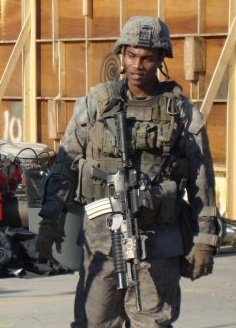
11858_1171807778919_1339760523_30438111_6270962_n.jpgIt was a great pleasure to speak with actor Cory Hardrict about his new film, “Battle: Los Angeles.” It is inspired in part by the real-life Battle for Los Angeles of 1942, just after the United States entered WWII. Hardrict, who has appeared in “Grand Torino” and “He’s Just Not That Into You,” is married to Tia Mowry of “Sister, Sister” and “The Game,” and they are expecting their first child this summer. We talked about going through “boot camp” to play a Marine and agreed that there isn’t much more fun than pretending to fighting aliens for a movie.
I want to begin by congratulating you on becoming a father!
Thank you so much. I look forward to being the best dad I can be.
How did you meet your wife? I am a huge fan.
We met about ten years ago on an independent film and we became best friends. She’s like a piece of me and she always supports me, very loving, very kind, a genuinely great person.
Was making this movie as much fun as it seems?
It was like a dream come true, being able to work on a movie of this magnitude. It was like a childhood dream! If you become an actor, you want to fight aliens, you want to do a war movie, you want to save the world! This is all of that combined in one. And it’s real — not just green screen, it’s like “Saving Private Ryan” meets “War of the Worlds,” “Independence Day,” and “District 9,” and “Black Hawk Town,” all in one big pot.
How do you make it work, fighting with something that isn’t really there?
We had targets to interact with. Jonathan Liebesman is an amazing director. Without giving too much away, it wasn’t like “That’s where you’re firing” — it was real. I’ve never been to war, but I can tell you that it felt like I was at a war.
That’s a big pretend — shooting at aliens — how do you get your head into that space?
Basically, it’s like fighting the unknown enemy, and you’re trying to protect the American soil by any means. No matter who you’re fighting with, there’s a sense of urgency, and a frightening experience as well. I put myself in that mode — that this could really happen. Putting all those variables into what we were shooting made the stakes higher. Just thinking about it — it really was frightening. A crazy cool experience.
You’re in the Marines in the movie — you can always tell a Marine by the way he moves. How did you learn to do that?
We had to go to boot came as soon as we got to Louisiana. The people who trained us were military advisers with drill sergeant experience. They were hands-on. We had three weeks of boot camp. It wasn’t like we staying in a hotel and went out there every day. All thirteen of us had to live in a tent we put up ourselves. We began each day at 5 am with a three-mile run. We got a crew cut. We fought as Marines, we slept as Marines, we lived as Marines. We were all one unit. They put us through the same treatment as Marine basic training going overseas. We were out there in the woods and it was very intense. That’s why I keep going back to saying how real it was. We slept outside in little tent-nets zipped up all around to stay away from mosquitoes, rats, raccoons, everything out there in the woods. There was water drippage every night. When people say, “How was that movie?” I say, “That was real.” I will never forget it. It was the hardest movie I’ve ever done but it was the most satisfying. It was blood, sweat, and tears out there. I wish all actors could have this experience.
I’m sure that helped you bond with the other actors.
They say you’re only as good as the last Marine in the unit. We all became close, we all became good friends, we all bonded for one common goal — to defend America to the best of our ability.
There was one scene where I had some interaction with Aaron Eckhart, assisting one another and saving each other’s lives. He’s all about the greatness of the project. He’s very method and puts his all into it. You just have to follow suit and that’s what we all did.
What movie inspired you to become an actor?
When I saw “Independence Day,” I said, “I want to be like Will Smith.” I want to do something like that. If he can do it, maybe one day I can come close to a set like that. To do a movie of this magnitude — and like “Independence Day” this is intense but emotionally driven by its characters — is a dream come true. If I wasn’t in this film, I would be there at midnight to see the first show! I love doing movies that touch people’s lives.

Related Tags:


Actors Behind the Scenes Interview

Interview: Topher Grace and Dan Fogler of ‘Take Me Home Tonight’

Posted on March 2, 2011 at 3:24 pm

Topher Grace (“That 70’s Show,” “”) and Dan Fogler (Tony award winner for “The 25th Annual Putnam County Spelling Bee”) co-star in the wild, raunchy, but sweet comedy “Take Me Home Tonight,” a loving tribute to the 80’s and 80’s music and movies. Grace plays a recent college graduate who is a little afraid to get on with his life until he runs into his high school crush (Teresa Palmer) and has one wild night risking everything to try to get her attention. Fogler plays his best friend and Anna Faris plays his twin sister. IMG_9274.JPG
This is like the movie John Cusack never made.
TG: That’s exactly what we wanted it to be. That’s a great review! It’s just as much genre travel as time travel. When we started the process, me and my friend said, “What happened to those John Hughes movies where you can do great comedy and great drama and work with great friends like Dan?” There are movies that are all raunchy now, and they’re great for what they are, or all romance. But we missed those movies from John Hughes and Cameron Crowe like “Fast Times at Ridgemont High” and “Say Anything” with actors that weren’t huge movie stars yet.
My producing partner pointed out that “Dazed and Confused” took place in the 70’s and was shot in the 90’s. “American Graffiti” took place in the early 60’s and was shot in the 70’s. I think 20 years are a revolution of time, where the 50’s are like the 70’s and the 60’s are like the 80’s.So if we made this now, we’d be the right distance from the time period. So we married those two themes together and began with the soundtrack.
It’s a great soundtrack! It does feel like a soundtrack with a movie attached — it has such a strong and evocative collection of songs.
DF: There’s a great song for every scene. I love the “Straight Outta Compton” one when we steal the car. I love the “You can Dance” getting into the dance-off.
TG: We wanted it to be like a musical, where the feeling of the character is so much they can’t just talk about it, they have to sing. We wanted the music to be so of what these characters are going through that the soundtrack had to come first.
What is it about 80’s movies that makes them special?
DF: Nostalgia. It was definitely a rabid cocaine-fueled peacock as far as decades go. So even if you weren’t growing up in that era, it’s still a fascinating time because everything is so in your face. I was born in 1976 so a lot of my formative years were in the 80’s and it was a total pleasure to go back and spend some time there again.
TG: We didn’t want to make fun of the time period. We wanted the movie to be about the characters and the decade but not to spoof it. It’s a hard decade not to make fun of. But we wanted it to be more like a time travel back to it. The real trick is that in movies like “American Graffiti” and “Dazed and Confused,” they deal with timeless issues and characters you want to watch, no matter when it takes place.
DF: It’s very relevant today, with economy issues and people getting out of college and not knowing what to do.
TG: I hope years from now, people won’t remember whether this movie came out in the 80’s or later on.
Your father in the movie is an 80’s icon, Michael Biehn of “The Terminator.”
TG: We wanted someone who was of the 80’s but not stuck in the 80’s. He is so talented and so great in the scene where he finds us in the car. And it is funny to think that in real life now we’re past the time when he was supposed to be living in the future.
I really enjoyed those moments that reminded me of details of the era I had forgotten, like Drexel Burnham, the powerhouse financial firm that collapsed after its most important trader, Mike Milken, went to jail).
TG: Yes, we had a couple of Mike Milken jokes in there but didn’t want to gild the lily, as they say.

What are your favorite 80’s movies?

DG: “Bachelor Party,” “Ferris Bueller” is probably my favorite, “Back to the Future,” “Breakfast Club”
TG: Our one wink to John Hughes is the name of the high school in the movie: Shermer. I liked “Fast Times at Ridgemont High” because not everything works out all right. They didn’t pull any punches. There’s stuff coming at you that’s dangerous and sexy and weird. And it has great characters.

Related Tags:


Actors Interview
Interview: George Nolfi of ‘The Adjustment Bureau’

Interview: George Nolfi of ‘The Adjustment Bureau’

Posted on March 2, 2011 at 8:00 am

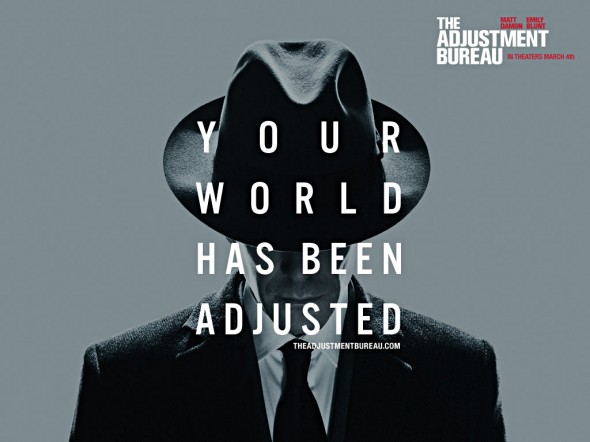
“The Adjustment Bureau” is the first great film of 2011, a big and hugely entertaining film that takes on big ideas — love, free will, destiny, God, and the meaning of life. I was lucky enough to speak with writer and first-time director George Nolfi about being inspired by a short story from Philip K. Dick.adjustment-bureau-poster-3.jpg
The movie is very different from “Adjustment Team,” the original story by Philip K. Dick. How did you approach adapting it for the screen?
The short story is just that, short. And it has a character at the center of it who is explicitly an everyman and so there isn’t much of a character to play there. It was going to need some adaptation one way or another. I was interested in a different thing than Philip K. Dick was. The story can be read from one angle was “Is this real or is this not real?” I wanted it to be — this thing happens and it spins the guy’s whole life on its head and all of his conceptions about the laws of physics and the universe are turned upside down. And he has to accept it because the evidence is just so overwhelming. What does that do to a person?
When my producing partner brought me the short story, I thought, what a great conception for a movie, the idea that fate is a group of people subtly pushing you back on plan. He also said, “You could do this as a love story. Your lead falls in love for the first time in his life and the adjuster comes along and says, ‘Sorry, there’s been a mistake. You weren’t even supposed to meet her.'” For whatever reason, my reaction to that was, “I think I know how to write that.” I didn’t know what I was going to put in the script but I thought the blending of genres would be fascinating and it would get me into territories of these much larger questions that every great system of thought — philosophical, literary, science-fiction, theological — this story would allow me to get there. There are not many stories that make big movies that take you to those questions.
It is unusual for a big-time movie with big-time movies stars to take on questions of life and fate and meaning and free will. I love the fact that it wasn’t focus-grouped away from engaging on those issues.
I optioned the rights and controlled them for six or seven years. I gave the script to Matt Damon and got some thoughts from him about his character. Neither of us thought his character was fully developed yet. I rewrote it to give his character more layers and more interesting things for him to play. And he said yes and we got it financed outside the studio system, from a group called MRC. When we then went to the studios we were able to say, “We have this movie and we have this movie star” and give them a fully-formed movie, so you don’t have this automatic development process where it’s nobody’s fault but things tend to get homogenized.
And Universal was really supportive, right from the beginning. They were on board with the notion of trying something that was really reaching. They were just like — let’s go for it. They thought people would leave the theater feeling satisfied even though we were blending genres. I had no interference while I was making the movie. In post-production they had just a few thoughts which in the Hollywood scheme of things would be considered minuscule. They had thoughts about the music but that was temp music anyway. I didn’t think the original ending worked and they agreed. So it was good people we were in business with and we were all pulling the same way. They were completely supportive of what we were trying to do, and so was Matt.
As a screenwriter, you’ve worked with directors but this is the first time you have directed. What did you learn from the directors you’ve observed?
I was on the set for all the movies I am credited on. And for “Oceans 12,” I knew I was basically going to be there the whole time. I said to Steven Soderbergh, “I’m interested in being director, are you cool with my occasionally ask you why you’re doing what you’re doing?” And he was extremely gracious to explain some of his thought processes about why he was choosing certain shots and so on. But the single biggest piece of advice he gave me that really stuck with me was, “In a perfect world you want to choose your shots and assemble to the movie so that the sound could go out and people could still follow the story.” That’s telling a story through pictures.
Clearly you listened to him! For a writer turned director, this is a very visual film. The effects are very significant and essential to the narrative.
As a writer making the leap to directing the first time, it was very important to me to make a film that was visually significant, to use visuals and music and sound as well as the performances of the cast to tell the story — those are the things you don’t have as a writer. I really wanted to do visual story-telling. I write scripts that are very visual but you can’t know until you try it whether it would come easily to me as a director, but I loved it.
I liked the idea that the Adjusters could do a lot of things but in a way the humans adjusted their options, too. They were nudging each other.
Thematically, I had this idea that the Chairman was limiting the Bureau in all kinds of different ways. That’s too many ripples so you have to go to a higher authority. Or you can’t go through that door unless you are wearing a hat. Or it’s raining out and water kind of blocks our ability. Those are foreshadowing the way that the Chairman will turn out to be supportive of free will.
And of love! It’s a very romantic movie.
I hope so! I hope you experienced it that way. I think it is.
And it is very spiritual, as well.
I wasn’t trying to make a religious film per se, but the most comprehensive attempts to make sense of the world are theological. In terms of fate and free will, that’s the oldest question human beings struggle with. It’s there in Gilgamesh and ancient Greece. Is it fate or do we have choices? There’s a reason for that. Human beings are questioning animals and we want to understand our existence.
Looked at in much less grand terms, most people have some sense that the person they turned out to be, the job they have, their moral code, their interests, their religion, were shaped by what country they were born in, what neighborhood they were born into, their family, their friends, their schools, their chance encounters have put them on a path. Even things considered more deeply personal choices like who your spouse is — you were introduced by friends or met at a wedding or you had mutual interests or whatever it is. So we have this sense that the course of our life is shaped by outside forces, whether a divine hand or your surrounding influences. But we also experience our lives as a series of choices. No religion has successfully answered that. We did an inter-faith screening with an audience of followers of Christianity, Judaism, and Islam, and we had a discussion with experts in all all three. They discussed faith and free will and pointed out to the audience that the importance of free will was found in all of them. They have to, in order to make sense of existence.

Related Tags:


Behind the Scenes Directors Interview Science-Fiction Spiritual films Writers
THE MOVIE MOM® is a registered trademark of Nell Minow. Use of the mark without express consent from Nell Minow constitutes trademark infringement and unfair competition in violation of federal and state laws. All material © Nell Minow 1995-2026, all rights reserved, and no use or republication is permitted without explicit permission. This site hosts Nell Minow’s Movie Mom® archive, with material that originally appeared on Yahoo! Movies, Beliefnet, and other sources. Much of her new material can be found at Rogerebert.com, Huffington Post, and WheretoWatch. Her books include The Movie Mom’s Guide to Family Movies and 101 Must-See Movie Moments, and she can be heard each week on radio stations across the country.

Website Designed by Max LaZebnik