Interview: Former Congressman Bob Ney of ‘Casino Jack’

Posted on May 5, 2010 at 1:57 pm

Bob Ney was a powerful Congressman (R-Ohio) brought down — and sent to jail — by the Jack Abramoff lobbying scandal. He is featured in “Casino Jack,” the new documentary about what happened. He now has a daily show on talk radio. He spoke to me about his decision to cooperate with the film and what he has learned.
Was this a chance for you to tell your side? Is that why you agreed to participate?
At first, I said I wasn’t going to do it. When I got out of what I call the Bush Housing Program, the federal prison at Morgantown, I had a lot of offers to do different shows and said no to them all, including this. And then I looked at Alex Gibney’s work, the Enron movie and “Taxi to the Dark Side.” I had lived in Iran and in Saudi Arabia and it’s a painful story, but it needed to be told. I met Zena Barakat and agreed to do the IFC story she wanted me to do. She told me Neil Votlz was going to do this film and that it was going to be more than the story of Abramoff, about what’s going on now, where does this lead. So, I think it’s a way for me to give back and second it’s a way of healing for myself and third, hopefully something will come out of it to make some changes.
What kind of change would make a difference? Public financing of elections? Is that the only way to keep the corrupting influence of political contributions out of government?
I didn’t before I resigned from Congress, and I chaired House Administration and oversaw election law. I thought we just needed full transparency. Then we get caught up in the waylay of “if you don’t go to Scotland,” “if you don’t eat at Jack’s restaurant,” the problem is solved. The swamp is drained. But the swamp was drained and re-filled. There’s a lot of good people on the Hill in both parties and I’ve been treated better than I deserve to be. But a lot hasn’t changed. Maybe on the surface it has changed. Maybe nobody’s been indicted. But that doesn’t mean the system has changed. There are still quotas, money from the leaders, more money than ever, and John McCain’s reforms made no difference. It leads me to the thought that there’s got to be something better. We can take care of the ethics, but the money flow is different, and I would now lean toward some type of public financing.
What are you proudest of from your time in Congress?
The help America Vote Act with Stenny Hoyer made it easier to vote and harder to cheat. Some of the housing initiatives I worked on with Maxine Waters, I’m proudest of that. And we tried to make the Capital a better place to be. We tried to make it safe and secure, a better working environment, following 9/11 and the anthrax, secure and safe but still usable.
Tell me about Jack Abramoff and what his motivations were, his judgment.
I think he was very idealistic. He got waylaid somewhere along the line as can happen to anyone. He had a chameleon-like appeal. He was the kind of guy where you had to watch what you had to say in front of him, an Orthodox Jew, so you wouldn’t suspect he would go too far with things. I think he believes some of the things were very justified, people tend to do that. “I’m doing this and that on the Hill, very important things, so certain things are okay.” In his mind I’m not sure that to this day he might not believe he did many things wrong.
That was a shocker. The fact of his religious nature, what he had in his heart, with his faith, he was always involved with some kind of charity. When I saw some of the emails, I thought, “Oh, my God,” that was a shocker.
People might think that a political contribution can make a representative change a vote, but that isn’t the way it works, is it?
In this business, whether it’s Jack Abramoff or the people currently on the Hill, it’s a buying of access. Is there a buying of a vote? There was not one time when Neil or Jack and I exchanged a “I’ll do that and you do this.” If there was, I would have been charged with bribery. That’s when you have $90,000 cash in your freezer. I’m not saying what I did was right. But he didn’t buy my vote with a dinner. There’s a buying of access, though. It goes in multiples. Leaders of both parties give money to members. They’ll say, “You’re really causing a lot of heartburn for us. Those guys have been good to us, help us out.” And you think, “I want to be a committee chairman.” I’ve got to get re-elected. He could help me raise $100,000. If you don’t go along, you might not get that help or they could give it to your opponent. Lobbyists don’t buy votes, but they buy access.
One of the most troubling parts of the movie is when you put statements into the Congressional record in support of SunCruz and critical of its original owner, Gus Boulis, at the request of Abramoff partner Michael Scanlon, onetime communications director for Congressman Tom Delay. It was a favor to someone who gave you a $10,000 contribution.
Neil and I talked, and Scanlon came to Neil. Though Jack badmouthed Scanlon all the time. I didn’t think they were even friends. We had no idea how entangled they were. They wanted something in the Congressional Record. We read it. So what? We put it in there. The Attorney General of Florida bad-mouthed Boulis. So we put it in there. We put it in again when Boulis stepped out.
I had no idea that Abramoff was using that to try to leverage something. I don’t think Neil did either. I trusted him. But we were dumb enough to do it twice. This is the biggest criticism I have of myself. I should have said, “What the hell is going on? Something doesn’t smell right. Something doesn’t feel right.” And then we read Boulis had been shot and killed. I was furious! Neil was furious. What are we into?
What can we do about the corrupting effect of money in politics?
A corporation is not a citizen. The Citizens United decision went too far. But I never liked the John McCain approach, come on. But McCain was touchy about his Keating problem and was going to clean the system up. If he had that problem today I’d have been keeping my bunk at Morgantown warm for him. Citizens United could be an opportunity for the Hill to make some changes but maybe not. They might close a loophole, but they have to keep their campaigns going.
Who are the most significant sources of money in politics?
Financial services is a very powerful group. I’ll give Pharma credit. When they buy access they buy it lock, stock, and barrel. Congress, the Senate, the White House, Republican, Democrat, rich, poor. They get to them all.

Related Tags:


Interview

Interview: Rich Christiano of ‘The Secrets of Jonathan Sperry’

Posted on May 4, 2010 at 1:59 pm

I spoke to writer-director Rich Christiano about making — and marketing — faith-based films.
You were really a one-man show behind the scenes for this film.
We have a good production team and worked hard on the distribution. This the third film we’ve put out theatrically. We learned a lot doing it. It played over 300 screens. We lot local churches to sponsor the movie in their cities. The churches that put forth the effort did well. We also worked with Christian radio. In Dayton, Ohio we ran 22 weeks because the radio station got the word out. In another city there was a pastor who really got behind the film and we did really well there. Promotion is the hardest part of it. We made sure we had local groups pushing the movie.
Is there a big audience for faith-based films?
The inspirational films have a lot of upside. One-third of this country goes to church each week and that’s our marketplace. And they’re an under-served audience. If everyone who goes to church would see our movie, we’d have “Avatar” numbers. Our society has changed over the last 20 years. If I’d told you back then there would be a weather channel, you would not have believed it. The Christian consumer group is now becoming more and more a player. They audience wants to watch these films; they just need to know they are there.
What do you hear about the way audiences respond to this film?
We’ve had wonderful reactions. There’s an emphasis to read the Gospel of John in the film. I heard from a lady who said her eight-year-old came home from the movie and read the Gospel of John. Then he wanted to go to Bible study like the boys in the movie. Another woman said her husband had drifted from the Lord. But when he came home he said three words that really lifted her spirit: “Where’s my Bible?” A 60-year-old lady told me her sister was visiting from Scotland and that she’d never, ever seen her cry until she saw this film. One of our sponsors in Fort Worth, Texas took his daughter to the film. When she saw a character change in the film, she told her father she wanted to show that she had been changed. There’s a strong message of forgiveness in this film. We’ve shown it in prison. Several of the prisoners wrote me a letter.
What can a movie convey better than a book or a sermon?
The church needs to recognize how powerful the audio-visual really is. I spoke to a man who was a church-goer and asked him if he could remember what his pastor preached a month ago. He couldn’t. I asked him if he could tell me about “The Wizard of Oz.” Even though he had not seen it for 15 years, he could remember all of the details.
Movies manipulate us, affect us, influence us. Most movies influence people away from the Lord. I want to use them to influence people for the Lord. There’s a spiritual battle going on and the Message of Christ is always being snuffed out. Movies are an entertainment medium, but every movie is religious because every movie has standards, every movie has a message about those standards. We’re trying to put forth films that are entertaining but put forth a message for the Lord, to inspire, to challenge thinking, to provoke spiritually, to make people think about eternity.
It was nice to see the film set in 1970 because that lends it a simplicity that suits its themes.
There’s no cell phones, no text messaging, no X-Box. I showed opening credits over pictures like old-school film-making. It’s like Mayberry with Bible study. It’s a throwback. It’s not edgy. It’s simply shot, no visual effects. It’s story-driven. It’s not an action film. It’s got laughs. And it’s got heart.

Related Tags:


Directors Interview Spiritual films
Interview: Derrick Borte of ‘The Joneses’

Interview: Derrick Borte of ‘The Joneses’

Posted on April 17, 2010 at 2:55 pm

Derrick Borte, an artist-turned journalist turned producer/director of commercials, was watching a television news magazine one night when a segment about “stealth marketing” came on the air. We channel-surf during ads on television and use pop-up blockers to avoid ads online. So now some companies are going back to in-person selling, but with a twist — the customer does not know that the tourist showing off a new camera or the pretty girl asking for a particular brand of vodka in the bar are being paid to do so. And this gave him an idea for a script, and that became The Joneses, a provocative debut film about a marketing division disguised as a family — mother, father, and two teens — who move into a wealthy community to make everyone envy their consumer goods enough to buy them.
I spoke to Mr. Borte at the AFI Silver Theater just before a screening of the film and Q&A session with the audience.
Did you ever buy something because someone cool had one?
Absolutely! It started when I was about seven years old, my first pair of Puma Clyde tennis shoes. Somebody wore them to school and I wanted them. So I am definitely not immune to this phenomenon.
Your story is not far from what is really happening. I wrote an article about companies that use middle schooler slumber parties to sell products to girls.
It’s also companies that give purses to an actress so she can be photographed with it. Or developers that have furnished model homes. They hire out-of-work actors to pretend that they were living on the houses and they sell better. It’s definitely an ever-evolving thing. As long as there are products, there will be money spent on trying to sell them.
The products in this movie are real, right?
For the most part. There is not yet a phone with the video feature we show in the film but we figured as we were shooting that by the time it came out, there might be. I wanted real products because fake products would take it into a cartoon world. I wanted a disarming naturalism. I wanted to feel like it could be happening in your neighborhood. But in certain places we couldn’t use real products because of what happens to them. Some companies saw this as celebrating consumerism and were glad to be included. Some saw it as an indictment. But many companies with high-end products were very happy to participate. It gives it great production value.
What surprised you about making your first feature film?
It wasn’t as intimidating as I thought it would be. I thought I would throw up in my trailer the first morning! But I had already spent so much time with the actors and prepping the crew that it was just another day at work. It was fun and exciting, but there weren’t any training wheels.
What did your preparation include?
It started with the producers. Kristi Zea is a legendary production designer, and Doug Mankoff. I was not very precious with the material. I wanted it to evolve and grow so I was open to listening to them. And the actors — we didn’t pay them a lot because it was not a big-budget film. They all wanted to be a part of this film and they were all generous in terms of coming to work with ideas. Before production people kept telling me, “You have to hold on tight to your vision because people will try to knock you off your game as a first-time director.” But I thought that was ridiculous. If you hold on to that vision you could hit that mark or fall short. But if you foster an environment of collaboration you can listen to other people’s ideas. You may not use all of them but be open to them and to allowing the process to help discover the characters and story. That’s the only way to get something that goes beyond your vision.
The top-liners are responsible but what a deep cast — I was so fortunate with Gary Cole and Glenn Headley, and Amber Heard. Sometimes they would have an idea that would spark another idea for us. Because I wrote it if I found something I liked better I could go with it, rewriting on the set or in a lot of late nights.
Why do people want to be cool and especially be cool by owning stuff or looking a particular way?
It can be a disease — affluenza — wanting to have what other people have because of the perceived effect it has on them. I don’t think anyone is immune to that. There’s no way to predict it; it just happens. I read Malcolm Gladwell’s The Tipping Point, great book. I wish I knew the secret of what makes things cool!
What movies inspired you?
Everything from the spaghetti westerns to the John Hughes films, the Plant of the Apes films, the David Fincher, Tarantino, the Coen Brothers. I’ve always loved film but everything I’ve done has led to this point.
What does that include?
I started off in college at Old Dominion studying fine arts but paying my way doing graphic design, t-shits and things like that. I was probably the first person to learn to use PhotoShop. I graduated with a degree in fine arts and went to LA where I was represented by a gallery. But when the bottom dropped out of the art market, I went back to get a Masters in Media Studies at the New School. It seemed like a logical progression. I was a production assistant and then after I graduated got an offer to be an on-camera reporter for an NBC affiliate. It was great training in guerrilla film-making. I had no budget but I had six or seven hours to come up with a story for that night. When I started my production company I knew I wanted to do features, but I knew I would not get a chance unless I wrote my own script. I turned down much more money for the script for the chance to direct it myself.
Were there other influences on your concept for the movie?
I was fascinated with reality TV. A lot of it is stranger than any fiction. I can’t imagine a prime-time sitcom that would be as captivating and bizarre as “Jersey Shore.” And they become celebrities and have endorsement deals.
I thought this forced intimacy that happens when you throw strangers into a house would be great to combine with the stealth marketing. When you’re going to do something with stealth marketing you have to decide — are you going to go broad comedy, are you going to do a thriller? I thought that would be an interesting angle. It it was just the stealth marketing, where would you go after the first 15 minutes? So I wanted to explore the fake family dynamic. Hopefully, the personal stories are enough to carry people through.
What’s next?
A movie based on a novel called “The Zero.” We’re waiting for the first draft of the book adaptation and we hope to be going to work in the fall. I love doing features. In my everyday life I am so attention-deficit but on the set time slows down and I’m very calm. I love being on the set working.

Related Tags:


Directors Interview Writers

Interview: Dr. Rick Hodes of ‘Making the Crooked Straight’

Posted on April 13, 2010 at 3:59 pm

makingcrookedstraight7.JPG

Dr. Rick Hodes is an Orthodox Jew who has devoted his life to “tikkun olam,” “healing the world. His motto is the Talmud’s statement that “He who saves one life, it is considered as if he saved an entire world.” Dr. Hodes has spent most of his professional life working with the poor and sick in Ethiopia, treating hundreds of patients and taking seventeen children into his own home to raise them as his family. His salary is paid by the American Joint Jewish Distribution Committee, and he raises the money for his patients. A new 30-minute documentary about the doctor, his work, and the children will be shown on HBO. The director is Susan Cohen Rockefeller.

I spoke to Dr. Hodes by phone as he was preparing to fly back to the US from Ethiopia.

How did you come to Ethiopia?

I came first in 1984 because of the famine. I came as a relief worker. I was a resident at Johns Hopkins and I took five or six weeks off and worked in the famine camps. For a while I was the only doctor for several thousand starving people.

What surprised you about Ethiopia?

The depth of the culture, the depth of the ancient Christianity, how people in Ethiopia really know who they are. They don’t think of themselves as black. They don’t think of themselves as African. They really think of themselves as Ethiopian. Even their Christianity is very much involved with their Ethiopian identity. If you go to a Christian ceremony, it will be very Ethiopian as well, with the colors and flags. Ethiopians know who they are. They really like their culture. They have their own religion, their own food, their own system. If they’re not in Ethiopia and find someone else from Ethiopia, they feel very close to them, especially if they are from the same region.

I have heard that in Ethiopia everyone carries the children around, that everyone takes care of the children as though they belong to the whole community.

They carry the children on their backs, there’s a lot of physical contact, child abuse is much less here. The rate of psychological problems from lack of care seems to be lower.

As an outsider, was it difficult for you to gain their trust?

Once you start doing good things, they start coming to you. They will ask if I can help them, teach them, do something with them. And learning the language.

What led you to take over responsibility for the children?

Bewoket had run away from home because he was dying. And he ended up in the university hospital. They discharged him to a Catholic mission. I was volunteering there. He was very attached to me. And he was in such difficult shape it was actually easier to have him in my house, where I could care for him. Once I took in one, I met another one, and so on. I try to say that this is finished, but it’s not finished.

Do the kids get along with each other?

Any two people under the same roof will not always agree, but they do well.

What do you do for fun?

They play board games. The healthier ones play soccer. The less healthy ones play Monopoly and card games. It’s funny, three years ago they had not seen a car or a white person and now what gets them most excited is buying a hotel on Boardwalk.

Do they want to become doctors?

A lot of them do. One boy was dying in Gojam and his dad sold two goats to get him $30 to come to the big city. They came to Addis Abeba,, and they spent 20 cents a night to sleep on the floor of the hotel with 20 people. They had no money for the bus so they had to walk six or seven miles to get to me. I reached into my pocket and gave him $10 and I said, “Here, every time you come I will give you more, so spend this. Eat two or three meals a day, sleep in a bed, take the bus, take care of yourself.” And that is when he started getting better.

And now this boy, who had been in a remote school studying to be an Orthodox priest is in eighth grade, speaks fluent English, and wants to be a doctor. When he came to America he told his life story at a fund-raiser and we raised $1 million. There’s another girl who was an orphan, living in a medical college because she had nowhere else to go. I ended up bringing her to Addis Abeba, treating her TB, sending her for surgery, and now she is in 6th grade and wants to be a doctor. When I first met her she said she wanted to be a housemaid because then she would have a place to live and cook. Now she’s living in my house, she speaks English. For $10-12 thousand we’ve completely transformed her life.

What do Americans need to know about Ethiopia?

The depth of the culture and the niceness of the people. It is a poor country, but it is a proud country with a deep culture, a history, definitely not uncivilized.

How does your Jewish faith inspire and sustain you?

I really enjoy being Jewish. I pray three times a day and keep the Sabbath to the extent that a doctor with patients can do that. We just had a big Passover seder. It is an important part of my life, the daily schedule, the weekly schedule, the monthly schedule. It becomes all-encompassing. But one of the nice things about being in Ethiopia is that I feel very welcome here. I respect other religions. Most of the kids are Orthodox Catholic, Protestant, or Muslim.

What I’m personally trying to do is making the world a better place for a few people, helping as many people as I can in that sense. I’m sending 16 kids in May to Ghana for surgery. That’s the greatest thing in the world for me.

Photo credit: Photograph by J. Kyle Keener/HBO

Related Tags:


Documentary Interview Television
Storytime Live! —  Interview with Director Sam Scalimoni

Storytime Live! — Interview with Director Sam Scalimoni

Posted on April 12, 2010 at 3:44 pm

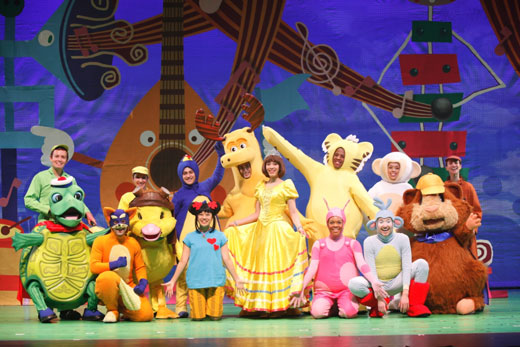
KaiLanStorytime0624.jpgSam Scalimoni is the director of Nickeoldeon’s new traveling “Storytime Live” show, starring its most popular characters, including Dora and Diego, the Backyardigans, the Wonder Pets, Kai-Lan, and more.
What is it like to create a show for the most enthusiastic audience in the world, pre-schoolers and their families?
We thought we knew what we were in store for, but we really didn’t know until we saw it in front of an audience. Last week we were at Radio City Music Hall and to see 6000 families come in and just cheer for all the characters — the young performers that we have definitely felt like rock stars.
How do you hold their attention? They’re a very squirmy bunch and very excited!
The great thing about our show as opposed to those in the past is that we have four different stories. So it’s like four mini-musicals of about 15 minutes long. And between them we have Moose and Zee from Nick, Jr. coming out and play puzzles with the audience and help them guess what’s coming up next. So they’re constantly being engaged and entertained with something new happening all the time, and being led through it, entertained and educated at the same time.
They’ve taken four of the most popular character groups from the Nickelodeon stories. And they’re very fun and clever and fast-moving and they never talk down to them. We like to think of our show as the first theatrical experience for young people. We have some very clever writing and parents have as good a time as the young people.CastStorytime0581-7.jpg
I approach this like any other project. It is about story-telling and it’s about clarity. We kept the focus on making it clear to anyone, not just young people. We use our paint-brushes, the costumes, the scenery, even the lighting to show you what’s happening next and where your focus should be. And I find young people have a better sense of reality than adults. They know the theater is a pretend kind of place. We have some fantasy — a dragon, a witch who flies, a monkey king who flies, a dragon that turns into a prince — we have those kind of thing but they are done in a theatrical way and the young people are right there with you.
You mentioned the costume design — what were some of the challenges?
The costume design is challenging because the characters are so well known and the kids want them to look familiar. But the actors are human and we did not want them to have big cartoon-y heads. And we wanted them to be comfortable and be able to do all of the movement they needed to do. So we were working with five different creative teams from Nickelodeon to get the essence of the character — real people and monkeys and puppetry — and make sure it was practical for what we wanted to do on stage.
We had very specific requirements. It very much reflects our audience, a lot of ethnic diversity, people who were tumblers, who could do the flying and all of that. But most important was we needed people who could be themselves, very honest performers, none of that phony kind of acting as opposed to really being a person so the young kids could connect to them.
Is there a moment that really gets a big reaction from the crowd at every performance?
When the monkey king flies from nowhere, he just appears, and it is very exciting. And Dora makes a magical transition into a princess and it always gets a big “Oooo.” And our finale is so exciting because it’s the first time Nickelodoen has let us mix the characters from all the shows, to see them all together in a really exciting dance number, the kids are all dancing in the aisles.
The Touring Schedule — Dates and Locations:

(more…)

Related Tags:


Behind the Scenes Directors Interview Preschoolers Television
THE MOVIE MOM® is a registered trademark of Nell Minow. Use of the mark without express consent from Nell Minow constitutes trademark infringement and unfair competition in violation of federal and state laws. All material © Nell Minow 1995-2026, all rights reserved, and no use or republication is permitted without explicit permission. This site hosts Nell Minow’s Movie Mom® archive, with material that originally appeared on Yahoo! Movies, Beliefnet, and other sources. Much of her new material can be found at Rogerebert.com, Huffington Post, and WheretoWatch. Her books include The Movie Mom’s Guide to Family Movies and 101 Must-See Movie Moments, and she can be heard each week on radio stations across the country.

Website Designed by Max LaZebnik