
Interview: Pete Docter of ‘Up’

Posted on May 26, 2009 at 3:55 pm

The first thing I saw when I walked into the room was — of course — a bunch of beautiful helium balloons. And then I saw Pete Docter, the lanky and affable director of Pixar’s new film, “Up,” about an extraordinary journey to South America in a house lifted into the sky by an enormous bunch of balloons.

What makes a good voice actor for an animated film?

Some actors can create a picture of what is happening with their voice. Some actors works a lot with their bodies and facial expressions. You have to unplug the video part and listen to the voice. For Carl we wanted a voice that was grouchy and curmudgeonly, a voice that suggests that nothing is quite as good as it used to be, but a voice that is still very appealing and funny and Ed Asner fit that bill. You can tell he deeply cares about the peoople he is insulting. For Russell Joe Grant taught me to ask, “What are you giving the audience to take home?” You have to have some relatable emotion as a foundation for the fun stuff. You need the sad beginning so that you care about Carl and want what he wants.

What movies did you love as a kid?

I loved “Dumbo.” I watched Bugs Bunny time and again. The Muppets were big, too. All of those, they have this real, not darkness but poignancy, that’s what makes it stick with you. We tried for that in this film. When we were about halfway done we showed it to an audience, and the highest group of positives was women age 12-25 because they connected to the story.

Did you draw inspiration from real-life locations for some of the stunning images in this film?

Yes, we studied the Tabletop Mountains called tepui, with all these weird rock shapes. You start to see figures in the mist. There are strange plants you dont see anywhere else. It is where Venezuela meets Brazil and Guyana. “The Lost World” was inspired by this one mountain we studied. Most of them have never been set foot on. The more we can base on real life, the more you will believe the stuff we make up. The bird in the film was based on a crane and a monal pheasant, the most iridescent creature there is.

Every animated movie director tells me there was one technical challenge that was especially difficult. What was yours?

Balloons! The maximum our system could only handle was 500 and we had to expand to ten thousands. Not only does each balloon “know” where the others are, each one can respond to wind, turbulence, and each of the other balloons. And we could not have thousand strings. The whole things is so preposterous we had to find little elements that anchor it and make it more believable but also poetic.

What were some of the decisions you made about the film that were different because it was being made in 3D?

We did a bunch of reseasrch what makes successful 3D. We did not want the “Whoa! 3D” effects that take you out of the movie; we wanted them coming out of the story. 3D allows us to play with the depth the way we use color and lighting. When Carl is cut off and closed, we made it claustrophobic and slow. When he triumphs we make it as spacious as we can.

I don’t know the exact quote, but there is this thing that Walt Disney said, something like, “We’re not making these movies for kids, we’re not making them for adults; we’re making them for that still quiet part the world has made you forget but that our films can make you remember.”

Related Tags:


3D Animation Interview
Book: History of Independent Cinema

Book: History of Independent Cinema

Posted on May 25, 2009 at 3:58 pm

Many thanks to Phil Hall for taking the time to be interviewed about his new book, The History of Independent Cinema.

How do you define independent cinema?

I see independent films as productions that are financed and created outside of the Hollywood studio system.

Who were some of the earliest pioneers?

You would need to go back to the silent era. Carl Laemmle and Adolph Zukor challenged the attempt by Thomas A. Edison to create a monopoly on film production and distribution. Those two men literally kicked down the door to enable independent filmmaking to flourish. D.W. Griffith’s “The Birth of a Nation” may be a morally reprehensible film, but it was the first independently produced film to elevate a cinematic release to the level of national conversation. L. Frank Baum, the author of “The Wizard of Oz,” is responsible for the first film franchise, circa 1914 with a brief series of Oz-related films. Lee DeForest and Theodore Case were the leaders in bringing sound to film, while Herbert Kalmus and his partners at the Technicolor Corporation helped to expand the cinematic palette beyond black and white.

Where do independent films get financing?

Traditionally, from private investors. Some filmmakers have self-financed their work, which is easier to do today since the costs of equipment is not very expensive.

What have been some of the innovations in independent film-making that have been adopted by studio films?

For starters, the first film made in Hollywood was an independently financed production – Cecil B. DeMille’s 1913 “The Squaw Man.” The concept of the movie star was invented by Carl Laemmle, who also cooked up the first movie publicity stunt (the rumor that his first star, Florence Lawrence, was killed in a streetcar accident).

As previously mentioned, the use of color and sound in filmmaking and the film franchise originated with independent producers. The use of three-dimensional cinematography, widescreen projection, and video in place of 35mm film stock were all independent creations.

Which independent directors have become mainstream? Which independent actors?

There is a list in the book that I call the indie-to-Hollywood train, and its passengers have included Francis Ford Coppola, Martin Scorsese, John Waters, Ralph Bakshi, George Lucas, Terrence Malick, Tobe Hooper, John Carpenter, Joan Micklin Silver, David Lynch, Joe Dante, Susan Seidelman, Joel and Ethan Coen, Gus Van Sant, Spike Lee, Steven Soderbergh, Richard Linklater, Quentin Tarantino, Kevin Smith, Robert Rodriguez, Edward Burns and Darren Aronofsky.

As for actors, Jack Nicholson is arguably the most prominent – rising from Roger Corman’s no-budget flicks to winning three Academy Awards.

Related Tags:


Books Interview
Parking Lot Rules — Parenting Book from Tom Sturges

Parking Lot Rules — Parenting Book from Tom Sturges

Posted on May 20, 2009 at 3:58 pm

Tom Sturges is the author of Parking Lot Rules & 75 Other Ideas for Raising Amazing Children. It is one of the most insightful and useful parenting books I have ever seen and I recommend it highly. I guarantee that even the most functional families will find some good new ideas to improve interaction not just between parents and children but in all relationships.
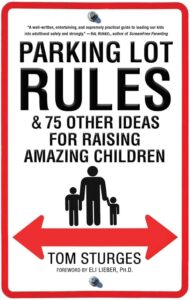
Sturges has a day job as executive vice president and head of creative affairs for Universal Music Publishing Group, the world’s largest music publisher, and he says it is a “fascinating and interesting job surrounded by remarkable people.” He is also the son of one of the most brilliant writer-directors in film history, Preston Sturges (of “The Lady Eve,” “The Miracle of Morgan’s Creek,” “Palm Beach Story,” “The Great McGinty,” and “Sullivan’s Travels”). But his father died when he was only two, so Sturges had to become the father he wished he had had. I had a wonderful time talking with him about raising children and the lessons he has learned and shares in this book.

When your first son was born, how did you think about the father you wanted to be and the impact it would have on you?

Being a good dad became almost a religion to me. I wanted to be the greatest dad ever, and the only people who could say whether or not I was successful would be my own sons. Along the way I discovered that there were many mistakes I was making or that I saw other parents making and I began to write them down, and that became the book.

My father died very early. He was 58 when I was born and 60 when he died. If I could make sure my children never experienced what I experienced it helped me recover the goodness of my own childhood, it heals you. When my child was the age I was when my father died, I had the date circled in red in the calendar because it was a milestone, passing that day was something I did for him and he did for me. Anything that was painful for you as a child, let’s say there was a day you got chased off the schoolyard or kicked off the cheerleading squad, you can recover that day with your child. You can heal yourself by breaking the chain.

What commitments do you make to your sons?

Children take the mortgage for granted, they take the material things for granted; the important thing is to build a relationship of trust with them. They learn to trust because they realize that you do what you say you will do. So I make Life Promises, and keep them. No hitting, no raised voices, no embarrassing them. This last one is the rule that gets used more than any other.

My son Sam is very sensitive to what the world thinks. After we’ve been playing basketball, when I pull off my t-shirt to change, he says, “Dad! Dad! You’re breaking the No Embarrassing rule!” He gets to say that, and I earn his trust by respecting that he gets to say it. When I do, it is another pebble of trust, and I hope all those little pebbles will build themselves into beautiful bridges of trust.

My favorite of your rules is “smile when you see them.”

That is such an important one! Your children will see a smile on your face and it will give them hope.  It is an easy one to forget because we get so caught up with telling them what we think they need to know.

Parents can make a difference just by making sure the child feels welcome before we launch into telling them what to do. Never be too correcting with your child after a sporting event. It’s just “You tried hard” and “I appreciate it.” We can talk about helping you with your hitting tomorrow. I recently returned from Hawaii and saw a mother scolding her child all the way down the aisle of the airplane. She could not see the look on his face, but I could. We have to remember what it feels like to have a big person, who might weigh twice what you do, yelling at you in front of strangers.

And it’s the person whose good opinion you most need.

The currency of parental discipline is disappointment. Your disapproval is so important and powerful that when you are correcting a child you must always whisper. It really works for me. I was upset with my 11 year old yesterday because he lost an important basketball game and did not practice his free throws afterward. I whispered to him, “We could be working harder.” You have to loft them into the sky like a glider, boost them when they fall.

What mistake parents make concerns you the most?

Forgetting the importance of respect. So many of the rules in the book are just about ways to show the child respect. “Yes not what,” for example – simply changing your response to begin with “yes!” instead of “what?” makes a big difference. Never yelling is a sign of respect, too.

That teaches them how to behave respectfully to other people.

Exactly! I donate a lot of time to a program for inner city children. I was speaking to them on Saturday and I said “The key to a good and successful life is to simply always show the most respect.”

And what are you working on next?

We have a new son, whose middle name, Sullivan, is a tribute to my father. Fifty years from now, he will help keep that legacy alive. And I am working on a sequel to Parking Lot Rules, about raising amazing adolescents.

Related Tags:


Books Interview Parenting
Interview: Jason Dolley of ‘Cory in the House’ and ‘Hatching Pete’

Interview: Jason Dolley of ‘Cory in the House’ and ‘Hatching Pete’

Posted on May 18, 2009 at 3:58 pm

Jason Dolley of the Disney Channel’s popular series Cory in the House stars in Hatching Pete, now out on DVD with another family-friendly feature, “Dadnapped.” He found time to talk to me between finals in his college classes, and I really enjoyed our conversation, especially his frank and sincere discussion of his faith and his description of what it was like to play the guy inside the chicken suit.

Where are you from originally?

I grew up in Southern California, Simi Valley. I’ve lived in the same house all my life. I have two older brothers who have moved away, but I still live with my mom and dad. I graduated from high school early and now I am going to college at Moorpark community college, 15 minutes away from the house.

Tell me about “Hatching Pete!”

It has me and Michael Musso and the basic story is best friends. He is normally the school mascot and he asks my character to sub in for him one night. Pete is very shy but he blossoms in the chicken suit. They don’t tell anyone it’s him, so that’s where it gets complicated.

Is it difficult to act in a chicken mascot costume?

It is tough! Even before filming began we went to mascot boot camp. The San Diego chicken from the Padres gave us “how to be a chicken” lessons. I had a lot of fun with it and that was good because my character was supposed to have fun. It was stuffier than anything, but well worth it. I had a blast! There are things you don’t think about — you have to make your movements really big because it is all in the body language. Small movements normally people would make, you had to blow it up. I did not do everything. I’m not really athletic. We had four chickens not including Mitchell, a dance chicken to do the dance routines and Ted the pro chicken would do some of the game stuff.

And how did you get started as an actor?

My first job was an AFI short film, “Chasing Daylight,” when I was 11 and I made a couple of commercials that never aired. For me, the acting bug got started when we would play dress-up. It didn’t have to be Halloween. We’d get dressed up and we’d become the people whose costumes we wore.

What was your favorite Halloween costume?

I was Darth Vadar three years in a row!

Did you study acting?

I started taking classes when I got an agent. But I learned from the best when I did a series called “Sweet Savages” where I played the youngest boy. Mel Gibson was the director, he was hilarious and kept throwing in little things for us to do. I learned a lot.

What makes you laugh?

One of my favorite comedies is Three Amigos!. Oh my gosh, me and my brother quote that all the time. Two of my favorites are Abbott and Costello, we did the “Who’s on First” routine for our school talent show and that was the first blossoming of my acting stuff.

What actors really inspire you?

Robert Redford and Paul Newman — I love seeing them in “Butch Cassidy and the Sundance Kid” and “The Sting.”

What role does your faith play in your life?

I think faith helps me a lot. God wants you to be where He wants you to be, and that’s where I want to be. If I do not get a part, I understand that maybe I needed to be home at that time, maybe in school, there’s always a reason. My faith is also where my core friends are, at my church, a faith-based friendship. It is a major thing.

Related Tags:


Actors Elementary School Interview

‘Night at the Museum 2’ Press Conference, Part 1

Posted on May 16, 2009 at 11:22 am

Yesterday, I attended a press conference at the historic Smithsonian Castle and had the immeasurable and almost-surreal pleasure of sitting opposite Ben Stiller, Amy Adams, Robin Williams, Owen Wilson, Ricky Gervais, director Shawn Levy, and screenwriters Robert Ben Garant and Thomas Lennon, who were in Washington DC to talk about the sequel to the unexpected blockbuster “Night at the Museum.” This one is set in the world’s biggest (and in my biased opinion, best) museum complex, the Smithsonian Institution. I will be posting more shortly, but as a starter, here’s a short clip with Amy Adams talking about her role as Amelia Earhart and Levy talking about what he wants children and their families to learn from the film.

Related Tags:


Actors Behind the Scenes Interview Trailers, Previews, and Clips
THE MOVIE MOM® is a registered trademark of Nell Minow. Use of the mark without express consent from Nell Minow constitutes trademark infringement and unfair competition in violation of federal and state laws. All material © Nell Minow 1995-2026, all rights reserved, and no use or republication is permitted without explicit permission. This site hosts Nell Minow’s Movie Mom® archive, with material that originally appeared on Yahoo! Movies, Beliefnet, and other sources. Much of her new material can be found at Rogerebert.com, Huffington Post, and WheretoWatch. Her books include The Movie Mom’s Guide to Family Movies and 101 Must-See Movie Moments, and she can be heard each week on radio stations across the country.

Website Designed by Max LaZebnik