Goran Visnjic stars in the family movie adventure The Journey Home, with Dakota Goyo as an Canadian boy who is determined to bring a polar bear cub back to its mother. The scenery is spectacular and the story is heartwarming and exciting. I spoke to Visnjic about making the film.
Can a polar bear cub be trained?
No. No. Pure and simple no. We had a polar bear cub that came with his trainers from China, I believe, and he was used for some shots from afar and he just couldn’t work with people. This little bear was a grizzly bear that these film trainers had in Canada. And he was pretty much very nice to Dakota and me. We were able to spend time around him. It’s just like he was okay with these guys with his trainers and with us. It was quite a pleasure to experience being around him. Honestly, you don’t work too much with the bear because the bear had more rights on the film set than kids and the lead actor. He can’t work for a long time because he gets really distracted by different things and he doesn’t understand what he’s doing. He just knows he’s doing something. So those were short bits and pieces. We did it so fast that it was amazing. I remember it was very often one or two takes and he would be off of the set. So that was really nice to see that somehow this bear was clicking really nicely with Dakota and I.
The scenery was gorgeous. Where did you film?
We were in Manitoba mostly and then we went up to Rankin Inlet for basically chasing the ice. The ice started melting much earlier than we anticipated so we started losing the ice cover. We had to literally take a little plane to go in search of ice. We went all the way up north to Rankin Inlet and another little town that is completely isolated. The only way to get there is in summer time with a boat and airplane and in winter time over the ice. There is no train to go there. That was a bit of adventure, filming there for about ten days on the sea ice. So this was literally going across the cracks and the ice jumping across the ocean. And below its was like a freezing water. The nature is just stunning, the sea ice and the color of the sky. And I have never been in my life in the so far north that we didn’t have any night. It was just like daylight during the whole time, so it messes up with your body a little. You know you don’t need as much sleep so you feel like you have much more energy. It’s just a really weird sensation.
What did you do to stay warm?
I’m a skier. I love skiing so I actually years ago took care of my equipment and I’m completely ready. If somebody calls me and invite me to go skiing I can be in my car ready with my gear under five minutes. Everything is ready to go. So I have some really cool hi-tech, my wife calls it my Spiderman shoes. It’s like a bionic kind of like a little underwear thing, body armor or whatever you call it, and it’s extremely warm and it’s breathable. So that was my secret weapon for all the scenes and of course the special boots — you’re able to walk on sea ice the whole day and your feet stay warm.
Your character in the movie is holding on to a big secret. And with all that is going on all the action and the cuteness of the bear and the gorgeousness of the scenery you have to really anchor that role. How do you do that?
It was it was a bit tricky. My old friend from Croatia said once to me, “My favorite actors with me are kids and the animals because if I do something wrong nobody is going to notice me. You know they’re always just looking at the kids and the animals.” So I was a little bit like that, you know, I was really trying the best that I could but I also kind of knew in the end that if I do something amiss or whatever nobody is going to care they’ll watch the bear and the kid.
What should families talk about after they see this movie?
It’s about friendship and it’s about trust, about trusting your kids and talking to them and believing in them. Sometimes when you think they are doing something wrong maybe you should think twice and see it from different angle and try to help them instead of just telling them not to do things. So it’s basically about relationships. You know it’s about trust between people but mostly between the parent and the kid. I learned a lot.
Interview: Giulio Ricciarelli of Holocaust Drama “Labyrinth of Lies”
Posted on October 1, 2015 at 3:43 pm
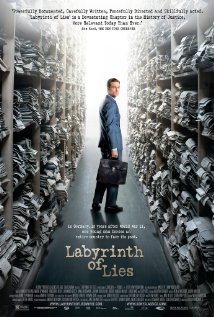
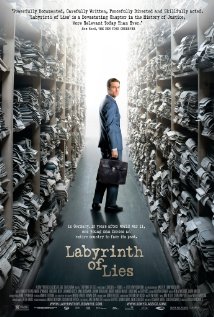
Giulio Ricciarelli co-wrote and directed the German film “Labyrinth of Lies,” based on the real-life story of the courageous post-WWII German prosecutors who insisted on investigating the atrocities of the concentration camps and prosecuting those responsible. Surrounded by former Axis and Allies officials who wanted to put the past behind them and move on to fighting the communists. He talked to me about the inspiration for the film, what really happens to the movie’s couple after the ambiguous ending, and why the owners of the vintage cars used in the film drove him crazy.
The movie’s opening takes us into a world almost impossible to imagine, where concentration camp survivors are living with the people who imprisoned and abused them and the world has almost no information about what would later come to be called the Holocaust. An artist is offered a light by a teacher watching some children in a school playground. When he bends over to reach the flame, he sees the teacher’s hand and recognizes him as a former Nazi. “That symbolized the theme of the movie, the tormented meeting the tormenter. And the second thing that was important that I wanted it to be a teacher because if you imagine him teaching children that is so horrible and that’s something that actually happened a lot. And so we had these two elements and I knew that as a filmmaker I needed a point of seeming harmony in perfect world, an innocent world. A school is like that. So it was important, the tree and the school and the children playing. And then the movie starts and you realize there is something very wrong there and so it was important to have this. There is a German word that means like a mix of sane and beautiful. It’s like an untouched world.”
The “big complex task” of the film was making what is very familiar to us unfamiliar, so we could feel the shock and horror of the young Germans who came of age after the war and did not know about the “Final Solution.” The movie’s main character is fictional, a young lawyer working as a prosecutor, though some of the other characters are based on historical figures. “That‘s why we choose this young naïve main character, hoping that we enter his world, we start looking through his eyes and the reaction I get is great. It seems to be working with go back in time and go with it. The other thing is esthetically of course; first of all you got to plot what you just mentioned.” The very pervasiveness of the portrayal of the Holocaust created a separate challenge as well. It is so well known that it is impossible to replicate in a persuasive way. The audience at some level always knows it is a re-creation. “The audience can almost hear the director say, ‘Okay lunch.’ And you see actors who are well fed. So I said, ‘Okay, we will not have any of that. We’ll not even have testimony like an actor acting as if he was in a camp and we will trust that these iconic images will come when we give them room to come and the audience.” And so, when the scene comes where a survivor provides testimony for the first time to the lawyers, we do not see or hear him. We just see the reaction of the woman taking dictation, and we feel we know what she heard and saw.Copyright 2015 Universal Pictures
One reason for the film was to recognize the courage of the lawyers who insisted on the truth. But just as important was showing that the only way to move forward after unthinkable inhumanity is to completely honest about it. “In Germany, anything we do politically or culturally is seen through that lens, that’s the reality and if you are talking about refugees if you are talking about Greece, if we talking about anything it’s all we see in the frame of this. The country who did that now does this. The thing is, you cannot deny it, that’s not the way, and you can’t leave it behind.” One way to do that is what he did here, finding a new way to tell the story by looking at a part that has not been told.
“I think what is important with our film is that it’s a not told story. I think what is most important is the movie doesn’t pull any punches when it comes to the involvement of Germany as a whole because there is sometimes a tendency to show two evil Nazis and the rest of the population is confused. That’s not historical fact but at the same time not to sit on a moral high horse. That’s why the main character says, ‘I do not know what I would done.’ And if you look at the atrocities not just in Germany but all over the world the human beings are usually not heroes but they go along and they do the easy thing and they don’t risk their own lives and there are heroes but they are few and far between.” He described the continual presence of this history in Germany as an iceberg. “Under the waterline it’s still huge and it’s still usually influential in Germany, it’s certainly the biggest influence in German politics and culture today.” Everyone in Germany was supportive of the film and cooperative in helping to get it made, including Frankfort, where they filmed on location at the places where the events actually happened. One of the most striking images is the rows and rows of documents. The real archive no longer exists in that form, but they found another storage facility with old documents and used camera angles to make it look biggers.
But one challenge they faced was the vintage cars they needed for the shoot. “First of all they are very expensive, but you know what the biggest problem is? They are owned by collectors, so in the morning you always get that spit shine car and they would say, ‘Don’t dirty it up,’ but we have to spray dust over it and sprinkle it with dust and tell them to bring it back dirty but the next day it’s clean again.”
He has been very moved by the response to the film from people who still struggle with the truth of what happened. “And how much rawness there still is. Like a woman came to me and said, ‘We have a box from our grandfather and our family and it’s closed as we are all afraid to open it, because we don’t want to know how grandpa died in the war.’ Or the man who shook my hand and said, ‘Thank you for this film,’ and then he went five steps and he came back and he looked me straight in the eyes and he said very quietly, ‘My father was a bad man.'”
The movie ends on a positive note about the prosecution of those responsible for wartime atrocities, including cooperation with the Mossad agents who tracked down Adolf Eichmann. But it is ambiguous when it comes to the future of the couple in the film. I pressed Ricciarelli to tell me what he thought would happen to them after the movie. He told me he shot two endings but went with the one he thought was more realistic. Still, he smiled and admitted “there is a ray of hope.”
You write a lot about fathers in the book. Why are they so important?
I think in everybody’s male or female, we come to see our dads in a unique way. They represent a kind of strength or weakness. They represent a power. They are our first contract with the mystery of manhood. I heard years ago, I believe it was when I was in the seminary, that some psychologists say that the way we feel about God is almost always directly linked to the way we feel about our own earthly fathers. That if our dads were loving and kind and strong then we tend to think of God that way. If our dads were violent and brutal and unpredictable then we have that impression of God and we spend our lives dealing with that. I say in the book that I believe the father relationship is one of the pinnacles of the Braveheart life, and I mean that not even if it’s not your biological father, you need to find a man in your life you can respect and you need to find someone in your life that you can parent even if that’s not your biological child. And not necessarily mean to raise them from infancy but to have that kind of loving, caring relationship with.
Was there really a piano-playing pig you named Pigarache?
Absolutely true story Nell. I majored in religion and spent a year in seminary after that and got the opportunity then to go to Nashville to explore writing and writing songs like Kris Kristofferson. He encouraged me to go to Nashville and my first job manager at the animal shows at Opryland, USA. And one of the shows that I managed was called Barnyard Animal Opry. We had 8000 people a day who would see this show. The barnyard animals were trained to play musical instruments. We had a razorback who played the piano and I named him Pigerache and put a little bright, red sequin bow tie around his neck. He was a show stopper I tell you. You can imagine how proud my parents were.
You are great at creating strong female characters in your films, and in the book you talk about women warriors.Copyright 2015 Thomas Nelson
The first book I ever did, the first two books in fact, had women as the main characters and one of the greatest compliments I ever got was when an editor from New York who was not my editor said she thought Randall Wallace writes the strongest women characters in fiction today. I thought that was a really striking compliment particularly because I didn’t think of a particular difference. When people ask me how I write strong women characters I’ve always said I just imagine myself in the situation that they are in and I suppose that their feelings in that situation would be mine, that we all long for a reason to have faith, even in the darkness. The power of believing as opposed to knowing, meaning that when we know or we think we know we’re relying on what we take to be facts but when those facts are proven to be wrong then our knowing crumbles. When we believe we are acting on something that’s greater than knowledge, we’re acting on a hope and courage. Women I believe manifest that sometimes in a deeper way than even men do because women rely on their intuition more than their brute strength and intuition I think is one of the first steps on the road to faith.
You’re not ashamed to talk about faith but that’s very rare today. Why do you think that our culture makes it so difficult to acknowledge that?
I believe the difficulty arises from what we have all perceived to be the falseness of people who present themselves as having faith when what they’re trying to do is convince others of what they don’t believe themselves and that is manifested in the people who preach a certain morality and don’t live by it themselves. People who preach tolerance but are in fact intolerant. The strange thing about this is that intolerance is so often manifested by people who claim to be tolerant. That is the secular world is more hypocritical it seems to me than the faith based world is. We’ve entered the age of the thought police in which we want to say that it should be illegal to hate. And hatred is hateful. Hatred is heinous but we are free creatures and if we suppress the freedom of other people then I believe what we lose is their freedom to change and grow and love. I didn’t invent that way of being. I believe God did. That’s why we are creatures of free will. God created us I believe and I say this in the book for the purpose of love and that’s why we have the choice to love or not because if we don’t, it’s not love, its fear and God is the opposite of fear.
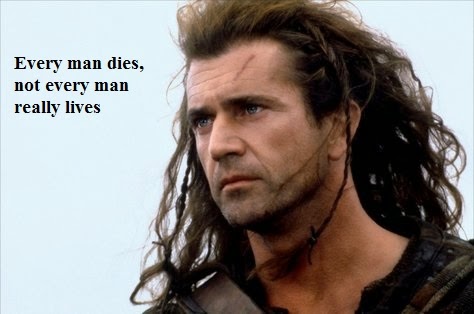
The word “freedom” of course is very important in “Braveheart” and which you have it carved on your mantle.
And carved into the stone of my heart.
Copyright 1995 ParamountAnd which you found that word and motto connected to your family when you first started researching your ancestry. So tell me a little bit more about what that means to you, freedom from what and for what?
Nell, all I have to use is metaphors. I don’t pretend that I have now figured out how to replace freedom with new rules of my own. I see freedom as the power to grow. Freedom from fear. Freedom to move into a life of faith, freedom to live a brave life. I think that the restriction on our lives is an idea that everything we do matters, that we are God. I think the fundamental problem is the violation of the first commandment and that all the other commandments are wrapped up in the first one, love God with all of your heart, with all of your soul, have no other God before me. If we are saying that God is our physical lives then we will be condemned to a life of fear and trying to hold on to what we can’t hold on to. Young people ask me a lot when I’m teaching it various schools. I’m frequently asked by sincere, ambitious, young Christians, “How do you hold onto your faith in a business and an atmosphere that is so hostile today?” And I tell them that I don’t hold on. Holding on is fear and I’m manifesting what you just described. If I am afraid that someone else’s expression of their belief or their disbelief in anything that I believe is going to make me crumble then I am rigid and dead. If I am alive and open and trusting that whatever challenge I encounter I don’t have to come up with the answer to that God will give me the strength, the wisdom, whatever it is that I need or even the silence whatever it is that I need to respond and to grow myself and I am the only one that I am really responsible for or. And I think I said in the book there was a rabbi who once said, “if you don’t see God in other people they’ll never see God in you. “And I try to do what Jesus saw, when Jesus saw in the outcasts of society people who were flawed in every way, he saw in them the love of God. And those people were the quickest to recognize that he was the son of God.
My favorite insight from the book, which I think you’ve put very beautifully, is when you say that prayers makes us listen. I think that’s something that is fundamentally misunderstood by many people about the purpose of prayer. So I’d like you to talk about that.
This comes from hard personal experience. I so often approach prayer out of fear. My fear is that whispering voice inside me that it says if you don’t say just the right words or if you don’t pray for everyone you love every single day then God is going to let those people be hurt and God is going to turn those words against you. This is not the voice of God. Jesus clearly teaches the Father knows what’s in your heart already and who of you has a son ask for a fish would give him a stone so don’t worry about the words. And then I think I’m always giving God advice: make these to do lists for God. “I know you’ve been waiting for instructions from me.” [Laughs} It goes to that humility that says God is God and God and I’m just trying to bring myself into hearing God and listening for God. And that’s part of what I need to tell myself every day in one of my prayerful meditations that I listen for God. I don’t hesitate to do that, to pray for others. I think the Bible teaches that we should intercede but it’s not my power or my responsibility that work there. It’s God. Clearly I don’t do very well in the rest of my life but I need to listen and I recognize it and prayer reminds me of that. That’s part of the majestic mystery of prayer.
Interview: Phil Vischer of VeggieTales in the House
Posted on September 25, 2015 at 7:00 am
Phil Vischer is co-creator of the popular VeggieTales characters and videos and still provides the voice of Bob the Tomato. It was a lot of fun to talk to him about the characters and their new series, VeggieTales in the House. The new season premieres on Netflix this week.
“This is the second season of Veggietales in the House so it’s not any different than the first season — it’s just more of it. On Netflix there were 26 half hours in the first season and there will be 26 half hours in this season so it’s a whole lot of vegetable content.” The dramatic changes in technology for creating and viewing the content have made a difference, though. “When I started, it was VHS cassettes that were the revolutionary technology that was transforming America. So I wrote and directed the first ten years of VeggieTales. We did about 20 different films in only two years. Moms would go to stores and then buy them and stick them in their VHS players. That’s completely changed now. It’s kids with Netflix and it’s kids with streaming on demand on their phones and on their iPods. So with the new Veggietales In The House which was created by Duncan Abel, he has really found the format to match the new technology with short little eleven minute clips and beautiful songs and lessons and they’re just much easier for kids to carry with them. So Mike and I are, we are voices now. We are not into writing or directing anymore but it’s fun to see what new generations of guys are doing with the old characters.”Copyright Big Idea 2015
Vischer told me a new generation of kids is watching VeggieTales with parents who grew up on the original series. “I do a lot of speaking on college campuses. Everywhere from big places like Baylor to little tiny Christian colleges. It’s about the same thing everywhere because I come out and the first thing I say is, ‘Hi kids I’m Bob the Tomato, and these college kids just flip out. It always amazes me because I don’t feel like I’m very cool. I get a lot of kids who come up to me and acknowledge that they are starting to have their own kids. They say, ‘We are introducing our kids to Bob and Larry. Thank you for making my childhood.”
He gave the new guys some advice about the characters. “OK, this is who Bob and Larry are; this is what makes them tick. Basically Bob wants to help kids and Larry wants to help Bob. You know, he is the sidekick and Bob, I’ve always described him as a frustrated Mr. Rogers. In the original shows he wants to be teaching, he wants everything to go smoothly and he wants to make it look effortless like Mr. Rogers always made it look but it always goes wrong and part of why it always goes wrong is because sidekick Larry is just so gosh darn silly that he can’t quite follow the directions.” He compares them to classic comedy duos like Abbott and Costello, with “a clear straight guy and then more of a goofy character or just a childlike character. A character who has the innocence and just not know what you should do not out of mischievousness but just out of innocence. Bob will start to put on a show and it can be frustrating to put on a show if you’ve got Mr.Goofball next to you who doesn’t take it as seriously as you do.” He admits that “I really am much closer to Bob the tomato in my temperament. I want to be teaching things and my buddy Mike is really much closer to Larry the Cucumber in temperament.”
And he says that teaching children the lessons about character, integrity, and faith affected him as well. “The best lessons are ones that change you while you are presenting them and while you are researching them. And the best way to learn something is to try to teach it to a four year old. If you don’t understand it well enough to articulate it clearly for a four year old you don’t understand it. And so it has been great for me for the last 25 years for all the projects I have worked on to have to bury myself in the Bible and reading commentaries and trying to figure out what is Biblical forgiveness? What is sanctification? And to understand it well enough that you can turn it around and explain it to a four year old.”
Interview: Writer-Director Carmen Marron of “Endgame”
Posted on September 23, 2015 at 3:18 pm
“Endgame” is a heartwarming family film inspired by the true story of a championship middle school chess team from a school in a poor Texas community. It stars “Modern Family’s” Rico Rodriguez and two actors from “Napoleon Dynamite,” Efran Ramirez and Jon Gries. Writer/director Carmen Marron talked to me about why it was important to her to tell this story.
How did you first hear about this chess team?
It was like three years ago actually I was working on another project and one of the producers on the other project was approached by the executive producer of “Endgame.” He knew her; they were both from Texas. He started writing a script about the story of what was going in Brownsville and he was like, “I would really like to make it into a movie and can you help me with that?” It was low-budget, they didn’t have much money. So she knew what I did with my first film, Go for It, that I basically put together myself. And she said, “Look, this is what you like to do, an inspirational movie, a movie that can help motivate youth and women in our society. This story might be up your alley. Would you be willing to jump on board and help make it happen?” I felt like it was going to be a lot of work and at the time it was not my priority. But then I researched it. I researched it online about the community, about Brownsville, about the teacher and the kids and everything and I was researching it all night and by the morning I was like, “I have to make this movie. I don’t care if I do it for free at this point.”
I grew up really poor in Chicago, one of 10 kids. My dad always raised me with the belief that one person can make a huge difference and so I felt like this is the perfect example of how this teacher in the third poorest community in the time in the US really turned it around and created so much faith and hope just for the love that he had and the belief that he had in these kids. He showed that you don’t need money, you don’t need the resources if you really have that hope and he turned it all around. It was amazing! And to see these kids, and how resilient they are. It reminded me of those kids that I worked with when I was a guidance counselor. These kids are put through so much at such a young age and you see what their potential is if they have adults around them who can make them believe that what they are going through is just going to make them stronger, it’s not going to ruin their future.
Why chess?
He said that he had it in his classroom and it didn’t cost any money. It’s very costly to put together a team and uniforms. And it’s about critical thinking and it helps keep the kids focused and in the classroom in their seats. That’s what these kids in detention weren’t able to do. And so he started doing that with them little by little and they were so perceptive. It just goes to show how resilient and so very resourceful they are. They are always thinking, they are always trying to figure out how they can survive really but he was just using it to make them analytical.
I liked the way you portrayed the culture of chess, shaking hands after every match, which you use to great dramatic effect in the film.
Yes, in addition to the analytic skill, it is important to teach them good sportsmanship and respect and to be able to look at the other kid in the eye regardless of who they are. And what he used to say is when he started the team, these were inner-city kids with no money. He put the uniforms together were just T-shirts and he said that when he first took them to Dallas the first year nobody even looked at them. They treated them like they were invisible, like they weren’t even contenders. So he wanted to teach the students that confidence. No matter who you play against, no matter how rich this kid is or what prep school he comes from you just look him in the eye and you wish him well and you have that sportsmanship which I thought was so beautiful.
It was great to see such strong female characters.
I think that’s my personal mission as a filmmaker. I did that with my first film and I am going to do that with every film. I really do believe and I think that what I learned as a guidance counselor that there really is such an imbalance of women role models or girl role models for these girls and so I really need to start creating stories that can show these young girls, older girls, older women as powerful role models and heroes and leaders in their own rights. It’s really important to me. That’s the mission that I have that I am going to continue to do because these young girls that I work with are just so hungry to try to identify with public figures. Unfortunately they are looking up to Kim Kardashian and Britney Spears and all of these women that really don’t care to be role models. And so I really want to create these characters that just have so much inner power, inner strength in them and intelligence and leadership. It is really like an obsession for me.
Now why was it important to you to include an undocumented character who was deported?
That was actually one of the requests of the executive producers because he is an attorney and he deals a lot with immigration law and also it was an issue that the coach said that he came across. Some of these kids on the team were undocumented. And so I really wanted to show that whether they are born here or not, they are living the American life just like the other kids and they are going through the journey together. You see the huge safety net that they don’t have under them that all the other kids have because all of this uncertainty with immigration laws and it shows the double burden that they are also dealing with as they are growing up but how they are also handling it with grace as much as possible.
Was it a challenge to work with so many young actors?
Well I completely understand is definitely, definitely a whole world onto itself working with kids I didn’t even know. But I have always worked with kids. I was a guidance counselor and I have a Masters in Educational Psychology so my goal is always to make a difference with kids through education. And so that was the easy part. The hard part is that dealing with the child labor laws because you have to treat them as employees in a way because you have this movie to make. I made the movie 19 days and these kids can only work six hour days and they have a teacher who has to spend time with them. When working with kids you have to be focused. You have to make sure that the kids are all on the same page before you even begin and that you just know. You have your vision and you know what it is because you really sometimes only have the one chance and you have to move on.
How do you go from being a guidance counselor to being a filmmaker?
That, I would say was divine intervention. I never wanted to be a filmmaker, to be honest with you. I always knew that I wanted to make a difference in society and that I was going to work with kids and with women but I didn’t know how. As a guidance counselor I loved what I did. I loved it, I loved it, I loved it. And then after about my second year, maybe after my first year I was thinking that I was making a difference with 600 kids. How can I reach much more? How can I reach the inner-city kids in Chicago? How can I reach them in LA and Texas? I was in Phoenix at the time and I didn’t know. I just knew that what I was doing at the school, I wanted to try to help more kids and so honestly I prayed a lot and it came to me when I was praying, when I was meditating and the answer was, “You have to tell what you’re trying to teach, how you are trying to inspire kids you have to make movies so that you can reach more.” And then from there I just followed my heart. Honestly I went to the library and I checked out a book on how to write a screenplay and then I just started writing, watching movies and then I just packed up my car and my dog and my laptop and moved to LA with a script.
“Bread and Roses,” I recommend that to everybody because when I saw the movie I moved to LA and for two years people basically laughed at me telling me that I had no idea what I was getting myself into, I didn’t know a thing about filmmaking. It’s like the worst industry to get into, to break into. Even when you are in it is even worse to try to move up. I remembered just feeling so dismayed and then I watched “Bread and Roses” and it just brought me back to life and I was like, “Those are the types of movies I want to make.” And then actually I reached out to Ken Loach, who directed it. I wrote him the longest letter on how I want to make this inspirational movie that revolves around inner-city girls and it deals with dance because I used to be a street dancer, blah blah blah and I wanted him to direct it and I wanted to be very raw and honest like “Bread and Roses.” And two weeks later his assistant calls me from London, wakes me up at seven in the morning and he says, “Ken and I read your email and he really wants me to tell you that you need to direct your movie.” And told him I don’t know how to direct a movie, I don’t know how to do anything like this, I just wrote it. And he said, “No, you really do. Your email spelled it all out and no one will have that passion like you. The hardest part is having the money and once you have the money everything is going to fall into place.” And so from there that’s when I just made the decision.



 . It was a great pleasure to talk to him.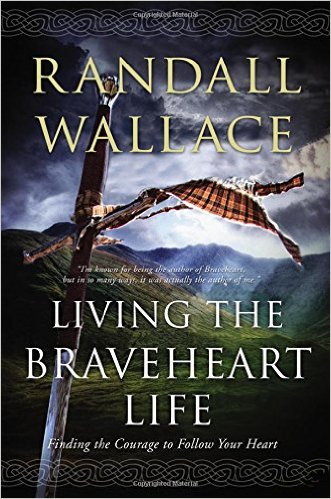


 , that I basically put together myself. And she said, “Look, this is what you like to do, an inspirational movie, a movie that can help motivate youth and women in our society. This story might be up your alley. Would you be willing to jump on board and help make it happen?” I felt like it was going to be a lot of work and at the time it was not my priority. But then I researched it. I researched it online about the community, about Brownsville, about the teacher and the kids and everything and I was researching it all night and by the morning I was like, “I have to make this movie. I don’t care if I do it for free at this point.”