
Interview: Us the Duo from “The Book of Life”

Posted on October 13, 2014 at 8:00 am

It’s a Cinderella story times two. Carissa and Michael Alvarado had a romance right out of a fairy tale. And then their creative and professional dreams became reality. One moment they were uploading six-second covers of popular songs to Vine and the next the song they wrote for their wedding was featured in a film (“The Book of Life”) and then they were on tour with Oprah.

If so many wonderful things are going to happen, these are the people you want them to happen to. Carissa and Michael are purely delightful, with enthusiasm and humility, committed to giving their best to each other, their art, and their audience.
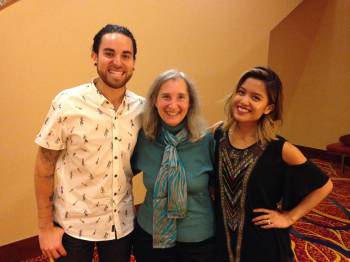
Copyright Nell Minow 2014

You wrote the song that’s in the movie for your wedding, right? When you perform it in concert now, does it bring that moment back to you?

Carissa: Totally, we actually go back in our minds to that day when I’m walking down the aisle and he’s crying like a baby and I’m trying not to cry because I don’t want to get my make-up all over my face. People were laughing because here I am in my wedding dress and I have this big old drum that I put around my neck. But it’s nice that every time we perform it we kind of are reminded about that day when we got married. It was the best day of our lives so it’s really nice to get to go back there every time we perform the song.

How long have you been married?

Carissa: About two and a half years now we’ve been married, yes.

Okay, so you performed it at your wedding, you put it up on Youtube and then what happened?

Michael: And then it went viral which was so weird. It had a million views in a week. And we were like, wow! I didn’t know this was that special to everyone. For us it was very special but to the public I didn’t think that they would take to it so well. We honestly just put it up just so we could share it with our friends and our family. So Fox was trying to complete this movie, “The Book of Life.” There was one scene left and it was missing music and they needed this triumphant love song to pull together the whole story. They reached out to our record label Republic and said, “Do you have anything that fits this moment?” And they recommended our song.

They called and said, “I have this opportunity, I don’t know if you’re interested.” We had just signed so everything is very new to us. Six months ago we were just mowing the lawn and playing with our dog and now we are doing this. “Hey, your song is going to be in a feature film and they want to meet with you.” And this is Fox! I mean these are big names. We show up to their studios and we play and they said, “Okay, you guys are great. We want to actually animate our characters to your song.” So not only is the song in the film but the actors are singing our song and they are animating to it, it’s amazing!

So our mind is blown and then Oprah sits down to watch this movie as she hears the song, falls in love with it and then asks us if we can come on tour with her and again, we are just…

Carissa: I am like pinching myself! Is this real? Like every day. It was a dream come true. First of all, to get to meet Oprah, which is pretty awesome! She hugged me and I’m like, “I don’t want to hug anyone else because I don’t want to get rid of this hug.” I’m like, “I want to hold on to you forever.”

Michael: I didn’t get hugs for a week!

Carissa: It’s crazy because the first day we performed on this tour, she actually surprised us and everyone else that was watching and came onstage. We didn’t expect that at all and my jaw about dropped to the floor.

Michael: There is a picture of it; she’s standing in between us and we are hugging her and our faces are like…

Carissa: Like shock face. But she is so sweet, she is a great hugger, she smells good.

So tell me a little bit about the tour. What does that involve?

Carissa:  It’s kind of just motivational speaking to everyone and it’s inspiring people to do what they love and live the life that they want to live.  That’s perfect for us because that’s kind of our passion as well and what I think is our calling to do; it’s a positive message and shows that you should follow your heart and follow your passions.

You met at a music video?

Michael: Yes, a music video shoot. We were both extras and there she is. I grew up in North Carolina so I never went to LA but I was there visiting and I end up at this music video shoot.  It was love at first sight for me and so I flew back to North Carolina and tried to make her fall in love with me for the next six months over social media, which worked!  She said, “Sure, I feel the same way about you.” So I packed my bags, moved to LA, I asked her to marry me; all very quick again. And we got married and then we started making music together.  But we were both musicians before that happened and nothing ever really happened in our careers.  We always wondered, “What is that missing piece?” We felt something was missing. And then when we got together for the first time and started singing and harmonizing, we looked at each other with this stare.  I am like, “Oh my gosh, did you hear what I just heard?”  Solo we are okay but together something unique happens.  We got married and then we started Us the Duo, just a few days after our marriage so it was really surreal and kind of crazy how it all came together.

What’s your best advice for a happy marriage?

Michael: Our advice is more about working together and balancing that with our relationship. I think it’s important to always keep the marriage first and the music will kind of follow and it will trickle-down into whatever we are playing. And we have seen the balance kind of switch and we get panicked like, “Man what are we doing?” So no matter if we are arguing or what’s happening we always work that out before we step on stage or before we go into an interview. Like, “We need 10 minutes just to figure this out and talk through it.” So communication really is the key and always keeping that as our top priority and then work second.

You became a Vine sensation with six-second covers that just showed the bottom of your face.  How did that happen?

Carissa: It’s funny because it started out, he came out to me and was like, “Hey, I have an idea.” When he gets an idea, he’s very passionate about it and he asked to do it in the moment.  So he found out about Vine, about 10 PM, I am on the couch there with the dog watching TV in my PJs, no makeup on and I’m ready just to hang out. He comes to me and he’s like, “Hey, we’ve got to film a Vine. I know you don’t know what Vine is but we’re going to do it right now.” And am like, “What are you talking about? I look like a wreck right now, my hair is looking crazy.” He says, “Okay, fine, we can film it from your nose down so people don’t know you look tired.  And I said, “Okay, fine.”  So we do it and then it kind of becomes our brand.  And he kept going and am like, “Okay, let’s just keep doing this, is our thing now.” And then Good Morning America invited us out and we did like a reveal of the rest of our faces, a dramatic reveal showing who we are, our identities.

And do you do covers when you perform before audiences?

Michael: Yes, and we end with the theme song from “The Fresh Prince of Bel Air.”

What you want people to know about “The Book of Life?”

Carissa: Oh my gosh everyone can see it, the whole family can go and see it.  It’s funny, it’s romantic, it’s adventurous and it’s just a mixture of all genres.  It kind of takes you on this journey with them and inspires people. And then you leave wanting to follow your passion, follow your heart.

Related Tags:


Composers Interview Music

Interview: Courtney Baxter, Actress, Producer, and Just Out of Her Teens

Posted on October 11, 2014 at 3:34 pm

Pennsylvania native Courtney Baxter attends Pace University in Manhattan as a double major in Economics and Film Studies.  In her early teens, Courtney filmed over a dozen national commercials and also appeared in television shows such as Gossip Girl, 30 Rock, and Criminal Minds.  At 16, Courtney became an Executive Producer/lead in the drama “Reco” which garnered many festival nominations and wins.

She has received widespread recognition for her character “Meghan Cleary” on the Onion News Network, leading her to become the backstage host at the 2011 Teen Choice Awards.  As an 18 year old, she Executive Produced and starred as Eve in the horror feature film “Hallow’s Eve” which was recently picked up by eOne for 2013 US and Canadian distribution.  2012 brought other feature and short film acting and producing opportunities in films such as Night Has Settled, ImagiGARY, and Parallax.

In 2013, Courtney appeared as “Serena” in the reboot of “All My Children” and will appear  as a guest star in the new MTV show “One Bad Choice” this fall. Courtney produced and starred in the independent feature “Chasing Yesterday” in the fall of 2013 before filming the cult-phenomena Sharknado 2 in early 2014. Sharknado 2 premiered on SyFy on July 30th 2014 and has since become to the most watched SyFy movie ever!  With “Sharknado 3” in the works for 2015, Courtney is eager to end 2014 strong with the production of “Donny Brook!”  Many thanks to Courtney for taking time for an interview about what it means to be a producer and what she’s learned.

People are often confused by all the different producers listed in the credits.  Why did you want to become a producer at such a young age and what exactly do you do?

Copyright Courtney Baxter 2014

The role of a producer can vary under different titles and for different projects.  A lot of time when I am on set solely as an actress, I do not get the full experience of making a film because my responsibility was simply to show up, and act!  I found myself wanting to make projects of my own, and producing came very naturally to me. In the most basic explanation, a producer puts the film together.  Producers find financing, hire the crew, scout locations, handle contracts and insurance, manage the budget and make sure everything runs smoothly on set.  Right now I am an associate producer on the upcoming feature Donnybrook.

Why do you think people love the “Sharknado” movies so much?

For one thing, the word “Sharknado” is super fun to say!  I think the Sharknado phenomenon found success by being commercially appealing, ridiculously self-aware, fun, and super entertaining.  Undoubtedly, much of the Sharknado’s success comes from the crazy amount of social media attention.  Sharknado is everywhere, you couldn’t avoid it if you wanted to!

How do you think the phenomenon of tweet-watching has changed the way we look at television?  Do you have a favorite “Sharknado 2” tweet?

I think that live tweeting is an awesome way for people to communicate and connect.  It is one thing to hear that 3.9 million people that watched Sharknado 2 on its premiere night, but it is absolutely incredible to see the millions and millions of people who not only watched the film, but took the time to write something about it.  As for my favorite tweet, I tweeted a picture of the scene when Kelly Ripa kills a shark by stomping on it with a stiletto, and she retweeted it.  Made my night.

How has what you have learned in your economics classes helped you as an actress and producer?  

One thing that is cool about studying economics is that everyone can benefit from understanding how the economy works.  We are all consumers, and it is really interesting to look at the economic choices we make, and feel confident in making fiscally responsible decisions.  The film industry has a major impact on the US and global economy, and when it comes to making a film, a lot of choices must be made.  By grounding my studies in business economics, I can produce films with good quality with a reasonably lower budget.

If you could go back in time to star in one favorite movie, what would it be?

Well I don’t know how this would work out, but I think it would be really cool to have starred in Forest Gump…and not as Jenny.  I would want to be Forest.  Then, of course, the obvious answer would be starring in Breakfast at Tiffany’s or just about any Alfred Hitchcock movie.

What’s the best advice you ever got about acting?

One life lesson that I always stand by with acting, is that no one can work harder for yourself than you.  The best acting advice, is to listen to whoever you are interacting with, and if it is just you in a scene, then listen to yourself. It keeps you present, and helps you take in each moment.

Which director you’ve worked with taught you the most?

Oh that is a tough one!  There are two directors who have not only taught me lot about acting, but also how to communicate effectively.  I think the relationship between a director and an actor is a really incredible thing because as an actress I put all my trust in the director. Steve Clark is a brilliant artist and filmmaker; I worked with him on Night Has Settled and I was amazed at how he could pull out such raw emotions in each actor’s performance. Joe Pernice directed our feature film, Chasing Yesterday and I was able to be there with Joe for every step of the way.  When Joe is directing, he knows exactly what he needs out of myself and out of the scene, and he knows how to finish a film right.

You have been involved in several different initiatives to help your community.  Is one of them closest to your heart? 

Absolutely, The Andrew L Hicks Jr Foundation was started in August of 2010 after Andrew, one of my classmates at Henderson High School in West Chester PA, was killed in a tragic accident.  Andrew had an infectious nature and dedicated his short life to helping others.  Upon Andrew’s passing, his incredible family started the foundation with the goal of connecting the underprivileged youth of Chester PA with the youth of West Chester PA in an effort to build relationships, create service opportunities, and help unite the two communities.  I have been working with the foundation since 2010 and have loved every second of it!  My favorite tradition is being a chaperone at Camp Paradise.

 Tell me about “Chasing Yesterday” — what is it about and what do you hope audiences will enjoy most about it?

Chasing Yesterday (formerly known as Running on Empty) is a coming of age story about a former college track star, who has fallen into a dangerous cycle of drinking and self-prescribed depression medicine after his girlfriend dies in a car accident.  My character, Jenny, comes into the picture and convinces Junior to get his life back on track by entering a half marathon.  Chasing Yesterday is a movie that people of just about any age can enjoy.  There are lots of laughs and some tender moments that stay grounded in my good friend (and lead actor) Eric Nelsen’s performance.

Related Tags:


Actors Interview

Interview: Bill Smitrovich

Posted on October 7, 2014 at 8:00 am

Bill Smitrovich appeared most recently in “The November Man” with Pierce Brosnan as a CIA official with some secrets even his colleagues did not know. He has had an extensive and varied career in theater (“Of Mice and Men”), television (“Life Goes On” and “The Last Ship”), and film (“Independence Day,” “Ghosts of Mississippi,””Iron Man”). He talked to me about creating a character and why his all-time favorite costume included a helmet made from a colander.

Copyright 2014 Bill Smitrovich

You’ve played a lot of law enforcement types. And what do you think it is about your look that makes you so suitable for those roles?

It’s not all about the look but sometimes it’s just about how to deliver the role. If you look a little further into my career, I played everything from a garbage man to the President of the United States. So it’s always kind of weird to think that. And even when I play policemen n they were all different characters in a uniform. It may seem the same to you or the public that I play a lot of characters in uniforms, but each of those men are different men. They are not all the same is what I think.

In “The November Man,” you play a character who personally and professionally keeps a lot of secrets. How do you approach a character like that?

Well, that’s a delicious part of it, playing a character who has a lot of secrets and conflicts. He’s a wonderful actor. And the best compliment I get from the movie is when people will go, “When you turned around in the chair and you were the bad guy was a real “aha moment.” It’s fun playing the perception of the character and then changing it and maybe possibly even changing it back again. People told that they thought that I was a bad guy from the get go and then they didn’t think I was a bad guy then I was a bad guy. So it was just delicious to do that.

It’s like the Vice President in “The Event.” All those secrets that he was keeping and doing it for what he thought was for the greater good. And he might be absolutely off his rocker. I don’t judge my characters. I don’t say they’re off their rocker. But I can’t judge them. All I can do is try to figure out their pure motive for doing what they do and to investigate that and to feel like I am involved with them. I take them on and sometimes a look is certainly helpful. I’ve been working on this a while and I think my experience, my life experience makes a difference because I didn’t get into acting until professional acting until I was like 32 or 33. So I was at a starter theater company. I have a Masters and I did a lot of theater but I never had a equity card or a SAG card or an AFTRA card. I think my life experience nourishes what I do and hopefully colors it and gives me some experience and gravitas in certain situations. But I think that is what comes with each actor that plays a role. You can only bring what we can imagine to the role.

Do you create a back story for your character and try to understand him that way?

In “November Man” the back story was also a part of the movie. They were in the agency together and so they had a back story. And the book helped in defining what that backstory was the ambitions, the risks they took and things of this nature. And then you embellish that. I mean then you look at that past and it enriches and informs what you’re doing in the moment because they had a history. There are things going on inside of each of their minds, especially being in the game, who is going to betray who? But there was a real moment there in their lives where they really trusted one another and got through. And then you have Devereaux’s relationship with Mason, Which is another kind of father-son thing. So it was pretty rich. I mean in terms of relationships, there were high stakes relationships, all of them; wife, Mason, his relationship with Devereaux, my relationship with Weinstein. There was a heart to it because these people did share so much. Not like Bond films, which are just action and sex and the drugs and fast cars.

What’s the best costume you ever had to wear?

In “Life Goes On,” we had a Halloween episode where space aliens came down and was a really funky crazy little kind of Buck Rogers show that we had and it was a lot of fun. And the prop guy made up these costumes.  They  helmets made out of a spaghetti colander.  They had flashing lights on the front and wires coming out the top. And it had a chinstrap – I still wear it at Halloween all the time. I just love it.  As far as theatrical costumes are concerned, when I played a garbageman in the theater, I had quite a costume and after a while they had to close the show, it stank so much.

Which director has taught you the most?

Michael Mann I would say. He gave me the opportunity to learn what I had to learn.  Great guy, he was very loyal to me, helped me in my career immensely.  Roger Donaldson for sure, we’ve done some things together. I think it was more about relationships. But what I learned most was from a teacher and the director of his own little community theater in Stanford Connecticut, his name is Al Pia and he directed me in college and it was my epiphany. It was where I discovered I was an actor.  Al taught me how to read a play, how to break it down into beats and scenes and how it moves along.  My favorite quote is “All art aspires to music.”  And so we talk about beats and the rhythm of a play. It’s all connected and when we speak like that, we can call it a play.

What’s next for you?

I just got done with “Ted 2.”  I was in Boston filming for 10 days and it should be coming up probably in July next year, sometime around there I would say. And the TNT show “The Last Ship;” I’ve just done the last couple of episodes for their finale and I’m waiting to see what is going to happen along with everybody else but I will be back.

And what’s the best advice you’ve ever gotten about acting?

If you don’t want to work 9-to-5, you’ve got to hustle 24-7.

Related Tags:


Actors Interview

Interview: Matthias Malzieu of “Jack and the Cuckoo-Clock Heart”

Posted on October 5, 2014 at 8:00 am

First it was a concept album of ethereally bittersweet songs from the French group Dionysos, and then it was a graphic novel, and now, writer/musician Matthias Malzieu has brought his tenderhearted fantasy love story to the screen in the animated Jack And The Cuckoo-Clock Heart. It is a gentle fairy tale about a boy with a cuckoo-clock for a heart who is told he must never fall in love, but who cannot help falling for a visually impaired singer, available on DVD and Blu-Ray October 7, 2014, with both English and French dialogue.
With some help from a translator, I spoke to Malzieu about creating this omni-media story, which, like “Hugo,” is a fictional tale but features real-life pioneering filmmaker Georges Melies as a character. He said, “Surrealism was the esthetic influence. We made a lot of researches and found a lot of Jules Verne, George Melies, this moment of history when medical things, magic things, and inventions, science, were completely mixed, charlatanism, religion, doctors, scientists -– a fog of sensation between all these things. Everything was possible for real. The story takes place in this moment of history, steampunk, trains, steam machines, first cameras, all these magical machines that seem to have a soul. It brings up the nice problem of the character, a machine with a soul. It has joy like a human, but the technical problems of a machine.”

One of the most striking scenes in the film is a train ride.

“The train is the link between the dream and reality,” Malzieu said, “all the atmosphere and spirits of the movie in one scene, dancing strange monsters, like a dream but scary, dance and silence just after a very loud scene with a lot of punk rock music and movement. Then just rocking in silence with no melody, the poetry and simple human emotion at the same time.”   He went on.  “The train and the music drive the dreams of escape of the character. The train is on paper to show it is fragile and small and even a breath can move it but it’s exciting.  This heart’s way of doing it with human hands, little things we like that a lot of people can see and feel all the mechanics.”  He explained that he identified with Melies, a stage magician before he became a filmmaker and pioneer of special effects.  “Making a movie was very close to making a magic trick, telling a story with little magic things. The producer and animators are like a magic tool of my own dreams, a human magic tool, always fragile, and delicate.”

He worked with illustrator Nicoletta Ceccoli in creating the look of the film and said it was “like Christmas to receive her messages, a strange train with wings, a character with a xylophone on his spine, not too soft a look, though.  It had to be alive but look like porcelain, maybe a little Pinocchio-esque but with very realistic eyes, and bodies not too elastic.”

The opening scene, with a woman trying to reach a midwife before she delivers her baby on the coldest day in history, had to be “intense and funny and mysterious at the same time.”  The main character has a clock instead of his heart, “so when I think about the movie I really want to show the emotion that he can bring with his machine. I would like to film a lot of the cogs and mechanical aspects.  With this mechanics he can love or not love, be a human and a machine.  I like the poetry that brings this together and want to see inside of the heart in a metaphoric way and a real way. The art and mechanics of the character are similar to the connection between George Melies and his camera.”

This movie is “about love in a passionate way.”  The lead female character is a visually impaired singer,  “She did not trust herself, so when she is angry she has vines with thorns around her. She is supposed to know everything about this emotion but she is scared by Jack who is different, and she rejects him because she is scared of herself.  When you are too scared of doing bad things you do bad things. She thinks she can’t risk breaking his heart. She’s scared, not of Jack but of making bad things happen to him.”

Malzieu says the story started with the idea of the character, about falling in love deeply and being different. “In the book, I wrote sometimes love can turn us into a monster of sadness, sometimes a monster of wonder, sometimes similar. A character with a mechanical heart is different so I can talk about the difference between people in a poetic way, and about the fragility.  Jack’e heart needs to be wound every morning to stay alive. And love is dangerous. He can’t fall in love but he will try to, and people will try to break his dreams.”

He describes Melies as “a fantastic inventor and magician, like the doctor of love,  the opposite of Madeleine,” who builds Jack’s heart.  “She’s like the mother.  She wants to protect, but maybe too much protecting.  Melies is the opposite.  He wants adventure and thinks it is good for the health.  That’s two different visions of life.”  And Malzieu finds appealing “the analogy between the camera and the heart – a machine with soul and emotion,” so he has Melies make a romantic movie inside the movie.  He is “the father, the friend everybody dreams to have, clever, funny, creating fantastic things all the time.”

Related Tags:


Animation Interview Music Writers

Interview: Ned Benson of “The Disappearance of Eleanor Rigby: Them, Her, and Him”

Posted on September 26, 2014 at 3:59 pm

Every story has at least two sides, especially the story of a relationship.  Writer/director Ned Benson explores romance and loss from the perspective of the man (James McAvoy) and the woman (Jessica Chastain) in two separate films, “The Disappearance of Eleanor Rigby: Him” and “The Disappearance of Eleanor Rigby: Her,” both to be released at the same time next month.  First, though, is “The Disappearance of Eleanor Rigby: Them,” which combines the two.  I spoke to Benson about how his leading lady persuaded him to add the title character’s point of view and the famous director who invited him to dinner.

What is it that makes us so curious to look inside the different characters and show us what the other character does not see?

When I started this I had only written a male perspective of it. And Jessica actually asked me some questions about the character of Eleanor Rigby and where did she go, who was she. I knew that I wanted to write a love story, I knew I wanted to make a film about a relationship. And then all of a sudden I was like, “Wait! There’s no better way to show a relationship than get both perspectives of it, both sides of what these two people were going through, are going through.”  So that spun this whole other script and that became this 223 page two-part script that an untested first-time director was going to try make with an actor who was about to be in a Terrence Malick movie but had not been seen in anything yet.  And my producer is a first-time or a second-time producer so we were sort of three untested delusional people trying to make this movie.

I think we’re all very different and sometimes we narcissistically project ourselves onto other people and don’t allow them to be exactly themselves.  I wanted to show the differences and the different personalities of people in terms of the way they deal with things which makes them exactly who they are and ultimately that’s the thing we love about them.

Tell me little bit about some of the visual cues that you used to help the audience keep straight whose view we were getting.

We created different color palettes for each of them. Different production design, different costume design. We created different visual rhythms for each character in Him and Her. So his film has a cooler, more detached feel with a sort of fluid visual rhythm because he is constantly moving.  If he stops he’s going to feel something.  He is running forward into his life wholeheartedly and running after Eleanor. And she has retreated into this sort of warmer color space with a more handheld feel.  Her film is a bit more interior because she’s a bit more interior character.  We sit with her and feel what she’s going through more.

I did the same thing with the production design and costume. And then the actors and I worked together to create different intentions for each version of the scenes that overlap. Because there are four scenes that overlap in Him and Her that are essentially the same moment but shots from different perspectives, different angles, different writing, different experiences with the same moment as if you and I are having this conversation right now and we’re each going to walk away with a different perception.  Sometimes we misremember, sometimes things emotionally resonate with us more and I just wanted to show that with those moments that the things that resonated more with each of them.  So for example in one of the overlapping scenes which occurs in a bar and then continues into a car ride. James is wearing a sort of white light collared shirt in one version of the event and then he’s wearing a dark gray in another version.  That played into the color palette that I was dealing with because I was dealing with mood but I was also dealing with memory and how we mis-remember certain things.

Do you consider yourself a romantic?

A cynical romantic yes.  I’m romantic in the idea that I believe in love, I just don’t know what it is necessarily in terms of how to do it right or how to make a relationship endure because I’ve never made one endure. I’ve been in long-term relationships but it’s something that’s interesting to me and I love the way love evolves and even though those relationship are over I think both my ex-girlfriends and I all have a great respect and love for each other and that love has just changed.

Jessica and I were in a four years relationship which is how we developed a script together so that’s definitely infused into the story. I have such great affection and respect for her as a person. She’s a wonderful human being and a great collaborator. She’s going to be a part of my life always. Eleven years ago she ran up to me at a film festival with my short playing that she had just seen because she won tickets to it on NPR and said, “I want to work with you.”  She had just graduated from Juilliard and done an episode of ER, so that was it. And then we grew together which is really cool.

Why is the character called Eleanor Rigby?  Is she one of the lonely people like in the Beatles song?

I was listening to it while I was outlining the script or the story and figuring out what the story was. And just one day I was like, “Wow!”  You know because I heard the “all the lonely people where do they all came from” and that mood just sort of infected the whole thing and infected each of those characters because they each were sort of going through their own quiet crisis. So that instilled itself into it and I named the character because of that.  But it was also this abstract idea because I’m the child of two baby boomers and my dad got kicked out of high school for stealing a TV to watch the Beatles on Ed Sullivan.  My parents gave me this wonderful music education.  I look at my parents’ relationship and how I am a reaction to and a reflection of it in a weird way and how that infects my relationships in a good way or in a bad way. So I wanted to use that in terms of these two characters and their parents in the story.  In the movie, her parents met at the Beatles concert that was supposed to happen but never happened. So since his last name was Rigby, they named their daughter Eleanor.

Copyright 2014 Weinstein

How did you use music in the film?

I try not to let music dictate feeling. I would rather let acting and talking do that. There’s a lot of diegetic music existing within the scenes because I love doing math but on top of I  that I looked into working with this wonderful composer who when he saw the films decided that he had this great idea to look at scene and see what objects existed in them and then create the instruments based on those objects. So they were based on things that existed within the film and ultimately I wanted a very atmospheric score but sort of like felt very theorial and existed within the mood of peace and sort of acted like a collaborator as opposed to a dictator feeling and then he wrote some beautiful songs on a big beautiful score. We don’t have ‘Oh so much score’ between three films but he did such a beautiful job and that was really cool to experience and get like, I love music in terms of when I write I usually listen to music and it’s a very important part of my artistic process and even when we’re shooting I was playing songs for the crew and what rhythm we’re going to shoot at and I gave playlist to each of the actors in terms of like what their character was listening to what their moods were. It was really cool to sit with somebody and hear sketches and then get to give notes on those sketches and feel like oh you can could push the guitar there a little bit or you could use the glass a little bit more because he create this wineglass instrument.

I think it works always but I think if you see Them first you can expand into these other two films and have those characters in each of these separate films be fleshed out more. And I think if you are going to watch all three that is the way to do it. But I don’t think it matters whether you see Her or Him first it will change your experience because one will give subtext to the next or change your opinions about a character from one to the other. But if you’re into this type of subject matter this type of film I encourage people to try and see all three. I would love that but again it’s sort of out of my hands.

Who are some of the directors you admire?

One is Robert Altman.  I met him and his wife at a brunch. I was a kid, a friend of mine was invited and I tagged along. It was in my 20s. I remember I walked outside he was sitting and smoking and he was like, “Come on, sit down” and just we started talking. And I geeked out! I was like, “Could we talk about the multi-track song in “The Long Goodbye,” could we talked about “McCabe and Mrs. Miller?”  He sort of looked at me like…”Sure!”  And I’m sitting with him, incredible.  And then he said, “Why don’t you come to my house?”  And I went to with my girlfriend to this dinner at his house in Malibu that he and his wife hosted and  Paul Thomas Anderson was there, all these other movie people, and I felt like I was in a Robert Altman movie myself.

What is next for you? 

I just know that there’s always room to improve, there is always room to improve in your writing, there is always room to improve in directing. The only point is to make better and better films.  I was lucky that I get a chance to make three the first time and I am hopeful my writing or directing will improve in the next one and I hope that I get to make more.


Related Tags:


Directors Interview Writers
THE MOVIE MOM® is a registered trademark of Nell Minow. Use of the mark without express consent from Nell Minow constitutes trademark infringement and unfair competition in violation of federal and state laws. All material © Nell Minow 1995-2026, all rights reserved, and no use or republication is permitted without explicit permission. This site hosts Nell Minow’s Movie Mom® archive, with material that originally appeared on Yahoo! Movies, Beliefnet, and other sources. Much of her new material can be found at Rogerebert.com, Huffington Post, and WheretoWatch. Her books include The Movie Mom’s Guide to Family Movies and 101 Must-See Movie Moments, and she can be heard each week on radio stations across the country.

Website Designed by Max LaZebnik