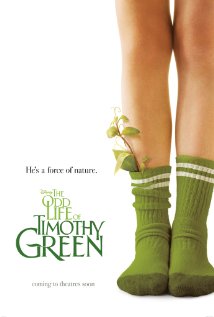
Interview: Peter Hedges of “The Odd Life of Timothy Green”

Posted on August 15, 2012 at 8:00 am

I am a huge fan of Peter Hedges, who wrote the book What’s Eating Gilbert Grape and wrote and directed Pieces of April and Dan in Real Life.  No one is better than he is at showing us messy families who sometimes hurt each other, do not always understand each other, but really love each other.  I loved talking to him about his new film, “The Odd Life of Timothy Green,” an endearing fable about a couple named Jim (Joel Edgerton) and Cindy (Jennifer Garner) who try to come to terms with their inability to conceive a child by writing down the qualities they wished their child would have and then burying the list in the garden.  Somehow, a little boy who has all those qualities appears, calling them Mom and Dad.  And he has leaves growing out of his ankles.  Hedges wrote the screenplay based on a story by Ahmet Zappa, the son of rock legend Frank Zappa.

What made you decide to take on this project?

What I’m looking for is a story. Sometimes I adapt someone’s novel. “Pieces of April” was original. “Dan in Real Life” was a rewrite of a script. In this instance, I sat down with Ahmet Zappa and he said “I have an idea about a couple that can’t have a kid and he grows out of the ground and he has ten leaves and they’re ten qualities,” and there was so much of the story that didn’t exist, but there was this incredible jumping off point.   I felt like I could write about things that matter most to me — being a parent, and family — and yet there was this magical element that I never would’ve thought of.  There was some preexisting story, but so much of the story didn’t exist. Most of the characters weren’t even in the story that I first heard.  I kind of adopted his concepts and he was so encouraging that I bring all of myself to it.  With the help of all my collaborators, I just kept writing draft upon draft upon draft. I feel like it’s comparable to someone who’s adopted a child, and they feel no less the parent because they actually are the parent.

Very apt!  And you had a real casting challenge to find the child for this movie. 

Sometimes it’s right in front of you; that’s a theme that I’m going to write about in the future. We did a nationwide search and who knew that a boy who had only been in one film before when he was six, playing a small role in my previous film, “Dan in Real Life,” would be the kid we cast as Timothy Green.

I didn’t think he had enough experience to play Timothy because he’d only done that one film, but we kept doing callbacks and there were a lot of amazing kids who came in to read, but they weren’t really Timothy. CJ is just a remarkable guy, and he kept coming in and after three or four callbacks it started to dawn on me and the casting team that we had our guy, and so, obviously, if you don’t have the right Timothy, you’re going to have the wrong film. And he was the right kid.  He’s really a special guy, and we have a great trust of each other—he taught me a great deal, I think more than I taught him.

I love it when Joel Edgerton says instead of “Have a wonderful day!” just “Have the day that you have.” The movie’s very smart about being a parent and what our hopes are and what our mistakes are.

The number of times I catch myself telling kids “Have fun,” my kids, “Have a great time,” and “Do well.”  And I started to realize in my own life, I’m constantly putting pressure on my kids when I think I’m being supportive, so we have to be careful about the words we say. Which is, you don’t have to have a great day. You can have a terrible day. Have the day you have. Just have it. And so it seemed to me that the act of parenting is always an act of revision. You constantly—in my case, with my life—you are constantly evaluating each other, refining our tactics, developing new strategies….right when we figure our kids out, they change.

Ahmet brought a magic element that I would never have thought of, but what I could bring was all this experience having been a parent and all the mistakes I’ve made and we’ve made and all the things we’ve done right. I felt like, here was an opportunity to explore the crimes and misdemeanors of parenting, all the great parental crimes and the minor parental crimes. And here were characters that were going to have an accelerated learning experience, they were going to be thrown into it.

Nature is brilliant, because when you conceive a child, and then you’ve got those months to prepare, and then the baby comes out and the baby sleeps and you have time to kind of evolve and figure out what the next stage requires. But for Jim and Cindy—this is what they want more than anything—they suddenly get a ten-year old boy, and they don’t have the tools or the experience. They’re just going to do a lot of the things we do, but do them maybe in a bigger and more delicious way, and hopefully it will be relatable, identifiable, and we’ll see ourselves up there. We’ll see at times the parents we hope we are, but oftentimes we’ll see the parents we are horrified to realize that we also are. I think for me, if I write it well, it will also be a chance for me to maybe find some new ways to approach the remaining time I have with my kids while they’re still at home.

What do you think families will talk about when they see this movie, afterwards? What would you want them to talk about?

What I always hope is that people will end up talking about their own lives or thinking about their own lives. They think about their kids or their parents. The good news is that everybody’s a kid (or was) and for people that aren’t parents, everybody has parents or had them, so I hope they’ll see themselves up there. For me, the great films or even the good films remind me that time is ticking and that life is fragile and that we’d better get living and be more alive and be more willing to love. Frequently, I go to these movies where I forget about my life, and I escape, and then as I’m leaving I have this feeling, I feel work begin to creep back in and by the time I’m home, I’m thinking about the bills I need to pay and I just had a vacation from my life. There are other times where I have a feeling that I’ve gotten to take a vacation but I also feel like I’ve been nourished or I feel more energized to be better, to be more, to be better, to mean more, to live more fully, and that’s what I’d like people to feel from this movie. Probably the simple version would be, you either go home and you wake-up your kid if they’re a baby and hold them, or you call your mom or your dad and you check-in on them or you squeeze the hand of the person next to you and go for some ice cream and you say nice things to each other, maybe something like that.
 

Related Tags:


Directors Interview Writers

Interview: Zoe Kazan and Paul Dano of “Ruby Sparks”

Posted on July 25, 2012 at 8:00 am

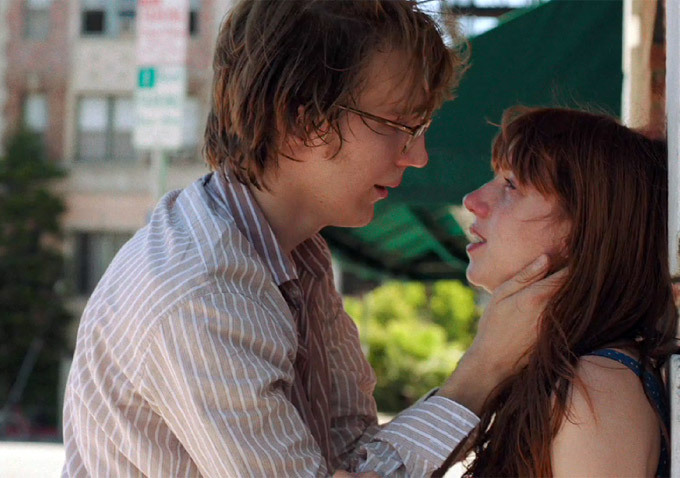
Zoe Kazan, the grand-daughter of legendary director Elia Kazan (“On the Waterfront”) and the daughter of two writers, has made a strong impression in small roles opposite Meryl Streep (“It’s Complicated”) and Leonardo DiCaprio (“Revolutionary Road”).  Her boyfriend is Paul Dano, whose performances in films like “There Will be Blood” and “Little Miss Sunshine” have earned him the reputation of one of the most thoughtful actors of his generation.  Kazan wrote and produced “Ruby Sparks” and they appear in it together.  Dano plays an acclaimed young writer who is struggling to follow his successful first book and is stunned and then captivated when the young woman he creates with his typewriter comes to life.

Did you know when you wrote the script that you would be playing the title character?

Kazan: Well, it wasn’t the title character when I wrote the script – that happened in retrospect, but yeah – I had a sort of flash of inspiration, not unlike Calvin . I had a dream and I woke up in the morning and the scenes of this movie were in my head and I wrote it down as fast as I could so I wouldn’t lose it and then showed those five or 10 pages to Paul and he said “you’re writing this for us, right?” It really hadn’t to occurred to me – and then it was completely obvious to me that that was what I was doing – so from that point on I knew I was writing for myself and I think it was…they were just such clear people to me that I didn’t think too much about us. It wasn’t until later when I was actually having to do it that I said “oh God, what have I written?”   For so long, I was just thinking about it as a writer but it wasn’t until the very last month of preparation that I even started thinking about acting it.

Both of them are really acting-challenge roles – people don’t like to play writers because they are sitting and looking at a piece of paper, and a lot of it is very internal.

Dano: Well, you just sort of take the basic building blocks that the script gives you.  In this case he’s gotten out of a long relationship, he does not have any friends—his brother, rather, is his only friend, he lives in a big house alone, he got a dog to try and help them meet people but that doesn’t seem to be working out, his father has passed away, and he’s had a huge success that he cannot follow up and has writer’s block and so those are all just great, great, great starting points to sort of then figure out, “okay, how do you feel about those things?” Because each of those is a big thing and a big feeling and you can start to figure out what happened before that, especially with his book and how he got into writing and what his relationship maybe with his father was like and with the ex-girlfriend– you just sort of build it up but you start with what’s on the page that’s given to you and then you just sort of fill in the blanks.

And Zoe, your character was almost like an acting exercise, somebody throwing things at you, ”now be this, and now be that.” How do you create a character, that is, when you’re playing something so changeable?

Kazan: Well, you know, the main thing that Jonathan and Valerie and I talked about in the writing and then in the playing of her was that we wanted her to feel very real, and we never wanted her to feel like a fantasy or like the idea of a person.  It was sort of like doing my preparation, like, “who is Ruby?” and finding things out about her as I wrote. She’s a very forthright person, and she’s sort of a person in charge of her own desires, she knows what she wants and she’s more straightforward than I am as a person, and there was some surprise in that,  especially when you started playing it in her rehearsal—where she lived, where her voice is where her energy is, she’s very front foot, very forward and I think a little more cat-like than dog-like. So, a part of it was just moving away from the writer’s head, which was all about the story and how these people interact and then moving into my body and then feeling who she was physically.  That was a real moment of discovery for me, which I wasn’t anticipating, because I sort of thought writing it, I would know everything, but I learned a lot just within the first week when we were rehearsing. The important thing for me with the changes that happened to Ruby me was that they feel like a related person but not the same – he’s changing her, he’s bringing out a different side of her, so, those things were fun to play because they were like an exaggerated quality. But you know, we were always trying to keep it grounded in reality.

Related Tags:


Actors Interview Writers

Interview: The “Little Miss Sunshine” Directors Discuss Their New Film “Ruby Sparks”

Posted on July 23, 2012 at 3:55 pm

Co-directors Valerie Faris and Jonathan Dayton are so smart, so dedicated, so creative, and so purely delightful that I found it hard to believe they are so good at showing us dysfunctional characters.  Their new film, “Ruby Sparks,” written by and starring Zoe Kazan, also stars Paul Dano, who played the sworn-to-silence teenager in their first hit, “Little Miss Sunshine.”  In this film, Dano plays a depressed author who has been unable to write following his very successful first book.  Prompted by his therapist, he creates an effervescent female character so vivid that she literally comes to life.  Faris and Dayton finish each other’s sentences, not interrupting each other, just a seamless flow of love, laughter, and ideas.

Dayton: We knew Paul and we met Paul was he was…what, 18?

Faris: First time we met him he was 18, an audition…

Dayton: And, we were trying to get “Little Miss Sunshine” off the ground and it took us so long to get that movie made and we were worried, oh my God, he’s going to be too old, and we knew he was such a great actor.

Faris: Such a special actor.

Dayton: We stayed friends and we met Zoe and Paul started dating her. And so when they came to us with a project with the two of them and it was the same producers as “Little Miss Sunshine.”

Faris: We almost accepted it on that alone.  We didn’t have the movie sold at that point, but we love the idea of a movie that stars two great actors – especially Zoe was an unknown quantity and that’s really exciting to be able to introduce a new actor to the audience, so.

Dayton: But then with the script. We just flipped over because I like the idea of doing a romantic story but not your traditional romantic comedy, and to do a film…

Faris: It was funny and we like that. It also had a comedy elements without particularly…

Dayton: But it was really about something, you really feel like I’ve had a full meal. Here, you can walk out of a theater and feel like you’ve been on this journey.

Faris: For us anyway, that’s what it was for us. Just even making the movie means to have those elements to keep our interest for two years, I think that’s sort of the test we use, it’s interesting enough for us to spend two years, hopefully it will be interesting enough for the audience to spend an hour and a half.

The climax of the movie is a very intense scene as the writer tries to keep his creation under control.  Was that difficult to film?

Dayton: Well, that was the scene that made us most excited about making this because we had never seen something like that in a movie and it was very intimidating and we didn’t know how to do it, but we knew that this was something we could sink our teeth into.

Faris: And it was also something that had to take place in the story, in this story you had to go there, you couldn’t get around it– but that didn’t mean we knew exactly what it was, it isn’t something that happens in real life, even though a lot of the other elements in the story are things that happen in real relationships, this isn’t is exactly what happens (although metaphorically it is) it was harder to sort of take the metaphor into reality, what would that be?

Dayton: As part of our regular process, we workshop films, scenes, so we workshopped that scene with other actors early on and then we acted out a lot ourselves.

Faris: Not all of that is on screen!

Dayton: Yeah, yeah, but a lot of it was – how dark does this go? We wanted it to be dark, but – I hate to even use the word dark because it is more than that; we wanted it to resonate.

Faris: Well, it’s painful, it’s going to a painful place – it’s dark, too, but I think it was more about the pain of him needing to let go of this thing that he created, and so we likened it to a binge drinker, just having to go to that point where you make yourself sick so you won’t do it again, so exploring that and trying to understand when he’s giving her these commands, does she resist him? Can she resist them? Or does she have to completely surrender? All those issues were a lot of what we did in rehearsal and it worked best to us if she had no control. And if he had complete control of her.

Dayton: And it was the one scene we couldn’t rehearse with Paul and Zoe in advance.  They feared it, Zoe in particular, and so we, in the script, had very little detail, we had workshop to so that and had been thinking about it for probably…

Faris: Months…

Dayton: Months and months…

Faris: A year, but not that specific…

Dayton: So, it wasn’t until the morning before we shot

Faris: The morning of the day we shot…

Dayton: Yeah, that we sat down, we wrote out what he was going to make her do…

Faris: In our pajamas at the breakfast table…

Dayton: …and then we gave it to Zoe and Paul and they did it and it was good – it was tricky, because they’re a couple in real life, as you know, and so you don’t want Paul doing certain things that are tinged with any relevance to their relationships…so these had to come from us…

Faris: We had to give him those commands.

Dayton: It’s like when you have actors doing a sex scene; you always have to tell them exactly what you want to do, “Put your hand on their butt,” because you don’t want the actress thinking the guy is putting his hand…

Faris: That he’s doing it out of his own volition, you want it to be the character doing it…

Dayton: The thing that was amazing to us in terms of that, Zoe just threw herself into that, she didn’t want to think about it beforehand, but when she went to do it and perform it, she gave it her all – to the point of, we would give her these commands and she would have to repeat them and do them until we made a loud sound and she would switch into the next command, and so on the last take we really pushed her, because part of it was her exhaustion and he was pushing her to her limit, so we really pushed her, and I remember watching that scene and thinking, “I think we have a movie now.” It was the first time—you’re kind of adding the scenes up in your head—and watching her perform that, I just felt like she gave every bit that she had to give to it.

Faris: Which is ninety percent of that scene, is that one take where she just sort of went for it it—and we shot her side of it, first, so Paul got to see what he did, which really helped him on his side of it, but it was hard to watch her and not know what he was going to do with it, and then when we were shooting him, we really needed him to feel as much pain as she was…if he was doing it in a cold manner throughout the whole scene, it would—and you know, through editing, too, you pick all the moments where you feel his pain the most, so a lot of it was in the shoot and on the set and then in editing. It’s amazing how much you can change the scene in the  and kind of calibrate how much pain you dole out and where you pull back and then the music is another element that really…

Tell us a bit about the music in the film.

Dayton: The soundtrack is really such an important part of the movie, and we worked really hard. It was the same composers we had on Little Miss Sunshine, but it’s an entirely different kind of score…

Faris: You know, it’s funny because small movies have ‘smaller sounding scores, indie-kind of sounding scores, and we decided we really wanted to go for a big sounding score.

Dayton: So we had like a 60 piece orchestra, and it was so much fun.

(more…)

Related Tags:


Directors Interview

Interview: Jade Pettyjon of the New American Girls Movie: McKenna Shoots for the Stars

Posted on July 22, 2012 at 3:48 pm

I absolutely loved the new American Girls movie, McKenna: Shoots For The Stars.  Based on the stories about the American Girl of the Year doll for 2012, a young gymnast. So it was a treat to get to interview the girl who plays McKenna, Jade Pettyjohn.  Her co-stars include Nia Vardelos of “My Big Fat Greek Wedding,” who plays her mother, and real-life gymnastics champion Cathy Rigby, who plays her coach.  In the movie, McKenna’s challenges include an injury and a learning disability but her family and friends provide a lot of support.  I especially appreciated the way that kids with disabilities are portrayed — in addition to McKenna’s learning issues, her tutor is in a wheelchair — it is frank and sympathetic but not at all condescending or marginalizing.

I have one copy of the DVD to give away!  If you want to enter, send me an email at moviemom@moviemom.com with “McKenna” in the subject line and tell me your favorite doll.  Don’t forget your address!  (US addresses only.)  I will pick a winner on July 28.

What was your audition like? And how did it feel to get the part?

It wasn’t a gymnastics movie when I did the audition.  They didn’t want to give away the idea, so I thought it was a dance movie.  They gave me lines to memorize and had me read them with the casting director.  I was in the car when I found out I got the job and so I couldn’t jump up and down but I was super-excited!  And it shot in Canada and that was really exciting because I had never been out of the country before, so that made it even better.

My favorite thing in the movie is the way it portrayed the friendships between the girls, even those of different ages and those who were competing against each other. Are your friends like that?

My friends don’t have as much drama!  But I liked that the characters in the movie all made up in the end and were better friends.  And the girls on the film had a lot of fun together on set and off set.  We would invite each other to where we were staying and watch movies and have classes with my mom and we celebrated Canada Day and watched the fireworks!

It was great to see disabled characters in the movie.  Do you have disabled friends?

I do.  I was  in a group called Kids on Stage for a Better World and one of the girls was in a wheelchair.

What surprised you about working on the film?

I knew gymnastics was hard but I did not know how much hard work and dedication it takes.  I was amazed by it.  I did a little bit before.  I could do cartwheels and a few things but they flew me out a few weeks before so I could learn the gymnastics.  One thing me and my character have in common is that we both love to make something come out right and work until it is perfect — for me it’s acting and for her it’s gymnastics.

What movies do you like?

It changes but right now I love “We Bought a Zoo.”  And I love “The Help.”  And the “Step Up” movies.  I am so excited for the new one!

You wore some great clothes in this movie!

I loved my characters outfits and stuff.  They were amazing!  I loved the dress at the end.  But it was really hectic on set and I had seven or eight costume changes in one day!

Did Cathy Rigby give you any pointers?

She is so amazing!  She is my role model.  I love her!  She helped with double cartwheels and splits — it was really cool to work with her.

What’s the best advice you ever got about acting?

It is really important to understand every word in the script.  I’ve learned a lot of new vocabulary words that way!

What do you want people to learn from this movie?

I want them to learn that it is important to have balance, a little bit of this and a little bit of that.  You can’t do just one thing because you might stop loving it and getting fun out of it.

(photo credit: Jessica Pettyjohn)

Related Tags:


Actors Based on a book Contests and Giveaways For the Whole Family Interview School Sports Stories About Kids Tweens

Interview: Lauren Greenfield of “The Queen of Versailles”

Posted on July 12, 2012 at 8:00 am

Lauren Greenfield is the director of the new documentary, The Queen of Versailles, the story of Jackie Siegel and her husband David, a monumentally wealthy couple who were building the largest residence in the United States, a 90,000 square foot mansion with ten kitchens, a baseball field, a spa, and two tennis courts.  While Greenfield was filming, the financial crisis hit the Siegels and like millions of other Americans, they were suddenly and unexpectedly at risk of losing their home.  It is just that their home was modeled on the palace that Marie Antoinette and Louis XVI lived in before the French revolution.  Greenfield spoke to me as she was in town for the Silverdocs film festival and was preparing to show her film to the Secretary of the Department of Housing and Urban Development.  David Seigel’s fortune comes from the timeshare company Westgate.

http://www.youtube.com/watch?v=bqDreqlPe98

Where are the Siegels now?

Jackie was here at Silverdocs last night and she’s on a road trip with her kids, a vacation road-trip. I asked if it was a downsized vacation and she said “kind of,” but she stopped at Saks Fifth Avenue and went to Chanel and Westgate is continuing to make sales, and David says it’s very profitable. At the end of the film Richard, his son, says, “If he gives up the keys to Vegas, the lenders will continue to lend and they can go back to making money, and he can go back to his life as it was.” Some of that has happened, the lenders have continued to land and so the rest of the resorts are making money and they are still in debt (I think they have estimated a few years to get out of debt). And David would like to start construction on the house again.

He’s such a good businessman in so many ways and yet he was very foolish about not segregating his own assets from the company’s and that put him under a lot of financial pressure he’d really didn’t need to be under.

Vegas was such a gamble and in a way such an irrational gamble, I think was part business and part emotion because he was also thinking about the $2 billion he was going to make there and was kind of holding onto that as his crowning achievement. He also had the Westgate name and lights brighter than anything else on the strip, perfect spot on the strip, and then the legacy of Vegas with his parents and then perhaps the other legacy of their gambling which ultimately kind of brings that dream down for him.

How do you as a film maker state close to a family like that over such a long period of time and yet maintain some objectivity? It must’ve been very difficult, particularly as you observe the way they behave with each other.

In a way that’s my modus operandi. I feel like I have that perspective in all my work and in my photography, too. I do get really close to the subjects, but I also am always kind of looking at things from a sociological perspective. I think with Jackie and David’s story – I could feel a lot of compassion for them and I really liked Jackie a lot and respected David.  The original premise of the film I really saw it as allegory that represented what happened to so many Americans. So, I saw their virtues and their flaws as speaking to our virtues and flaws as Americans, too, and so I guess I solve them as individuals and also sort of symbolic. I am able to kind of get close to people and be there on a day-to-day basis but also step back and look at “what does it mean, what does it mean for us in the context of the bigger picture, eventually the allegorical picture?” With that said, some of that comes with living with the footage.  I filmed over a three-year period and I cut over a six-month period in that process would show mentors and other editors and I went to the Sundance lab with the film, so I also had a chance to kind of step back, how do people react what do they get what do they not get?  But in terms of my view I was always looking at them as both incredibly fascinating characters, incredibly fascinating story and also kind of a symbolic one; that in a way is a viewpoint in all my work.

I just don’t take on being an interventionist in the work. I feel like in a way this is a social issue film, it’s about the housing crisis, it’s about our culture of consumerism. I feel like it’s a morality tale that also speaks to the consequences of access, but I would never take it upon myself to intervene. I try not to judge, too, and I think you can see that in the perspective of the film that I am kind of there, and let’s step back and see what it means.

Tell me about the decision to include in the film the incredibly poignant commentary from Virginia the nanny about her own situation.

The minor characters are always important to me, and even before when they were building the house, when I thought this was going to be about the building of the house, I was interested in the upstairs downstairs quality of the house and the kind of different cultures, different classes all living as a kind of unusual extended family and with Virginia and with Cliff and with Jonquil , I was really interested in showing other experiences of the American dream, both their similarities and their differences. So, Virginia has a tragic story about not seeing her kids for over 20 years now. And yet, I think her story also speaks to so many people stories about coming to America to find fortune and Virginia is a salaried employee, her two other colleagues have gone back to the Philippines and yet Virginia chooses to send all her money home and not go there herself. I think she would like to, she was actually saving for it but her mother died and there was a funeral to pay for.  So, these are really hard choices. I saw a parallel, too, between Jackie and Virginia because money was the reason both of them were not doing direct parenting. So, I guess I saw a lot of relationships and when Virginia said her dream was to build a concrete house in the Philippines, that was really poignant to me, and I also got the sense that she thought it was hard to go back if you didn’t have something to show for it – in other words, she could afford the ticket, but she couldn’t afford to go and give everybody money, and she didn’t want to go back without that. Again, I think that story speaks to the virtues and flaws of the American dream and the importance of money. She works seven days a week she has another job on the weekends at the supermarket.

What does Jonquil bring to the story?

Jackie’s niece and adopted daughter Jonquil is another story; in a way, she represented Jackie’s experience because she came from Binghamton, but overnight she went from poverty (she came from a poor family and her mother passed away and Jackie took her in) to the mansion overnight, and also has a down to earth, quirky character. What was interesting was to see her evolution because she kind of goes from “I can’t believe I’m in this house” and Victoria—her sister now talks about how she’s had this positive influence on all the other kids so they won’t be spoiled.  By the end you can see how she is  when she says, “When I used to see rich people on TV, I thought I’d be happy, and now I see I just want more and more” and so that, to me, really speaks to the whole story.

Have you been surprised by people’s reaction to the film?

I’ve been really pleased that people have found them relatable. Not everybody does, but most people tell me that they don’t expect to in the beginning, and they’re surprised to find themselves in the end. I feel like that is really what I wanted to get through because I think there’s no point in a film where you’re like, “Look at them and their bad decisions!” It’s really only valuable if you’re kind of like, “Did I spend too much on my credit card? How am I complicit in this?”  It makes the movie more compelling if you understand them or care about them.


Related Tags:


Directors Documentary Interview
THE MOVIE MOM® is a registered trademark of Nell Minow. Use of the mark without express consent from Nell Minow constitutes trademark infringement and unfair competition in violation of federal and state laws. All material © Nell Minow 1995-2026, all rights reserved, and no use or republication is permitted without explicit permission. This site hosts Nell Minow’s Movie Mom® archive, with material that originally appeared on Yahoo! Movies, Beliefnet, and other sources. Much of her new material can be found at Rogerebert.com, Huffington Post, and WheretoWatch. Her books include The Movie Mom’s Guide to Family Movies and 101 Must-See Movie Moments, and she can be heard each week on radio stations across the country.

Website Designed by Max LaZebnik