
Interview: Eugene Jarecki, Director of “The House I Live In”

Posted on October 12, 2012 at 8:00 am

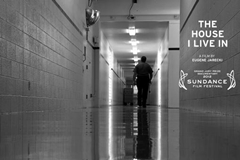
Eugene Jarecki’s new documentary about the failure of the drug wars by any standard — economic, practical, moral — is a powerful and sobering call for treating drug abuse as a public health problem and not a criminal problem.  I spoke to him about the film, his decision to include a very personal story, and what he has learned about programs that are more effective in addressing the problems caused by drugs.

You begin with a home movie about your own family and bring in a very personal story of drug abuse in a family close to you, unusual choices for a documentary about an important public policy issue.  Why did you do that?

You ask yourself at a certain point when you’re making a film of this kind whether and how to be most honest about the role that you are playing as a pursuer of this information in these stories.  Sometimes staying very much out of the way has its place, particularly in a movie like this where there are so many characters and there’s so much to tell.  It seems like a clumsy vanity that I would be in the movie at all. I would have thought, “What business do I have being in this movie when the people who really need to occupy screen-time are the people whose the stories will appear in the film, who have so much to say about this broken system, whose lives are such a testament to its carnivorous behavior?” So what role do I have? And then at the end of the day, I played that game for a long time, but I was making a movie where it was very hard to understand what was the modus operandi of the filmmaker, because these stories were chosen in 20 or 25 states; they were all over the place at all levels of the war on drugs.  When we would do early screenings for our friends and in the editing room it felt a little bit like there is a driving force in this film that is inside Eugene’s feelings about the country he lives in that is somehow missing here—and how do you inject a little bit of that without getting in the way at all? And so it meant the occasional glimpse of me as a pursuer of this national story, of trying to unravel this national mystery as well, was at least a role I could play.  But to have me in there at all, of course, that brought up the fact that I had a deep, intimate, personal relationship with one of the stories I had been telling.  In my early cuts in the film that early on, Nannie Jetter appears in this film just as a character, with no mention of the fact that I had an intimate reason for being interested in her. So that changed.

As a filmmaker, I’d like you to talk a little bit about the sometimes glamorous images that we see of the drug world in films, mostly fiction from feature films like “Scarface” and “American Gangster,” but also television shows.
Don’t lump “American Gangster” in with other movies that have been made about the drug war in America because American Gangster is already a post-modern take the drug war in that it is a movie that understands what my movie understands. It’s a movie made from a very critical perspective, where Steve Zaillian’s script really examines the war on drugs and the hypocrisy and the humanity of it all with a lot of wisdom,  I was very impressed by “American Gangster,” particularly for a Hollywood movie. It’s hard to get good substance through Hollywood. Hollywood is a town driven by fear and by economics and the people in it, unfortunately whatever their inner politics are, they tend to make movies that portray images that are serviceable to some exploitative vision of industrialized film-making.  So you end up seeing over and over dehumanization in the service of making a big box office, and the movies tend to exploit that in us which is our least and our worst rather than looking for that in us which is majestic and human. And so what I can do if I have my little camera and my little team and the idea of a movie, is to be an antidote to that, and to try and portray majesty in the human condition.  That includes the majesty of a survivor like Nannie Jetter who survives slings and arrows I couldn’t imagine, or the majesty of a security chief in a prison who finds a way from his position of power to nonetheless risk his own job in talking to me and being so candid, to people up and down the chain of command who, in one way or another, demonstrate tremendous personal reserves.  That’s the best antidote I can give to the dehumanized, cartoonish portraits that the industrial system produces.

You’re quite right about the conclusion of “American Gangster,” but it does perpetuate this notion of the kind of glamorous, killing machine that is at the root of drugs and I think is often part of the popular perception.

Yeah, but it does that in the middle of an argument that the U.S. government aided and abetted the injection of drugs into the inner cities. This is an extraordinarily dark aspect of the American story, one so dark I was probably too cowardly to go into it in my movie, and yet that movie, for all of its other Hollywood tropes, notwithstanding that, went into some very intense territory there.  And I don’t think portrays Frank Lucas as a hero. I think it portrays Frank Lucas as a human, and as such, he does some stuff which looks and feels like a movie because there’s killing and there’s cut-throatedness, but he also is a human being trapped inside a cycle of ongoing degradation and despair in the African American community. So for him to want to get his, but he does so at the expense of his own people.  That is the bitter irony of that character and it is a super-sensitive movie to have understood that.  Look, Hollywood is what it is, it needs to sell some tickets, they’re going to do certain things that are conceits that are time-proven, and I don’t want them to do that. But if you gave me the choice to not have a movie or have a rather substantive movie like “American Gangster” that’s going to have just enough of those to get over and get some box-office, I’ll probably choose the second because this needs to be more talked about, not less, and I’ll lose my religion over some of those details.

You have mentioned Portugal as a good counter-example to the US approach of criminalization.  Tell me a little bit about what they do well.

They pursued wholesale decriminalization, and you can Google the statistics online. The statistics of success in Portugal, in the early phases but relatively substantive phases of their process, are exemplary. And they speak to the possibility, they speak to what all of us would know to be the case, I mean, we’ve learned in New York City for example, that one of the primary determining factors of why New York City has a reduced crime rate over what it had in the past is that New York State is one of the only states in the country that has actually reduced its prison population. We know in this country statistically from criminology that the prison is criminogenic, that prisons create more crime. So this mass incarceration system creates a spiral towards increased crime and increased incarceration, and when you reduce it, you defuse that spiral, you de-energize that spiral and so when you see other countries in the world that, from a starting point, don’t have our commitment to mass-incarceration and from a starting point do not have industrialized systems of mass-incarceration like ours, you already see that they don’t have that kind of explosive tragedy unfolding and that means their spiral is not getting worse and worse all the time as ours is.

You touch on some very important stuff in the movie, the follow-the-money incentives, like federal programs now that reward local jurisdictions based on the number of drug arrests that they make.

Michelle Alexander talks about them in her book, The New Jim Crow, and she talked to me quite a lot in our interview with her, that stuff was a little bit in the weeds, it’s so specific. But yes, the grant programs that reward police departments for increased drug arrests create a climate of incentivized, low-level law enforcement harassment, so it should be no wonder, for example, that in New York City, we have several hundred thousand stops a year, 350,000 of them become frisks. Of these, 90% of these people are young blacks and Latinos.  Of those 350,000 frisks a year, only 10% lead to an arrest. So 90% are just harassment.  This is a grotesque system. So once you know that that’s at work, this has to be stopped.

Are there any politicians who are on-front in this issue or are they all terrified?

Congressman Bobby Scott is an exemplar on the matter of the drug war. Senator Jim Webb, who could not get sufficient support for his omnibus crime bill, but should, and should be given support for the setting up of a blue-ribbon commission to study our criminal justice system and overhaul it.  Cory Booker’s one of the leading voices against the drug war in the nation and from his mayorship in Newark.  And there are others across the country in their small ways, here and there, who matter deeply and who’ve gone up against the country’s drug policies. And the occasional judge will do that, and the occasional public figure will do that, but of course, it’s far too few. The real headline is, it’s far too few.

What do you think the fascination is with shows like “Weeds” and “Breaking Bad” in glamorizing small-time drug-dealers?

I think people are fascinated by drugs in America. We’re one of the most addicted countries in the world for a lot of reasons. I think drugs are a place that despairing people find solace in and escape, I think there’s an increasing level of despair in this country over a sense of existential meaninglessness. The point of being a country has been undermined by capitalism in this country.
Related Tags:


Directors Interview

Interview: Matthew Heineman of the Health Care Documentary, “Escape Fire”

Posted on October 11, 2012 at 6:56 pm

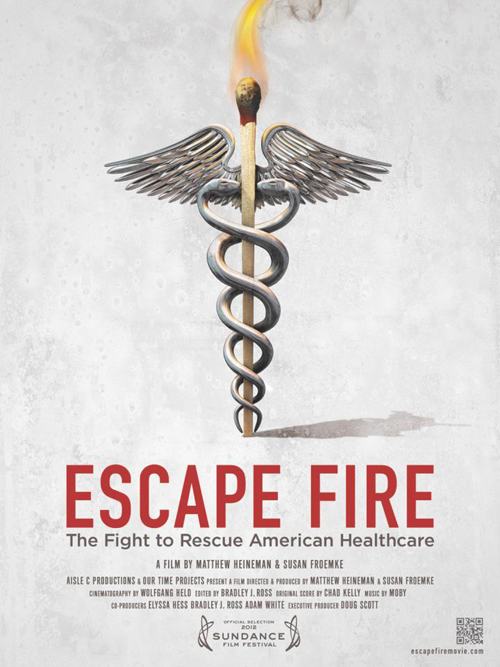
“Escape Fire” is a new documentary about what does not work in our system for preventing and treating illness, and what some people are doing to make it better.  I spoke to Matthew Heineman, co-director and co-producer of the film.

Tell me about the reactions you have been getting from people who see this film.

I think one of the most inspiring things for us is to really see what happens when a local community screens the film. Just two weeks ago we screened the film at 62 medical schools across the country, all on one night.  There is an outpouring of optimism, that this is a problem that we can fix, a problem that we don’t have to wait, necessarily, for someone to come in from Washington, that change can really happen on the local level, sort of doctor-by-doctor community, system-by-system, and that’s how change can happen quickly.  One of the real goals of the film is to transform how our country views health and habit.  Medical school is the future, so their response is important.  We also screened last week at the Pentagon, hosted by the U.S. Army Surgeon General, and have sort of a room full of leadership generals and medical leadership at the Pentagon. And again, they recognize this problem that they have with over-medication, recognize that the status quo’s not working, and the Surgeon General said herself that she really thinks that this film can help change the culture of medicine in the army to begin with, but hopefully with the military at large. So it’s pretty amazing, we’re already seeing impact happening.

A big light-bulb moment for me comes fairly early in the film when somebody says, “We don’t have a healthcare system, we have a disease-management system.”

We did 6-8 months of research on the topic and almost everyone was saying that.  It’s a system that profits from sickness, not on health. 75% of healthcare costs go to preventable diseases, so how did this system come to be? Why did it not want to change? We wanted to try and find people out there who are trying to change it. Just to quickly mention one thing I didn’t say about your first question,

It seems to be that the problem which you touch on in the last part of the film, the inevitable corruption of corporate money and politics, is the real insoluble problem.  You can have the good will in the world and you can have all the data in the world, but when people are getting paid hundreds of millions of dollars under the current system, it’s very hard to get them to change it.

There’s no question about that.  As Andrew Weil says in our film, there’s rivers of money flowing to very few pockets, and the owners of those pockets don’t want to see anything changed.  I think what’s different now, and one of the reasons why we made the film is that things can’t get any worse.  We’re spending 2.7 trillion dollars a year on healthcare. That’s just a number, but when it comes down to individual companies or healthcare systems or cities or towns or small businesses or individual people, it’s bankrupting us. So, we’re being forced to change, we’re being forced to adapt, because what’s happening now is unsustainable.  We see that with the military in our film, we see that with Safeway Corporation in our film, we see that at the Cleveland clinic, that these major institutions are being forced to change, and so I think, yes, the system is making a lot of money out of the way things are, but many of the players in the system recognize how unsustainable it is and thus are being forced to change.

Your movie makes the case that when you spend more money it doesn’t necessarily correlate to better outcomes.

That was one of the most eye opening things for us.  In America we have this fascination with faster, bigger, better, now; we want the quick fix. We want that pill, we want that procedure, we view healthcare as something that somebody gives to us or does to us or something that we put in our throat, and I don’t think we really recognize that more isn’t necessarily better when it comes to healthcare, that more can often hurt us, that there’s this term called ‘over-treatment.”  We reward for quantity and not for quality. Doctors, we pay for the diabetics to get their foot amputated when they’re 60, but we don’t pay for simple nutritional counseling when they’re 20, 30 or 40 to prevent that from happening in the first place. It’s just a perverse system.

What got you interested in this as an issue?

We started the film three years ago just as the healthcare debate was heating up, and I think like many Americans we were just confused by the traditional media coverage of the topic, I mean, it was so hyperbolic and so confusing; healthcare was really dividing our country. So, I think we really wanted to try to understand, systemically, how it was broken, why it was broken, but also highlight people out there who were trying to fix it.  So many films like this are just polemics, that you walk out of there, head hanging low and just hopeless, and I think we knew from day one that we didn’t want to do that. We also knew from day one that we wanted to have real, powerful human narratives that would provoke audiences to want to keep watching.

What can a movie do that an op-ed or book or politician could not do?

I’m obviously biased; I’m a film-maker. I think documentary film has the power to really bring an issue that to life, with real human stories in a way that facts or articles or tweets don’t or can’t.  What we really tried to do was make a film that would not only move you intellectually but move you viscerally.  We look at healthcare through a number of different lessons and through a number of different characters that I think almost anyone in American can identify with, at least one, two, three or all of our characters in this film and say, “I know somebody like that,” “that’s sort of like me.”  It is just the power of film to associate at a more visceral level with an issue. I think that’s what documentary has the power to do.

Why did you choose to name the film after a technique for stopping a forest fire by setting a small controlled “escape fire?”

Escape fire is a metaphor between our healthcare system and a forest fire from 1949 that happened in Mann Gulch, Montana.  The fire fighters were filled with hubris, with the latest and greatest technology, they thought they’d have it beat by 10 o’clock the next morning—then the wind shifted directions and they found themselves running down this hill for dear life.  The foreman, the leader of this group, came up with this ingenious idea on the spot, where he lit a match and he burned the area around him to consume the fuel, so that when the fire came over to them, he’d be safe in what is now known as an “Escape Fire.”  He called to allow his fellow smoke-jumpers to join him, but nobody listened, and they kept running up the hill.  They all died, but he survived, basically, unharmed. And I think it’s a really powerful metaphor because it shows that the status quo is so strong, especially in healthcare, it’s so easy to keep doing what we’re doing, and we’re making a lot of money continuing to do what we’re doing, but we really need to look outside the box and think outside the box to come up with an escape fire for our system.  Otherwise we’re doomed.


Related Tags:


Directors Documentary Interview

Breitbart Documentary Delayed Over Dispute with MPAA on the F-Word

Posted on October 10, 2012 at 9:28 am

A new documentary, “Hating Breitbart,” has delayed its release as the producers argue with the MPAA Ratings Board over the “f-word.”  According to the Hollywood Reporter, the film about the late conservative provocateur and internet mogul Andrew Breitbart was originally given an R for language that includes various epithets and the use of the f-word by and about the controversial new media pioneer.  They removed many of the f-words used by other people, leaving in four f-words used by Breitbart, and resubmitted the film, but were unable to persuade the ratings board to give them a PG-13.  Director Andrew Marcus told the Hollywood Reporter, “I scrubbed everybody else’s use of the word except for four by Andrew, because it’s essential to who he was. He was passionate, and he wasn’t polished.” They cited other PG-13 films that had strong material as precedent, but the MPAA has always resisted appeals based on ratings given to other movies.  Marcus says he will release the film next week with an R-rating if he is unable to get a PG-13.


Related Tags:


Understanding Media and Pop Culture

Hear the Director’s Commentary on “Looper” In the Theater

Posted on October 9, 2012 at 5:04 pm

It is not unusual for DVDs and Blu-Rays to include director commentary, but it is unusual to listen to the director’s comments in the movie theater.  “Looper” director Rian Johnson has recorded director has made an audio guide to the film that can be downloaded to an mp3 player or phone and listened to as you watch the film in the movie theater.  According to Slate,

For those still puzzling out the film’s twisty and twirly timeline, Johnson reveals some of the finer mechanics of how the plotting works. He also confirms that the clumsy henchman Kid Blue (Noah Segan) could be Jeff Daniels’ characters’ son—or at least that he’s long enjoyed that theory. And we hear about some of the scenes that didn’t make the final cut: For thoselooking for more of the “My Dinner With Me” scene from the diner, Johnson suggests that there will be much more on the DVD.

For those interested more in the magic of moviemaking, Johnson is particularly open about revealing his intentions—and explaining technical decisions in a way that’s not too wonkish.

And he also points out some insider details — his own parents appear in the film and he has inserted a reference to his groundbreaking earlier film with “Looper” star Joseph Gordon-Levitt.  A nice way to sell a second ticket to the film — but please, use earphones!

Related Tags:


Directors

Interview: Dee Wallace, Elliot’s Mother in “E.T.”

Posted on October 9, 2012 at 8:00 am

It was so exciting to talk to Dee Wallace about her role in one of the most beloved films of all time, E.T. The Extra-Terrestrial in honor of the 30th anniversary of the film’s release.  To celebrate, there is a new anniversary edition with an E.T. Spaceship available for a limited time only.  Ms. Wallace talked to me about how she got the job and why director Steven Spielberg picked her, how she bonded with the children, and how her character change the way mothers were portrayed on film.

Did you audition for this part?

Actually, I auditioned for another film that Steven did called Used Cars. I didn’t get that one, I’m happy he saved me for “E.T,” He said it was because he thought I was very child-like. He wanted everybody in the film to be child-like, so when “E.T.” came along I just got the offer.

The book version says that E.T. was in love with you. Did you feel any of that as you were shooting the movie, that he had kind of a crush on you?

Actually, there was a whole ‘B’ story about that, most of which got cut out of the film. The only part that’s really left was when he comes in and puts the Reese’s Pieces down on my table.  There was more of the ‘B’ story where E.T. was fascinated with Mary, but Steven (and I think rightfully so) thought that that took the focus away from what the film was really about.

What was the hardest part of making this film? Was it working with the mechanical creature?

Oh, not at all. You know, it’s so funny, everybody asks me that question and truly—it was like working with another character. They kept the hydraulic eyes working, kept him alive all the time.  We never saw people getting in and out of the suit when there were people in there.  I think that was largely for the kids, to keep him really real and alive for the kids, but it sure did help me, too.

You had fantastic chemistry with those kids.  What did you do to connect with them and make them feel comfortable with you?

Well thank you, that’s a lovely compliment. You know, I don’t know—we just were. We did spend time together, we definitely bonded. I would play basketball sometimes with them and help them with their homework and stuff like that, but I think it’s the magic of what happens on a set when you really commit, you know? And I wasn’t a mother when I did E.T., but we’ve all had mothers, so we know what mothers do, and what mothers do is they love you no matter what, and part of the way they love you is by telling you you shouldn’t be doing things and protecting you, which is what this was all about for me. It’s just loving these kids. And you know I think I’m correct in this that I was the first single-mother in a major feature film back then.

You made a very specific character, she wasn’t just the usual movie mother. You had that slightly frazzled element of the single mother, and I thought you really captured that so well.

I have to say that I didn’t pattern this on my mother, but that’s who my mother was. My father was home, but he was an alcoholic and very non-present, and so my mother was always trying to figure out how to get us up, get us to school so that she could take the bus to work. She took the bus home, and how could she make dinner before she collapsed at night, and still somehow took me to ballet lessons and stuff like that.  I watched a mother who was frazzled all the time who loved her kids beyond words.

I want to ask you about one of my favorite scenes in the movie which is Halloween, and your costume for Halloween. That’s what I immediately thought of when you said you mentioned the child-like quality, the fact that you were a mother and you dressed up for Halloween really drives that home. Can you tell me a little bit about that costume, did you work with a designer on that, or how did that come about?

Deborah —the woman who did all the costumes—created that. We tried on several different things, none of which I can remember right now, but we all thought the cat-woman thing was cute, with the ears.  Also, Steven wanted to have it a little bit sexy, too, and so that outfit seemed to work on all different levels.  And I really loved it because it really made me look skinny—the most important thing, you know!

Between getting an Oscar and looking and skinny, I think we’d all pick looking skinny.

Well, I’m not so sure about that one, though. I would like to look skinny while I’m getting the Oscar!

That would be the ultimate. And what is the best advice that Steven Spielberg gave you about making the film or about doing your part?

He said, “Be real,” which is not hard for me, because if I’m not real, I feel really yucky.  Eww, I feel like stuff is crawling all over me if I’m “acting.” Sometimes in the middle of a take, I’ll just stop and I’ll go, “Wait, I have to find out why I’m acting…” and the director often-times has, “What, are you kidding? It looked great.” There’s something that’s not real that I’m trying to do because I’m not quite sure what it’s about, and when I find that, it shifts everything. Then, the director will go, “Oh my God, I see what you were talking about.” So it’s an inside-job thing, but it’s really important to me to always really be real and truthful to what that moment is.


Related Tags:


Actors
THE MOVIE MOM® is a registered trademark of Nell Minow. Use of the mark without express consent from Nell Minow constitutes trademark infringement and unfair competition in violation of federal and state laws. All material © Nell Minow 1995-2026, all rights reserved, and no use or republication is permitted without explicit permission. This site hosts Nell Minow’s Movie Mom® archive, with material that originally appeared on Yahoo! Movies, Beliefnet, and other sources. Much of her new material can be found at Rogerebert.com, Huffington Post, and WheretoWatch. Her books include The Movie Mom’s Guide to Family Movies and 101 Must-See Movie Moments, and she can be heard each week on radio stations across the country.

Website Designed by Max LaZebnik