Interview: Ben Affleck, Director and Star of “Argo” (Part 1)

Posted on October 14, 2012 at 3:11 pm

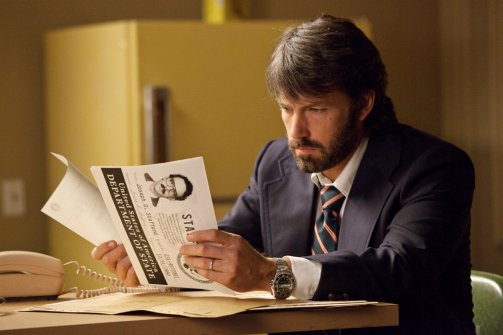
Ben Affleck directed “Argo,” the incredible story of a real-life 1980 CIA rescue mission, and he plays Tony Mendez, the “exfiltration” expert who came up with the idea to create a fake Hollywood film production company and get the six American out of Iran by convincing the people who had captured 52 other State Department employees that these six were members of a Canadian film crew, scouting locations for a big sci-fi/fantasy film.  I spoke to him about the movie with a small group of journalists, the day after a screening attended by some of the real people rescued by Mendez.
You did something really remarkable in combining what is really two movies with two completely different tones in this film.  How did you put that together so skillfully?

Well, I wish I could say it was my own skill, I don’t think it was.  They’re really smart actors, they kind of looked at the material on the page and did me a favor of playing it honestly.  Because it was played realistically it kind of blended anyway. If it hadn’t, I suppose I would’ve had a bunch of conversations about how we were going to get the jigsaw puzzles to fit, but all the parties, Bryan Cranston, John Goodman, and Alan Arkin were really pretty adept.  They knew how to play it real, and that kind of saved my bacon.

Did you anticipate that there would be so much connection to current events and what do you think the movie can say about where we are now?

I was kind of stunned, naturally, just to see that the material that I looked at for research from 30 plus years ago all of a sudden was looking exactly like what was on the evening news.  That surprised me and it surprised everybody and obviously, it was just a terrible thing for everyone. I expected the movie to be resonant to the sense of what happens when the United States gets involved with the government of another country and overlooks some of the negative things they may be doing because they’re pro-Western, the unintended consequences of revolution, those are the kinds of things I was anticipating. What it ended up being more about, in some ways, was an homage to our clandestine service and our foreign service folks, who, as illustrated by these tragic events do a lot, sacrifice a lot, put themselves in harm’s way, give up a lot to go overseas.  Our Foreign Service folks are doing a lot and making a lot of sacrifices for us, and sometimes it’s even the ultimate sacrifice.

It really seems like you shot it as if it was a film made in the 70s, starting from the old Warner Bros. logo. 

I thought it would be a trick of the brain, where, if you’re looking at a movie that looks like the kind of movie that was made in the 1970’s, it’s easier for the brain to subconsciously accept this notion that the events they’re watching are taking place during that period. Now, you can’t do that if you’re doing a movie about the Revolutionary War, but that’s why we had this interesting advantage. Even better, that era that I was trying to replicate, to sort of fool the brain, was a really great era for film-making, so I got to copy these great films and great film-makers, Lumet, Pakula, Scorsese.

How does it complicate things when you’re making what is basically a living history film, knowing that the people who were really there will see it?

It’s about a whole story, you know, and you have to maintain the integrity and the honesty of the spine of the story. That’s one profound responsibility because.  I want them to look at it and say, “Yeah, that’s basically it.” Now, the real takeover was four hours long, and we have five minutes. That’s the kind of thing that we need to do to sort of compromise. It was raining in the real takeover, it’s not raining there. There are some details that are naturally changed. But the essential spirit of it, that has to be preserved. You know somebody did find a picture of Khomeini with the darts in it and say, “Who did this?”  They really did blindfold people and things like that. I also have a responsibility to make a good movie, to tell a good story, because that’s what I do, and so those two things are constantly intentioned with one another, because I want to make it true, but I gotta make it good, you know?

How much was changed for dramatic purposes?

The main change, really, is the cars in the runway. They got to the third checkpoint, they got through, that was all the same, and they got there and sat there and they said, “Well, your plane has been delayed.” I thought, “Well, we’ve all been through that!” And then they got on the plane and left, and so in an effort to sort of externalize that and make the third act work, I added the sort of, them just barely getting away, when in fact they got away a little bit more ahead of the wire. But that really, fundamentally, in my view, doesn’t change the story. The same things happened, you know?  It was a close-call in terms of trying to get out in terms of their own deadline. Most of the sins, really, in terms of story-telling, are sins of omission, you know? Not being able to include the fact that Pat Taylor got money from her co-workers or that in Ottawa they approved this special session to make these passports that had never been done before.  You have people who are all alive, there’s a natural tendency to feel like, “Well, this is my story.” So you have to sort of do everyone’s story justice, and also take into account the sort of Rashomon phenomenon where you hear slightly different accounts from different people, and definitely maintain the realism of it while not sacrificing what’s really interesting about it.

What movies of the period ended up inspiring elements of this film?

There were a lot of them that I had seen and I still watched again, and I liked “The Thing” for my hair, and I liked Killing of a Chinese Bookie, the Cassavetes movie, for the sort of seedy LA, I just loved the look, the feel, the way they use zooms, the way it felt kind of raw but you also realized it was choreographed—and I didn’t expect to see that coming. There’s a movie called Let Me In that I watched, that’s really good, a guy named Matt Reeves directed it, the remake of the original one, and I thought it was really well directed and watched it with my DP, and we were looking at stuff that they did with focus in that movie, you know, keeping things in the foreground, focus, and maybe soft the background—that was something that I didn’t expect to influence me and it really did.


Related Tags:


Actors Directors Interview

Agent Coulson Returns

Posted on October 14, 2012 at 12:18 pm

Just because a character has died on screen, even very dramatically, does not mean we won’t see him again.  I’m delighted that Clark Gregg’s Agent Phil Coulson, who was killed in this year’s biggest film, “The Avengers,” will be returning as that character, though not in the next “Avengers” movie.  Gregg has played loyal S.H.I.E.L.D Agent Coulson in “Iron Man,” “Iron Man 2,” and “Thor” and provided the voice for the animated version of the character in Disney XD’sUltimate Spider-Man.  Now “Avengers” writer/director Joss Whedon is working on a S.H.I.E.L.D. television series for ABC and Gregg will be back to play the role.  Stay tuned!

Related Tags:


Actors Great Characters

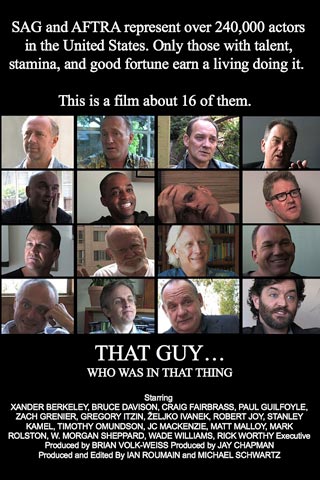
“That Guy” — Showtime’s Documentary About Character Actors

Posted on October 13, 2012 at 3:59 pm

I have a special affection for character actors.  They have to create a character and move the story forward without having the luxury of time and the audience’s primary attention, and they have to do it without overshadowing the star.  So I was delighted to see Showtime’s tribute to character actors, a documentary called, “That Guy….Who Was in That Thing.”  Candid interviews with actors who all look familiar but not instantly recognizable, who might be mistaken for someone you went to school with or once saw at a family reunion cover touchy subjects like auditions, being a guest star on a show where the stars do not think it is worthwhile even to introduce themselves, going for months without a job, family and financial stress, being stuck with a lot of technical talk or exposition, and the pure joy of having the opportunity to perform.  It’s On Demand through November 13 and well worth a look.

Related Tags:


Actors Documentary Television

Interview: Dante Brown of “Won’t Back Down”

Posted on October 13, 2012 at 8:00 am

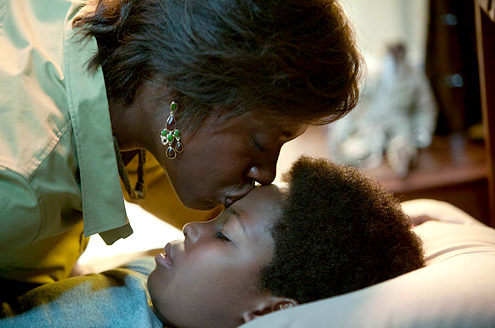
Oprah called him one of her all-time smartest and most talented kids.  And now Dante Brown is appearing in the new movie “Won’t Back Down,” a touching performance as the son of the teacher character played by Viola Davis.  He was nice enough to answer my questions about the film.
What do you see as the biggest challenge facing schools today?

I feel that when your parents are not as active in your life, then disruptive behaviors come out in other places… home, after school programs, interacting with classmates & friends, etc.  I feel the biggest challenge that teachers face in schools, today, is… kids’ inappropriate behavior in class and a lack of respect for authorities.  As for schools in general, probably, a lack of resources and funding for students to have access to the latest technology, supplies and other stuff needed to make for a great school.

What happened to the school that inspired this story?

I’m not really sure there was one particular school that the movie was “inspired” by… at least that’s what I’ve heard Mr. Daniel Barnz say in some of his interviews, so I don’t really have an answer for that directly, but overall, for school’s that have experienced this or something similar to what takes place in the movie, I’d venture to say that the result might have been difficult at first, but like anything, if you keep at it and continue seeking excellence, the Principal and teachers prevail… the parents & students will prevail, so the school eventually is a success.  As long as there’s mutual respect and cooperative efforts toward the one goal of making the school successful.

How can families be more effectively involved in supporting local schools?

By taking an active role… when the school/kids have different events, go.  Know what’s going on with your child.  Attend the parent-teacher conferences.  Sign up to receive the emails, voice broadcasts and other communication.  Show that you care.  Take the time to attend different school events and if you have the time, volunteer and participate.  If you have ideas, share them and see them through.  That’s all it takes. Lead by example for your child that’s a student at the school, so that they, too, will be encouraged and excited about participating and being active in the school’s activities, whether it’s a school clean up day, a fundraiser, a movie night or talent show.

If you could make one change in the law to help schools, what would it be?
Every Principal would be required to have successful scores on their evaluations before being given a school.  I say this because my parents told me that the way a business or organization functions, depends heavily on its leaders.  I’m not really sure about school laws, haven’t really given that much thought, but if there’s not a law monitoring how effective a Principal or Teacher is, then perhaps there should be one. A law that would somehow monitor their effectiveness in helping their students to thrive, because after all, that’s the whole purpose, right?

How did you become involved with this project?
When my agent sent over the sides for my audition on the tape, the project was originally named “Still I Rise.” I immediately thought of Maya Angelou’s poem and was very interested in getting to know my character more, as well as the story. My name means poetic, so it’s ironic that I love poetry, and I was like, “Wow, interesting movie!   Then I read the sides and the character was very different than me. But since the movie is a drama, and I love drama, I wanted to nail my audition to make sure I got a callback and be strongly considered for the role. So, I auditioned for it, is how I became involved with Won’t Back Down. LOL

Can you tell me about your casting process?
Sure.  My agent submitted me for the role and I auditioned for it.  My first audition was on video tape.  My Mom took me to someone in LA that tapes actors for auditions… it came out really nice… it was in high definition and looked great.  So we forwarded the link to my agent and my agent forwarded the link to casting in NY, I believe, because that’s where the Director Mr. Daniel Barnz is based… I think.  At least I know his family is from the east coast.  I didn’t know that until recently. *smiles*  Anyhow, I guess Mr. Barnz liked what he saw, so I was called in to meet him in person, out here in LA, for callbacks.  During callbacks he complimented me alot and before I left, said that he’d see me later, which they often do, but I don’t think anything of it, until my manager or agent actually calls to tell me I got the part.  Anyhow, a couple of weeks later they called and told me I booked it and I was super excited, especially after learning that I would play the son of Mrs. Viola Davis and Mr. Lance Reddick.

Related Tags:


Actors Interview
THE MOVIE MOM® is a registered trademark of Nell Minow. Use of the mark without express consent from Nell Minow constitutes trademark infringement and unfair competition in violation of federal and state laws. All material © Nell Minow 1995-2026, all rights reserved, and no use or republication is permitted without explicit permission. This site hosts Nell Minow’s Movie Mom® archive, with material that originally appeared on Yahoo! Movies, Beliefnet, and other sources. Much of her new material can be found at Rogerebert.com, Huffington Post, and WheretoWatch. Her books include The Movie Mom’s Guide to Family Movies and 101 Must-See Movie Moments, and she can be heard each week on radio stations across the country.

Website Designed by Max LaZebnik