I was delighted to have a chance to interview Byron Mann for The Credits about this week’s release “Skyscraper,” co-starring with Dwayne Johnson. He is deliciously arrogant in one of my favorite scenes in one of my favorite films, as the “synthetic CDO” guy eating sushi as Steve Carell fumes in “The Big Short.”
An excerpt:
I have to begin by asking you about one of my favorite scenes in one of my favorite movies, The Big Short. It’s compliment to say that in a very brief appearance you created a very complete and utterly loathsome character. Tell me about the audition for that role and what you and the director discussed.
I ate potato chips in the audition. I’m serious. The director, Adam McKay, midway through the audition, asked me, “Hey, would you like to have some potato chips?” I said, “What?” He said, “Yeah, would you like to have some potato chips while you’re doing the scene.” His intention, I found out, was to do it exactly as the scene happened in real life: my character and Steve Carell’s character were having sushi in real life, so Adam McKay wanted to see what that felt like in the audition. Apparently, I’m pretty good at eating potato chips.
What was the toughest part of the training for Altered Carbon? What’s your favorite training tip?
I had a personal trainer who was helping me gain muscle mass, and “shred” at the same time. So I was lifting crazy weights, as well as doing a gazillion aerobic exercises at the same time: doing a hundred revolutions skipping rope – three sets, a hundred burpees, a hundred mountain climbers, a hundred jackknives…thinking about it now makes me tired already. My favorite training tip: hire a kick-ass (no pun intended) personal trainer and watch what you eat. My second favorite training tip: burpees. If you don’t know what that means, google it. It’s an instant fat burner and wakes you up like no other exercise.
You live in four cities on two continents. How do you remember where your toothbrush is?
I have four different toothbrushes in all four cities. You should have asked me how I keep my currencies straight: I have four Muji pouches, all with a sticker on them that denotes the four cities: Los Angeles, Vancouver, Hong Kong, Beijing. Everything — SIM cards, bills, coins, keys — goes in these pouches.
What is your technique for maintaining focus when you’re working on green screen?
Honestly, that’s the hardest part. Looking at a yellow tennis ball is a lot different than looking at a building on fire and ready to collapse. That’s why they pay me the big bucks.
One of the best essays about film I’ve read this year is Roxana Hadadi’s “Amid the Latest Western Genre Resurgence, ‘Lean on Pete’ and ‘The Rider’ Challenge Cowboy Masculinity in the American West” in Pajiba. She discusses several recent movies, including “Logan,” HBO’s “Westworld,” and “Hell or High Water,” but focuses on “Lean on Pete” and “The Rider.” The Western has always been the quintessential representation of the American spirit of independence, isolation, adventure, arrogance, as well as a way to explore our nation’s deepest conflicts and history of brutality and racism. And, as with most movie stories over the past century, the stories have almost always been about men and from their point of view. Hadadi writes:
The American experience has long been linked to the masculinity of the solitary cowboy, pushing the limits of the frontier. But what happens when there is nowhere left to go?
…Which brings us to Lean on Pete and The Rider, two films that also fit into the Western genre but are less about what the New West represents and more about what it actually is….These are stories about boys on the cusp of being men, each of whom is attempting to navigate selfhood in situations of poverty and desolation, in places where the cowboy code was once enough but isn’t anymore. Where so many Westerns focus on exploring (and romanticizing) the destructive ways that masculinity manifests, Lean on Pete and The Rider are concerned with what happens when those stereotypical markers—violence, sex, and lawlessness—are not only stripped away but are never the right choice at all. If you reject what it is to be a cowboy but you exist in the shadow of that figure, who are you?
You won’t read a better, wiser, or more goregously written essay on film this year.
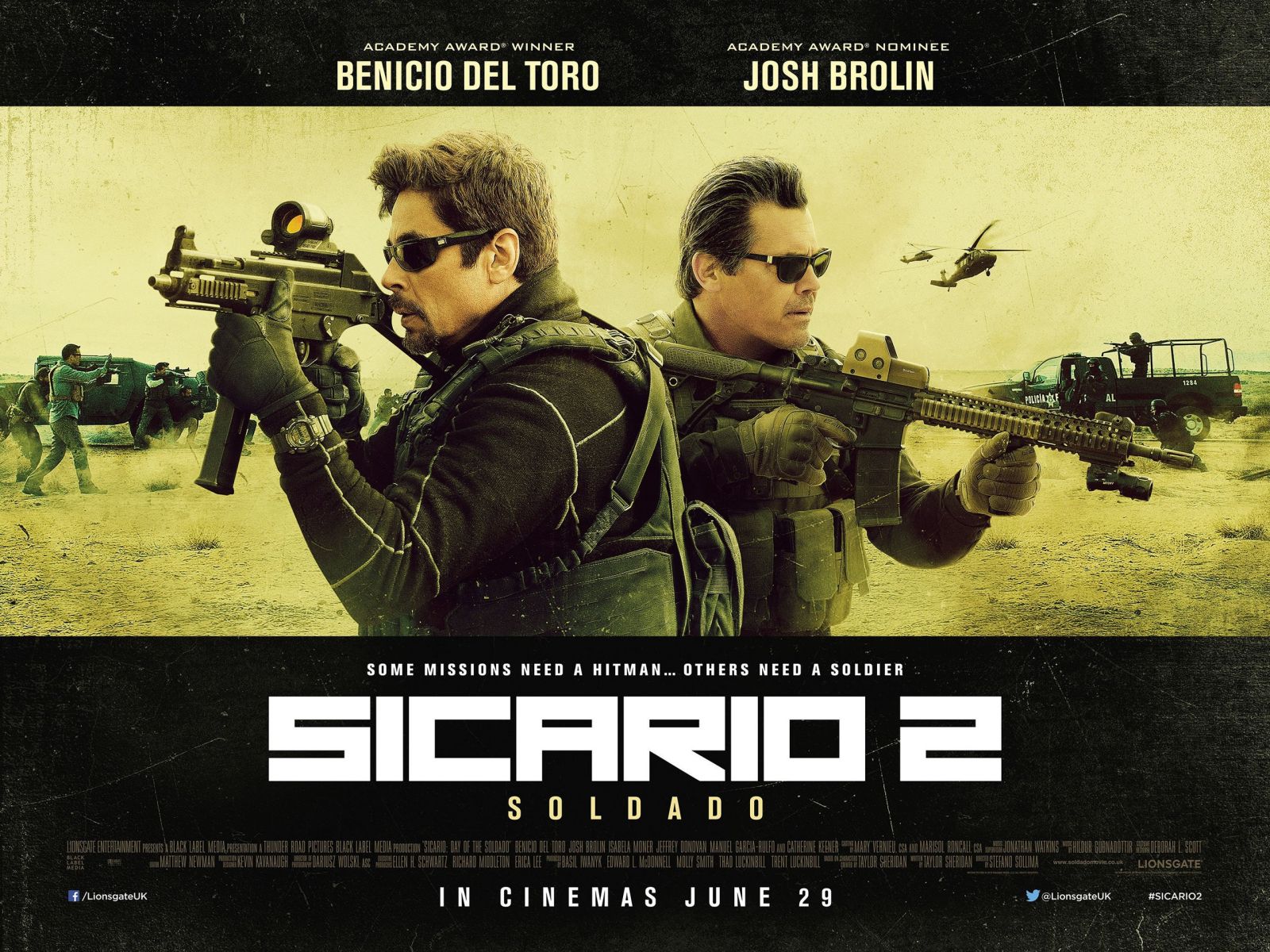
I didn’t like “Sicario: Day of the Soldado.” But I made no pretense of being fit to evaluate its portrayal of Mexicans and Mexican-Americans. So I was glad to see this round-up of responses to the film from Latino critics. All are worth reading in full. Here are some highlights.
If you are someone who can actually sit in a theater and watch this film without thinking about its political implications and how it feeds into the Trump narrative (even with its mid-movie glimpses of truth) then this is clearly for you. For the rest of us who believe there should be a certain level of responsibility to what’s put on screen, the mere existence of a work so blatantly obtuse signals the terrifying possibility that those who already dismiss the lives of immigrants and Muslims will find new ammunition for their hatred here.
It’s not that cinema shouldn’t explore the complex relationship between Mexico and the United States in a provocative manner, the problem is that writer Taylor Sheridan has a taste for writing stories where people of color are a central component, yet their perspectives are ignored (see Wind River as another example). He makes it obvious that his gaze is that of a straight white American male who can write a good thriller, but gives little importance to non-white characters aside from making sure stereotypes are perpetuated.
Nearly every Latino in this film is either an unnamed (or unseen) cartel member, is paid off by the cartels, wants to be in the cartel, or is generally associated with drugs….Having just rewatched the first feature, Benicio del Toro’s Alejandro is also problematic. This is a man who had no compunction killing innocent children in the first movie, yet will sacrifice himself for a teenage girl in this one. (Taylor Sheridan is a little too fascinated with foreign teenage girls.) Del Toro is perfectly fine, but this movie doesn’t get a cookie for having one prominent Latino in the cast who supposedly isn’t terrible. In the times we’re currently living in, I don’t need to pay $20 to see Mexicans erroneously portrayed as horrid people.
The latest Sicario, as ham-fistedly written by Taylor Sheridan, has a kind of vacant timeliness, lacking any nuance in its depiction of incendiary issues. Of course, the filmmakers couldn’t have known that this border thriller would be released in the midst of one of the worst immigration crises in the nation’s history. But context is sorely lacking. Why does a quiet middle school kid get mixed up in shepherding refugees for cash? Virtually all the Latino characters in the film are portrayed as clichéd villains – drug dealers, dirty cops, or greedy kids taking advantage of hapless immigrants.
Ben Foster stars in Debra Granik’s new film, “Leave No Trace,” as a veteran with PTSD who lives in a public park with his daughter. It is based on Peter Rock’s novel My Abandonment, which itself inspired by a news story reporting that a father and daughter were living off the grid but in plain sight. Writer/director Debra Granik (“Winter’s Bone”) adapted the story in a quiet wonder of a film co-starring newcomer Thomasin Harcourt McKenzie. I spoke to Ben Foster about preparing for the role and what it meant to him as a new father himself.
The opening scene has almost no dialogue as the characters get ready for the day by making breakfast and taking care of the campsite. There is such a believably capable and coordinated routine between you and Thomasin. How do you achieve that sense of having done it a million times?
I suppose that’s the big question. You try to personally at least spend as much time training in whatever tasks or whatever tools are necessary to the film in order to not have to think about it when we’re shooting.
I had a two-week extensive training camp in the Pacific Northwest on wilderness appreciation and survivalism, from building shelters to building fires to what kind of fire pits to make — we had a Dakota pit because we took a military aspect. This is a kind of fire pit that has a low smoke profile. I did the homework and then I brought that to Debra and then Debra integrated what sparked her. And then she and I went through the script and red-lined it and got rid of about forty percent of the dialogue. Once we realized that it is the physical actions that speak for Will, that was a great joy of the film. The way that he would choose his belongings was the way that he would choose his words. Very spare.
What were some of the things that you learned in your wilderness training that surprised you?
What surprised me was how blind I was to a forest environment, I’ve been drawn to the Pacific Northwest for years but through the training I learned it’s a language; learning the language of the forest, learning how to read tracks, learning how to cover up your own tracks, learning how to find resources where ordinarily it would look like an emergency. I learned that one can create a shelter or find food and water and that kind of appreciation has given me a confidence that I’ll take with me for the rest of my days. It’s not hard to learn, anyone can take a weekend course to feel a little bit more prepared if they get in a pinch. It’s a mental and emotional security to know how to take care of yourself and your own in whatever environment you find yourself in.
We don’t learn many details about your character’s life and what made him decide this was the best way to raise his daughter.
The script is beautiful. Once I got involved in the training and we were sharing stories of people that we’d met along the way, friends of mine who have served, who have talked with me candidly about their experience of returning and Debra’s experiences with documentaries — it’s just like that line in the script: Is it a want or a need?
That was my door into the role. I came to Debra and said, “I think we can get away with saying a lot less here,” and it became a wonderful experience of telling rather than saying.
You started acting very young. How did that help you work with Thomasin?
I didn’t need to help her. She came in poised, she had done her homework, and she was a joy beginning to end to work with. She was she was a very present, beautiful actor. Sometimes you’ve got to work a lot harder at it than others to cope with a believable relationship. With Thom it was immediate and I imagine audiences will feel the same way when they watch her. She has something rare.
I felt that the story was really just a very heightened version of what all parents go through. We all try to create in our own way a controlled environment around our children and protect them in whatever way we think we can and they all grow up and say, “I’m going to live my own life and I have my own choices to make.” Do you think that’s right?
I do. I was expecting the birth of our first child while we were shooting so these questions were very loud in my mind and my heart and will continue to be. Since the birth of our daughter I have apologized more to my parents and I’ve apologized to anyone in my life -“I’m so sorry and thank you, thank you, thank you.”
It’s such a troubling time right now and particularly for families. I hope when people see this film they call the one they love or even better yet if they are near you, squeeze them. It goes fast and we can get so distracted in our lives with technology and we can get distracted with the darkness in the world. But I hope this film reminds people that there are good people out there. There aren’t necessarily just villains running the world, there are good people on every corner in this world not just America but in the world and it’s important that we take the time to acknowledge them and love the people closest to us.
You have often gravitated toward playing military characters. Is that something that specially resonates with you?
The desert wars are my generation’s wars and in terms of drama and narrative they continue and are still affecting so many lives. I’m just naturally impressed and inspired by anybody who is in the service; anybody who decides to do for others. Whatever your reasons for getting into and continuing to be in service, not just military, I’m just drawn to that kind of dedication and giving. I’ll cry just thinking about it.
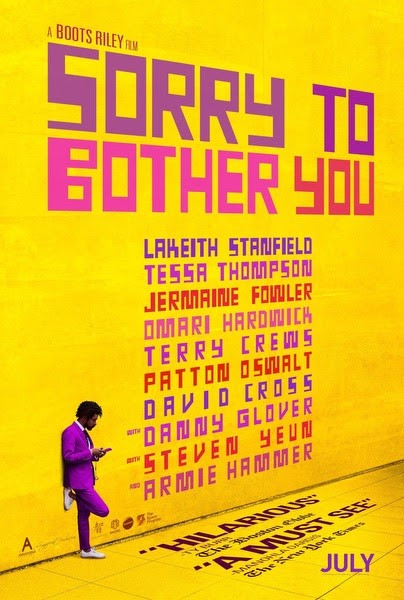
Boots Riley is a filmmaker who made a slight detour into music, where he found great success as lead singer for The Coup and Galactic, and in teaching a high school class called “Culture and Resistance: Persuasive Lyric Writing.” His provocative, wildly funny, and remarkably assured first film is Sorry to Bother You, starring LaKieth Stanfield as Cash Green, a telemarketer who achieves great sales numbers by using his “white voice” (provided by David Cross), and Tessa Thompson as his graphic and performance artist girlfriend, Detroit.
In an interview, Riley spoke about what he learned about communication when he was a telemarketer, and when his father asked him what voice he was using after he overheard a phone call with one of Riley’s friends, and why Armie Hammer’s family history played a part in his casting as the corporate CEO.
I have to begin by asking you about Detroit’s wild earrings, like the ones that say in big letters “MURDER MURDER MURDER KILL KILL KILL.” What do we learn about her as an artist from the way she puts herself together?
Copyright Annapurna Pictures 2018
Detroit is always looking for a way to make a statement, looking for a way to talk about the world. So she uses every wall she can find, every piece of her being to say something to the world. The are earrings are just a part that symbolizes that about her and the words on the earrings are all quotes from songs.
Detroit is much more political than Cash, but she has a job that is just as demeaning and corporatist as his job, standing on a street corner twirling a sign. He is out there selling and he’s out there selling; does that bother her at all?
One of the reasons that she maybe wasn’t all the way against what Cassius was doing or didn’t leave him right away is that she’s not of the mind that the way that we get rid of capitalism is somehow going out into the woods and creating some alternative system. She knows that whatever she’s doing is going to be part of that.
And what did you learn about selling when you were a telemarketer? What was your most effective pitch?
I’ve actually been doing sales sort of stuff forever. There’d always be these 17-year olds who were hired by some company or whatever and they’d go pick up kids like me in the neighborhood when we were around 11. You go knock on doors and sell newspapers. I learned through those sorts of jobs for the wrong reasons how to listen to people and to understand that people may be saying something that the words they’re using aren’t saying. That was for manipulative reasons that I learned that but then that carried over into my style of organizing which is not to be caught up on the linguistics of someone. It wasn’t so much about vocabulary and identifying words as it was about what is the thing that we’re trying to create.
So if you call and somebody says, “I haven’t got time for this?”
You figure out through that some clue of who they are. “I haven’t got time for this” sounds like somebody is really overwhelmed with things that are going on in their life and other things they don’t want to be doing. They’re not saying, “I got all this stuff that I really want to be doing.” They’re saying, “I don’t have time for this,” so you could play off of that.
I’m sold! Do all black people have a white voice they can use?
There are some people that don’t consciously know that they do and maybe don’t have jobs where they have to have that but definitely a lot do.
I guess everybody has to code switch some time in their life.
I know when I was growing up and getting to the age where I got on the phone with my friends, I remember getting off the phone one time and my father being like, “Who was that”? And I was like, “Oh that was Joey.” “No, who was that on the phone?” I said, “I told you it was Joey.” “No, who was that on the phone here because I didn’t recognize that voice at all.”
In the movie it’s all about performance. We’re all performing in some way even when you don’t do the switching thing it’s sometimes a reaction to who you think you are and all of these things that you will perform or not perform. It might not be switching but I think the more relevant thing is that it’s all a code because we’re made up of all of these influences and all of these ideas. It’s not saying that any of it is bad. I don’t think the goal is to try and figure out how to not do that.
One of the things that I think is important is that what it puts out there is because a lot of times blackness is codified. Like “it comes from this and this and this: and whiteness it ends up because of that being like this pure thing it’s just the thing that is and everything else is a reaction. Danny Glover’s character Langston says that “there are no real white voices.” What their white voices try to convey is the sense that everything’s okay and “I’ve got everything taken care of.” To the extent that that voice does exist, it’s in reaction to the idea the racist tropes of blackness and of people of color. Through all sorts of media and culture we get told that poverty is a fault of the impoverished and that through these bad choices but no one wants to talk about the fact that capitalism demands that there be poverty; it is necessitated. You can’t have full employment under capitalism otherwise everyone would be able to demand every wage they want. You have to have an army of unemployed workers and the only time it gets talked about openly is when the Wall Street Journal is worrying about the unemployment rate going down which causes wages to go up and stocks to plummet.
It would be great if there was an episode of one of those cop shows like CSI where they figure out that they’re not going to stop crime because crime comes from people needing to eat who are unemployed. As long as we have this system we’re going to have unemployed people who need to eat.
Copyright 2018 Annapurna Pictures
And as your wealthy CEO you have Armie Hammer, whose great-grandfather, Armand Hammer, was a famous CEO notorious for his disregard of shareholder interests.
I think it’s really great casting historically and also he’s a really great guy and a guy that people don’t understand how much acting he’s doing because it seems so natural.
He is remarkable in the film, and so is LaKeith Stanfield.
I don’t think this movie would have worked with another kind of actor. I got notes about him which were like, “He needs to be more active,” which means like the blockbuster style of action — “I’m confused now, look at my eyebrow,” that sort of thing. We did pre-preparation so we knew what his posture was going to be like at different points of the story and everything else was more about him feeling whatever it is he supposed to be feeling and not worrying about whether he’d look like he was feeling that.
The movie features a company called WorryFree that promises to give people everything they need — a job, a place to live, food, clothes — but it is clear to us in the audience it is a sort of prison.
The point is I don’t think it’s illegal, I really would like someone to point out whether that company is illegal; if it’s not illegal it’s going to be done. And actually it’s a lot like how many places in other parts of the world that US companies contract out to work. The big thing in the movie is that it’s happening here in the US; that is the big difference.
Which is why those corporate folks are the puppet masters and we only get to vote on the puppets. We get to vote which one will be the puppet that might more resist the pulling of the strings but we know that they’re all still puppets. And so I think that my movie puts forward an idea and approach that has to do with trying to go directly to the puppeteers through withholding of labor and that we need movements.