58 Years Ago Today: Newton Minow and the Vast Wasteland Speech

Posted on May 9, 2019 at 12:01 am
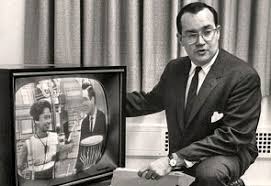
On May 9, 1961, my father, Newton Minow, delivered a speech that continues to inspire the conversation about media. He was President Kennedy’s new Chairman of the FCC, just 35 years old, and in his first major address he told the National Association of Broadcasters that while there was much to admire on television, too much of it was a “vast wasteland.” Last Friday, our family had the privilege of watching him receive the Chicago Television Academy’s Silver Emmy Award for his contributions to broadcasting, including the launching of the first telecommunications satellite, the creation of PBS, and helping to start the Presidential debates. He continues to serve as Vice Chair of the Commission on Presidential Debates, which he helped to form.

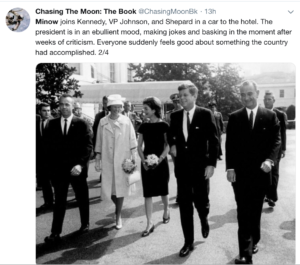
He told the audience about the day before the speech, when President Kennedy brought Commander Alan Shepherd, who had just become the first American in space, and his wife, to the National Association of Broadcasters event Dad would be speaking to the following day.  President Kennedy invited Dad to come upstairs while he changed his shirt, to give him some ideas about what to tell the broadcasters.  Dad suggested that he talk about the difference between the way Americans and the Soviet Union conducted their space program.  In the US, we had all the television cameras there to show the American people, good or bad, what was happening.  The authors of the forthcoming book and documentary Chasing the Moon tweeted about it today:
At the time Dad called on the broadcasters to do better, there were just three national television networks. There was no PBS, just a National Educational Television which was not even available in most of the country, including Washington DC itself. My father told the broadcasters that as long as the airwaves were a scarce resource, they would have to do better to live up to their statutory obligation to serve the public interest, convenience, and necessity, especially with regard to coverage of news and programming for children. He worked over the next half-century to make more choices available, including cable and satellite as well as the creation of a robust public television station. He helped get the original funding for “Sesame Street,” served as chairman of PBS and of the Chicago affiliate WTTW, served on the board of CBS, is vice-chair of the Presidential Debates Commission, pushed for closed captioning to make television programming available to hearing-impaired viewers, and argued one of the only cases in history to have a broadcast license rescinded — a station that spewed hatred across the airwaves. And in protest of his critique of television, the sinking ship on “Gilligan’s Island” was named after him, the S.S. Minnow!

He is also the world’s best dad and we are all so proud of him.

Related Tags:


Understanding Media and Pop Culture

Marvel Movies Deserve Your Respect

Posted on March 12, 2019 at 8:00 am

Copyright Marvel 2018
On Medium, Shelby Fielding makes a strong case that the greatest filmmaker of the 21st Century is Marvel Studios’ Kevin Feige.

Feige, 45, and Marvel Studios have taught a moviegoing audience who may have never even thought about picking up and flipping through a comic book before, how to absorb a narrative over the course of differentiating stories, characters, and uniquely made worlds. With movies plotted until 2022, the studio shows no sign of slowing down, despite their reported break over the next year following “Spider-Man: Far From Home.” It is the most widely regarded and well-known story of the 21st century, to the point that a movie like “Avengers: Endgame” has a more than fair chance at breaking the opening weekend box office record that the “Avengers” film before it set almost a year prior — — which was $257.6 million mind you.

Related Tags:


Superhero Understanding Media and Pop Culture
How Two 1994 Movies Transformed Screen Portrayals of Female Sexuality

How Two 1994 Movies Transformed Screen Portrayals of Female Sexuality

Posted on March 11, 2019 at 3:58 pm

Copyright MGM 1994

For rogerebert.com’s Women Writer’s Week, I wrote an essay about how two films, both made 25 years ago, transformed the way female sexuality is portrayed on screen. Before these films, female characters either seemed unaware of sex or determined not to have sex until marriage. If they did, the consequences were usually terrible — an unwanted pregnancy, a nervous breakdown, loss of reputation, even death. There were sex comedies based on successful Broadway farces like “Sunday in New York,” “The Moon is Blue,” and the weirdest of all, written by Arthur Marx (son of Groucho), “The Impossible Years.”

David Niven (one of the failed seducers from “The Moon is Blue”) plays a psychology professor obsessed with his daughter’s virginity—in a sex comedy kind of way but still pretty creepy. Spoiler alert: She is safely married by the time she has sex (with her father’s young professional colleague/rival, hmmm, wonder what a psychology professor would make of that). And somehow the act of having sex instantly transforms her into a mature, thoughtful, responsible person as well, just in time for her dad to start worrying about her younger sister.

Other movies feature the tragic consequences of pre-marital sex. In “Where the Boys Are” Yvette Mimieux is not only raped but also hit by a car as the consequence for her decision to have sex on spring vacation in Fort Lauderdale. Worst of all, “they’re not even Yalies.” Meanwhile, Dolores Hart, who intellectually is in favor of sexual autonomy and freedom from shame for young women, maintains her purity and thus achieves the ultimate—an invitation to the spring dance from handsome Ivy Leaguer George Hamilton.

How Two 1994 Movies Transformed Screen Portrayals of Female Sexuality
Copyright Miramax 1994
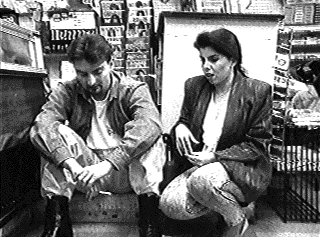
But the micro-budget “Clerks” and the glossy romantic comedy “Four Weddings and a Funeral” both did something remarkable and revolutionary — they gave us female characters who were comfortable with sexual desire and expression, unapologetic because they saw no reason to be. And the men they confided in were not disgusted, disappointed, or contemptuous. They were impressed and intimidated. Compare this to Audrey Hepburn’s similar — except entirely fictitious — recitation of imaginary lovers to Gary Cooper in “Love in the Afternoon,” just one example of this era’s pretend to have your cake but don’t eat anything attitude during this era.

This idea that sexual experience was evidence of a healthy, confident ownership of sexual expression was an enormous shift, the foundation for later films like the raunchy but sweet-natured sex comedy “American Pie” (1999), also revolutionary in the female characters’ ownership of their sexuality, compared to “Porky’s” (1981) or “Revenge of the Nerds” and “Sixteen Candles” (both 1984), where the perspective is all about male sexual gratification including voyeurism, sexual assault, and a boy selling a look at a teenage girl’s underwear.

2018’s “Blockers,” like “The Impossible Years,” also featured parents who were way too invested in whether their daughters were going to have sex. But this time, the point of view of the movie was very much on the side of the girls and their ability to make their own choices. Series like “Big Mouth,” “PEN15,” and “Broad City,” have characters who may make some bad decisions and suffer the consequences, but they do not pretend that sexual desire is wrong or bad. They follow in the steps of “Clerks” and “Four Weddings and a Funeral,” as those two films provided a turning point for healthier depictions of women and our right to our feelings and our choices.

Where once slasher films almost made killing teens who had sex a given, after “Clerks” and “Four Weddings and a Funeral” came “Scream,” with a heroine who only after having sex achieved the wisdom and power to defeat the killer(s).

Related Tags:


Critics Gender and Diversity Understanding Media and Pop Culture
Horror is More than Scares and Carnage

Horror is More than Scares and Carnage

Posted on February 27, 2019 at 10:20 pm

As we see in movies like “Get Out,” “28 Days Later,” and “Dawn of the Dead,” horror can be more than scares and carnage. It can reflect and challenge our assumptions. Two new articles provide some fascinating commentary on these themes.

Horror is More than Scares and Carnage
Copyright 1976 Red Bank Films
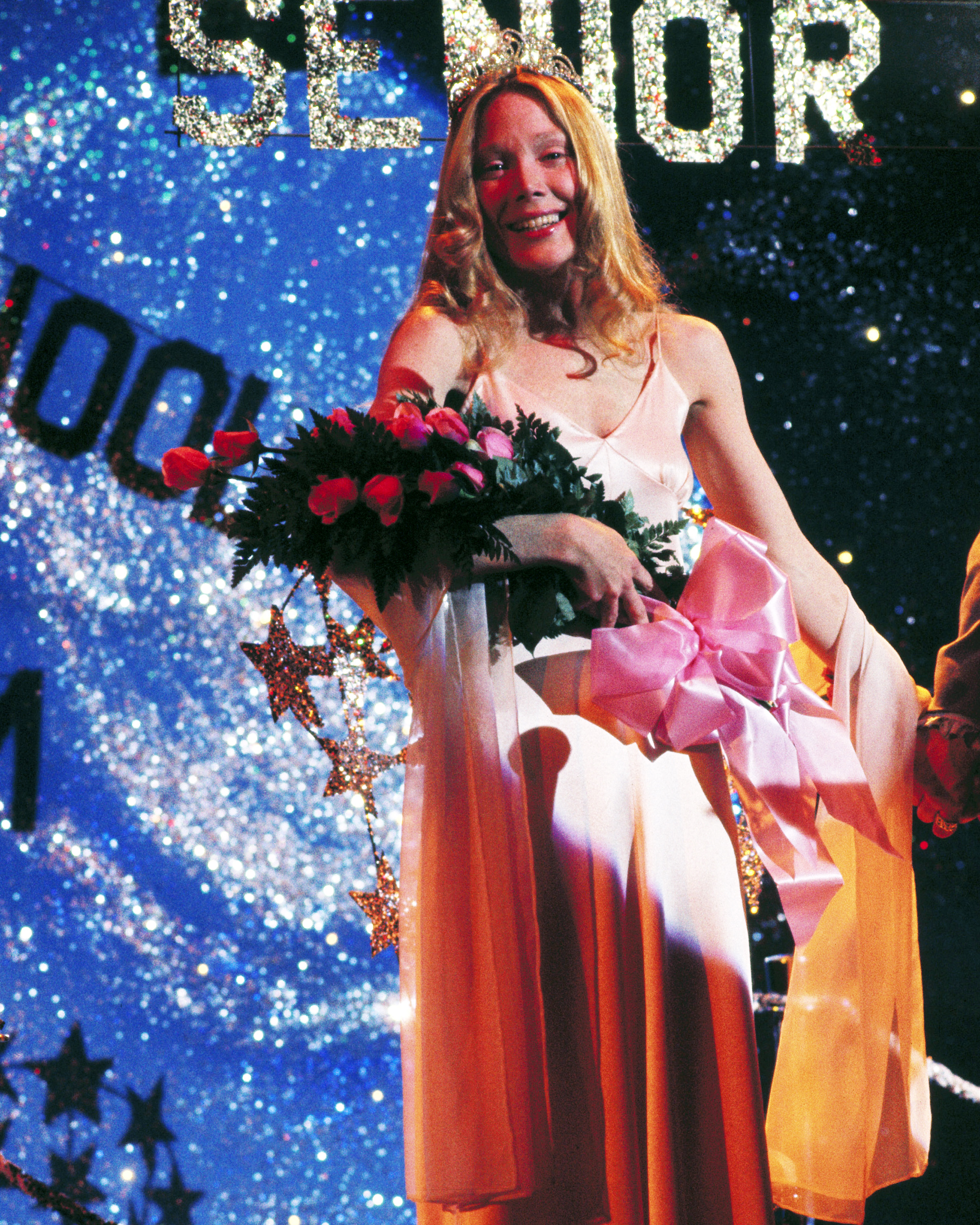
Mary Beth McAndrews writes on Reel Honey about “reclaiming female exploitation” in horror. “Recently, female directors have been working to reclaim this exploitation by appropriating these tropes to create empowering horror narratives. These films are still violent, but they do not solely depend on the suffering and abjection of their female characters….These directors and writers are just a few of the women in horror working to change the trajectory of the horror narrative and how we view the female body on-screen. Yes, horror is a genre built on violence and gore. But these women are re-evaluating the use of that exploitative violence into something thoughtful, empowering, and equally gory. The monsters they construct are not so fantastical and the scenarios they portray are much more real, giving their violence more meaning and purpose. It is not just about reveling in women’s bodies in pain; it is about understanding their pain.”

Copyright Universal 2017
And on Medium, Marcus Benjamin writes about a new documentary: “Horror Noire: A History Of Black Horror’ Makes The Case For Empathy In A Scary World.” Traditionally, he says, “Outside of dying, tending to the the main character’s need was our number one function. This was all done while doing a disservice to our own lives, which we may or may not have had on screen because no one cared enough to give them one. Or in the case of Rachel True’s character from The Craft, someone decided to cut out portions of the film altogether that explored her family life and other struggles….When you’re not surrounded by people of races other than your own, you don’t develop the empathy gene for them. How can you begin to comprehend how a black person feels about blackface if you don’t have any black people in your circle to tell you? Or if you’ve didn’t grow up with any black friends? Or if you grew up in a racist city or town? Despite all your efforts to learn, you’ll likely have a cultural blindspot or two. Similarly, when the history of cinema is filled with blackface or monsters and gigantic apes as stand-ins for black people, that means entire generations grew up believing black people were always lesser.”

Related Tags:


Critics Gender and Diversity Horror Race and Diversity Understanding Media and Pop Culture
THE MOVIE MOM® is a registered trademark of Nell Minow. Use of the mark without express consent from Nell Minow constitutes trademark infringement and unfair competition in violation of federal and state laws. All material © Nell Minow 1995-2026, all rights reserved, and no use or republication is permitted without explicit permission. This site hosts Nell Minow’s Movie Mom® archive, with material that originally appeared on Yahoo! Movies, Beliefnet, and other sources. Much of her new material can be found at Rogerebert.com, Huffington Post, and WheretoWatch. Her books include The Movie Mom’s Guide to Family Movies and 101 Must-See Movie Moments, and she can be heard each week on radio stations across the country.

Website Designed by Max LaZebnik