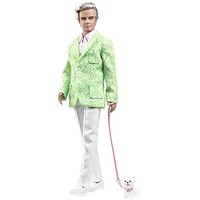
And while we’re on the subject of makeovers, what is happening to Ken?
Barbie’s beau has had to endure some humiliating looks since he arrived on the scene in 1961. Of course his function is primarily as arm candy for Barbie, and so his primary job is looking good in a tux or whatever best matches her endless variety of outfits. When Barbie was a bride, he was the groom. When Barbie was Dorothy (and the Wicked Witch), Ken was the scarecrow (and the tin man and lion).
But Mattel has announced that Ken’s latest incarnation is “Palm Beach Sugar Daddy.”
I am not making this up.
Mattel says that this is intended for adult collectors, not children. It will be available in April for $81.99. Still, there is something louche and just plain creepy about this.
Featherston’s conventional figure gives her movie an added sense that what we’re watching isn’t some artificial construct – even though it is just that.
It’s likely the next time you see her on screen she’ll be thinner, leaner and more like her Hollywood peers. But for “Paranormal Activity” her figure proves a very normal part of the film’s gimmick.
Toto says he likes the way Featherston looks now and wishes more actresses would appear on screen that way. But with the tabloid fat police shrieking about “mom jeans” for any actress who wears as much as a Size 4, I suspect that Featherston is already working with a personal trainer for some upcoming “how I lost 10 pounds” magazine story.
Pixar is the most successful movie studio in history, with every one of its 10 films a critical and box office success. But not one of those ten films has featured a female lead. There have been memorable girls and women in films like “The Incredibles,” “Finding Nemo,” and “A Bug’s Life,” but the main action has gone to the male characters — in “Up” the only female other than the main character’s late wife, who never speaks, is a bird. That will change with two of Pixar’s upcoming releases, according to Willa Paskin on Slate sister site Double XX.
The first film, Newt, out in 2011, imagines “What happens when the last remaining male and female blue-footed newts on the planet are forced together by science to save the species, and they can’t stand each other?” This sounds like the animated version of It Happened One Night (plus a few action sequences), so, you know, sign me up. The second film, The Bear and The Bow, will be even more girlcentric, telling the tale of “the impetuous, tangle-haired Merida, though a daughter of royalty, would prefer to make her mark as a great archer.” It’s also set to come out 2011 and will be voiced by Reese Witherspoon.
Paskin wonders whether we really need another princess story, and I see her point. But I look forward to meeting these characters and to the reactions from girls — and their brothers — to seeing stories where girls get to take the lead.
Mickey Mouse is my favorite animated character. Part of the reason is historic — he starred in the first movie to feature a synchronized soundtrack, “Steamboat Willie.” And he was the first character and later the emblem for what would become Walt Disney Studios. Walt Disney lost the rights to his successful Oswald Rabbit character and decided to start his own studio with a new idea. As Disney said,
We thought of a tiny bit of a mouse that would have something of the wistfulness of Chaplin — a little fellow trying to do the best he could. When people laugh at Mickey Mouse, it’s because he’s so human; and that is the secret of his popularity. I only hope that we don’t lose sight of one thing — that it was all started by a mouse.
My favorite Mickey appearance is in “Fantasia,” where he plays the sorcerer’s apprentice who gets into trouble when he tries to perform a little magic.
But Mickey has not been much more than a logo for quite a while. What I like best about him, his perpetually cheery outlook, is a challenge for film-makers. It is easier for them to write stories for characters who are frustrated (Donald Duck), clumsy (Goofy), or mischievous (Chip and Dale). As he gets ready to turn 81 on November 18, Mickey is getting more attention — and a bit of a personality change. The New York Times reports that Mickey will star in a new video game and is getting a new look to go with a more aggressive persona. The game is “Epic Mickey, in which the formerly squeaky clean character can be cantankerous and cunning, as well as heroic, as he traverses a forbidding wasteland” battling none other than Oswald Rabbit. Players will be able to decide whether their Mickey character will be helpful or “selfish and destructive.”
I understand that Disney wants to make Mickey Mouse relevant to a new generation. But I hope Disney remembers what makes Mickey so appealing. And I hope Disney pays attention to the lessons of “The Sorcerer’s Apprentice” about how much trouble you can get into messing with magic.
Disney Admits that Baby Einstein Does Not Help Babies
Posted on October 26, 2009 at 8:00 am
Disney, which had to drop the word “educational” from its marketing of Baby Einstein DVDs following complaints from the Campaign for a Commercial-Free Childhood (CCFC), has now had to back down further and offer a refund.
The New York Times reports that the $200 million a year business, which is predicated on the idea that DVD-watching is beneficial to infants even though the American Academy of Pediatrics recommends no screen time of any kind, television, DVDs, or computers, before age 2, is so pervasive that as many as a third of all American babies have seen at least one of these DVDs. In what the company is calling an “enhanced consumer satisfaction guarantee” and the CCFC is characterizing as capitulation, the company will refund $15.99 for up to four “Baby Einstein” DVDs per household, bought between June 5, 2004, and Sept. 5, 2009, and returned to the company.
I have been a furious opponent of Baby Einstein and the other DVDs for infants since I published the one of the first exposes of them as a racket in the mainstream media, a 2005 article in the Chicago Tribune. When I was working on the article, a company representative’s absurd response to my question about academic studies showing no benefits in learning from their products that their DVDs were “not research-based.” The New York Times story reports that even though they had to remove the word “educational” from their literature following CCFC complaints and a Federal Trade Commission investigation, the website still promises “number recognition” and introduction of shapes. And, of course, the name itself implies that the products increase knowledge or intellectual capacity.
The academic studies show that what infants learn from watching a family member once takes them four times as long to absorb in a DVD. And the very act of watching a DVD with the pulsing refresh rate of the screen can be at the same time soporific and stimulating, making it more difficult for them to get restful sleep. The only thing they learn from these DVDs is how to watch television. Susan Linn of the CCFC was a terrific resource for me in my work on this issue and I am delighted to see her success in bringing to parents’ attention how useless these DVDs are.