
Thoughts on ‘Precious’

Thoughts on ‘Precious’

Posted on November 19, 2009 at 3:59 pm

“Precious: Based on the Novel Push by Sapphire” has been warmly embraced by audiences and critics since it first appeared in festivals. Two of the biggest media powerhouses in the world, Oprah Winfrey and Tyler Perry, signed on as producers after the film was completed to help ensure its distribution and box office. Ninety percent of the critics on Rotten Tomatoes have given the film a positive review. I gave it an A- .

But I find some of the criticism and commentary on the film very thoughtful and the issues raised well worth discussion. In my own review, I raised the question of what is sometimes referred to as “poverty porn.” It can be hard to draw a line between what is exploitative and what is sensitive and illuminating. The movie is based on the best-seller Push (re-named Precious to tie in with the movie), by the poet Sapphire, inspired by the girls she worked with as a teacher.

PreciousMovieStill1.jpg

One of my favorite critics, Dana Stevens of Slate, made some of the strongest objections to the movie. She says the director’s “methodical commitment to abjection, his need to shove the reality of Precious’ life in our faces and wave it around till we acknowledge its awfulness, winds up robbing the audience (and, to some extent, the actors) of all agency….But in offering up their heroine’s misery for the audience’s delectation, created something uncomfortably close to poverty porn.”

Washington Post columnist Courtland Milloy strongly objected to the film. “In ‘Precious,’ Oprah and Perry have helped serve up a film of prurient interest that has about as much redeeming social value as a porn flick.”

Milloy is critical of the plaudits from mostly-white audiences and of Winfrey and Tyler who rhapsodize about the small achievements of the downtrodden heroine instead of telling their own stories of unparalleled fame and fortune.

Maybe there is something to the notion that when human pathology is given a black face, white people don’t have to feel so bad about their own. At least somebody’s happy.

Sexual abuse is certainly an equal-opportunity crime, with black and white women similarly affected. But only exaggerated black depravity seems to resonate so forcefully in the imagination.

White suburban boys are so fascinated by it that they fueled an explosion of gangsta rap — misogynistic lyrics against a backdrop of booty-shaking black women.

I think this is an over-reaction, and in parts just wrong. Stories are a way of helping us make sense of the world by imposing a sense of certainty, logic, and meaning that often eludes us in life. Therefore, they are often melodramatic, exaggerated, and unrealistic. They often focus on suffering and on exaggerated depravity and very often rich white people are doing the suffering or bearing up under the depravity. Look at soap operas. Or any given episode of “Law and Order.” And white suburban boys can bear only a portion of the blame for gangsta rap. The rest goes to the perpetrators. There is an unforgettable moment in the Jay-Z documentary “Fade to Black” when two aspiring rap stars admit they feel queasy about writing songs that glorify violence and misogyny but do it to make money.

Frequent provocateur Armond White is one of the film’s harshest critics. He objects to the way that after it was completed Winfrey and Perry signed on as “producers” because it fit with their own narratives of triumph over abuse and poverty. “Promoting this movie isn’t just a way for Perry and Winfrey to aggrandize themselves, it helps convert their private agendas into heavily hyped social preoccupation.” He calls director Lee Daniels a “pathology pimp” and says that the movie is “an orgy of prurience.” He criticizes the film for “cast light-skinned actors as kind (schoolteacher Paula Patton, social worker Mariah Carey, nurse Lenny Kravitz and an actual Down syndrome child as Precious’ first-born) and dark-skinned actors as terrors” and says that the daydreams Precious has about being adored on a black carpet “sells materialist fantasy as a universal motivation.”

He concludes his review:

Worse than Precious itself was the ordeal of watching it with an audience full of patronizing white folk at the New York Film Festival, then enduring its media hoodwink as a credible depiction of black American life. A scene such as the hippopotamus-like teenager climbing a K-2 incline of tenement stairs to present her newborn, incest-bred baby to her unhinged virago matriarch, might have been met howls of skeptical laughter at Harlem’s Magic Johnson theater. Black audiences would surely have seen the comedy in this ludicrous, overloaded situation, whereas too many white film habitués casually enjoy it for the sense of superiority–and relief–it allows them to feel. Some people like being conned.

White’s point about the skin color of the movie’s characters is echoed in an essay by Jada F. Smith on The Root. Also on The Root, Deborah Douglas criticizes the film for its portrayal of incest, contrary to what statistics show about the far greater likelihood of abuse by a step-father or brother than by a biological father. And Salamishah Tillet compares the response to this film to the more critical reaction to another movie about an abused teenager impregnated through incest, “The Color Purple.”

I suspect the greater outcry about “The Color Purple” was in part because while it was based on a book by a black woman, the movie was made by a white man. But “Precious” director Lee Daniels is black. There is always more leeway for anyone telling a story about his or her own ethnic and cultural group.

I think that Stevens makes some good points and the issue of the characters’ skin color seems a valid one, though Mo’Nique’s skin is much lighter than Gabourey Sidibe’s. While I like the way he writes and admire the intensity of his engagement, I do not agree with White’s comments about “materialist fantasy.” A key theme of the movie (as in many movies) was the heroine’s realization that the limited fantasy life she had based on television did not offer the satisfaction of real achievement and real relationships.

I really like the commentary from another of my favorite critics, Teresa Wiltz, also on The Root. She gets it exactly right when she reminds us to focus on the characters in the story rather than trying to make them stand for some major cultural conclusions.

deserves every bit of attention that it gets. But there’s something discomfiting about her declarations that “We are all Precious.” In short, she Oprah-fies Precious, rendering Precious’ fierce individuality the stuff of platitudes and Stuart moments on SNL.

No, we are not all Precious. We all get our power from the individuality of our stories. Precious stands alone.

Wiltz and Smith are featured in an NPR interview about “Precious” as well.

If you see the movie or if you or someone you care about is dealing with issues of abuse, please visit Beliefnet’s prayer wall inspired by the story. And if that abuse is in the present, please take inspiration from the story of Precious and get help now.

Related Tags:


Commentary Understanding Media and Pop Culture

Wait, Women Go to Movies?

Posted on November 19, 2009 at 8:00 am

MaryAnn Johanson has a great piece in her series on the website of the Association of Women Film Journalists in response to the Hollywood conventional wisdom that movies need to be directed at boys and men to make money. Noting that the advance sales for “New Moon” are ahead of “Transformers” at this stage, she says:

If the boys can be targeted by Hollywood with movies that pander to their basest instincts — toys! explosions! Megan Fox! — then I suppose we must see it as a sign of progress that girl audiences are getting the same treatment: sighing! moon eyes! Robert Pattinson!

And speaking of Megan Fox, Johanson skewers Lynn Hirschberg’s profile in the New York Times Magazine.

Later, noting that the TV in the hotel room was on and tuned to some girly reality show about wedding dresses or somesuch, and that Fox said she watches these things because she doesn’t understand them and is trying to figure them out, Hirschberg characterizes Fox thusly:

Fox said this as if she were contemplating an alien species.

Because, you see, reality shows about wedding dresses represent the actual actuality of all women, and a woman who doesn’t comprehend why anyone would collapse into fits of tears over a wedding dress must be an alien. Because no real women would need to study such a reality show, as Fox indicates she does — a real woman would just understand.

I like to read Johanson’s summary of the way women are portrayed in current releases. Here’s what she had to say last week:

OPENING THIS WEEK. Women are there to be rescued in 2012, whether it’s the Mona Lisa or Amanda Peet as John Cusack’s ex-wife, who does literally nothing but scream for two and a half hours while the world ends around her. Good riddance to this world. Women — or females, at least — are all but absent from Fantastic Mr. Fox, except Meryl Streep as the alternately scolding and praising wife to the titular character; the male animals are the ones who get to have all the adventure and all the fun, and they’re the ones who get to learn things about themselves and grow as people. And forget Pirate Radio: the boat HQ of the illegal broadcaster is boys only — well, there’s one girl present, to cook, but she’s a lesbian, so she doesn’t really count.

On the indie side, things aren’t much better. Women in Trouble does feature an ensemble cast of terrific actresses, but it’s all in service of writer-director Sebastian Gutierrez’s fantasies about what women are really like (hint: it frequently involved lingerie). The Messenger, a drama about the soldiers who notify families that their loved one has been killed overseas, does at least feature Samantha Morton in a powerful and unexpected role as a new widow.

Related Tags:


Commentary Understanding Media and Pop Culture

Another Word Goes Mainstream?

Posted on November 18, 2009 at 8:00 am

In my concern for the continuing coarsening of language, I last wrote about whether the term “pimp” had become acceptable for children after it was used in the PG film “G-Force.”
The New York Times writes about another word that has crossed into the mainstream and has become a go-to insult on television and in movies.

On many nights this fall, it has been possible to tune in to broadcast network television during prime time and hear a character call someone else a “douche.”

In just the last several weeks, it has happened on CBS’s “The New Adventures of Old Christine” and the CW’s “The Vampire Diaries,” which are broadcast at 8 p.m., during what used to be known as the family hour. It has been heard this fall on Fox’s new series “The Cleveland Show,” which begins at 8:30, and on ABC’s “Grey’s Anatomy.” On NBC, its use has spanned the old and the new, blurted out on the freshman comedy “Community” and the seasoned drama “Law & Order: Special Victims Unit.”

In total, the word has surfaced at least 76 times already this year on 26 prime-time network series, according to research by the Parents Television Council, which compiled the statistics at the request of The New York Times. That is up from 30 uses on 15 shows in all of 2007 and just six instances on four programs in 2005….And while the word “douche” is neither obscene nor profane — although this usage is certainly offensive to many people — it seems to represent the latest of broadcast television’s continuing efforts to expand the boundaries of taste, in part to stem the tide of defections by its audience to largely unregulated cable television….”As a writer, you’re always reaching for a more potent way to call somebody a jerk,” Dan Harmon, the creator of “Community,” said about the word “douche.” “This is a word that has evolved in the last couple of years — a thing that sounds like a thing you can’t say.”

Unquestionably, the language on television has become more vulgar. And the argument that this is acceptable because it can be limited to a particular time slot has become less supportable. When television programs like “Law and Order” and “CSI” (and their variations and spin-offs) seem to be on 24/7 and raunchy sit-coms like “Two and a Half Men” run in syndication in the early evening. I find this word particularly ugly and misogynistic and am sorry to see it become mainstream.

Related Tags:


Commentary Understanding Media and Pop Culture

‘Idols’ Around the World

Posted on November 16, 2009 at 3:46 pm

Cynthia Schneider, former US Ambassador to the Netherlands and specialist in international culture, tells the TED audience about the impact of “Idol”-style television programs around the world. We know how winning can transform the lives of the performers. She helps us understand how watching these shows can transform the lives of the audience.

Related Tags:


Shorts Television Understanding Media and Pop Culture
‘Couples Retreat’ Poster Omits Black Stars

‘Couples Retreat’ Poster Omits Black Stars

Posted on November 16, 2009 at 2:44 pm

I thought there was nothing that the awful movie “Couples Retreat” could do to be more offensive. I was wrong.
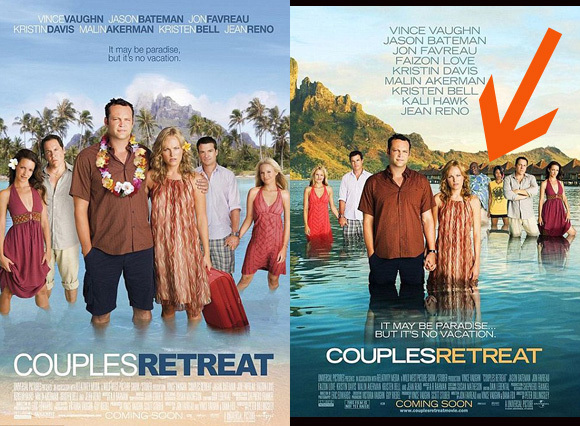
According to the Huffington Post, the blockbuster comedy has eliminated one of its four couples in its non-US posters. It is the black couple, played by Faizon Love and Kali Hawk.
COUPLES-RETREATposter.jpg
The studio has “retreated” from this position and issued a statement saying that they made the decision only to emphasize the stars most recognizable in the international markets. Of course, you don’t get recognizable by being left off the poster. Now, if I had been in this movie, I would ask to have my name, face, and performance excised from the film. But this decision, insensitive at best, overtly racist at worst, is terribly unfair to the performers and insulting to the audience.

Related Tags:


Advertising Understanding Media and Pop Culture
THE MOVIE MOM® is a registered trademark of Nell Minow. Use of the mark without express consent from Nell Minow constitutes trademark infringement and unfair competition in violation of federal and state laws. All material © Nell Minow 1995-2026, all rights reserved, and no use or republication is permitted without explicit permission. This site hosts Nell Minow’s Movie Mom® archive, with material that originally appeared on Yahoo! Movies, Beliefnet, and other sources. Much of her new material can be found at Rogerebert.com, Huffington Post, and WheretoWatch. Her books include The Movie Mom’s Guide to Family Movies and 101 Must-See Movie Moments, and she can be heard each week on radio stations across the country.

Website Designed by Max LaZebnik