Why Do Mega-Budget Movie Directors Make Small Films About Kids?
Posted on April 19, 2017 at 8:00 am
On Vulture, Kyle Buchanan has a fascinating column about three directors who took time off between blockbusters to make remarkably similar small budget films about gifted kids and their single parents. It is well worth reading in full.
Take “Gifted,” this week’s dramedy about a precocious child and the overwhelmed uncle (Chris Evans) who serves as her single parent. It’s directed by Marc Webb, who made the last two Amazing Spider-Man movies, but it’s not to be confused with June’s The Book of Henry, about another child genius and his single parent (Naomi Watts), which director Colin Trevorrow squeezed in between “Jurassic World” and his upcoming production of “Star Wars: Episode IX.” With his schedule so packed, Trevorrow had to abdicate the director’s chair on Jurassic World 2, a gig that went to spectacle-seller Juan Antonio Bayona … who just released his own precocious-child/single-parent movie, “A Monster Calls,” this past December….What’s prompting these similar small movies? To some degree, I expect the directors are treating them as penance: After you’ve neglected your family to fly around the world working on a giant blockbuster, what better way to work out your issues than with a film about a distracted parent reconnecting with a special child? That’s part of the reason that after directing two Iron Man movies, Jon Favreau made the much smaller Chef, where he stars as a single father who quits his fancy restaurant job to start paying attention to his precocious preteen. At the end of their cross-country adventure together, Favreau’s character goes back into the restaurant business a better man who’s informed by the time he’s spent with his son; so, too, has Favreau returned to tentpole filmmaking after his gap-year movie, only now he’s directing films like The Jungle Book and The Lion King that are explicitly made for families.
But I suspect there’s more to this trend than just personal catharsis. For as much as these directors think they’re trading one mode of filmmaking for another, in a way, they’re just toggling between two influential blockbusters: Instead of making Star Wars (literally, in Trevorrow’s case), they’re making E.T.
White Actors in Asian Roles — Not Just Ghost in the Shell
Posted on April 9, 2017 at 12:39 pm
Copyright DreamWorks 2017
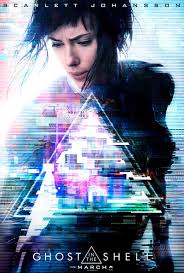
The casting of Scarlett Johansson in “Ghost in the Shell” is just the most recent “whitewashing” that has created controversy and played at least a contributing factor to the poor results at the box office. Audiences have understandably objected to having white actors play Asian characters. It might be different if it ever worked the other way, if actors of color were cast in roles written for white actors. But with so few explicitly Asian characters in movies and so few Asian actors being cast in lead roles, it is especially troubling. To make matters much worse (SPOILER ALERT) the cybernetic characters played by Johansson and white actor Michael Carmen Pitt are both supposed to be Japanese humans who now have white-featured robot “shells” or bodies.
This is just one of many examples in current and past productions. Asian characters have been played by white actors for decades, including Katharine Hepburn, John Wayne, Marlon Brando, Alec Guinness, Peter Sellers, Warner Oland, Peter Lorre, and Mickey Rooney. More recently, Cameron Crowe was sharply criticized for casting Emma Stone in “Aloha” as a woman with some native Hawaiian heritage.
Chang: We seem to have fallen into a dispiritingly familiar pattern where Hollywood-goes-East blockbusters are concerned, and it usually starts with the announcement of some fresh casting outrage: Tilda Swinton enlisting as a Celtic version of a Tibetan mystic in Marvel’s “Doctor Strange,” or Matt Damon being called in for white-hero duty on “The Great Wall” (a China-U.S. co-production, incidentally).
From there, the woker-than-thou factions of the press and public react with unsurprising anger. The marketing campaign becomes a passive-aggressive exercise in damage control. The movie is released, and the casting is duly dubbed either the worst thing ever or a complete non-issue. And neither reaction, I think, really gets at the more complicated truth of the matter….I liked Johansson in “Ghost in the Shell,” just as I liked Swinton in “Doctor Strange.” And I was perfectly fine with Damon in “The Great Wall,” in which he’s not really a white savior at all, and is in fact amusingly upstaged by director Zhang Yimou’s make-China-great-again production design.
As she demonstrated in “Lucy” and the masterful “Under the Skin,” Johansson can be a mesmerizing screen presence, with the kind of otherworldly aura that naturally lends itself to science fiction. All of which is to say: It’s possible to admire a performance while still acknowledging the ways in which it’s — to use a word I loathe, but sometimes there’s no alternative — problematic.
Yamato: It’s one thing for a film or television show (see Marvel’s “Iron Fist” and Netflix’s upcoming Americanized “Death Note”) to be problematic. It’s more insulting for filmmakers — and the stars whose white faces are plastered on posters and billboards in front of exotic Asian scenery — to ignore the damage their failures have wrought. That is both irresponsible and cowardly….But whether you call it yellowface, white saviorhood, race-bending, erasure — it’s all whitewashing if a story rooted in Asian origins or an Asian setting defaults to a white normative reality. The filmmakers behind these properties, nearly all white men, are forcing white preference and white privilege into the spotlight and blaming it on a system that necessitates bankable white stars. The more these movies bomb while others like “Get Out” flourish, the more these excuses get exponentially more tedious.
Keiko Agena: It was harder to watch than I thought it was gonna be. To get emotionally invested, you have to really care that she needs to find out who she is. But when she finally meets her mom, my gut felt so weird in that moment.
Atsuko Okatsuka: ScarJo was probably lost. “OK, hold on. So I’m a Japanese woman. I used to be? Wait, I am. I talk to my boss in English even though he speaks to me in Japanese?”…It’s not even about seeing me on the screen as a performer. It’s a bigger concern. It’s 2017 and I don’t know why these representation issues are still happening. It’s overwhelming. This means so much to our community but is so on the side, still, for a lot of people.
Even if Hollywood does better on this (and on casting trans and disabled actors in roles reflecting their experience and understanding), we still have the problem of the past. An Asian friend recently wrote to a movie theater about their showing of the beloved Audrey Hepburn classic, “Breakfast at Tiffany’s.” Hepburn’s impeccable elegance cannot make up for the outrageously offensive portrayal of her Japanese neighbor, played by Mickey Rooney.
The theater manager’s thoughtful response:
I can say that this is a constant issue of programming a repertory theater. Showing anything from classic Hollywood is generally at the very least problematic, and in many cases, such as “Breakfast at Tiffany’s,” an example of a horrible history of filmmaking. While this is not a plea to justify our decision to book this film, I hope you can understand that we do not condone every element of all of the films that we show and when booking classic film this issue is unavoidable. This film is playing as a part of a ‘music in film’ series; they will be performing a song from this film later in the month. I do hope the rest of our programming, specifically the new indie and modern repertory titles, reflect our commitment to diversity, progressivism, and positive depictions.
After a further exchange, the manager said they would provide some context.
On the evening of the screening, I will be present to introduce the film and to discuss Rooney’s performance in “Breakfast at Tiffany’s” in order to shed light on these issues in classic Hollywood cinema and to let the audience know that both institutions are opposed to such portrayals. We will also be distributing a handout that discusses Rooney’s character and the history of racial stereotypes in Hollywood films.
That is the best we can do for movies of the past — to raise the issue and insist that it be addressed. We can do a lot better with movies of the future, to make sure that the history of racial stereotypes in Hollywood films is coming to an end.
Thelma Schoonmaker: Three Oscars, Martin Scorsese, and Why She Misses Working on Silence
Posted on April 5, 2017 at 3:50 pm
Thelma Schoonmaker, winner of three Oscars for editing, and long-time creative partner of Martin Scorsese, has a great interview in Crave.
When we edit, I do the first cut, but then after he’s through shooting, we cut everything else together. I mean every single thing. So we talk to each other constantly in the editing room. It’s just a give-and-take that goes on every second we’re in this room. We also talk about all kinds of other things, but it is a constant communication that goes on about the editing. I wish more people could see it, because it’s fascinating, how his mind works. A very high level. He has very high standards. And he’s very tough on himself. And it’s just incredible to be in this room. I wish everybody could see it .
Like Scorsese, she loves to spend time exploring the nature of spirituality. “I loved living in that world. A world of spirituality. Which is something you don’t see much of. And I miss it. I wish I was still working on it, frankly.” Their next film together is “The Irishman,” about aging gangsters. But she thinks they will return to “Silence”-type themes of faith and doubt in the future.
My enjoyment of this series was never driven by figuring out who died and by whose hand; I had no expectation that there would be some phenomenal “didn’t see that coming” type of twist. The murder serves mostly as a convenient narrative device that draws the audience into the story, then allows us to soak up the thorny dynamics between these fascinating women, who happen to be played by dynamite actors relishing putting on a weekly fireworks display. That said, the finale is so well-executed that it actually made me more anxious than ever to find out what happened during that explosive confrontation at the Audrey & Elvis party. Writer David E. Kelley and director Jean-Marc Vallée turn up the dial on the tension with such careful deliberateness that it’s impossible to feel any way other than on edge while watching.
The show started out by threatening to become a glossier, more art-house-pretentious answer to ABC’s Desperate Housewives, with a scrambled-up structure that sometimes interfered with the momentum of otherwise nicely shaped story lines. The regular cutaways to the police interviews grew tiresome, and even in the second half, which was stronger than the first, there were obnoxious moments when the series would cut to different subplots, rather than letting a strong scene build and crest. At the same time, though, there was real beauty in its cutaways to rolling, crashing waves, which complemented the loose, handheld camerawork, the silent-with-music montages, and the many unnerving moments when the dialogue dropped out.
The boldest thing about Big Little Lies, though, is the way it centers on women’s experiences as wives and mothers and depicts their internecine fights with each other as a distraction from a larger, ongoing conflict with men — some of whom truly love them. A show populated by one-percenters who live in mansions by the sea would seem an unlikely venue for a smash-the-patriarchy narrative, but damned if Big Little Lies didn’t deliver one.
As well as thoughts from the director, Jean-Marc Vallée, who explains why the audience does not hear what the characters are saying in a crucial moment:
The girls are being interrogated and we don’t hear them. It’s because we are seeing them from the detective’s perspective, from her point of view, and she didn’t want to listen to them. She turned the intercom off.
And from Alexander Skarsgård, who plays the abusive husband of Nicole Kidman’s character, where he says the final scene
made me think of like a nature documentary where you see a larger predator being taken down by a group of smaller predators, where they collectively attack him from all angles. He could take them down one-on-one, but as a group, it just exhausts him. It’s too many of them. It’s like when you set a bunch of dogs on a bear.
Behind the Scenes of Buffy, Ghost, Daria, and More in Entertainment Weekly
Posted on April 2, 2017 at 2:56 pm
This week’s issue of Entertainment Weekly is a treasure trove of behind the scenes information about favorite movies like “Love Actually” and “Ghost” and favorite television shows like “Buffy the Vampire Slayer and “Daria.” Be sure to pick it up to find out about deleted and never-filmed scenes, cast replacements, and where some of pop culture’s most iconic moments came from. I especially enjoyed the conversation between Kenya Barris (“Black-ish”) and television legend Norman Lear (“All in the Family,” “Good Times,” “One Day at a Time,” “The Jeffersons” and many, many others).