A fascinating look at what made Warner Brothers cartoons work. Surprisingly, within these anarchic worlds, there were a lot of rules. This video has some very thoughtful commentary, including Leonard Maltin and Steven Spielberg.
Common Sense Media has developed Digital Compass to help tweens learn about safety, privacy, and “digital citizenship,” as they begin to go online by themselves and get their first smartphones.
Designed by Common Sense for middle schoolers, this engaging game helps teach the valuable lessons that today’s kids need to thrive in our digital world. It’s an invaluable tool to open up the conversation around digital citizenship between parents and their (almost) teenagers to help kids think about the real-world impact of their online choices.
In this animated, choose-your-own-journey format set in a fictional town called Anywhere, players control their characters’ digital fates by making good and not-so-good decisions. Kids have the freedom to safely experiment with the impact of their choices while keeping their real-life digital reputations intact. Kids will be faced with a number of challenges and lessons that explore safe sharing, copyright rules, and dealing with digital drama.
Why Are There Scenes in the Trailer That Aren’t In the Movie? Again!
Posted on July 16, 2015 at 1:48 pm
Both of the big nationwide releases this week have widely distributed trailers that include scenes that are not actually in the movie. I’ve written about this before. Sometimes the movie is still being edited as the trailer is being prepared. Sometimes the trailer is edited to make edgier or more adult material tame enough to secure a “green band” for wider release. “Red band” trailers are supposed to be shown only to audiences 17 and over, though online it is all but impossible to make that distinction.
But both “Ant-Man” and “Trainwreck” are missing scenes that are in the trailers and there does not seem to be any particular reason. The “Ant-Man” trailer has Paul Rudd charmingly say that the name wasn’t his idea. Not in the film. The “Trainwreck” trailer seems to have as many lines that are not in the movie as those that are in.
Trailers used to be called “coming attractions.” We know they’re going to give us the highlights and make the movie seem as appealing as possible. But they should accurately represent what we are going to see.
Comic-Con 2015 Panel on Fandom: The Next Generation
Posted on July 12, 2015 at 11:16 am
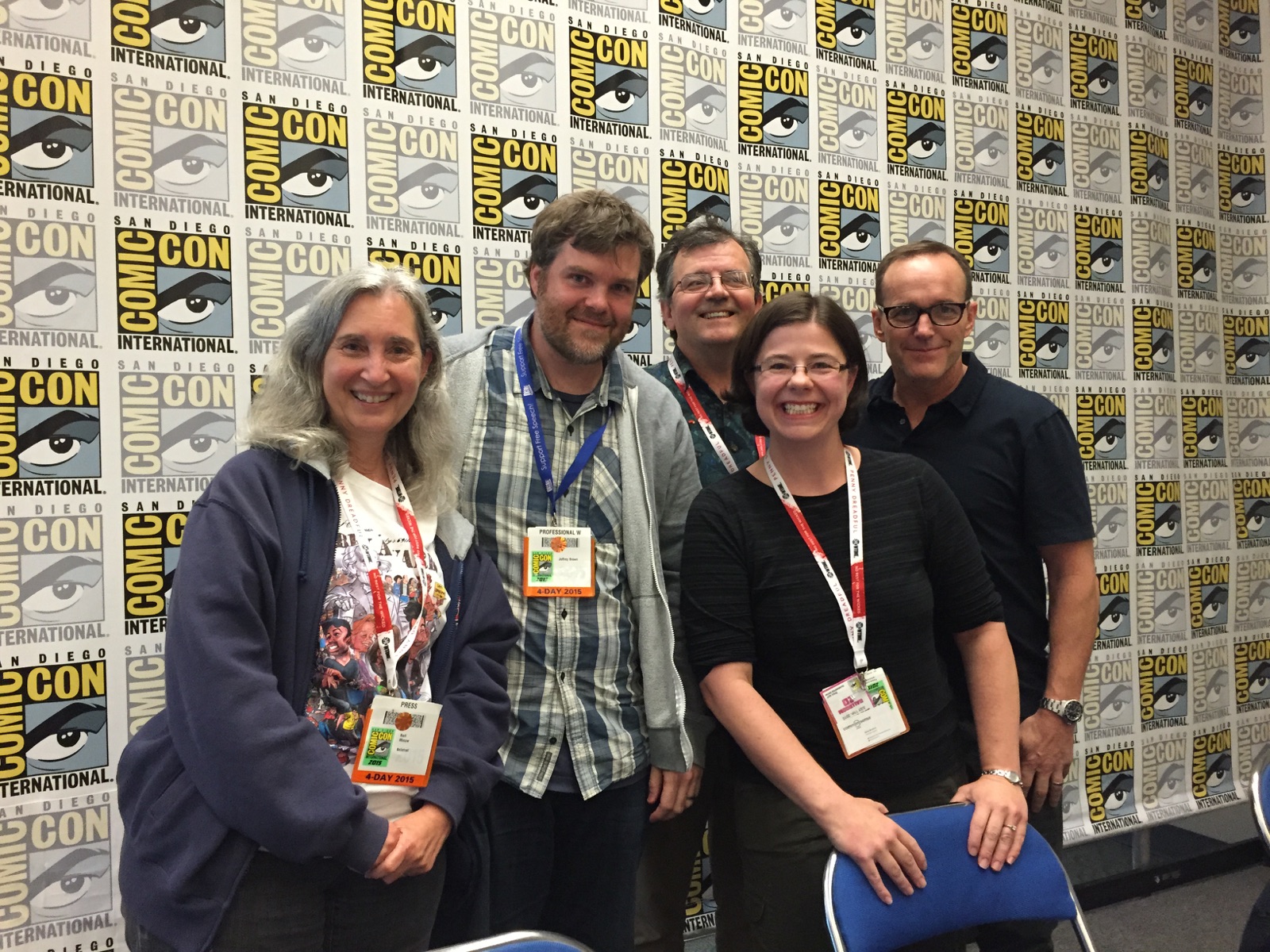
I was thrilled to be invited by Betsy Bozdech of Common Sense Media to appear on a panel discussion if and how to share our nerdy passions with our children. I was even more thrilled when I found out who would be on the panel with me: Jeffrey Brown, author of Darth Vader and Son, Jim McQuarrie of GeekDad, and none other than Clark Gregg, Agent Coulson himself!
Copyright Common Sense Media 2015
We all dream of sharing our passions with our children. But it is important to be careful about it. Everyone on the panel had a story about sharing the wrong movie — or the right movie too soon — with a child who got upset, and feeling that we had “flunked parenting.” Young children will say what they think you want to hear and if it seems too important to you, they will tell you they like something when they really do not. Older children will say the opposite of what they think you want to hear; they will tell you they don’t like something when they really do. What matters is to let them develop their own nerdy attachments, the ones that they use to connect with their peers. Let them see you be passionate about something. If you want them to read, don’t tell them to read; let them see you read. If you want them to put down their devices, don’t tell them to put down their devices; put down your devices.
The best moment of the panel was when I mentioned Pokemon as a nerdy obsession kids love and adults generally do not, and McQuarrie said that his son had been a huge Pokemon fan, pointing to his now-adult son sitting in the audience. The entire room smiled at him and then, all at once, noticed that the young woman he had his arm around was dressed as…Pokemon!


 , Jim McQuarrie of GeekDad, and none other than Clark Gregg, Agent Coulson himself!